
The Effect of Roasting Degrees and Brewing Techniques on the Physicochemical and Sensory Characteristics of Anaerobically Fermented Liberica Coffee (Coffea liberica)
DOI:
https://doi.org/10.48048/tis.2025.9819Keywords:
Brewing, Liberica coffee, Roasting, Sensory profile, VolatileAbstract
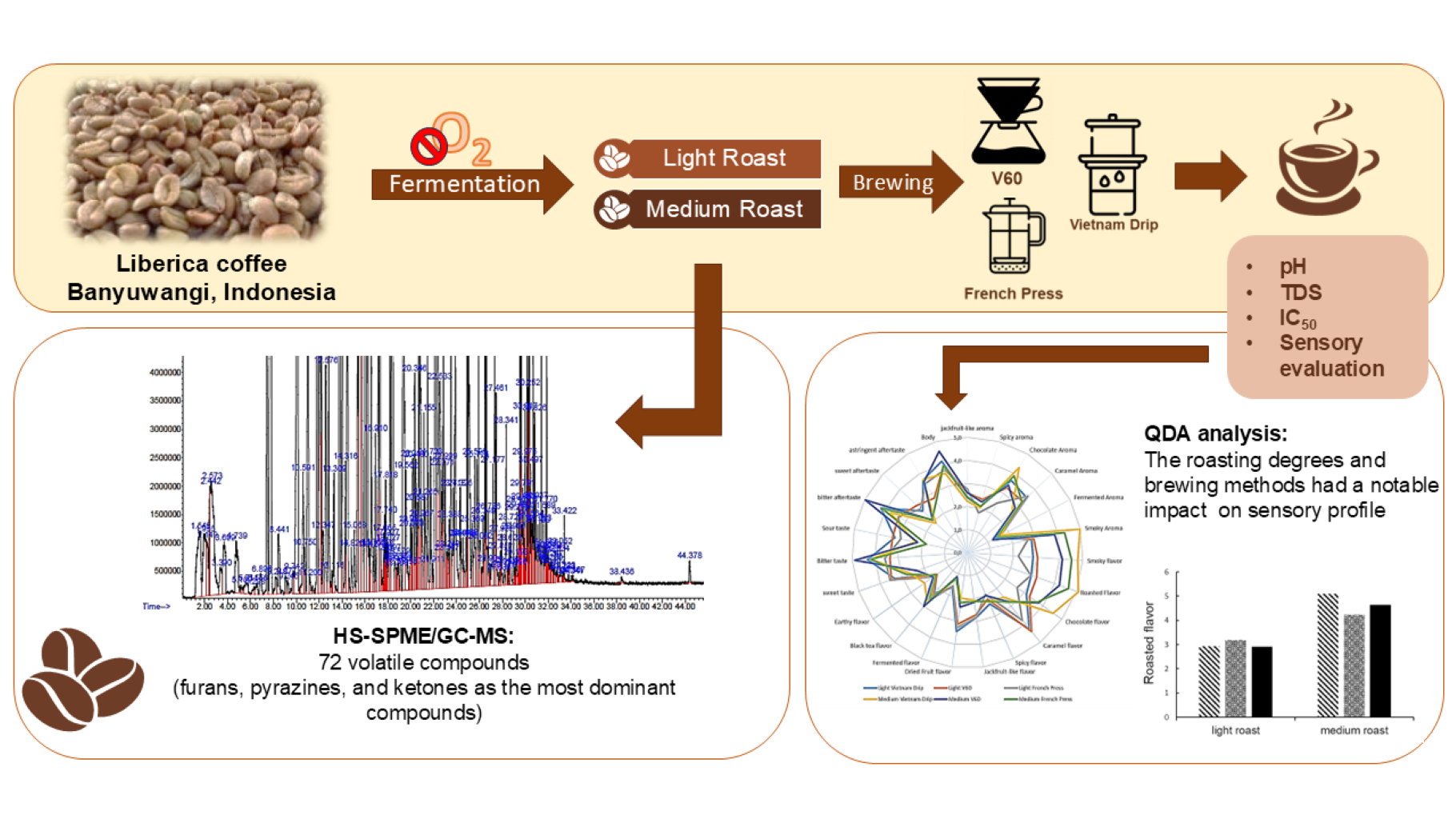
Liberica coffee from Banyuwangi, Indonesia, is distinguished by its unique flavor and high antioxidant content but is often considered inferior to Robusta and Arabica. This study investigated the effects of roasting degrees and brewing methods on the physicochemical and sensory properties of anaerobically fermented Liberica coffee. Coffee beans were roasted at light and medium levels and brewed using V60, French Press, and Vietnam Drip methods. The results indicated that the roasting degree significantly influenced the pH, antioxidant activity, and total dissolved solids (TDS) of the brewed coffee. Light roasting enhanced fruity and acidic notes, particularly a jackfruit-like aroma, while medium roasting pronounced stronger chocolate, roasted, and caramel flavors. Sensory analysis confirmed that roasting had a greater impact on flavor than brewing methods. HS-SPME/GC-MS analysis identified 72 volatile compounds, demonstrating that medium roasting yielded a higher concentration of furans, pyrazines, and ketones, as the most dominant compounds. These findings emphasize the importance of carefully selecting roasting and brewing techniques to optimize the chemical and sensory qualities of Liberica coffee. By refining these methods, Banyuwangi Liberica coffee can be positioned as a distinctive and appealing choice in the global coffee market.
HIGHLIGHTS
- Roasting degree significantly influences physicochemical properties, including pH, antioxidant activity, and total dissolved solids (TDS).
- Brewing techniques, including V60, French Press, and Vietnam Drip, modulate sensory attributes, with V60 highlighting acidic and fruity notes and French Press delivering a fuller body. Roasting degree, however, has a more substantial impact on flavor profiles.
- Light roasting pronounced fruity and acidic characteristics, including a distinctive jackfruit-like aroma, while medium roasting enhances chocolate, roasted, and caramel flavors.
- HS-SPME/GC-MS analysis detected 72 volatile compounds, with medium roasting achieving higher concentrations of key flavor-enhancing compounds, such as pyrazines and furans.
GRAPHICAL ABSTRACT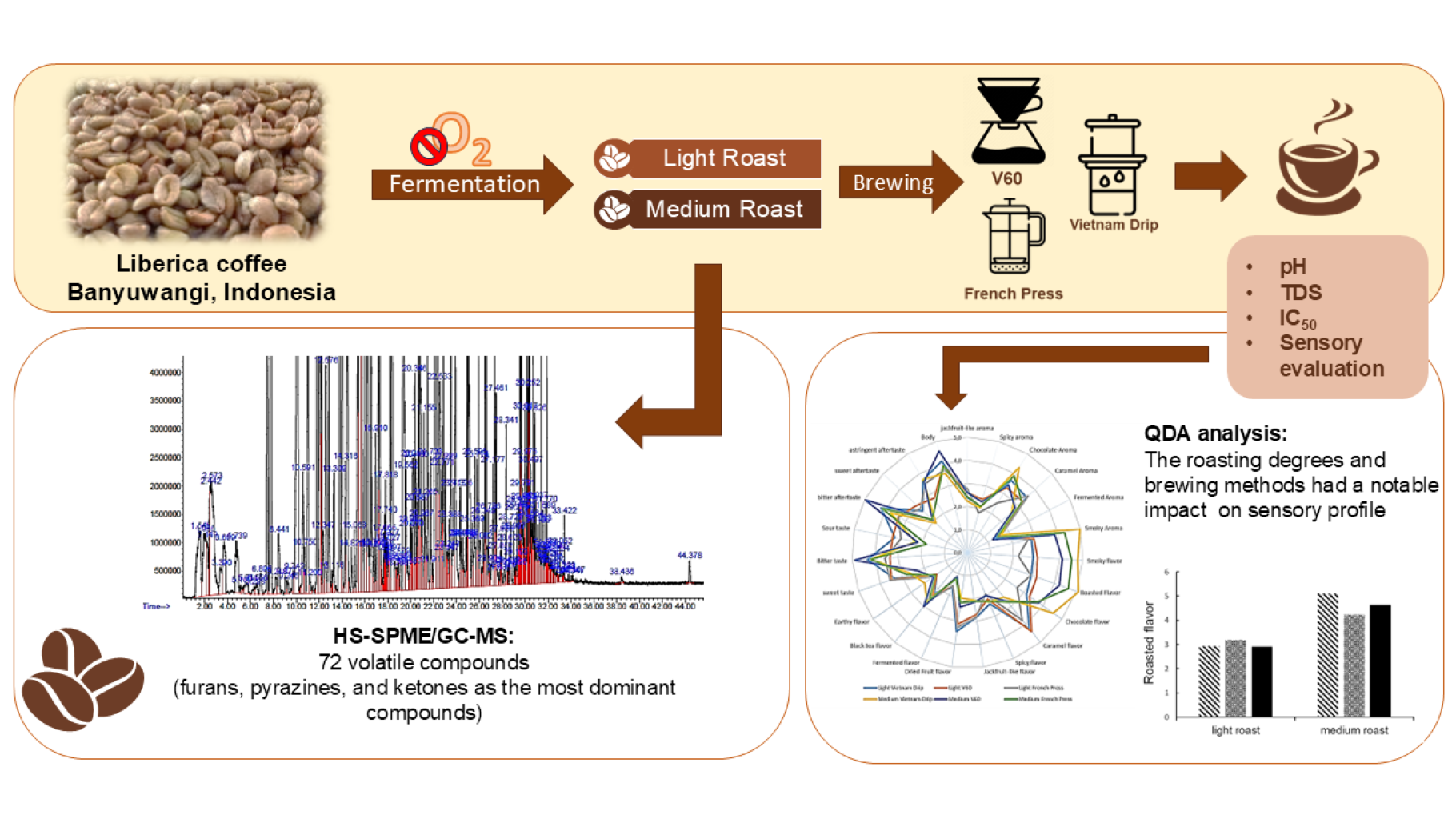
Downloads
References
DW Lachenmeier, P Weller, A Farah, MCA Lagman, M Fabian, MDD Castillo and S Schwarz. Shaping the future of coffee: Climate resilience, Liberica’s rise, and by-product innovation—Highlights from the International Coffee Convention 2023 (ICC2023). Foods 2024; 13(6), 832.
NA Wibowo, W Mangunwardoyo, TJ Santoso and Yasman. Effect of fermentation on sensory quality of Liberica coffee beans inoculated with bacteria from saliva Arctictis binturong Raffles, 1821. Biodiversitas 2021; 22(9), 3922-3928.
DR Azizah, WB Sunarharum, T Mahatmanto, AA Kartika and L Hakim. Exploring the impact of various manual brewing techniques on the physicochemical and sensory characteristics of brewed coffee. In: Proceedings of the 1st International Conference on Tropical Agroforestry in Indonesia, Malang, Indonesia. 2024.
D Athinuwat, A Klomchit, K Phonwong, R Nachalaem, P Thammakulkrajang and S Brooks. Assessing the impact of yeast fermentation in dry processing on coffee quality from Coffea arabica cv. Caltimor, C. arabica cv. Bourbon, and C. canephora cv. Robusta. Trends in Sciences 2024; 21(10), 8132.
M Várady, J Boržíková and P Popelka. Effect of processing method (natural, washed, honey, fermentation, maceration) on the availability of heavy metals in specialty coffee. Heliyon 2024; 10(3), e25563.
TS Pereira, NN Batista, LPS Pimenta, SJ Martinez, LS Ribeiro, JAO Naves and RF Schwan. Self-induced anaerobiosis coffee fermentation: Impact on microbial communities, chemical composition, and sensory quality of coffee. Food Microbiology 2022; 103, 103962.
LCF Silva, PVR Pereira, MADD Cruz, GXR Costa, RAR Rocha, PLL Bertarini, LRD Amaral, MS Gomes and LD Santos. Enhancing sensory quality of coffee: The impact of fermentation techniques on Coffea arabica cv. Catiguá MG2. Foods 2024; 13(5), 653.
D Herawati, MO Loisanjaya, RH Kamal, DR Adawiyah and N Andarwulan. Profile of bioactive compounds, aromas, and cup quality of Excelsa coffee (Coffea liberica var. dewevrei) prepared from diverse postharvest processes. International Journal of Food Science 2022; 2022, 2365603.
A Analianasari, D Berliana and S Shintawati. Defects of coffee beans with different postharvest processes and roasting temperatures on volatile compounds of coffee beans from coffee small-scale industries of West Lampung Indonesia. Trends in Sciences 2024; 21(7), 7695.
I Laukaleja, Z Kruma and I Cinkmanis. Impact of the roast level on chemical composition of coffee from Colombia. Proceedings of the Latvian Academy of Sciences. Section B: Natural, Exact, and Applied Sciences 2022; 76(1), 145-151.
T Dippong, M Dan, MH Kovacs, ED Kovacs, EA Levei and O Cadar. Analysis of volatile compounds, composition, and thermal roasting intensity. Foods 2022; 11(19), 3146.
WB Setianto, H Yohanes, G Atmaji, M Susanto, EP Astin and Lanjar. The effect of fluidized bed roaster temperature on the roasted coffee beans antioxidant activity and its sensory evaluation. IOP Conference Series: Earth and Environmental Science 2023; 1246, 12005.
W Choe, JH Woo, M Hong, H Jang, P Deepa and S Kim. Determination of aromatic profiles of coffee beans according to different roasting times by SPME/GC-MS analysis. Journal of Applied Pharmaceutical Science 2023; 13(10), 157-171.
I Laukaleja and Z Kruma. Influence of the roasting process on bioactive compounds and aroma profile in specialty coffee: A review. In: Proceedings of the 13th Baltic Conference on Food Science and Technology, Jelgava, Latvia. 2019, p. 7-12.
AS Santanatoglia, G Caprioli, M Cespi, D Ciarlantini, L Cognigni, L Fioretti, F Maggi, AM Mustafa, F Nzekoue and S Vittori. A comprehensive comparative study among the newly developed Pure Brew method and classical ones for filter coffee production. LWT 2023; 175, 114471.
B Lapčíková, L Lapčík, P Barták, T Valenta and K Dokládalová. Effect of extraction methods on aroma profile, antioxidant activity, and sensory acceptability of specialty coffee brews. Foods 2023; 12(22), 4125.
R Fadhil, D Nurba and E Sukmawati. Sensory assessment of Gayo Arabica coffee taste based on various varieties and manual brewing devices. Coffee Science 2021; 16, e161918.
S Cortés-Diéguez, C Otero-Cerviño, H Rodeiro-Mougán and JA Feijóo-Mateo. Quantitative descriptive analysis of traditional herbal and coffee liqueurs made with grape marc spirit (orujo). Foods 2020; 9(6), 753.
NZ Rao, M Fuller and MD Grim. Physiochemical characteristics of hot and cold brew coffee chemistry: The effects of roast level and brewing temperature on compound extraction. Foods 2020; 9(7), 902.
H Jeong, S Yoon, SM Jo, SJ Hong, YJ Kim, JK Kim and EC Shin. Chemical sensory investigation in green and roasted beans Coffea arabica L. (cv. Yellow Bourbon) by various brewing methods using electronic sensors. Journal of Food Science 2023; 88(3), 1033-1047.
LDO Silva, CP Rosado, FDS Ferreira, J Melengati, S Terra and AJ Teodoro. The effect of brewing method and different roasting degree on physicochemical characteristics, total phenolic content and antioxidant activity of Amazonian Robusta coffee (Coffea canephora). Revista de Gestão Social e Ambiental 2024; 18(9), e06197.
NH Zakaria, K Whanmek, S Thangsiri, W Chathiran, W Srichamnong, U Suttisansanee and C Santivarangkna. Optimization of cold brew coffee using central composite design and its properties compared with hot brew coffee. Foods 2023; 12(12), 2412.
G Angelonia, L Guerrini, P Masella, M Bellumori, S Daluiso, A Parenti and M Innocenti. What kind of coffee do you drink? An investigation on effects of eight different extraction methods. Food Research International 2019; 116, 1327-1335.
WB Sunarharum and M Farhan. Effect of manual brewing techniques on the sensory profiles of Arabica coffees (Aceh Gayo wine process and Bali Kintamani honey process). In: Proceedings of the International Conference on Agriculture, Environment and Food Security, Medan, Indonesia. 2020.
L Pan, Y Xiao, F Jiang, T Jiang, J Zhu, W Tang, X Liu, Y Zhou and L Yu. Comparison of characterization of cold brew and hot brew coffee prepared at various roasting degrees. Journal of Food Processing and Preservation 2023; 2023(1), 3175570.
PV Nerurkar, J Yokoyama, K Ichimura, S Kutscher, J Wong, HC Bittenbender and Y Deng. Medium roasting and brewing methods differentially modulate global metabolites, lipids, biogenic amines, minerals, and antioxidant capacity of Hawai‘i-grown coffee (Coffea arabica). Metabolites 2023; 13(3), 412.
S Yildirim, I Gok, E Demir and O Tokusoglu. Use of electrochemical techniques for determining the effect of brewing techniques (espresso, Turkish and filter coffee) and roasting levels on total antioxidant capacity of coffee beverage. Journal of Food Processing and Preservation 2022. https://doi.org/10.1111/jfpp.16626.
WB Sunarharum, R Ahmad and E Primadiani. Effect of different manual brewing techniques to the sensory profile of the Indonesian Arabica and Robusta ‘natural coffees’. In: Proceedings of the International Conference on Green Agro-industry and Bioeconomy, Malang, Indonesia. 2020.
M Várady, J Tauchen, P Klouček and P Popelka. Effects of total dissolved solids, extraction yield, grinding, and method of preparation on antioxidant activity in fermented specialty coffee. Fermentation 2022; 8(8), 375.
WD Ristenpart, AR Cotter and JX Guinard. Impact of beverage temperature on consumer preferences for black coffee. Scientific Reports 2022; 12(1), 20621.
MC Pham, NY Dinh and PH Le. Coffee volatile compounds. International Journal of Food Science and Nutrition 2023; 8(3), 50-57.
S Awwad, R Issa, L Alnsour, D Albals and I Al-Momani. Quantification of caffeine and chlorogenic acid in green and roasted coffee samples using HPLC-DAD and evaluation of the effect of degree of roasting on their levels. Molecules 2021; 26(24), 7503.
P Zakidou, F Plati, A Matsakidou, EM Varka, G Blekas and A Paraskevopoulou. Single origin coffee aroma: From optimized flavor protocols and coffee customization to instrumental volatile characterization and chemometrics. Molecules 2021; 26(15), 4609.
DR Seninde and IVE Chambers. Coffee flavor: A review. Beverages 2020; 6(3), 44.
H Wu, P Lu, Z Liu, J Sharifi-Rad and HAR Suleria. Impact of roasting on the phenolic and volatile compounds in coffee beans. Food Science and Nutrition 2022; 10, 2408-2425.
SC Frost, P Walker, CM Orians and A Robbat. The chemistry of green and roasted coffee by selectable 1D/2D gas chromatography mass spectrometry with spectral deconvolution. Molecules 2022; 27(16), 5328.
H Zhai, W Dong, Y Tang, R Hu, X Yu and X Chen. Characterization of the volatile flavour compounds in Yunnan Arabica coffee prepared by different primary processing methods using HS-SPME/GC-MS and HS-GC-IMS. LWT 2024; 192, 115717.
F Vezzulli, M Lambri and T Bertuzzi. Volatile compounds in green and roasted Arabica specialty coffee: Discrimination of origins, post-harvesting processes, and roasting level. Foods 2023; 12(3), 489.
M Bolka and S Emire. Effects of coffee roasting technologies on cup quality and bioactive compounds of specialty coffee beans. Food Science and Nutrition 2020; 8(11), 6120-6130.
WB Sunarharum, T Mahatmanto, DY Ali, YP Prananto, N Efrat, NE Asih and NG Mirillia. Sensory and physicochemical characteristics of two common roast defects in Robusta coffee. International Journal of Advanced Science Engineering and Information Technology 2022; 12(1), 394-402.
A Pinsuwan, S Suwonsichon, P Chompreeda and W Prinyawiwatkul. Sensory drivers of consumer acceptance, purchase intent and emotions toward brewed black coffee. Foods 2022; 11(2), 180.
WB Sunarharum, DJ Williams and HE Smyth. Complexity of coffee flavor: A compositional and sensory perspective. Food Research International 2014; 62, 315-325.
Y Zou, M Gaida, FA Franchina, PH Stefanuto and JF Focant. Distinguishing between decaffeinated and regular coffee by HS-SPME-GC×GC-TOFMS, chemometrics, and machine learning. Molecules 2022; 27(6), 1806.
N Chindapan, C Puangngoen and S Devahastin. Profiles of volatile compounds and sensory characteristics of Robusta coffee beans roasted by hot air and superheated steam. International Journal of Food Science and Technology 2021; 56(8), 3814-3825.
SE Yeager, ME Batali, LX Lim, J Liang, J Han, AN Thompson, JX Guinard and WD Ristenpart. Roast level and brew temperature significantly affect the color of brewed coffee. Journal of Food Science 2022; 87(4), 1837-1850.
N Stanek, M Zarębska, Ł Biłos, K Barabosz, E Nowakowska-Bogdan, I Semeniuk, J Błaszkiewicz, R Kulesza, R Matejuk and K Szkutnik. Influence of coffee brewing methods on the chromatographic and spectroscopic profiles, antioxidant and sensory properties. Scientific Reports 2021; 11, 21377.
DAL Meireles, ASB Valdez, M Boroski, SC Augusto and AT Toci. Effects of pollination on the composition of volatile compounds in Coffea arabica L. Journal of the Science of Food and Agriculture 2022; 102(11), 4955-4960.
R Rusinek, JB Dobrzański, A Oniszczuk, M Gawrysiak-Witulska, A Siger, H Karami, AA Ptaszyńska, A Żytek, K Kapela and M Gancarz. How to identify roast defects in coffee beans based on the volatile compound profile. Molecules 2022; 27(23), 8530.
M Latief, Muhaimin, Heriyanti, IL Tarigan and Sutrisno. Determination antioxidant activity of Coffea arabica, Coffea canephora, Coffea liberica and sunscreens cream formulation for sun protection factor (SPF). Pharmacognosy Journal 2022; 14(2), 335-342.
E Alamri, M Rozan and H Bayomy. A study of chemical composition, antioxidants, and volatile compounds in roasted Arabic coffee. Saudi Journal of Biological Sciences 2022; 29(5), 3133-3139.
CDC Couto, DWH Chávez, EMM Oliveira, O Freitas-Silva and S Casal. SPME-GC-MS untargeted metabolomics approach to identify potential volatile compounds as markers for fraud detection in roasted and ground coffee. Food Chemistry 2024; 446, 138862.
AM Obando and JG Figueroa. Effect of roasting level on the development of key aroma-active compounds in coffee. Molecules 2024; 29(19), 4723.
L Anokye-Bempah, T Styczynski, NDAT Fernandes, J Gervay-Hague, WD Ristenpart and IR Donis-González. The effect of roast profiles on the dynamics of titratable acidity during coffee roasting. Scientific Reports 2024; 14, 8237.
J Zhao, J Lin, J Yan, C Zhang, T Wang and B Gan. Evaluation of the nutritional value, umami taste, and volatile organic compounds of Hypsizygus marmoreus by simulated salivary digestion in vitro. Current Research in Food Science 2023; 7, 100591.
F Yang, H Meng, A Fu, Y Liu and S Bi. Quantification- and structural-taste intensity of umami peptides from Agrocybe aegerita through quantitative structure-activity relationship. Food Chemistry 2024; 455, 139919.
Y Lee and KG Lee. Effects of pan- and air fryer-roasting on volatile and umami compounds and antioxidant activity of dried laver (Porphyra dentata). Food Chemistry 2024; 458, 140289.
Published
How to Cite
Issue
Section
License
Copyright (c) 2025 Walailak University

This work is licensed under a Creative Commons Attribution-NonCommercial-NoDerivatives 4.0 International License.





