
Characteristics of Canna Starch-based Edible Film Produced using Various Types of Plasticizers and Their Application on Tomatoes
DOI:
https://doi.org/10.48048/tis.2025.9793Keywords:
Canna starch, Edible film, Coating, Tomatoes, QualityAbstract
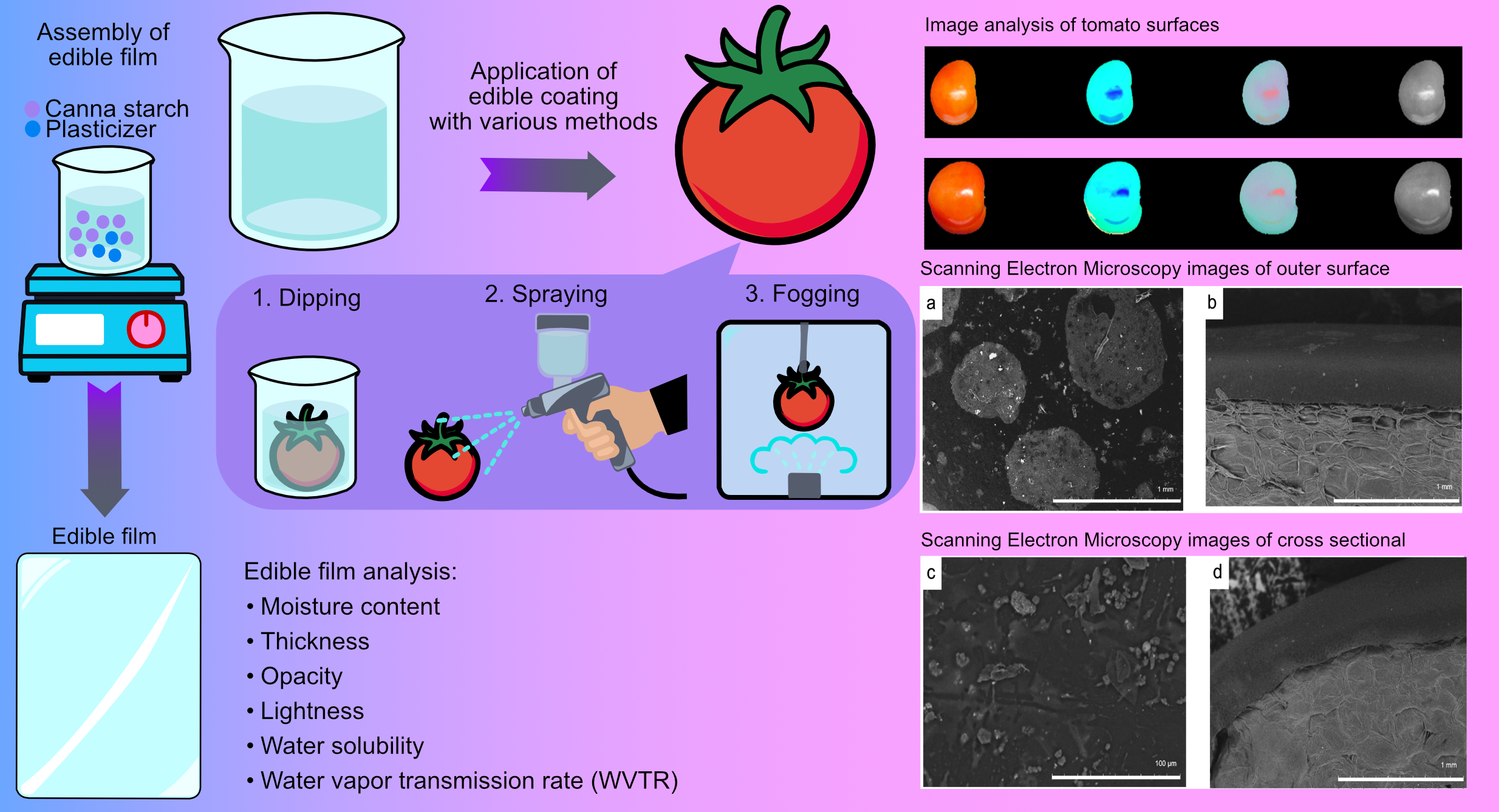
Currently, eco-friendly postharvest treatments are required to fulfill consumers’ demands and extend fresh agricultural commodities’ shelf life. Starch-based coatings offer promising potential for this application due to their desirable properties. The objectives of this research were to investigate the effect of various canna starch concentrations and plasticizer types on the characteristics of edible film and to evaluate their effectiveness in coating tomatoes applied by spraying and fogging methods. Results indicated that starch concentration significantly influenced moisture content, thickness, and water vapor transmission rate. The plasticizer type affected lightness, water solubility, and optical properties. The interaction between starch concentration and plasticizer type significantly impacted moisture content. Based on these findings, a coating formulation of 1 % starch concentration with sorbitol as a plasticizer was selected. The fogging application of this coating resulted in a uniform coverage on the tomato surface. These results highlight the potential of canna starch-based edible films as a sustainable and effective postharvest treatment for fresh agricultural commodities.
HIGHLIGHTS
- This manuscript provides a comprehensive report on the utilization of canna starch as a raw material for producing of edible films and the subsequent application of the resulting solution for coating tomatoes.
- The production of an effective edible coating requires an optimized formulation, specifically employing 1% canna starch and incorporating sorbitol as a plasticizer.
- Tomatoes treated using the fogging method exhibited superior visual characteristics compared to those treated using alternative methods (dipping and spraying).
GRAPHICAL ABSTRACT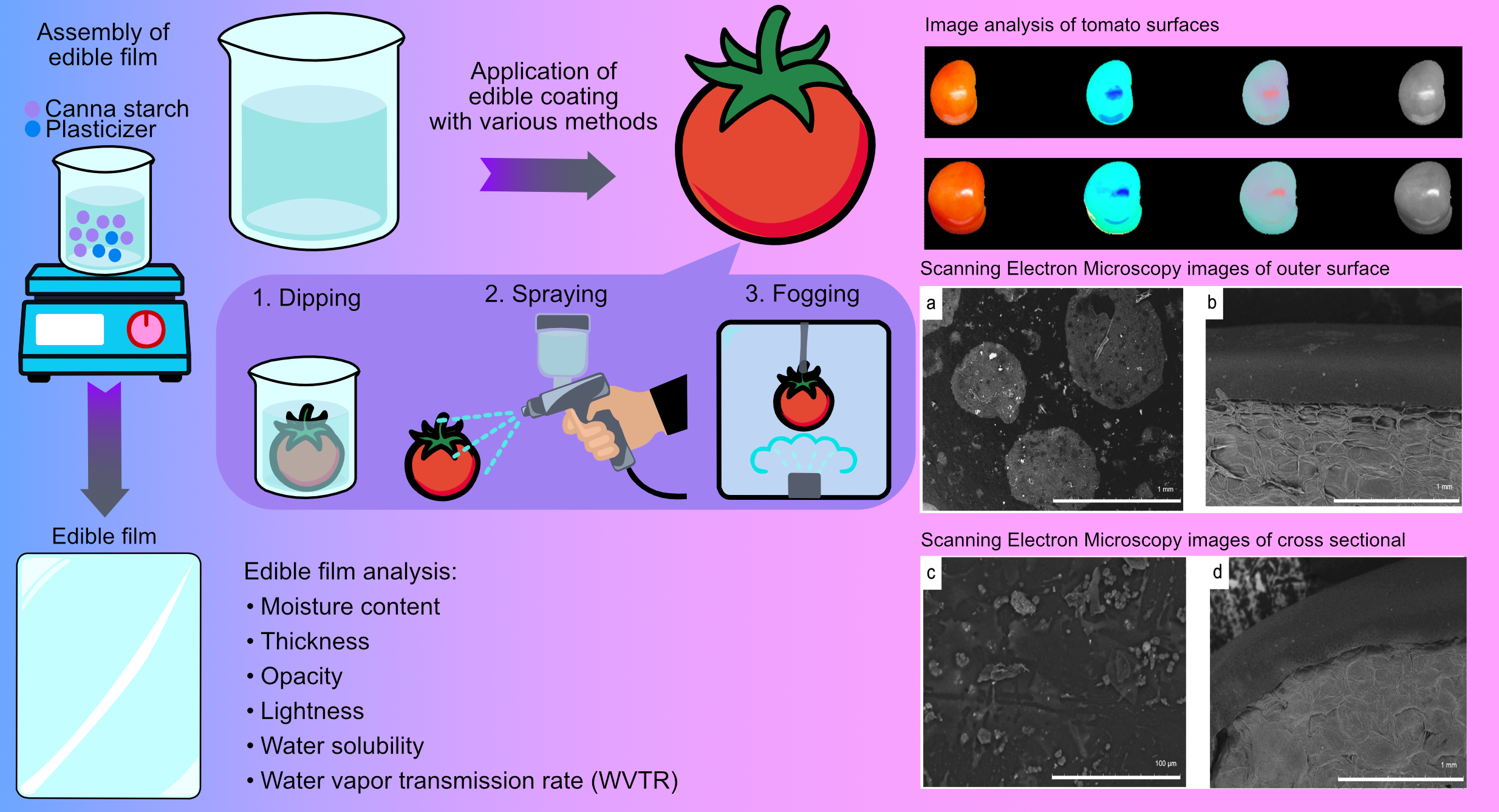
Downloads
References
C Wibowo, S Salsabila, A Muna, D Rusliman and HS Wasisto. Advanced biopolymer-based edible coating technologies for food preservation and packaging. Comprehensive Reviews in Food Science and Food Safety 2024; 23(1), e13275.
H Li, Z Huang, K Addo and Y Yu. Evaluation of postharvest quality of plum (Prunus salicina L. cv. ‘French’) treated with layer-by-layer edible coating during storage. Scientia Horticulturae 2022; 304(1), 111310.
Y Peralta-Ruiz, CDG Tovar, A Sinning-Mangonez, EA Coronell, MF Marino and C Chaves-Lopez. Reduction of postharvest quality loss and microbiological decay of tomato ‘chonto’ (Solanum lycopersicum L.) using chitosan-E essential oil-based edible coatings under low-temperature storage. Polymers 2020; 12(8), 1822.
Q Hu, F Zhou, NK Ly, J Ordyna, T Peterson, Z Fan and S Wang. Development of multifunctional nanoencapsulated trans-resveratrol/chitosan nutraceutical edible coating for strawberry preservation. ACS Nano 2023; 17(9), 8586-8597.
AN Al-Baarr, W Widayat, AM Legowo, N Apsari, D Perdanawati, KR Negara, W Pangestika, FP Lestari and AA Mawarid. Implementation of carrageenan and xanthan gum in ‘Raja’ banana (Musa sapientum) for coating application. IOP Conference Series: Earth and Environmental Science 2021; 803(1), 012047.
K Chen, J Jiang, R Tian, Y Kuang, KWu, M Xiao, Y Liu, H Qian and F Jiang. Properties of konjac glucomannan/curdlan-based emulsion films incorporating camellia oil and the preservation effect as coatings on ‘Kyoho’ grapes. International Journal of Biological Macromolecules 2024; 258(P1), 128836.
C Wibowo, Erminawati, R Wicaksono and P Haryanti. Effect of starch-based edible coating application on potato chips characteristic from tubers and flour of potato variety Granola. Food Research 2020; 4(6), 1905-1911.
A Augusto, A Miranda, D Crespo, MJ Campos, D Raimundo, R Pedrosa, G Mitchell, K Niranjan and SFJ Silva. Preservation of fresh-cut Rocha Pear using Codium tomentosum extract. LWT 2022; 155, 112938.
N Tabassum and MA Khan. Modified atmosphere packaging of fresh-cut papaya using alginate based edible coating: Quality evaluation and shelf life study. Scientia Horticulturae 2020; 259, 108853.
SMB Hashemi and D Jafarpour. Bioactive edible film based on Konjac glucomannan and probiotic Lactobacillus plantarum strains: Physicochemical properties and shelf life of fresh-cut kiwis. Journal of Food Science 2021; 86(2), 513-522.
B Abera, R Duraisamy and T Birhanu. Study on the preparation and use of edible coating of fish scale chitosan and glycerol blended banana pseudostem starch for the preservation of apples, mangoes, and strawberries. Journal of Agriculture and Food Research 2024; 15(3), 100916.
MV Alvarez, MF Bambace, G Quintana, A Gomez-Zavaglia and MDR Moreira. Prebiotic-alginate edible coating on fresh-cut apple as a new carrier for probiotic lactobacilli and bifidobacteria. LWT 2021; 137(2), 110483.
S Swarupa and P Thareja. Techniques, applications and prospects of polysaccharide and protein based biopolymer coatings: A review. International Journal of Biological Macromolecules 2024; 266(P2), 131104.
BR Moreira, MA Pereira-Júnior, KF Fernandes and KA Batista. An ecofriendly edible coating using cashew gum polysaccharide and polyvinyl alcohol. Food Bioscience 2020; 37, 100722.
N Utama-ang, S Sida, P Wanachantararak and A Kawee-ai. Development of edible Thai rice film fortified with ginger extract using microwave-assisted extraction for oral antimicrobial properties. Scientific Reports 2021; 11(1), 14870.
Y Pratama, SBM Abduh, AM Legowo and A Hintono. Effect of chitosan-palm olein emulsion incorporation on tapioca starch-based edible film properties. International Food Research Journal 2019; 26(1), 203-208.
S Silviana, PB Brandon and BA Silawanda. Preparation of cassava bagasse starch-based biodegradable film reinforced with chicken feet gelatin, citric acid as crosslinker, and glycerol as plasticizer. Indonesian Journal of Chemistry 2018; 18(4), 688-695.
SB Wahjuningsih, Rohadi, S Susanti and HY Setyanto. The effect of K-carrageenan addition to the characteristics of jicama starch-based edible coating and its potential application on the grapevine. International Journal on Advanced Science Engineering and Information Technology 2019; 9(2), 405-410.
JS Lee, ES Lee and J Han. Enhancement of the water-resistance properties of an edible film prepared from mung bean starch via the incorporation of sunflower seed oil. Scientific Reports 2020; 10(1), 13622.
C Wibowo, P Haryanti, R Tamalea and R Wicaksono. The properties of edible film made of Tapioca, canna and arrowroot as affected by application of various concentration of plasticizer. AIP Conference Proceedings 2019; 2094(1), 020033.
P Deng, Y Zhang, Z Niu, Y Li, Z Wang and F Jiang. Multifunctional konjac glucomannan/ xanthan gum self-healing coating for bananas preservation. International Journal of Biological Macromolecules 2024; 270(P1), 132287.
NT Tung, TTH Pham, NT Duc, TT Pham, KN Van, TH Nguyen and NA Pham. Effect of oxidation on physicochemical characteristics of ther-moplastic canna starch. Vietnam Journal of Chemistry 2024; 62(S1), 15-22.
B Santoso, F Pratama, B Hamzah and R Pambayun. The effect of eel’s protein extract on the characteristics of edible film from crosslinked modified canna starch. International Food Research Journal 2019; 26(1), 161-165.
KD Tafa, N Satheesh and W Abera. Mechanical properties of tef starch based edible films: Development and process optimization. Heliyon 2023; 9(2), e13160.
R Thakur, P Pristijono, CJ Scarlett, M Bowyer, SP Singh and QV Vuong. Starch-based edible coating formulation: Optimization and its application to improve the postharvest quality of ‘Cripps pink’ apple under different temperature regimes. Food Packaging and Shelf Life 2019; 22, 100409.
OA Silva, MG Pellá, MG Pellá, J Caetano, MR Simões, PRS Bittencourt and DC Dragunski. Synthesis and characterization of a low solubility edible film based on native cassava starch. International Journal of Biological Macromolecules 2019; 128, 290-296.
D Praseptiangga, N Mufida, C Panatarani and IM Joni. Enhanced multi functionality of semi-refined iota carrageenan as food packaging material by incorporating SiO2 and ZnO nanoparticles. Heliyon 2021; 7(5), e06963.
ML Zambrano-Zaragoza, D Quintanar-Guerrero, AD Real, RM González-Reza, MA Cornejo-Villegas and E Gutiérrez-Corte. Effect of nano-edible coating based on beeswax solid lipid nanoparticles on strawberry’s preservation. Coatings 2020; 10(3), 253.
L Ballesteros-Mártinez, C Pérez-Cervera and R Andrade-Pizarro. Effect of glycerol and sorbitol concentrations on mechanical, optical, and barrier properties of sweet potato starch film. NFS Journal 2020; 20, 1-9.
Y Sun, Z Liu, L Zhang, X Wang and L Li. Effects of plasticizer type and concentration on rheological, physico-mechanical and structural properties of chitosan/zein film. International Journal of Biological Macromolecules 2020; 143(8), 334-340.
Y Dong, Y Li, Z Ma, Z Rao, X Zheng, K Tang and J Liu. Effect of polyol plasticizers on properties and microstructure of soluble soybean polysaccharide edible films. Food Packaging and Shelf Life 2023; 35(3), 101023.
N Youseftabar-Miri, N Sedaghat and S Khoshnoudi-Nia. Effect of active edible coating on quality properties of green-raisin and ranking the samples using fuzzy approach. Journal of Food Measurement and Characterization 2021; 15(1), 46-58.
GE Fematt‐flores, I Aguiló-Aguayo, B Marcos, BA Camargo-Olivas, R Sánchez-Vega, MC Soto-Caballero, NA Salas-Salazar, MA Flores-Córdova and MJ Rodríguez-Roque. Milk protein‐based edible films: Influence on mechanical, hydrodynamic, optical and antioxidant properties. Coatings 2022; 12(2), 196.
L Ballesteros-Mártinez, C Pérez-Cervera and R Andrade-Pizarro. Effect of glycerol and sorbitol concentrations on mechanical, optical, and barrier properties of sweet potato starch film. NFS Journal 2020; 20, 1-9.
M Patel, S Islam, P Kallem, R Patel, F Banat and A Patel. Potato starch-based bioplastics synthesized using glycerol–sorbitol blend as a plasticizer: characterization and performance analysis. International Journal of Environmental Science and Technology 2023; 20(7), 7843-7860.
C Chang and MT Nickerson. Effect of plasticizer-type and genipin on the mechanical, optical, and water vapor barrier properties of canola protein isolate-based edible films. European Food Research and Technology 2014; 238(1), 35-46.
ML Flores-López, MA Cerqueira, DJD Rodríguez and AA Vicente. Perspectives on utilization of edible coatings and nano-laminate coatings for extension of postharvest storage of fruits and vegetables. Food Engineering Reviews 2016; 8, 292-305.
G Lara, S Yakoubi, CM Villacorta, K Uemura, I Kobayashi, C Takahashi, M Nakajima and MA Neves. Spray technology applications of xanthan gum-based edible coatings for fresh-cut lotus root (Nelumbo nucifera). Food Research International 2020; 137(1), 109723.
I Keawpeng, S Lekjing, B Paulraj and K Venkatachalam. Application of clove oil and sonication process on the influence of the functional properties of mung bean flour-based edible film. Membranes 2022; 12(5), 535.
ES Pak, SN Ghaghelestani and MA Najafi. Preparation and characterization of a new edible film based on Persian gum with glycerol plasticizer. Journal of Food Science and Technology 2020; 57(9), 3284-3294.
S Paudel, S Regmi and S Janaswamy. Effect of glycerol and sorbitol on cellulose-based biodegradable films. Food Packaging and Shelf Life 2023; 37, 101090.
P Zhang, Y Zhao and Q Shi. Characterization of a novel edible film based on gum ghatti: Effect of plasticizer type and concentration. Carbohydrate Polymers 2016; 153, 345-355.
D Fransiska, Giyatmi, J Basmal and E Susanti. The effect of organic powdered cottonii concentration and types of plasticizers on the characteristics of edible film. IOP Conference Series: Earth and Environmental Science 2020; 483, 012008.
J Chen, J Chai, X Chen, M Huang, X Zeng and X Xu. Development of edible films by incorporating nanocrystalline cellulose and anthocyanins into modified myofibrillar proteins. Food Chemistry 2023; 417, 135820.
NCY Cáceres, HS Mahecha, AD Francisco, SMV Mejia and CD Moreno. Physicochemical, thermal, microstructural and paste properties comparison of four achira (Canna edulis sp.) starch ecotypes. International Journal of Gastronomy and Food Science 2021; 25, 100380.
D Praseptiangga, D Widyaastuti, C Panatarani and IM Joni. Development and characterization of semi-refined iota carrageenan/SiO2-ZnO bionanocomposite film with the addition of cassava starch for application on minced chicken meat packaging. Foods 2021; 10(11), 2776.
K Ratprakhon, W Neubauer, K Riehn, J Fritsche and S Rohn. Developing an automatic color determination procedure for the quality assessment of mangos (Mangifera indica) using a CCD camera and color standards. Foods 2020; 9(11), 1709.
L Rabasco-Vílchez, F Jiménez-Jiménez, A Possas, R Morcillo-Martín and F Pérez-Rodríguez. Evaluation of the effect of nanocellulose edible coating on strawberries inoculated with Aspergillus flavus through image analysis. LWT 2024; 191(6), 115697.
Published
How to Cite
Issue
Section
License
Copyright (c) 2025 Walailak University

This work is licensed under a Creative Commons Attribution-NonCommercial-NoDerivatives 4.0 International License.





