
Mechanistic Insights into the Anti-Urolithiatic Potential of Ecbolium viride Ethanolic Extract: In Silico Targeting of Human Glyoxylate Reductase Hydroxypyruvate Reductase and Adenine Phosphoribosyltransferase, Supported by In Vitro Validation
DOI:
https://doi.org/10.48048/tis.2025.9757Keywords:
Urolithiasis, Ecbolium viride, Phytochemical screening, GC-MS analysis, Molecular docking, In vitro assays, Calcium oxalate crystals, Anti-urolithiasis activityAbstract
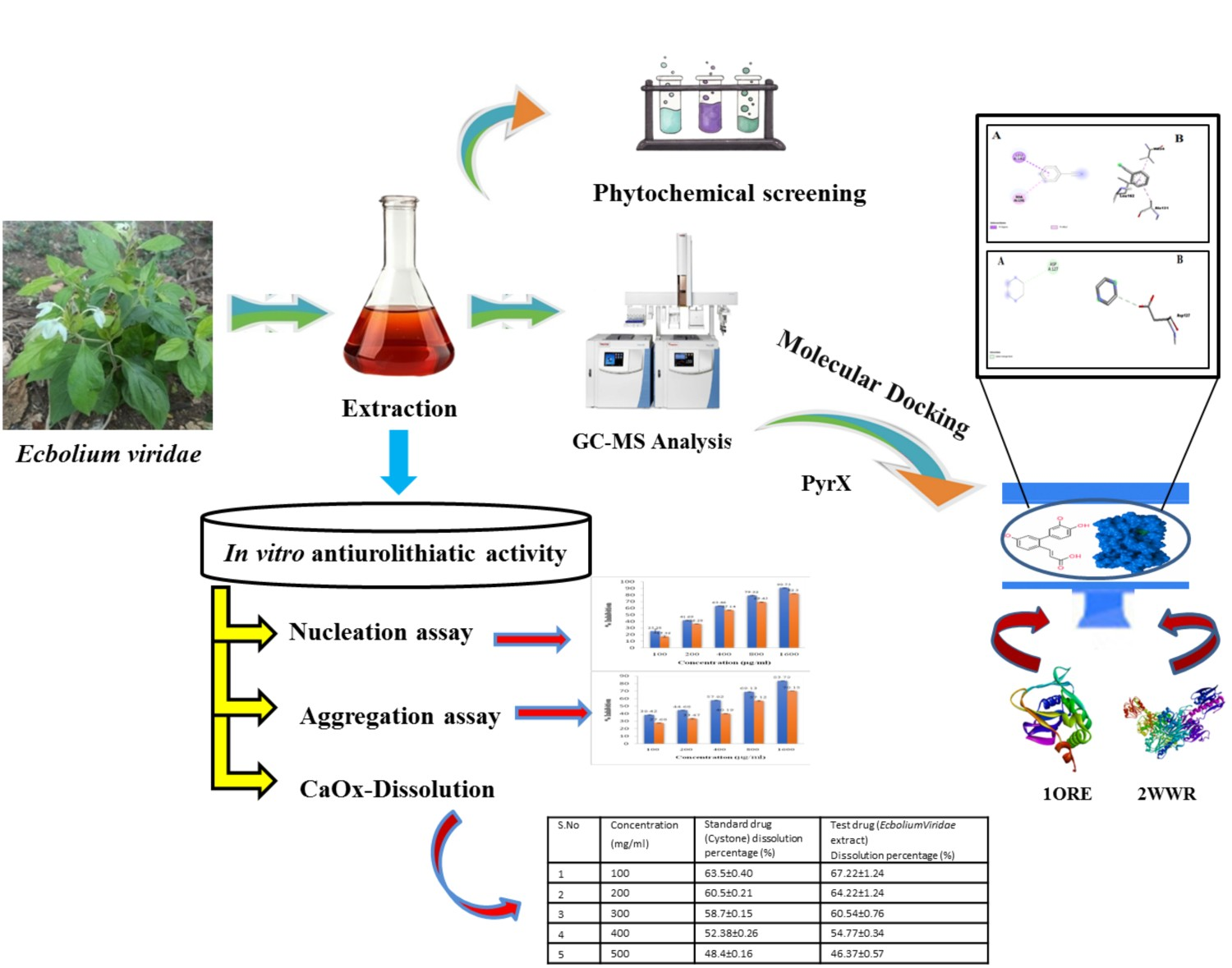
Urolithiasis is characterized by the formation of urinary stones and represents a significant global health burden, frequently necessitating invasive treatments and leading to recurrent symptoms. Due to the limitations of conventional therapies, there is a growing interest in alternative treatments, especially those based on traditional herbs. This research examines the therapeutic potential of Ecbolium viride leaves for urolithiasis by conducting a thorough evaluation that encompasses phytochemical screening, GC-MS analysis, in silico molecular docking, and in vitro assays for anti-urolithiasis. Phytochemical screening demonstrated the presence of bioactive compounds, such as alkaloids, flavonoids, tannins, and polyphenols, which are acknowledged for their pharmacological properties. GC-MS analysis further characterized these phytoconstituents, identifying compounds with potential anti-urolithiasis activity. In silico molecular docking studies revealed significant binding affinities between these compounds and target proteins associated with stone formation, indicating their potential to disrupt the molecular mechanisms of urolithiasis. In vitro assays, such as nucleation, aggregation, and dissolution studies, demonstrated the extract’s substantial ability to inhibit the formation and aggregation of calcium oxalate crystals, as well as to enhance crystal dissolution. The results from these methodologies provide substantial evidence that Ecbolium viride leaves may serve as a natural agent for managing urolithiasis. This research endorses the application of plant-derived compounds as substitutes for traditional treatments of urolithiasis. Further in vivo studies and clinical trials are necessary to confirm the safety, efficacy, and pharmacokinetics of Ecbolium viride in the treatment of urolithiasis.
HIGHLIGHTS
- Investigated Ecbolium viride leaves for urolithiasis using phytochemical, GC-MS, in silico, and in vitro
- Identified bioactive compounds disrupting urolithiasis-related molecular pathways.
- Demonstrated inhibition of calcium oxalate crystal formation and enhanced dissolution.
- Highlighted Ecbolium viride as a potential plant-based alternative for urolithiasis management.
GRAPHICAL ABSTRACT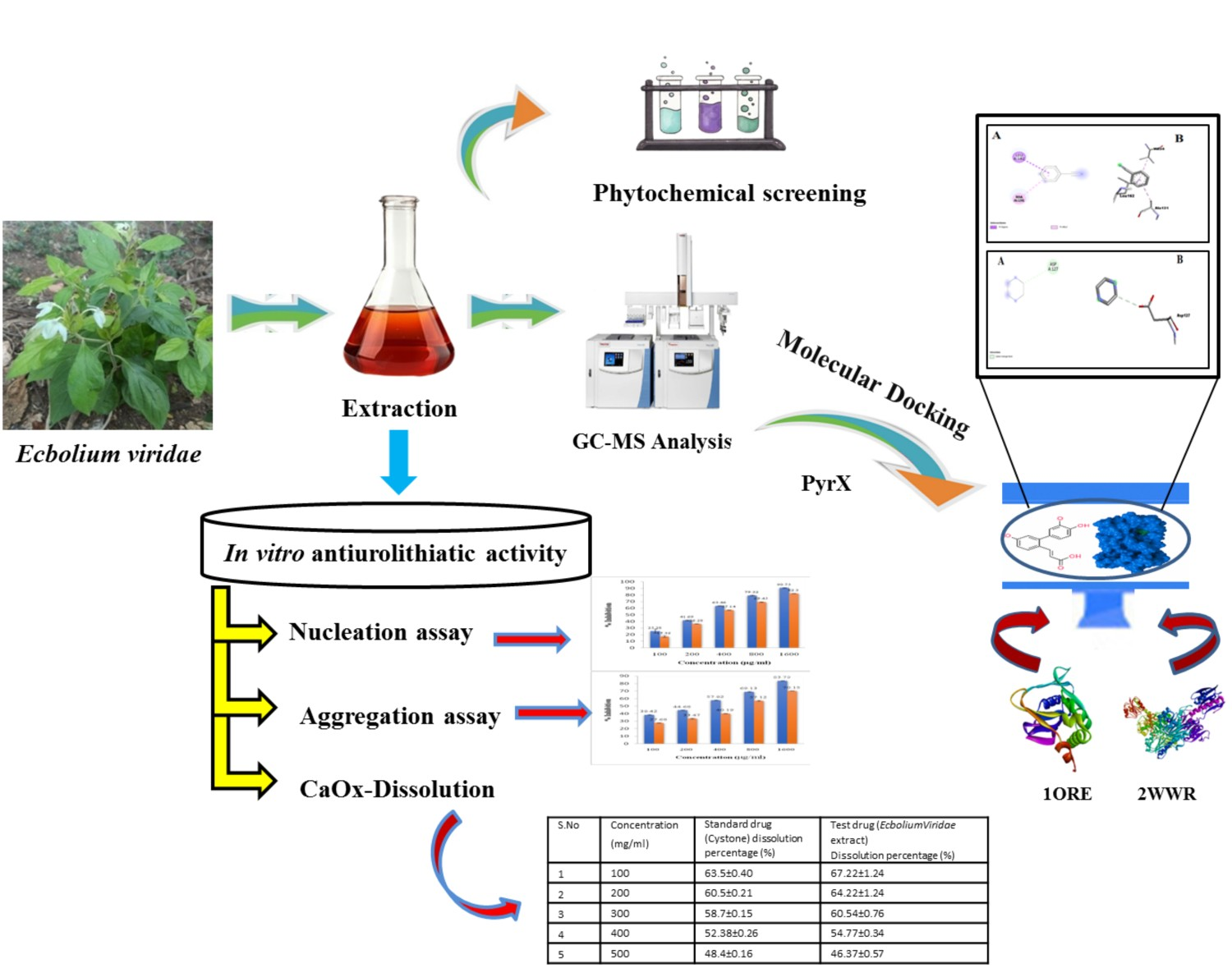
Downloads
References
R Kachkoul, GB Touimi, GE Mouhri, RE Habbani, M Mohim and A Lahrichi. Urolithiasis: History, epidemiology, aetiologic factors and management. The Malaysian Journal of Pathology 2023; 45(3), 333-352.
CA Wagner. Etiopathogenic factors of urolithiasis. Archivos Espanoles de Urologia 2021; 74(1), 16-23.
P Peerapen and V Thongboonkerd. Kidney stone prevention. Advances in Nutrition 2023; 14(3), 555-569.
VD Coninck, A Skolarikos, P Juliebo-Jones, M Joris, O Traxer and EX Keller. Advancements in stone classification: Unveiling the beauty of urolithiasis. World Journal of Urology 2024; 42(1), 46.
M Corrales, S Doizi, Y Barghouthy, O Traxer and M Daudon. Classification of stones according to michel daudon: A narrative review. European Urology Focus 2021; 7(1), 13-21.
AV Kustov, AI Strelnikov, EV Lyalyakina, MA Moriganov and TV Kustova. Renal stones: Classification, structure, methods of analysis. From Chemistry Towards Technology Step-By-Step 2021; 2(1), 97-110.
S Choong, JDL Rosette, J Denstedt, G Zeng, K Sarıca, G Mazzon, I Saltirov, SK Pal, M Agrawal, J Desai, A Petrik, N Buchholz, MV Maroclo, S Gordon and A Sridhar. Classification and standardized reporting of percutaneous nephrolithotomy (PCNL): International Alliance of Urolithiasis (IAU) consensus statements. Minerva Urology and Nephrology 2022; 74(1), 110-118.
F Tamborino, R Cicchetti, M Mascitti, G Litterio, A Orsini, S Ferretti, M Basconi, AD Palma, M Ferro, M Marchioni and L Schips. Pathophysiology and main molecular mechanisms of urinary stone formation and recurrence. International Journal of Molecular Sciences 2024; 25(5), 3075.
EAH Allam. Urolithiasis unveiled: Pathophysiology, stone dynamics, types, and inhibitory mechanisms: A review. African Journal of Urology 2024; 30(1), 34.
G Zeng and W Zhu. Urolithiasis: From pathogenesis to management (part one). Asian Journal of Urology 2023; 10(3), 213-214.
G Zeng and W Zhu and R Huang. Urolithiasis: From pathogenesis to management (part two). Asian Journal of Urology 2024; 11(2), 137-138.
A Razi, A Ghiaei, FK Dolatabadi and R Haghighi. Unraveling the association of bacteria and urinary stones in patients with urolithiasis: An update review article. Frontiers in Medicine 2024; 11, 1401808.
V Jahrreiss, C Seitz and F Quhal. Medical management of urolithiasis: Great efforts and limited progress. Asian Journal of Urology 2024; 11(2), 149-155.
MA Chakra, AE Dellis, AG Papatsoris and M Moussa. Established and recent developments in the pharmacological management of urolithiasis: An overview of the current treatment armamentarium. Expert Opinion on Pharmacotherapy 2020; 21(1), 85-96.
SH Moosavi-Asil, M Dadmehr, F Tabrizian and M Shirzad. A review on management of urolithiasis in medieval persia. Urology 2020; 138, 1-4.
DM Ng, M Haleem, A Mamuchashvili, KY Wang, JF Pan, Y Cheng and Q Ma. Medical evaluation and pharmacotherapeutical strategies in management of urolithiasis. Therapeutic Advances in Urology 2021; 13, 1756287221993300.
T Yasui, A Okada, S Hamamoto, R Ando, K Taguchi, K Tozawa and K Kohri. Pathophysiology‐based treatment of urolithiasis. International Journal of Urology. 2017; 24(1), 32-8.
RM Geraghty, NF Davis, L Tzelves, R Lombardo, C Yuan, K Thomas, A Petrik, A Neisius, C Turk, G Gambaro and A Skolarikos. Best practice in interventional management of urolithiasis: An update from the european association of urology guidelines panel for urolithiasis 2022. European Urology Focus 2023; 9(1), 199-208.
P Jiang, L Xie, R Arada, RM Patel, J Landman and RV Clayman. Qualitative review of clinical guidelines for medical and surgical management of urolithiasis: consensus and controversy 2020. Journal of Urology 2021; 205(4), 999-1008.
G Zeng, W Zhu and W Lam. Miniaturised percutaneous nephrolithotomy: Its role in the treatment of urolithiasis and our experience. Asian journal of urology 2018; 5(4), 295-302.
M Desai, Y Sun, N Buchholz, A Fuller, T Matsuda, B Matlaga, N Miller, D Bolton, M Alomar and A Ganpule. Treatment selection for urolithiasis: Percutaneous nephrolithomy, ureteroscopy, shock wave lithotripsy, and active monitoring. World journal of urology 2017; 35(9), 1395-1399.
S Gorain, S Barik, M Mandal, M Patra, AK Rajwar, D Gope and SJ Biswas. Traditional herbal remedies used in the management of urolithiasis by the tribals of Purulia District, West Bengal, India. Springer Nature, Chennai, India, 2024.
Q Jiang, C Dong, Z He, Y Wang, R Jiang, W Liao and S Yang. Research landscape and pharmacological mechanisms of traditional Chinese medicines in treating and preventing urolithiasis: Unearthing an anti-urolithic treasure trove. Journal of Ethnopharmacology 2024; 334, 118502.
V Butterweck and SR Khan. Herbal medicines in the management of urolithiasis: Alternative or complementary? Planta Medica 2009; 75(10), 1095-1103.
KG Ingale, PA Thakurdesai and NS Vyawahare. Effect of hygrophila spinosa in ethylene glycol induced nephrolithiasis in rats. Indian journal of pharmacology 2012; 44(5), 639-642.
K Diyya, V Gummadi and G Battu. Pharmacognosy of ecbolium viride: A review. International Journal of Pharmacognosy and Phytochemical Research 2014; 6(1), 45-52.
M Moghimi, V Farzaneh and H Bakhshabadi. The effect of ultrasound pretreatment on some selected physicochemical properties of black cumin (Nigella Sativa). Nutrire 2018; 43(1), 18.
KR Khandelwal. Practical pharmacognosy. Pragati Books Pvt. Ltd., Maharashtra, India, 2008.
JB Harborne. Phytochemical methods: A guide to modern techniques of plant analysis. Springer Nature, South Holland, Netherlands, 1998.
R Roghini and K Vijayalakshmi. Phytochemical screening, quantitative analysis of flavonoids and minerals in ethanolic extract of Citrus paradisi. International Journal of Pharmaceutical Sciences and Research 2018; 9(11), 4859-4864.
RP Cook. Reactions of steroids with acetic anhydride and sulphuric acid (the liebermann-burchard test). Analyst 1961; 86(1023), 373-381.
V Balamurugan, FMA Sheerin and S Velurajan. A guide to phytochemical analysis. International Journal of Advance Research and Innovative Ideas in Education 2019; 5(1), 236-245.
KS Banu and L Cathrine. General techniques involved in phytochemical analysis. International journal of advanced research in chemical science 2015; 2(4), 25-32.
KP Ingle, AG Deshmukh, DA Padole, MS Dudhare, MP Moharil and VC Khelurkar. Phytochemicals: Extraction methods, identification and detection of bioactive compounds from plant extracts. Journal of Pharmacognosy and Phytochemistry 2017; 6(1), 32-36.
N Ghedadba, L Hambaba, A Ayachi, MC Aberkane, H Bousselsela and SM Oueld-Mokhtar. Polyphenolstotaux, activitesantioxydante et antimicrobienne des extraits des feuilles de Marrubiumdeserti de Noe. Phytotherapie 2015; 13(2), 118-129.
K Lee and D Kim. In-silico molecular binding prediction for human drug targets using deep neural multi-task learning. Genes 2019; 10(11), 906.
SM Ali, H Helina, SV Kumar, E Varshini, KM Ahmad and H Rajamohamed. Novel drug repurposing strategy as an alternative therapeutic concept for scrub typhus using computational studies. Journal of Pure and Applied Microbiology 2024; 18(2), 1167-1176.
GW Drach, S Thorson and A Randolph. Effects of urinary organic macromolecules on crystallization of calcium oxalate: enhancement of nucleation. The Journal of Urology 1980; 123(4), 519-523.
F Atmani, Y Slimani, M Mimouni and B Hacht. Prophylaxis of calcium oxalate stones by Herniariahirsuta on experimentally induced nephrolithiasis in rats. BJU international 2003; 92(1), 137-140.
S Raj, MS Rajan, S Ramasamy, RI Goldy, R Ariyamuthu, M Sudhagar, S Gandhi, P Shoba and M Gurusamy. An in vitro anti-urolithiasis activity of a herbal formulation: Spinacia oleracea L. and coriandrum sativum L. Clinical Complementary Medicine and Pharmacology 2024; 4(1), 100124.
Q Zhang, L Lin and Y Wen-Cai. Techniques for extraction and isolation of natural products: A comprehensive review. Chinese Medicine 2018; 13, 20.
D Karamakar and P Patki. Evaluation of efficacy and safety of a herbal formulation cystone in the management of urolithiasis: Meta-analysis of 50 clinical studies. International Journal of Alternative Medicine 2010; 8, 1-8.
D Palaniyamma and R Jeyaraman. Evaluation of efficacy and safety of a herbal formulation cystone forte in the management of urolithiasis. Journal of Urology and Research 2017; 4(4), 1093.
R Kachkoul, GB Touimi, GE Mouhri, RE Habbani and A Lahrichi. Pathophysiological aspects of renal stone formation and stone types. Notulae Scientia Biologicae. 2023; 15(1), 1-16.
N Kulkarni, N Kapse, R Pachori and P Sadar. Studies on inhibition of calcium oxalate crystallisation by using plant extract and soil microflora. European Journal Pharmaceutical and Medical Research 2017; 4(8), 329-334.
S Saha and RJ Verma. Inhibitissson of calcium oxalate crystallisation in vitro by an extract of Bergenia ciliata. Arab journal of urology 2013; 11(2), 187-192.
Published
How to Cite
Issue
Section
License
Copyright (c) 2025 Walailak University

This work is licensed under a Creative Commons Attribution-NonCommercial-NoDerivatives 4.0 International License.





