
Apolipoprotein E (ApoE) Gene Polymorphism and Cardiovascular Risk in Type 2 Diabetic Patients: A Systematic Review
DOI:
https://doi.org/10.48048/tis.2025.9754Keywords:
ApoE gene polymorphism, Cardiovascular diseases, Type 2 diabetes mellitus, Systematic reviewAbstract
Background: Apolipoprotein E gene (ApoE) polymorphism has been extensively studied in the context of lipid metabolism and cardiovascular disease (CVD) risk. Its association with Type 2 Diabetes Mellitus (T2DM) patients presents a unique subset of cardiovascular risk due to underlying metabolic changes. This systematic review aims to summarize and critically evaluate the available evidence on the impact of ApoE gene polymorphism on cardiovascular risk among T2DM patients. Methods: We used the PEO (Population, Exposure and Outcome) framework to develop our protocol, which is publicly available in the Open Science Framework (OSF) registries. Following this protocol, a systematic search was conducted in PubMed, SCOPUS, and Google Scholar to identify studies focusing on adult individuals (≥ 18 years old) diagnosed with Type 2 Diabetes Mellitus (T2DM) that reported on ApoE gene polymorphisms. Only studies published in English between 2014 and 2024 were included. Three authors independently assessed the quality of the eligible studies using the Newcastle-Ottawa Scale (NOS) for case-control, cohort, and cross-sectional designs and the qualified studies were selected for full-text screening and data extraction. Results: 16 studies satisfied the quality assessment using the Newcastle-Ottawa Scale (NOS) with satisfying NOS scores included in the final review, which comprised 1 cohort study, 2 cross-sectional studies, and 13 case-control studies. Across the studies, E3/E3 is the dominant genotype in both control and T2DM populations. E3/E4 and E4/E4 genotypes are found to be significantly elevated in T2DM cases with cardiovascular risk factors compared to controls. The Ɛ3 allele is the most common across all populations, in most studies. The Ɛ4 allele is consistently strongly associated with elevated levels of low-density lipoprotein (LDL-C), total cholesterol, and triglycerides. Conclusion: Apolipoprotein E gene polymorphism is an evident risk factor for cardiovascular complications and ApoE genotyping will be a valuable tool for stratifying T2DM patients based on cardiovascular risk.
HIGHLIGHTS
- Apolipoprotein E gene polymorphisms exert significant influences on lipid metabolism and cardiovascular risk among type 2 diabetes patients (T2DM).
- The Ɛ4 allele contributes to increased levels of low-density lipoprotein (LDL-C), total cholesterol, and triglycerides in T2DM patients.
- Apolipoprotein E gene genotyping can aid in stratifying cardiovascular risk in T2DM patients.
- The E3/E4 and E4/E4 genotypes are more frequent in T2DM patients with cardiovascular complications.
GRAPHICAL ABSTRACT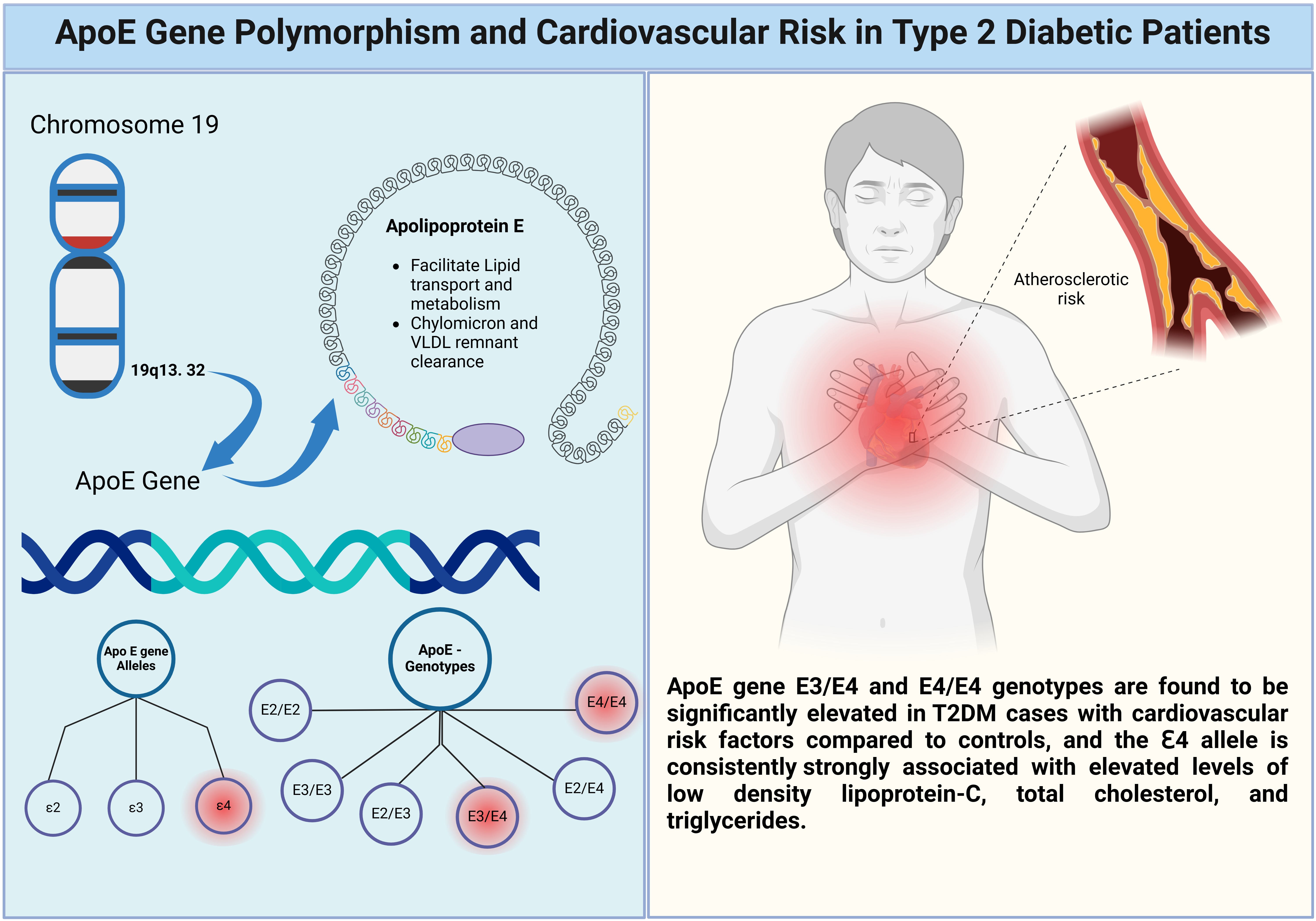
Downloads
References
T Gaziano, KS Reddy, F Paccaud, S Horton and V Chaturvedi. Cardiovascular disease. In: D Jamison, JG Breman, AR Measham, G Alleyne, M Claeson, DB Evans, P Jha, A Mills and P Musgrove (Eds.). Disease control priorities in developing countries. World Bank, Washington DC, 2006, p.645-662.
World Health Organization, Available at: https://iris.who.int/handle/10665/42510, accessed December 2024.
N Sattar, J McMurray, J Borén, A Rawshani, E Omerovic, N Berg, J Halminen, K Skoglund, B Eliasson, HC Gerstein, DK McGuire, D Bhatt and A Rawshani. Twenty years of cardiovascular complications and risk factors in patients with type 2 diabetes: A nationwide swedish cohort study. Circulation: Journal of the American Heart Association 2023; 147(25), 1872-1886.
S Rosa, B Arcidiacono, E Chiefari, A Brunetti, C Indolfi and DP Foti. Type 2 diabetes mellitus and cardiovascular disease: Genetic and epigenetic links. Frontiers in Endocrinology 2018. https://doi.org/10.3389/fendo.2018.00002
Y Zeng, S Wen, L Huan, L Xiong, B Zhong and P Wang. Association of ApoE gene polymorphisms with serum lipid levels and the risk of type 2 diabetes mellitus in the Chinese Han population of central China. PeerJ: The Journal of Life and Environmental Sciences 2023; 11, 15226.
P Abondio, M Sazzini, P Garagnani, A Boattini, D Monti, C Franceschi, D Luiselli and C Giuliani. The genetic variability of APOE in different human populations and its implications for longevity. Genes 2019; 10(3), 222.
DA Raichlen and GE Alexander. Exercise, APOE genotype and the evolution of the human lifespan. Trends in neurosciences 2014; 37(5), 247-255.
A Thahira, DT Kumar, D Roy, S Pradhan, Y Kumar, N Tandon, A Das, A Panvalkar and VP Akshay. ApoE gene polymorphism and cardiovascular risk in type 2 diabetic patients: A systematic review. MetaArXiv 2024. https://doi.org/10.17605/OSF.IO/R36TS
MJ Page, JE McKenzie, PM Bossuyt, I Boutron, TC Hoffmann, CD Mulrow, L Shamseer, JM Tetzlaff, EA Akl, SE Brennan, R Chou, J Glanville, JM Grimshaw, A Hróbjartsson, MM Lalu, T Li, EW Loder, E Mayo-Wilson, S McDonald, LA McGuinness and D Moher. The PRISMA 2020 statement: An updated guideline for reporting systematic reviews. Revista Española de Cardiología (English Edition) 2021; 74(9), 790-799.
S Nadeem, T Maqbool, JA Qureshi, A Altaf, S Naz, MM Azhar, I Ullah, TA Shah, MU Qamar and AM Salamatullah. Apolipoprotein E gene variation in Pakistani subjects with type 2 diabetes with and without cardiovascular complications. Medicina (Published in Kaunas, Lithuania) 2024; 60(6), 961.
D El-Lebedy, HM Raslan and AM Mohammed. Apolipoprotein E gene polymorphism and risk of type 2 diabetes and cardiovascular disease. Cardiovascular Diabetology 2016. https://doi.org/10.1186/s12933-016-0329-1
AA Galal, AA Abd Elmajeed, RA Elbaz, AM Wafa and RM Elshazli. Association of apolipoprotein E gene polymorphism with the risk of T2DM and obesity among Egyptian subjects. Gene 2021; 769, 145223.
W Chen, B Li, H Wang, G Wei, K Chen, W Wang, S Wang and Y Liu. Apolipoprotein E E3/E4 genotype is associated with an increased risk of type 2 diabetes mellitus complicated with coronary artery disease. BMC Cardiovascular Disorders 2024; 24(1), 160.
B Sapkota, A Subramanian, G Priamvada, H Finely, PR Blackett, CE Aston and D Sanghera. Association of APOE polymorphisms with diabetes and cardiometabolic risk factors and the role of APOE genotypes in response to anti-diabetic therapy: Results from the AIDHS/SDS on a South Asian population. Journal of Diabetes and its Complications 2015; 29(8), 1191-1197.
N Wang, Q Liu, H Liu, X Cong, H Yang, Y Yu, Y Cao and L Ma. Association of apolipoprotein E polymorphisms and risks of ischemic stroke in Chinese patients with type 2 diabetes mellitus. Journal of Diabetes Research 2021; 2021, 8816996.
C Srirojnopkun, K Kietrungwilaikul, K Boonsong, J Thongpoonkaew and N Jeenduang. Association of APOE and CETP TaqIB polymorphisms with type 2 diabetes mellitus. Archives of Medical Research 2018; 49(7), 479-485.
JY Seo, BJ Youn, HS Cheong and HD Shin. Association of APOE genotype with lipid profiles and type 2 diabetes mellitus in a Korean population. Genes & Genomics 2021; 43(7), 725-735.
S Ereqat, S Cauchi, K Eweidat, M Elqadi, M Ghatass, A Sabarneh and A Nasereddin. Association of DNA methylation and genetic variations of the APOE gene with the risk of diabetic dyslipidemia. Biomedical Reports 2022; 17(1), 61.
M Touré, FD Agne, A Dieng, RN Diallo, L Gueye and A Samb. Roles of the apolipoprotein E Gene and its polymorphisms in the etiopathophysiology of type 2 diabetes mellitus and its atherosclerotic complication in senegalese females. Journal of Diabetes Mellitus 2023; 13(4), 300-324.
X Liu, H Zhou, X Li, R Zhang, C Zhao, Y Zhou and S Xu. Correlation between ApoE gene polymorphism and LEAD in patients with T2DM that are of Han nationality in Northern China. Clinical and Applied Thrombosis/Hemostasis: Official Journal of the International Academy of Clinical and Applied Thrombosis/Hemostasis 2022; 28, 10760296221092405.
K Gonzalez-Aldaco, S Roman, LA Torres-Reyes and A Panduro. Association of apolipoprotein e2 allele with insulin resistance and risk of type 2 diabetes mellitus among an admixed population of Mexico. Diabetes, Metabolic Syndrome and Obesity: Targets and Therapy 2020; 13, 3527-3534.
L Zhang, S He, Z Li, X Gan, S Li, X Cheng, N Yang and F Zheng. Apolipoprotein E polymorphisms contribute to statin response in Chinese ASCVD patients with dyslipidemia. Lipids in Health and Disease 2019; 18(1), 129.
S Liu, J Liu, R Weng, X Gu and Z Zhong. Apolipoprotein E gene polymorphism and the risk of cardiovascular disease and type 2 diabetes. BMC Cardiovascular Disorders 2019; 19(1), 213.
C Santos-Ferreira, R Baptista, M Oliveira-Santos, R Costa, J Pereira Moura and L Gonçalves. Apolipoprotein E2 genotype is associated with a 2-Fold increase in the incidence of type 2 Diabetes mellitus: Results from a long-term observational study. Journal of Lipids 2019; 2019(1), 1698610.
AD Marais. Apolipoprotein E in lipoprotein metabolism, health and cardiovascular disease. Pathology 2019; 51(2), 165-176.
D Seripa, G D’Onofrio, F Panza, L Cascavilla, C Masullo and A Pilotto. The genetics of the human APOE polymorphism. Rejuvenation Research 2011; 14(5), 491-500.
AR Templeton. The theory of speciation VIA the founder principle, Genetics 1980; 94(4), 1011-1038.
NB Ruderman, D Carling, M Prentki and JM Cacicedo. AMPK, insulin resistance and the metabolic syndrome. The Journal of Clinical Investigation 2013; 123(7), 2764-2772.
Published
How to Cite
Issue
Section
License
Copyright (c) 2025 Walailak University

This work is licensed under a Creative Commons Attribution-NonCommercial-NoDerivatives 4.0 International License.





