
Physicochemical Properties, Fatty Acid and Amino Acid Profiles, and Antioxidant Activity of Sacha Inchi (Plukenetia Volubilis L.) Seed Oil and Press Cake Extracted Using Hydraulic Press and Soxhlet Methods
DOI:
https://doi.org/10.48048/tis.2025.9690Keywords:
Sacha Inchi oil, Physicochemical characteristics, Fatty acid profile, Amino acid profile, Antioxidant activity, Functional foodsAbstract
Sacha Inchi (Plukenetia volubilis L.) oil is increasingly recognized for its high polyunsaturated fatty acid content, particularly its balanced omega-3 and omega-6 ratio, making it a valuable ingredient in functional foods and nutraceuticals. However, the choice of extraction method significantly affects its physicochemical properties, bioactive compound retention, and oxidative stability. This study aims to compare the effects of hydraulic press (SIOP) and Soxhlet extraction (SIOS) methods to determine the most effective technique for preserving the nutritional integrity of Sacha Inchi oil and its by-products. The study assessed oil density, refractive index, moisture content, peroxide value, and acid value, employing gas chromatography for fatty acid composition and high-performance liquid chromatography for amino acid profiling. SIOP was obtained through mechanical pressing without solvents, while SIOS involved continuous solvent reflux. The press cakes (SIOPC and SIOSC) were analyzed for protein and fiber content. Results showed that SIOP exhibited superior oil quality, with lower peroxide values (2.31 mEq O₂/kg), higher α-linolenic acid content (46.77 %), and greater antioxidant activity (IC50: 104.05 mg/mL) compared to SIOS. Additionally, SIOPC retained more protein and antioxidants, highlighting its potential as a functional food ingredient. Our findings highlight the trade-offs between oil quality and yield. SIOP retains more polyunsaturated fatty acids and antioxidants, making it ideal for high-quality oil, while SIOS achieves higher yield but compromises bioactive retention. These insights help industries select the most suitable extraction method based on quality or efficiency priorities.
HIGHLIGHTS
- Physicochemical chemical analysis revealed that sacha inchi oil extracted with hydraulic press (SIOP) exhibited higher quality compared to sacha inchi oil extracted with soxhlet method (SIOS)
- SIOP contain higher levels of α-linolenic acid, linoleic acid, and oleic acid compared of SIOS
- Proximate analysis revealed that the protein and fat content in the press method (SIOPC) is higher than in the soxhlet method (SIOSC)
- Antioxidant activity of SIOP and SIOPC are higher compared to SIOS and SIOPS
- Amino acids profile of SIOPC revealed the presence of 7 non-essential amino acids and 8 essential amino acids
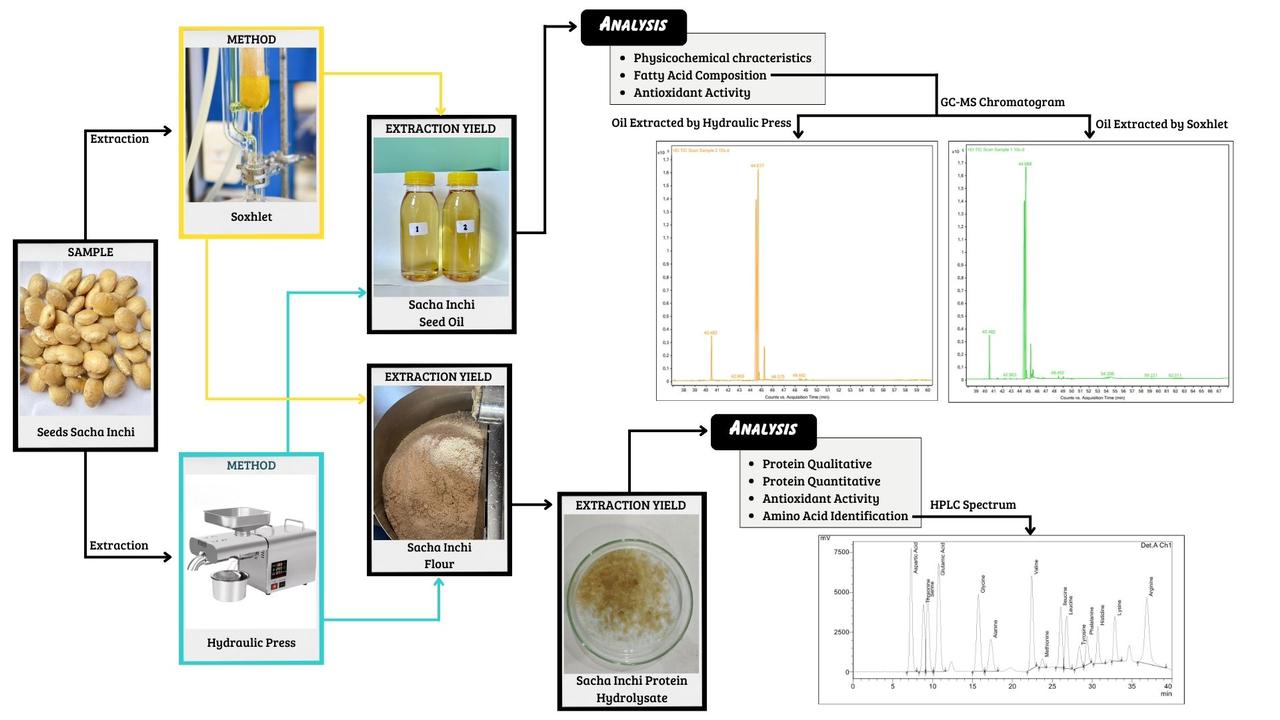
GRAPHICAL ABSTRACT
Downloads
References
AKL Nascimento, RF Melo-Silveira, N Dantas-Santos, JM Fernandes, SM Zucolotto, HAO Rocha and KC Scortecci. Antioxidant and antiproliferative activities of leaf extracts from plukenetia volubilis linneo (euphorbiaceae). Evidence-Based Complementary and Alternative Medicine 2013; 2013(1), 950272.
S Wang, F Zhu and Y Kakuda. Sacha inchi (Plukenetia volubilis L.): Nutritional composition, biological activity, and uses. Food Chemistry 2018; 256, 316-328.
S Yanti, DC Agrawal, DS Saputri, H Lin and W Chien. Nutritional comparison of sacha inchi (plukenetia volubilis) residue with edible seeds and nuts in taiwan: A chromatographic and spectroscopic study. International Journal of Food Science 2022; 19, 9825551.
A Valencia, FL Romero-Orejon, A Vinas-Ospino, D Barriga-Rodriguez, AM Munoz and F Ramos-Escudero. Sacha inchi seed (Plukenetia volubilis L.) oil: Terpenoids. IntechOpen Limited, London, 2021.
N Muna, D Setyaningsih, MS Rusli, N Amanah and I Tarida. Application of sacha inchi oil and deterpenated nutmeg oil as natural antiaging in facial cream formulation. IOP Conference Series Earth and Environmental Science 2024; 1354(1), 012025.
I Maya, DO Winardi, E Amalia, SR Mita, CK Kusumawulan, NA Putriana and S Sriwidodo. Physicochemical characteristics, fatty acid profile, and in vitro antioxidant activity evaluation of sacha inchi seed oil from Indonesia. Cosmetics 2023; 10(6), 171.
W Soimee, W Nakyai, P Charoensit, F Grandmottet, S Worasakwutiphong, P Phimnuan and J Viyoch. Evaluation of moisturizing and irritation potential of sacha inchi oil. Journal of Cosmetic Dermatology 2020; 19(4), 915-924.
S Kittibunchakul, V Kemsawasd, C Hudthagosol, P Sanporkha, S Sapwarobol and U Suttisansanee. The effects of different roasting methods on the phenolic contents, antioxidant potential, and in vitro inhibitory activities of sacha inchi seeds. Foods 2023; 12(22), 4178.
MSF Valente, FCM Chaves, MTG Lopes, JM Oka and RAF Rodrigues. Crop yield, genetic parameter estimation and selection of sacha inchi in central Amazon. Pesquisa Agropecuaria Tropical 2017; 47(2), 226-236.
H Hariadi, T Wahyono, S Darniadi, H Maulana, B Nurhadi, S Amien, A Karuniawan, AA Khan, T Aziz and AF Alasmari. Effect of maltodextrin concentration and drying temperature on the physicochemical characteristics of Sacha inchi (Plukenetia volubilis) extract powder. Italian Journal of Food Science 2024; 36(2), 74-82.
L Sterbova, PH cepkova, I Viehmannova and DC Huansi. Effect of thermal processing on phenolic content, tocopherols and antioxidant activity of sacha inchi kernels. Journal of Food Processing and Preservation 2017; 41(2), e12848.
P Mora-Aguirre, L Romero-Hidalgo, E Landines-Vera, R Ordonez-Araque and M Valdez-Diaz. Obtention, yields, chemical-microbiological properties and amino acids profile in a flour from Sacha Inchi (Plukenetia volubilis L.). International Journal of Research in Pharmaceutical Sciences 2020; 11(4), 5723-5728.
W Chansuvarn and S Panich. Nutritional and sensory properties of plant-based milk produced from Sacha inchi seeds (Plukenetia volubilis L.). Food Science and Applied Biotechnology 2024; 7(1), 14.
J Vicente, MGD Carvalho and EE Garcia-Rojas. Fatty acids profile of Sacha Inchi oil and blends by 1H NMR and GC-FID. Food Chemistry 2025; 181, 215-221.
EGT Sanchez, B Hernandez-Ledesma and L Gutierrez. Sacha inchi oil press-cake: Physicochemical characteristics, food-related applications and biological activity. Food Reviews International 2021; 39(4), 148-159.
LM Paucar-Menacho, R Salvador-Reyes, J Guillen-Sanchez, J Capa-Robles and C Moreno-Rojo. Comparative study of physical-chemical features of sacha inchi oil (Plukenetia volubilis l.), olive oil (Olea europaea) and fish oil. Scientia Agropecuaria 2015; 6(4), 279-290.
A Rabadan, M Alvarez‐Orti, JE Pardo, R Gomez, A Pardo-Gimenez and M Olmeda. A comprehensive approach to pistachio oil production. British Food Journal 2017; 119(4), 921-933.
X Wang and A Liu. Expression of genes controlling unsaturated fatty acids biosynthesis and oil deposition in developing seeds of sacha inchi (plukenetia volubilis L.). Lipids 2014; 49(10); 1019-1031.
AOAC Association of Official Analytical Chemists. Official methods of analysis of international. AOAC International, Washington DC, 2016.
LF Gutierrez, LM Rosada and A Jimenez. Chemical composition of sacha inchi (Plukenetia volubilis L.) seeds and characteristics of their lipid fraction. Grasas y Aceites 2011; 62(1), 76-83.
NA Chasquibol, CD Aguila, JC Yacono, A Guinda, W Moreda, RB Gomez-Coca and MC Perez-Camino. Characterization of Glyceridic and Unsaponifiable Compounds of Sacha Inchi (Plukenetia huayllabambana L.) Oils. Journal of Agricultural and Food Chemistry 2014; 62(41), 10162-10169.
NTP 151.400, Norma Técnica Peruana para Aceitede Sacha Inchi del género Plukenetia, Requistitos, 2009.
S Sabahannur and S Alimuddin. Identification of fatty acids in virgin coconut oil (VCO), cocoa beans, crude palm oil (CPO), and palm kernel beans using gas chromatography. IOP Conference Series: Earth and Environmental Science 2022; 1083, 012036.
W Lu, C Chiu, Y Chan, AT Mulio and P Li. New perspectives on different Sacha inchi seed oil extractions and its applications in the food and cosmetic industries. Critical Reviews in Food Science and Nutrition 2023; 65(3), 475-493.
D Penagos-Calvete, V Duque, C Marimon, DM Parra, SK Restrepo-Arango, O Scherf-Clavel, U Holzgrabe, G Montoya and CH Salamanca. Glycerolipid composition and advanced physicochemical considerations of sacha inchi oil toward cosmetic products formulation. Cosmetics 2019; 6(4), 70.
Q Liu, YK Xu, P Zhang, Z Na, T Tang and YX Shi. Chemical composition and oxidative evolution of Sacha Inchi (Plukentia volubilis L.) oil from Xishuangbanna (China). Grasas y Aceites 2014; 65(1), e012.
M Zhang, J Zhao, X Dai and X Li. Extraction and analysis of chemical compositions of natural products and plants. Separations 2023; 10(12), 598.
S Jitpinit, C Siraworakun, Y Sookklay and K Nuithitikul. Enhancement of omega-3 content in sacha inchi seed oil extracted with supercritical carbon dioxide in semi-continuous process. Heliyon 2022; 8(1), e08780.
Australian Oilseeds Federation Incorporated. Section 1: Quality standards, technical information & typical analysis. Australian Oilseeds Federation, Sydney, Australian, 2022.
L Niu, J Li, M Chen and Z Xu. Determination of oil contents in Sacha inchi (Plukenetia volubilis) seeds at different developmental stages by two methods: Soxhlet extraction and time-domain nuclear magnetic resonance. Industrial Crops and Products 2014; 56, 187-190.
T Kyaw, TL Nwe, O Myint, MT Khaing, PP San, KH Kyaing, TT Mon and ET Htun. Studies on nutritional compositions of sacha inchi seed and physicochemical characteristics of sacha inchi oil. International European Extended Enablement in Science, Engineering & Management 2019; 7(8), 111-119.
W Mamozai, AM Hesam and WH Hemma. Impacts of crude oils on water quality: A comprehensive review. European Journal of Theoretical and Applied Sciences 2024; 2(1), 126-138.
TL Hohenbrink, C Jackisch, W Durner, K Germer, SC Iden, J Kreiselmeier, F Leuther, JC Metzger, M Naseri and A Peters. Soil water retention and hydraulic conductivity measured in a wide saturation range. Earth System Science Data 2023; 15(10), 4417-4432.
M Say, P Heng, S Kong, CP Tan, S Phal, Y Nat and R Tan. Characterization of physicochemical properties of cooking oils sold in Phnom Penh, Cambodia. Journal of Food Science and Nutrition Research 2024; 7, 28-36.
DTD Almeida, TV Viana, MM Costa, CDS Silva and S Feitosa. Effects of different storage conditions on the oxidative stability of crude and refined palm oil, olein and stearin (Elaeis guineensis). Food Science and Technology 2019; 39(1), 211-217.
DT Nghiem, NPT Nhan, LD Truong, MH Cang. Effect of storage time and temperature on the quality of sacha inchi oil (Plukenetia volubilis) during processing. AIP Conference Proceedings 2023; 2682, 050001.
M Ivanova, A Hanganu, R Dumitriu, M Tociu, G Ivanov, C Stavarache, L Popescu, A Ghendov-Mosanu, R Sturza, C Deleanu and N Chira. Saponification value of fats and oils as determined from 1H-NMR Data: The case of dairy fats. Foods 2022; 11(10), 1466.
N Rahman, S Hashem, S Akther and JS Jothi. Impact of various extraction methods on fatty acid profile, physicochemical properties, and nutritional quality index of Pangus fish oil. Food Science & Nutrition 2023; 11(8), 4688-4699.
M Flores, V Avendano, J Bravo, C Valdes, O Forero-Doria, V Quitral, Y Vilcanqui and J Ortiz-Viedma. edible oil parameters during deterioration processes. International Journal of Food Science 2021; 2021(1), 7105170.
Y Li, K Bundeesomchok, N Rakotomanomana, A Fabiano-Tixier, R Bott, Y Wang and F Chemat. Towards a zero-waste biorefinery using edible oils as solvents for the green extraction of volatile and non-volatile bioactive compounds from rosemary. Antioxidants 2019; 8(5), 140.
RM Suzuki, MCS Gomes, JG Sgorlon, RO Defendi, ACR Aranha and CC Sipoli. Reusing a residue from the juice industry: Extraction of oil from passion fruit seeds and its incorporation into liposomes. Journal of Chemical Technology & Biotechnology 2024; 99(3), 685-694.
F Ramos-Escudero, AM Munoz, MR Escudero, A Vinas-Ospino, MT Morales and AG Asuero. Characterization of commercial Sacha inchi oil according to its composition: tocopherols, fatty acids, sterols, triterpene and aliphatic alcohols. Journal of Food Science and Technology 2019; 56(10), 4503-4515.
J Ren and SH Chung. Anti-inflammatory effect of α-linolenic acid and its mode of action through the inhibition of nitric oxide production and inducible nitric oxide synthase gene expression via NF-κB and mitogen-activated protein kinase pathways. Journal of Agricultural and Food Chemistry 2007; 55(13), 5073-5080.
R Reifen, A Karlinsky, AH Stark, Z Berkovich and A Nyska. α-Linolenic acid (ALA) is an anti-inflammatory agent in inflammatory bowel disease. The Journal of Nutritional Biochemistry 2015; 26(12), 1632-1640.
X Zhu, B Wang, X Zhang, X Chen, J Zhu, Y Zou and J Li. Alpha-linolenic acid protects against lipopolysaccharide-induced acute lung injury through anti-inflammatory and anti-oxidative pathways. Microbial Pathogenesis 2020; 142, 104077.
JA Fleming and PM Kris-Etherton. The evidence for α-linolenic acid and cardiovascular disease benefits: Comparisons with eicosapentaenoic acid and docosahexaenoic acid. Advances in Nutrition 2014; 5(6), 863S-876S.
C Bertoni, M Abodi, V D’Oria, GP Milani, C Agostoni and A Mazzocchi. Alpha-linolenic acid and cardiovascular events: A narrative review. International Journal of Molecular Sciences 2023; 24(18), 14319.
JM Geleijnse, JD Goede and IA Brouwer. Alpha-linolenic acid: Is it essential to cardiovascular health? Current Atherosclerosis Reports 2010; 12(6), 359-367.
M Simard, A Tremblay, S Morin, C Martin, P Julien, J Fradette, N Flamand and R Pouliot. α-linolenic acid and linoleic acid modulate the lipidome and the skin barrier of a tissue-engineered skin model. Acta Biomaterialia 2022; 140, 261-274.
CBN Lauson, S Tiberti, PA Corsetto, F Conte, P Tyagi, M Machwirth, S Ebert, A Loffreda, L Scheller, D Sheta, Z Mokhtari, T Peters, AT Raman, F Greco, AM Rizzo, A Beilhack, G Signore, N Tumino, P Vacca, … T Manzo. Linoleic acid potentiates CD8+ T cell metabolic fitness and antitumor immunity. Cell Metabolism 2023; 35(4), 633-650.
M O’Shea, J Bassaganya-Riera and IC Mohede. Immunomodulatory properties of conjugated linoleic acid. The American Journal of Clinical Nutrition 2004; 79(6), 1199S-1206S.
NS Pegoraro, C Camponogara, L Cruz and SM Oliveira. Oleic acid exhibits an expressive anti-inflammatory effect in croton oil-induced irritant contact dermatitis without the occurrence of toxicological effects in mice. Journal of Ethnopharmacology 2021; 267, 113486.
C Santa-Maria, S Lopez-Enriquez, SML Paz, I Geniz, ME Reyes-Quiroz, M Moreno, F Palomares, F Sobrino and G Alba. Update on anti-inflammatory molecular mechanisms induced by oleic acid. Nutrients 2023; 15(1), 224.
Z Paduchova, B Katrencikova, M Vavakova, L Laubertova, Z Nagyova, I Garaiova, Z Durackova and J Trebaticka, The effect of omega-3 fatty acids on thromboxane, brain-derived neurotrophic factor, homocysteine, and vitamin D in depressive children and adolescents: Randomized controlled trial. Nutrients 2021; 13(4), 1095.
B Katrencikova, M Vavakova, I Waczulíkova, S Oravec, I Garaiova, Z Nagyova, N Hlavacova, Z Durackova and J Trebaticka. Lipid profile, lipoprotein subfractions, and fluidity of membranes in children and adolescents with depressive disorder: Effect of omega-3 fatty acids in a double-blind randomized controlled study. Biomolecules 2020; 10(10), 1427.
B Fotschki, P Opyd, J Juskiewicz, W Wiczkowski and A Jurgonski. Comparative effects of dietary hemp and poppy seed oil on lipid metabolism and the antioxidant status in lean and obese zucker rats. Molecules 2020; 25(12), 2921.
L Relina, O Suprun, R Bohuslavskyi, L Vecherska, O Antsyferova, N Ilchenko, V Kolomatska and L Kobyzeva. Fatty acid composition of grain of einkorn and its relatives. Contribuţii Botanice 2023; 57, 121-132.
VM Lavenburg, KA Rosentrater and S Jung. Extraction methods of oils and phytochemicals from seeds and their environmental and economic impacts. Processes 2021; 9(10), 1839.
A Thuanthong, J Patchimpet, W Visessanguan, J Panyo, S Benjakul, Y Zhang and S Klomklao. Antioxidant properties of sacha inchi (Plukenetia volubilis) shell extracts as affected by solvents used for prior decolorization. ASEAN Journal of Scientific and Technological Reports 2021; 24(3), 1-8.
WIC Teran, MF Quinteros, CL Carpio, D Morales, G Vasquez, M Alvarez and M Silva. Identification of fatty acids in sacha inchi oil (cursive plukenetia Volubilis L.) from ecuador. Asian Journal of Pharmaceutical and Clinical Research 2018; 11(2), 389.
P Molyneux. The use of the stable free radical diphenylpicryl-hydrazyl (DPPH) for estimating antioxidant activity. Songklanakarin Journal of Science and Technology 2004; 26(2), 211-219.
R Muangrat, P Veeraphong and N Chantee. Screw press extraction of Sacha inchi seeds: Oil yield and its chemical composition and antioxidant properties. Journal of Food Processing and Preservation 2018; 42(6), e13635.
S Dhavamani, YPC Rao and BR Lokesh. Total antioxidant activity of selected vegetable oils and their influence on total antioxidant values in vivo: A photochemiluminescence based analysis. Food Chemistry 2014; 164, 551-555.
HC Yoo, YC Yu, Y Sung and JM Han. Glutamine reliance in cell metabolism. Experimental & Molecular Medicine 2020; 52, 1496-1516.
D Zhang, Z Hua and Z Li. The role of glutamate and glutamine metabolism and related transporters in nerve cells. CNS Neuroscience & Therapeutics 2024; 30(2), e14617.
MC Walker and WAVD Donk. The many roles of glutamate in metabolism. Journal of Industrial Microbiology and Biotechnology 2016; 43(2-3), 419-430.
K Wijnands, T Castermans, M Hommen, D Meesters and M Poeze. Arginine and citrulline and the immune response in sepsis. Nutrients 2015; 7(3), 1426-1463.
N Pahlavani, M Jafari, O Sadeghi, M Rezaei, H Rasad, HA Rahdar and MH Entezari. L-arginine supplementation and risk factors of cardiovascular diseases in healthy men: A double-blind randomized clinical trial. F1000Research 2014; 3, 306.
K Ren, L Feng, P Wu, Y Liu, H Ren, X Jin, J Jiang, X Zhou and W Jiang. Dietary isoleucine promoted myofiber hypertrophy associated with myonucleus input and protein deposition in fish. Aquaculture 2025; 598, 742050.
SU Rehman, R Ali, H Zhang, MH Zafar and M Wang. Research progress in the role and mechanism of Leucine in regulating animal growth and development. Front in Physiology 2023; 14, 1252089.
S Lee, BC Small, B Patro, K Overturf and RW Hardy. The dietary lysine requirement for optimum protein retention differs with rainbow trout (Oncorhynchus mykiss Walbaum) strain. Aquaculture 2020; 514, 734483.
SR Hertzler, JC Lieblein-Boff, M Weiler and C Allgeier. Plant proteins: Assessing their nutritional quality and effects on health and physical function. Nutrients 2020; 12(12), 3704.
A Vanegas-Azuero and L Gutierrez. Physicochemical and sensory properties of yogurts containing sacha inchi (Plukenetia volubilis L.) seeds and β-glucans from Ganoderma lucidum. Journal of Dairy Science 2018; 101(2), 1020-1033.
Published
How to Cite
Issue
Section
License
Copyright (c) 2025 Walailak University

This work is licensed under a Creative Commons Attribution-NonCommercial-NoDerivatives 4.0 International License.





