
Can Artificial Intelligence and Machine Learning Predict the Performance of Nano-based Drilling Fluids? A Review
DOI:
https://doi.org/10.48048/tis.2025.9686Keywords:
Drilling Fluids, Nanoparticles, Novel Additives, Artificial Intelligence, Machine LearningAbstract
Drilling fluids play a crucial role in the control and functionality of oil and gas well operations. Continuous monitoring, enhancement, and optimization of their properties are essential for successful drilling processes. Recently, a variety of additives, including nanoparticles (NPs) and novel polymers, have been introduced to modify and improve the performance of drilling fluids, addressing the emerging challenges in the field. The behavior of these fluids can change over time or under extreme drilling conditions, necessitating the use of predictive models to optimize their properties, particularly their rheological characteristics. In the past decade, there has been a growing trend of developing new models and correlations through artificial neural networks (ANN) and machine learning (ML) techniques within the petroleum industry. These methods enable the development of mathematical formulas that can predict the behavior of specific parameters based on known variables. Compared to traditional models, ANN and ML offer enhanced reliability and accuracy in predicting drilling fluid properties. This review aims to provide a comprehensive overview of the latest applications and mechanisms of various additives, with a particular focus on NPs, in drilling fluids. Additionally, it highlights the valuable insights and advancements in using ANN and ML techniques to predict and optimize the behavior of drilling fluids, which could pave the way for innovative applications and more efficient utilization of these technologies.
HIGHLIGHTS
- The paper highlights the growing role of nanoparticles (NPs) and novel additives in enhancing drilling fluid performance, as well as the increasing use of Artificial Intelligence (AI) methods like Artificial Neural Networks (ANN) and Machine Learning (ML) for improved fluid management.
- NPs have demonstrated significant improvements in the properties of drilling fluids with promising potential for fluid performance in the field.
- The integration of ANN and ML with traditional models allows for more accurate predictions of drilling fluid behavior, providing better control over fluid properties and improving operational efficiency.
- Future research should focus on refining the existing models, exploring alternative environmentally friendly additives, and integrating AI models with advanced materials to enhance the sustainability and environmental safety of drilling fluids.
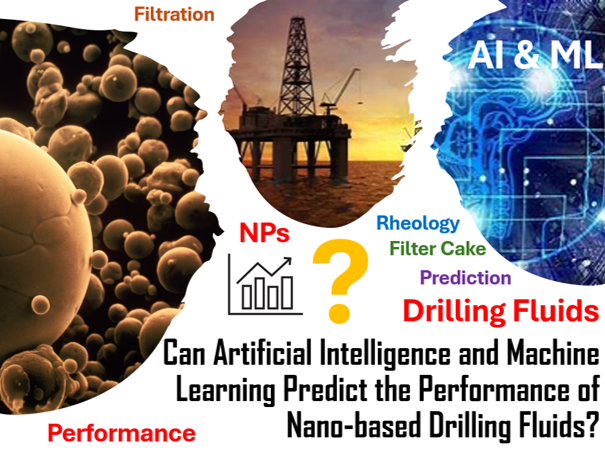
GRAPHICAL ABSTRACT
Downloads
References
AT Bourgoyne, KK Millheim, ME Chenevert and SF Young. Applied drilling engineering. Vol II. Society of Petroleum Engineers, Richardson, United States, 1991.
S Elkatatny, M Mahmoud and HA Nasr-El-Din. Filter cake properties of water-based drilling fluids under static and dynamic conditions using computed tomography scan. Journal of Energy Resources Technology 2013; 135(4), 042201.
FB Growcock, TP Frederick, AR Reece, GW Green and MD Ruffin. Novel lubricants for water-based drilling fluids. In: Proceedings of the SPE International Symposium on Oilfield Chemistry, Houston, Texas, United States. 1999.
WE Foxenberg, SA Ali, TP Long and J Vian. Field experience shows that new lubricant reduces friction and improves formation compatibility and environmental impact. In: Proceedings of the SPE International Symposium and Exhibition on Formation Damage Control, Lafayette, Louisiana, United States. 2008.
American Petroleum Institute. API RP 13-B1: Recommended practice for field testing of water-based drilling fluids. 5th ed. American Petroleum Institute, Washington, D. C., United States, 2003.
EC Bingham. Fluidity and plasticity. McCraw-Hill, New York, United States, 1922.
AH Salih and H Bilgesu. Investigation of rheological and filtration properties of water-based drilling fluids using various anionic nanoparticles. In: Proceedings of the at the SPE Western Regional Meeting, Bakersfield, California, United States. 2017.
T Hemphill, W Campos and A Pilehvari. Yield-power law model more accurately predicts mud rheology. Oil and Gas Journal 1993; 91, 34.
WH Herschel and R Bulkley. Konsistenzmessungen von Gummi-Benzollösungen. Kolloid-Zeitschrift 1926; 39(4), 291-300.
C Mark. Rheology of disperse systems. In: Proceedings of the Conference Organized by the British Society of Rheology, Swansea, Massachusetts, United States. 1959.
H Rahmanifard and T Plaksina. Application of artificial intelligence techniques in the petroleum industry: A review. Artificial Intelligence Review 2019; 52(4), 2295-2318.
TA Olukoga and Y Feng. Practical machine-learning applications in well-drilling operations. SPE Drilling & Completion 2021; 36(04), 849-867.
OE Agwu, JU Akpabio, SB Alabi and A Dosunmu. Artificial intelligence techniques and their applications in drilling fluid engineering: A review. Journal of Petroleum Science and Engineering 2018; 167, 300-315.
S Choubey and GP Karmakar. Artificial intelligence techniques and their application in oil and gas industry. Artificial Intelligence Review 2021; 54(5), 3665-3683.
G Cheraghian. Nanoparticles in drilling fluid: A review of the state-of-the-art. Journal of Materials Research and Technology 2021; 13, 737-753.
C Zamora-Ledezma, C Narváez-Muñoz, VH Guerrero, E Medina and L Meseguer-Olmo. Nanofluid formulations based on 2-dimensional nanoparticles, their performance, and potential application as water-based drilling fluids. ACS Omega 2022; 7(24), 20457-20476.
A Mady, O Mahmoud and A Dahab. Can nanoparticles improve the characteristics of drilling fluids? In: Proceedings of the 13th International Conference on Mining, Metallurgical, and Petroleum Engineering, Suez, Egypt. 2019.
A Mady, O Mahmoud and A Dahab. Nanoparticle-based drilling fluids as promising solutions to enhance drilling performance in Egyptian oil and gas fields. International Journal of Industry and Sustainable Development 2020; 1(1), 24-38.
A Mady, O Mahmoud and A Dahab. Nanoparticles as promising additives to improve the drilling of Egyptian oil and gas fields. In: Proceedings of the ASME 39th International Virtual Conference on Ocean, Offshore and Arctic Engineering. Florida, United States, 2020.
M Amanullah, MK Al-Arfaj and Z Al-Abdullatif. Preliminary test results of nano-based drilling fluids for oil and gas field application. In: Proceedings of the SPE/IADC Drilling Conference and Exhibition, Amsterdam, Netherlands. 2011.
Y Jung, M Barry, JK Lee, P Tran, Y Soong, D Martello and M Chyu. Effect of nanoparticle-additives on the rheological properties of clay-based fluids at high temperature and high pressure. In: Proceedings of the AADE National Technical Conference and Exhibition, Houston, Texas, United States. 2011.
J Abdo and MD Haneef. Nano-enhanced drilling fluids: Pioneering approach to overcome uncompromising drilling problems. Journal of Energy Resources Technology 2012; 134, 014501.
Z Vryzas, O Mahmoud, HA Nasr-El-Din and VC Kelessidis. Development and testing of novel drilling fluids using Fe2O3 and SiO2 nanoparticles for enhanced drilling operations. In: Proceedings of the International Petroleum Technology Conference, Doha, Qatar. 2015.
Z Vryzas, O Mahmoud, HA Nasr-El-Din, V Zaspalis and VC Kelessidis. Incorporation of Fe3O4 nanoparticles as drilling fluid additives for improved drilling operations. In: Proceedings of the ASME 35th International Conference on Ocean, Offshore and Arctic Engineering, Busan, South Korea. 2016.
Z Vryzas, V Zaspalis, L Nalbantian, O Mahmoud, HA Nasr-El-Din and VC Kelessidis. A comprehensive approach for the development of new magnetite nanoparticles giving smart drilling fluids with superior properties for hp/ht applications. In: Proceedings of the International Petroleum Technology Conference, Bangkok, Thailand. 2016.
Z Vryzas, VC Kelessidis, MB Bowman, L Nalbantian, V Zaspalis, O Mahmoud and HA Nasr-El-Din. Smart magnetic drilling fluid with in-situ rheological controllability using Fe3O4 nanoparticles. In: Proceedings of the SPE Middle East Oil & Gas Show and Conference, Manama, Kingdom of Bahrain. 2017.
MM Barry, Y Jung, JK Lee, TX Phuoc and MK Chyu. Fluid filtration and rheological properties of nanoparticle additive and intercalated clay hybrid bentonite drilling fluids. Journal of Petroleum Science and Engineering 2015; 127, 338-346.
Z Vryzas, L Nalbandian, VT Zaspalis and VC Kelessidis. How different nanoparticles affect the rheological properties of aqueous wyoming sodium bentonite suspensions. Journal of Petroleum Science and Engineering 2019; 173, 941-954.
AR Ismail, NM Rashid, MA Jaafar, WRW Sulaiman and NA Buang. Effect of nanomaterial on the rheology of drilling fluids. Journal of Applied Sciences 2014; 14, 1192-1197.
A Aftab, AR Ismail and ZH Ibupoto. Enhancing the rheological properties and shale inhibition behavior of water-based mud using nanosilica, multi-walled carbon nanotube and graphene nanoplatelet. Egyptian Journal of Petroleum 2017; 26, 291-299.
AR Ismail, A Aftab, ZH Ibupoto and N Zolkifile. The novel approach for the enhancement of rheological properties of water-based drilling fluids by using multi-walled carbon nanotube, nanosilica and glass beads. Journal of Petroleum Science and Engineering 2016; 139, 264-275.
AR Ismail, WRW Sulaiman, MZ Jaafar, A Aftab, AA Razi and ZH Ibupoto. The application of MWCNT to enhance the rheological behavior of drilling fluids at high temperature. Malaysian Journal of Fundamental and Applied Sciences 2017; 12(3), 95-98.
A Aftab, AR Ismail, S Khokhar and ZH Ibupoto. Novel zinc oxide nanoparticles deposited acrylamide composite used for enhancing the performance of water-based drilling fluids at elevated temperature conditions. Journal of Petroleum Science and Engineering 2016; 146, 1142-1157.
AA Nizamani, AR Ismail, R Junin, AQ Dayo, AH Tunio, ZH Ibupoto and MAM Sidek. Synthesis of titania-bentonite nanocomposite and its applications in water-based drilling fluids. Chemical Engineering Transactions 2017; 56, 949-954.
O Mahmoud, HA Nasr-El-Din, Z Vryzas and VC Kelessidis. Using ferric oxide and silica nanoparticles to develop modified calcium bentonite drilling fluids. SPE Drilling & Completion 2018; 33(1), 12-26.
O Mahmoud, HA Nasr-El-Din, Z Vryzas and VC Kelessidis. Effect of ferric oxide nanoparticles on the properties of filter cake formed by calcium bentonite-based drilling muds. SPE Drilling & Completion 2018; 33(4), 363-376.
MAA Alvi, M Belayneh, S Bandyopadhyay and MW Minde. Effect of iron oxide nanoparticles on the properties of water-based drilling fluids. Energies 2020; 13(24), 6718.
O Mahmoud, HA Nasr-El-Din, Z Vryzas and VC Kelessidis nanoparticle-based drilling fluids for minimizing formation damage in HTHP applications. In: Proceedings of the International Conference & Exhibition on Formation Damage Control, Lafayette, Louisiana, United States. 2016.
M Rashidi, A Sedaghat, B Misbah, M Sabati and K Vaidyan. Use of SiO2 nanoparticles in water-based drilling fluids for improved energy consumption and rheology: A laboratory study. SPE Journal 2021; 26(6), 3529-3543.
O Mahmoud and HA Nasr-El-Din. Formation damage assessment and filter cake characterization of NPs/Ca-bentonite fluids for drilling harsh environments using computed-tomography scan. In: Proceedings of the SPE Trinidad and Tobago Section Energy Resources Conference, Port of Spain, Trinidad and Tobago. 2018.
MT Al-saba, A Al Fadhli, A Marafi, A Hussain, F Bander and MF Al Dushaishi. Application of nanoparticles in improving rheological properties of water based drilling fluids. In: Proceedings of the SPE Kingdom of Saudi Arabia Annual Technical Symposium and Exhibition, Dammam, Saudi Arabia. 2018.
SR Smith, R Rafati, AS Haddad, A Cooper and H Hamidi. Application of aluminium oxide nanoparticles to enhance rheological and filtration properties of water based muds at HPHT conditions. Colloids and Surfaces A: Physicochemical and Engineering Aspects 2018; 537, 361-371.
S Medhi, S Chowdhury, JS Sangwai and DK Gupta. Effect of Al2O3 nanoparticle on viscoelastic and filtration properties of a salt-polymer-based drilling fluid. Energy Sources, Part A: Recovery, Utilization, and Environmental Effects 2019; 45(1), 2385-2397.
PAL Anawe and AJ Folayan. Investigation of the effect of Yttrium Oxide (Y2O3) nanoparticle on the rheological properties of water based mud under high pressure high temperature environment. International Journal of Mechanical Engineering and Technology 2018; 9(7), 545-559.
MS Al Ruqeishi, Y Al Salmi and T Mohiuddin. Nanoparticles as drilling fluids rheological properties modifiers. Progress in Petrochemical Science 2018, 1(5), 97-103.
J Aramendiz, AH Imqam and SM Fakher. Design and evaluation of a water-based drilling fluid formulation using SiO and graphene oxide nanoparticles for unconventional shales. In: Proceedings of the International Petroleum Technology Conference, Beijing, China. 2019.
DV Kosynkin, G Ceriotti, KC Wilson, JR Lomeda, JT Scorsone, AD Patel, JE Friedheim and JM Tour. Graphene oxide as a high-performance fluid-loss-control additive in water-based drilling fluids. ACS Applied Materials & Interfaces 2012; 4(1), 222-227.
NM Taha and S Lee. Nano graphene application improving drilling fluids performance. In: Proceedings of the International Petroleum Technology Conference, Doha, Qatar. 2015.
EI Mikhienkova, SV Lysakov, AL Neverov, VA Zhigarev, AV Minakov and VY Rudyak. Experimental study on the influence of nanoparticles on oil-based drilling fluid properties. Journal of Petroleum Science and Engineering 2022; 208, 109452.
AV Minakov, MI Pryazhnikov, EI Mikhienkova and YO Voronenkova. Systematic experimental study of the temperature dependence of viscosity and rheological behavior of water-based drilling fluids with nano-additives. Petroleum 2023; 9, 534-544.
M Cheraghi, M Hajipour and A Emamzadeh. Enhancement of the heat capacity of water-based drilling fluids for deep drilling applications. Brazilian Journal of Chemical Engineering 2022; 39(1), 77-86.
AH Salih, TA Elshehabi and HI Bilgesu. Impact of nanomaterials on the rheological and filtration properties of water-based drilling fluids. In: Proceedings of the SPE Eastern Regional Meeting, Canton, Ohio, United States. 2016.
MT Alsaba, MF Al Dushaishi and AK Abbas. Application of nano water-based drilling fluid in improving hole cleaning. SN Applied Sciences 2020; 2(5), 905.
AK Abbas. Experimental investigation of cuttings transport with nanocomposite water-based drilling fluids modified by cellulose nanoparticles. Colloids and Surfaces A: Physicochemical and Engineering Aspects 2021; 615, 126240.
AK Abbas, HH Dahm and FA Hadi. Experimental study of cuttings transport efficiency of low solid bentonite drilling fluids modified by cellulose nanoparticles. Arabian Journal for Science and Engineering 2022; 47(9), 11863-11878.
MC Li, Q Wu, T Lei, C Mei, X Xu, S Lee and J Gwon. Thermothickening drilling fluids containing bentonite and dual-functionalized cellulose nanocrystals. Energy Fuels 2020; 34(7), 8206-8215.
A Aftab, M Ali, M Arif, S Panhwar, N M C Saady, E A Al-Khdheeawi, O Mahmoud, A R Ismail, A Keshavarz and S Iglauer. Influence of tailor-made TiO2/API bentonite nanocomposite on drilling mud performance: towards enhanced drilling operations. Applied Clay Science 2020; 199, 105862.
HM Ahmad, TA Iqbal, M Al Harthi and MS Kamal. Synergistic effect of polymer and nanoparticles on shale hydration and swelling performance of drilling fluids. Journal of Petroleum Science and Engineering 2021; 205, 108763.
O Mahmoud, A Mady, A S Dahab and A Aftab. Al2O3 and CuO nanoparticles as promising additives to improve the properties of KCl-polymer mud: An experimental investigation. The Canadian Journal of Chemical Engineering 2022; 100(1), 1384-1397.
MH Ahasan, FA Alvi, N Ahmed and S Alam. An investigation of the effects of synthesized zinc oxide nanoparticles on the properties of water-based drilling fluid. Petroleum Research 2021; 7(1), 131-137.
M Mirzaasadi, V Zarei, M Elveny, SM Alizadeh, V Alizadeh and A Khan. Improving the rheological properties and thermal stability of water-based drilling fluid using biogenic silica nanoparticles. Energy Reports 2021; 7, 6162-6171.
S Medhi, S Chowdhury, DK Gupta and A Mazumdar. An investigation on the effects of silica and copper oxide nanoparticles on rheological and fluid loss property of drilling fluids. Journal of Petroleum Exploration and Production Technology 2020; 10(1), 91-101.
S Ponmani, R Nagarajan and JS Sangwai. Effect of nanofluids of CuO and ZnO in polyethylene glycol and polyvinylpyrrolidone on the thermal, electrical, and filtration-loss properties of water-based drilling fluids. SPE Journal 2016; 21(02), 405-415.
A Ahmed, AS Haddad, R Rafati, A Bashir, AM AlSabagh and AA Aboulrous. Developing a thermally stable ester-based drilling fluid for offshore drilling operations by using aluminum oxide nanorods. Sustainability 2021; 13(6), 3399.
C Zhang, J Sun, X Huang, Y Zhang, J Zong, K Lv and J Dai. Use of modified polystyrene micro-nano spheres to improve the inhibition and plugging performance of water-based drilling fluids. Colloids and Surfaces A: Physicochemical and Engineering Aspects 2023; 668, 131409.
Y Lin, Q Tian, P Lin, X Tan, H Qin and J Chen. Effect of nanoparticles on rheological properties of water-based drilling fluid. Nanomaterials 2023; 13, 2092.
Z Tahr, JA Ali and AS Mohammed. Sustainable aspects behind nano-biodegradable drilling fluids: A critical review. Geoenergy Science and Engineering 2023; 222, 211443.
G Wang, W Li, S Qiu, J Liu, Z Ou, X Li, F Ji, L Zhang, S Liu, L Yang and G Jiang. Application of a core-shell structure nano filtration control additive in salt-resistant clay-free water-based drilling fluid. Polymers 2023; 15, 4331.
A Bardhan, F Khan, H Kesarwani, S Vats, S Sharma and S Kumar. Performance evaluation of novel silane coated nanoparticles as an additive for high-performance drilling fluid applications. In: Proceedings of the International Petroleum Technology Conference, Bangkok, Thailand. 2023.
C Martin, M Babaie, A Nourian and GG Nasr. Designing smart drilling fluids using modified nano silica to improve drilling operations in Geothermal wells. Geothermics 2023; 107, 102600.
A Bardhan, A Singh, H Nishanta, S Sharma, AK Choubey and S Kumar. Biogenic copper oxide nanoparticles for improved lubricity and filtration control in water-based drilling mud. Energy & Fuels 2024; 38(10), 8564-8578.
A Ahmed, E Pervaiz, U Abdullah and T Noor. Optimization of water based drilling fluid properties with the SiO2/g-C3N4 Hybrid. ACS Omega 2024; 9(13), 15052-15064.
AD Abdullah, JA Ali and M Abdalqadir. Exploring the role of hydrophobic nanofluids in reducing shale swelling during drilling: A step towards eco-friendly and sustainable practices. Colloids and Surfaces A: Physicochemical and Engineering Aspects 2024; 694, 134164.
A Bardhan, S Vats, DK Prajapati, D Halari, S Sharma and A Saxena. Utilization of mesoporous nano-silica as high-temperature water-based drilling fluids additive: Insights into the fluid loss reduction and shale stabilization potential. Geoenergy Science and Engineering 2024; 232, 212436.
C Vipulanandan and AS Mohammed. Hyperbolic rheological model with shear stress limit for acrylamide polymer modified bentonite drilling muds. Journal of Petroleum Science and Engineering 2014; 122, 38-47.
YH Chai, S Yusup and VS Chok. Study on the effect of nanoparticle loadings in base fluids for improvement of drilling fluid properties. Journal of Advanced Chemical Engineering 2014; 4(3), 115.
V Srivastava, M Beg, S Sharma and AK Choubey. Application of manganese oxide nanoparticles synthesized via green route for improved performance of water-based drilling fluids. Applied Nanoscience 2021; 11(8), 2247-2260.
C Vipulanandan, A Mohammed and RG Samuel. Fluid loss control in smart bentonite drilling mud modified with nanoclay and quantified with vipulanandan fluid loss model. In: Proceedings of the Offshore Technology Conference, Houston, Texas, United States. 2018.
RO Afolabi, OD Orodu, VE Efeovbokhan and OJ Rotimi. Optimizing the rheological properties of silica nano-modified bentonite mud using overlaid contour plot and estimation of maximum or upper shear stress limit. Cogent Engineering 2017; 4(1), 1287248.
OE Agwu, JU Akpabio, ME Ekpenyong, UG Inyang, DE Asuquo, IJ Eyoh and OS Adeoye. A comprehensive review of laboratory, field and modelling studies on drilling mud rheology in high temperature high pressure (HTHP) conditions. Journal of Natural Gas Science and Engineering 2021; 94, 104046.
MM Dardir, IA Awadallah, SI Abd El-Wahab and HI Al-Shefey. Improvement of the rheological properties of local bentonite clay using new blending polymers for water-based drilling fluids. Egyptian Journal of Chemistry 2016; 59(1), 59-78.
HM Ahmad, MS Kamal, M Mahmoud, SMS Hussain, M Abouelresh and MA Al-Harthi. Organophilic clay-based drilling fluids for mitigation of unconventional shale reservoirs instability and formation damage. Journal of Energy Resources Technology 2019; 141(9), 093102.
G Cheraghian, Q Wu, M Mostofi, M-C Li, M Afrand and SJ Sangwai. Effect of a novel clay/silica nanocomposite on water-based drilling fluids: improvements in rheological and filtration properties. Colloids and Surfaces A: Physicochemical and Engineering Aspects 2018; 555, 339-350.
V Nooripoor, R Nazemi and A Hashemi. Employing nano-sized additives as filtration control agent in water-based drilling fluids: study on barium sulfate, bentonite, surface-modified bentonite, titanium oxide, and silicon oxide. Energy Sources, Part A: Recovery, Utilization, and Environmental Effects 2020; 46(1), 1-17.
Z Tang, Z Qiu, H Zhong, H Mao, K Shan and Y Kang. Novel acrylamide/2-acrylamide-2-3 methylpropanesulfonic acid/styrene/maleic anhydride polymer-based CaCO3 nanoparticles to improve the filtration of water-based drilling fluids at high temperature. Gels 2022; 8(5), 322.
J P Deville, PA May and JJ Miller. Nanoparticle fluid loss control additive enables zero-spurt loss in high performance water-based drilling fluids. In: Proceedings of the IADC/SPE International Drilling Conference and Exhibition, Galveston, Texas, United States. 2022.
JK Adewole and MO Najimu. A study on the effects of date pit-based additive on the performance of water-based drilling fluid. Journal of Energy Resources Technology 2017; 140(5), 052903.
AR Ismail, NMNA Mohd, NF Basir, JO Oseh, I Ismail and SO Blkoor. Improvement of rheological and filtration characteristics of water-based drilling fluids using naturally derived henna leaf and hibiscus leaf extracts. Journal of Petroleum Exploration and Production Technology 2020; 10, 3541-3556.
RA Khan, M Murtaza, HM Ahmad, A Abdulraheem, MS Kamal and M Mohamed. Development of novel shale swelling inhibitors using hydrophobic ionic liquids and gemini surfactants for water-based drilling fluids. In: Proceedings of the SPE Middle East Oil & Gas Show and Conference, event canceled. 2021.
M Murtaza, Z Tariq, MS Kamal, M Mahmoud and D Al Sheri. Application of okra mucilage for the prevention of shale swelling. In: Proceedings of the Abu Dhabi International Petroleum Exhibition & Conference, Abu Dhabi, UAE. 2021.
M Murtaza, Z Tariq, X Zhou, D Al Sheri, M Mahmoud and MS Kamal. Application of a novel ecofriendly okra powder as fluid loss controller in water based drilling fluids. In: Proceedings of the SPE Middle East Oil & Gas Show and Conference, event canceled. 2021.
M Murtaza, HM Ahmad, X Zhou, D Al-Shehri, M Mahmoud and MS Kamal. Okra mucilage as environment friendly and non-toxic shale swelling inhibitor in water based drilling fluids. Fuel 2022; 320, 123868.
M Murtaza, MS Kamal, M Mahmoud and D Al-Shehri. 2023, Okra composition as a shale swelling inhibitor in water-based drilling fluids, US Patent US20240158684A1.
JA Ali, RN Ahmed, AD Abdullah, NH Ali, AM Kalhury, AN Sabir, AK Manshad, A Keshavarz and AH Mohammadi. Development of a nanobiodegradable drilling fluid using Prosopis farcta plant and pomegranate peel powders with metal oxide nanoparticles. ACS Omega 2022; 7(35), 31327-31337.
J Yang, G Jiang, G Wang, L Yang, Y He, T Dong and X Yuan. Performance evaluation of polymer nanolatex particles as fluid loss control additive in water-based drilling fluids. Geoenergy Science and Engineering 2023; 223, 211462.
R Ikram, BM Jan, W Ahmad, HSC Metselaar, A Sidek, MAM Sarjidan and G Kenanakis. An experimental study to improve filtration properties of water-based drilling fluids using rambutan as green additive. Biomass Conversion and Biorefinery 2024. https://doi.org/10.1007/s13399-024-06203-y
AS Fadairo and O Oni. The suitability of eggshell for improving the performance of water-based drilling mud in a high-temperature well. Geothermics 2024; 119, 102920.
MG Zahiri, JJ Sheng and E Esmaeilnezhad. Optimal design of a water-based mud of nanoparticles-natural surfactant and its potential green application to oil well drilling. Journal of Cleaner Production 2025; 490, 144784.
F Khan. Basics of artificial intelligence and machine learning. Kindle Edition, 2024.
F Bre, JM Gimenez and VD Fachinotti. Prediction of wind pressure coefficients on building surfaces using artificial neural networks. Energy and Buildings 2018; 158, 1429-1441.
M Gasser, A Naguib, MM Abdelhafiz, SA Elnekhaily and O Mahmoud. Artificial neural network model to predict filtrate invasion of nanoparticle-based drilling fluids. Trends in Sciences 2023; 20(5), 6736.
S Agatonovic-Kustrin and R Beresford. Basic concepts of artificial neural network (ANN) modeling and its application in pharmaceutical research. Journal of Pharmaceutical and Biomedical Analysis 2000; 22(5), 717-727
GE Hint. How neural networks learn from experience. Scientific American 1992; 267(3), 144-151.
J Brownlee. Basic concepts in machine learning. Machinelearningmastery 2015. https://machinelearningmastery.com/basic-concepts-in-machine-learning/
AM Salem, MS Yakoot and O Mahmoud. Addressing diverse petroleum industry problems using machine learning techniques: Literary methodology-spotlight on predicting well integrity failures. ACS Omega 2022; 7(3), 2504-2519.
J Brownlee. A tour of machine learning algorithms. Machinelearningmastery 2019. https://machinelearningmastery.com/a-tour-of-machine-learning-algorithms/
Q Yin, J Yang, M Tyagi, X Zhou, X Hou, N Wang, G Tong and B Cao. Machine learning for deepwater drilling: Gas-kick-alarm classification using pilot-scale rig data with combined surface-riser-downhole monitoring. SPE Journal 2021; 26(4), 1773-1799.
M Ahmadi and Z Chen. Machine learning-based models for predicting permeability impairment due to scale deposition. Journal of Petroleum Exploration and Production Technology 2020; 10, 2873-2884.
CI Noshi and JJ Schubert. The role of machine learning in drilling operations; A review. In: Proceedings of the SPE/AAPG Eastern Regional Meeting, Pittsburgh, Pennsylvania, United States. 2018.
CI Noshi, SF Noynaert and JJSchubert. Failure predictive analytics using data mining: How to predict unforeseen casing failures. In: Proceedings of the Abu Dhabi International Petroleum Exhibition & Conference, Abu Dhabi, UAE. 2018.
CI Noshi, SF Noynaert and JJSchubert. Data mining approaches for casing failure prediction and prevention. In: Proceedings of the International Petroleum Technology Conference, Beijing, China. 2019.
AMS Ragab, MS Yakoot and O Mahmoud. Managing well integrity of mature fields by employing machine learning algorithms. In: Proceedings of the SPE/IATMI Asia Pacific Oil & Gas Conference and Exhibition (Virtual). 2021.
MS Yakoot, AMS Ragab and O Mahmoud. Machine learning application for gas lift performance and well integrity. In: Proceedings of the SPE Europec Featured at 82nd EAGE Conference and Exhibition, Amsterdam, The Netherlands. 2021.
MS Yakoot, AMS Ragab and O Mahmoud. Multi-class taxonomy of well integrity anomalies applying inductive learning algorithms: Analytical approach for artificial-lift wells. In: Proceedings of the SPE Annual Technical Conference and Exhibition (ATCE), Dubai, UAE. 2021.
S Gomaa, R Emara, O Mahmoud and AN El-hoshoudy. New correlations to calculate vertical sweep efficiency in oil reservoirs using nonlinear multiple regression and artificial neural network. Journal of King Saud University-Engineering Sciences 2021; 34(7), 368-375.
Z Tariq, M Mahmoud and A Abdulraheem. Machine learning-based improved pressure-volume-temperature correlations for black oil reservoirs. Journal of Energy Resources Technology 2021; 143(11), 11300.
AM Salem, MS Yakoot and O Mahmoud. A novel machine learning model for autonomous analysis and diagnosis of well integrity failures in artificial-lift production systems. Advances in Geo-Energy Research 2022; 6(2), 123-142.
M Nour, MS Farahat and O Mahmoud. Picking the optimum directional drilling technology (RSS vs PDM): A machine learning-based model. In: Proceedings of the 41st International Conference on Ocean, Offshore and Arctic Engineering, Hamburg, Germany. 2022.
MY Saad, AA Gawish and O Mahmoud. Dimensionless data-driven model for cuttings concentration prediction in eccentric annuli: Statistical and parametric approach. Arabian Journal for Science and Engineering 2024; 49, 8699-8726.
T Yehia, M Gasser, H Ebaid, N Meehan and ER Okoroafor. Comparative analysis of machine learning techniques for predicting drilling rate of penetration (ROP) in geothermal wells: A case study of FORGE site. Geothermics 2024; 121, 103028.
S Thabet, A Elhadidy, M Elshielh, A Taman, A Helmy, H Elnaggar and T Yehia. Machine learning models to predict total skin factor in perforated wells. In: Proceedings of the SPE Western Regional Meeting, Palo Alto, California, United States. 2024.
S Thabet, H Zidan, A Elhadidy, A Taman, A Helmy, H Elnaggar and T Yehia. Machine learning models to predict production rate of sucker rod pump wells. In: Proceedings of the SPE Western Regional Meeting, Palo Alto, California, United States. 2024.
SA Thabet, AA Elhadidy, M Heikal, A Taman, T Yehia, H Elnaggar, O Mahmoud and A Helmy. Next-gen proppant cleanout operations: Machine learning for bottom-hole pressure prediction. In: Proceedings of the Mediterranean Offshore Conference, Alexandria, Egypt. 2024.
MY Saad, AM Salem and O Mahmoud. An automated approach for discriminating hole cleaning efficiency while predicting penetration rate in egyptian western desert wells. Arabian Journal for Science and Engineering 2024. https://doi.org/10.1007/s13369-024-09706-y
M Nour, SK Elsayed and O Mahmoud. A supervised machine learning model to select a cost-effective directional drilling tool. Scientific Reports 2024; 14, 26624.
S Elkatatny, Z Tariq and M Mahmoud. Real time prediction of drilling fluid rheological properties using artificial neural networks visible mathematical model (white box). Journal of Petroleum Science and Engineering 2016; 146, 1202-1210.
K Abdelgawad, S Elkatatny, T Moussa, M Mahmoud and S Patil. Real-time determination of rheological properties of spud drilling fluids using a hybrid artificial intelligence technique. Journal of Energy Resources Technology 2019; 141(3), 032908.
A Gowida, S Elkatatny, K Abdelgawad and R Gajbhiye. Newly developed correlations to predict the rheological parameters of high-bentonite drilling fluid using neural networks. Sensors 2020; 20(10), 2787.
A Alsabaa, H Gamal, S Elkatatny and Y Abdelraouf. Machine learning model for monitoring rheological properties of synthetic oil-based mud. ACS Omega 2022; 7(18), 15603-15614.
MH Jondahl and H Viumdal. Estimating rheological properties of non-Newtonian drilling fluids using ultrasonic-through-transmission combined with machine learning methods. In: Proceedings of the IEEE International Ultrasonics Symposium (IUS), Kobe, Japan. 2018.
MA Ahmadi, SR Shadizadeh, K Shah and A Bahadori. An accurate model to predict drilling fluid density at wellbore conditions. Egyptian Journal of Petroleum 2018; 27(1), 1-10.
OE Agwu, JU Akpabio and A Dosunmu. Artificial neural network model for predicting the density of oil-based muds in high-temperature, high-pressure wells. Journal of Petroleum Exploration and Production Technology 2020; 10, 1081-1095.
KZ Abdelgawad, M Elzenary, S Elkatatny, M Mahmoud, A Abdulraheem and S Patil. New approach to evaluate the equivalent circulating density (ECD) using artificial intelligence techniques. Journal of Petroleum Exploration and Production Technology 2019; 9, 1569-1578.
H Gamal, A Abdelaal and S Elkatatny. Machine learning models for equivalent circulating density prediction from drilling data. ACS Omega 2021; 6(41), 27430-27442.
M Samnejad, MG Shirangi and R Ettehadi. A digital twin of drilling fluids rheology for real-time rig operations. In: Proceedings of the Offshore Technology Conference, Houston, Texas, United States. 2020.
S Gul and E van Oort. A machine learning approach to filtrate loss determination and test automation for drilling and completion fluids. Journal of Petroleum Science and Engineering 2020; 186, 106727.
MJ Aljubran, HI AlBahrani, J Ramasamy and A Magana-Mora. Drilling fluid properties prediction: A machine learning approach to automate laboratory experiments. Research Square 2022. https://doi.org/10.21203/rs.3.rs-1407939/v1
A Golsefatan and K Shahbazi. A comprehensive modeling in predicting the effect of various nanoparticles on filtration volume of water-based drilling fluids. Journal of Petroleum Exploration and Production Technology 2019; 10, 859-870.
A Lekomtsev, A Keykhosravi, MB Moghaddam, R Daneshfar and O Rezvanjou. On the prediction of filtration volume of drilling fluids containing different types of nanoparticles by ELM and PSO-LSSVM based models. Petroleum 2022; 8(3), 424-435.
M Gasser, O Mahmoud, F Ibrahim and M Abadir. Using artificial intelligence techniques in modeling and predicting the rheological behavior of nano-based drilling fluids. In: Proceedings of the ASME 40th International Virtual Conference on Ocean, Offshore and Arctic Engineering (OMAE). 2021.
M Gasser, A Naguib and O Mahmoud. New approach to predict the filtrate invasion of nanoparticle-based drilling mud using artificial neural network. In: Proceedings of the ASME 41st International Conference on Ocean, Offshore and Arctic Engineering (OMAE). 2022.
S Davoodi, M Mehrad, DA Wood, H Ghorbani and VS Rukavishnikov. Hybridized machine-learning for prompt prediction of rheology and filtration properties of water-based drilling fluids. Engineering Applications of Artificial Intelligence 2023; 123(C), 106459.
M Al-Rubaii, M Al-Shargabi, B Aldahlawi, D Al-Shehri and KM Minaev. A developed robust model and artificial intelligence techniques to predict drilling fluid density and equivalent circulation density in real time. Sensors 2023; 23(14), 6594.
A Kandil, S Khaled and T Elfakharany. Prediction of the equivalent circulation density using machine learning algorithms based on real-time data. AIMS Energy 2023; 11(3), 425-453.
A Othman, Z Tariq, M S Aljawad, B Yan and MS Kamal. Enhancing fracturing fluid viscosity in high salinity water: a data-driven approach for prediction and optimization. Energy Fuels 2023; 37(17), 13065-13079.
YC Ning, S Ridha, SU Ilyas, S Krishna, I Dzulkarnain and M Abdurrahman. Application of machine learning to determine the shear stress and filtration loss properties of nano-based drilling fluid. Journal of Petroleum Exploration and Production Technology 2023; 13, 1031-1052.
M Gasser, T Yehia, H Ebaid, N Meehan and Mahmoud. Nano-enhanced drilling fluids: Effects of MgO and ZnO nanoparticles on rheological properties and ANN modeling for predictive analysis. In: Proceedings of the SEG/AAPG International Meeting for Applied Geoscience & Energy, Houston, Texas, United States. 2024.
LH Quitian-Ardila, YJ Garcia-Blanco, ADJ Rivera, RS Schimicoscki, M Nadeem, OP Calabokis, V Ballesteros-Ballesteros and AT Franco. Developing a machine learning-based methodology for optimal hyperparameter determination - A mathematical modeling of high-pressure and high-temperature drilling fluid behavior. Chemical Engineering Journal Advances 2024; 20, 100663.
A Aftab, AR Ismail, ZH Ibupoto, H Akeiber and MGK Malghani. Nanoparticles based drilling muds a solution to drill elevated temperature wells: A review. Renewable and Sustainable Energy Reviews 2017; 76, 1301-1313
O Mahmoud, HA Nasr-El-Din, Z Vryzas and VC Kelessidis. Characterization of filter cake generated by nanoparticle-based drilling fluid for HP/HT applications. In: Proceedings of the SPE International Conference on Oilfield Chemistry, Montgomery, Texas, United States. 2017.
A Mady, MM Abdelhafiz, AS Dahab, G Hegazy and O Mahmoud. Influence of nanoparticle–based drilling fluids on egyptian shale swelling - an experimental investigation. In: Proceedings of the Abu Dhabi International Petroleum Exhibition and Conference (ADIPEC), Abu Dhabi, UAE. 2023.
V Gokapai, P Pothana and K Ling. Nanoparticles in drilling fluids: A review of types, mechanisms, applications, and future prospects. Eng 2024; 5(4), 2462-2495.
MS Asad, MT Jaafar, FL Rashid, H Togun, MK Rasheed, MA Al-Obaidi, QR Al-Amir, HI Mohammed and IE Sarris. Sustainable drilling fluids: A review of nano-additives for improved performance and reduced environmental impact. Processes 2024; 12(10), 2180.
S Medhi, S Chowdhury, R Dehury, GH Khaklari, S Puzari, J Bharadwaj, P Talukdar and JS Sangwai. Comprehensive review on the recent advancements in nanoparticle-based drilling fluids: Properties, performance, and perspectives. Energy Fuels 2024; 38(15), 13455-13513.
T Yehia, H Khattab, M Tantawy and I Mahgoub. Improving the shale gas production data using the angular- based outlier detector machine learning algorithm. Journal of University of Shanghai for Science and Technology 2022; 24(8), 152-172.
T Yehia, H Khattab, M Tantawy and I Mahgoub. Removing the outlier from the production data for the decline curve analysis of shale gas reservoirs: A comparative study using machine learning. ACS Omega 2022; 7(36), 32046-32061.
T Yehia, A Wahba, S Mostafa and O Mahmoud. Suitability of different machine learning outlier detection algorithms to improve shale gas production data for effective decline curve analysis. Energies 2022; 15(23), 8835.
T Yehia, S Mostafa, M Gasser, MM Abdelhafiz, N Meehan and O Mahmoud. Investigating curve smoothing techniques for enhanced shale gas production data analysis. Journal of Natural Gas Geoscience 2024; 9(6), 431-458.
Published
How to Cite
Issue
Section
License
Copyright (c) 2025 Walailak University

This work is licensed under a Creative Commons Attribution-NonCommercial-NoDerivatives 4.0 International License.





