
Study of Selectivity Anionic Dye Removal and Sustainable Regeneration of Hydrochar from Spirogyra sp. Algae Biomass
DOI:
https://doi.org/10.48048/tis.2025.9657Keywords:
Spirogyra sp., Hydrochar, Selectivity, Regeneration, Anionic dyeAbstract
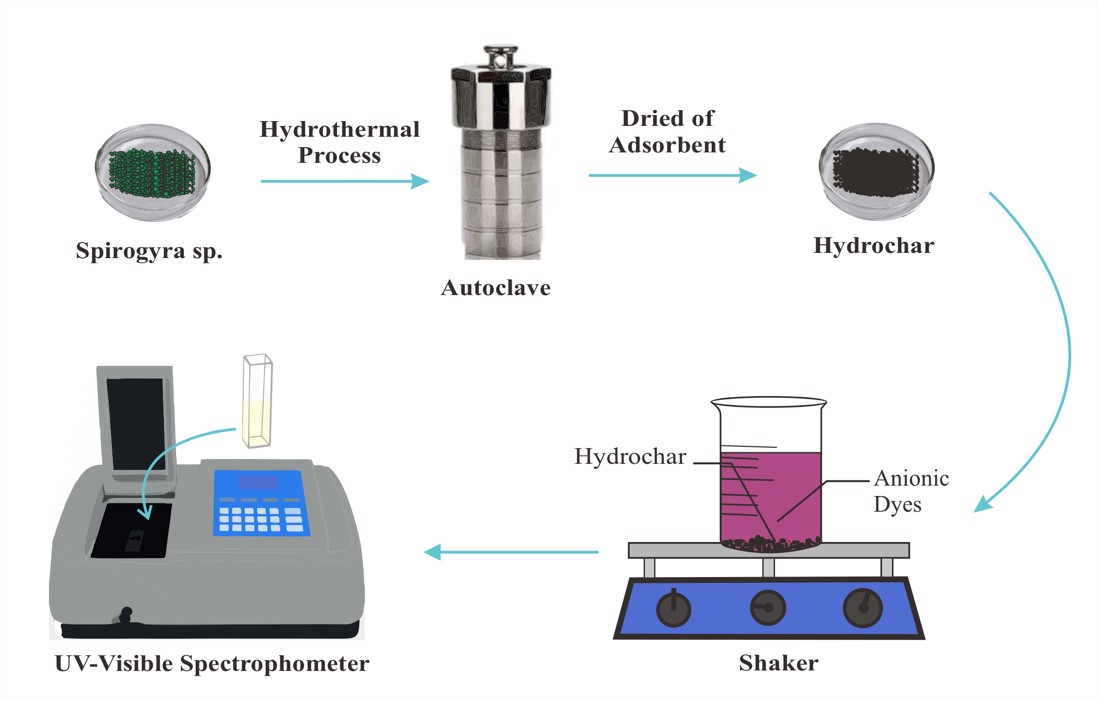
This study investigates the synthesis of hydrochar from Spirogyra sp. algae biomass and its selective adsorption performance for anionic dyes. The hydrochar (SpiHC) was prepared via hydrothermal carbonization and characterized using XRD, FTIR, and BET analysis, revealing a significant increase in surface area (5.369 m²/g) and the development of a more ordered carbon structure. Selectivity studies showed that direct yellow (DY) exhibited the highest adsorption efficiency, with 62.07 % on SpiHC compared to 54.02 % on unmodified Spirogyra sp. (Spi). Adsorption experiments demonstrated optimal conditions at pH 6 and fit better with the pseudo-second-order kinetic model. Freundlich isotherm analysis indicated improved adsorption capacity and surface affinity of SpiHC. Thermodynamic parameters confirmed the endothermic and spontaneous nature of the adsorption process, with SpiHC showing higher adsorption affinity than Spi. Regeneration studies revealed that SpiHC retained 67.11 % adsorption efficiency after 4 cycles, highlighting its superior stability and reusability compared to Spi. These findings demonstrate the potential of Spirogyra-derived hydrochar as a sustainable adsorbent for water treatment applications.
HIGHLIGHTS
- Hydrochar from Spirogyra sp was successfully synthesized by the hydrothermal method
- Selective adsorption on direct yellow is better than other anionic dyes
- The maximum adsorption capacity for direct yellow was 95.24 mg/g in hydrochar
- Regeneration studies revealed that SpiHC retained 67.11 % adsorption efficiency after four cycles.
GRAPHICAL ABSTRACT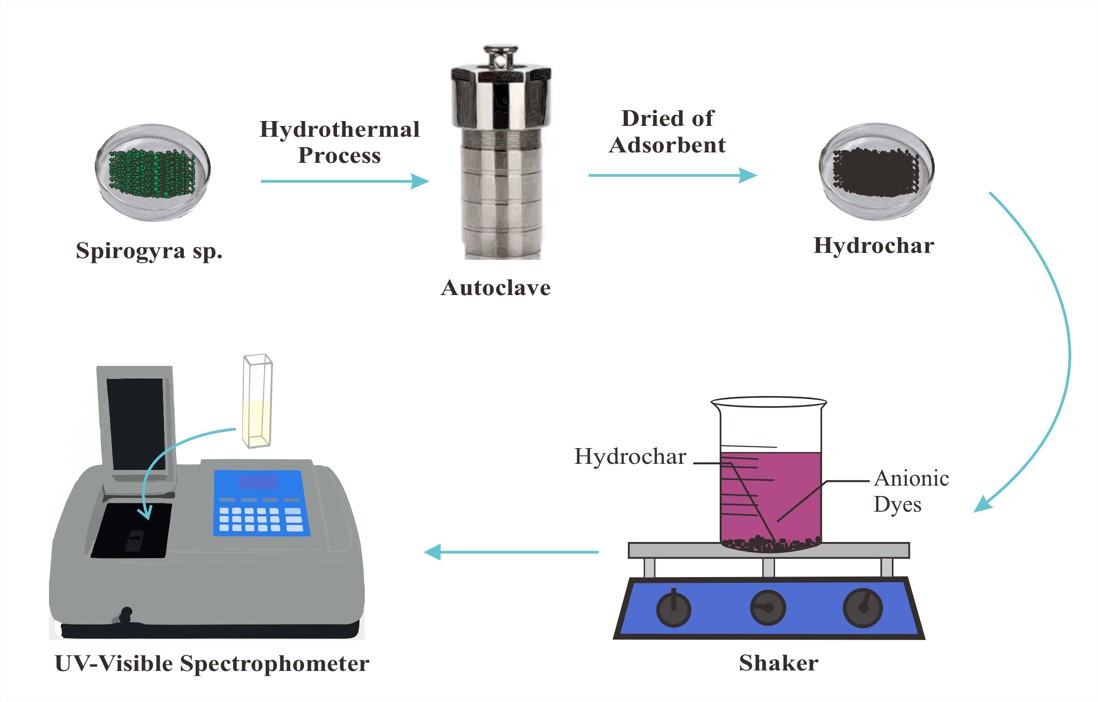
Downloads
References
S Wibiyan, I Royani, and A Lesbani. Selective adsorption of cationic and anionic dyes using Ni/Al layered double hydroxide modified with Eucheuma cottonii. Indonesian Journal of Material Research 2024; 2(1), 1–6.
M Zabihi and A Motavalizadehkakhky. PbS/ZIF-67 nanocomposite: Novel material for photocatalytic degradation of basic yellow 28 and direct blue 199 dyes. Journal of the Taiwan Institute of Chemical Engineers 2022; 140, 104572.
S. Yao, M Fabbricino, L Pontoni, M Race, F Parrino, L Savignano, G D’Errico and Y Chen. Characterization of anthropogenic organic matter and its interaction with direct yellow 27 in wastewater: Experimental results and perspectives of resource recovery. Chemosphere 2022; 286, 131528.
F Ullah, G Ji, M Irfan, Y Gao, F Shafiq, Y Sun, QU Ain and A Li. Adsorption performance and mechanism of cationic and anionic dyes by KOH activated biochar derived from medical waste pyrolysis. Environmental Pollution 2022; 314, 120271.
C Cui, W Qiao, D Li and L Wang. Dual cross-linked magnetic gelatin/carboxymethyl cellulose cryogels for enhanced Congo red adsorption: Experimental studies and machine learning modelling. Journal of Colloid and Interface Science 2025; 678, 619-635.
P Doondani, D Panda, V Gomase, KR Peta and R Jugade. Novel Chitosan-ZnO nanocomposites derived from Nymphaeaceae fronds for highly efficient removal of reactive blue 19, reactive orange 16, and congo red dyes. Environmental Research 2024; 247, 118228.
YAB Neolaka, ZS Ngara, Y Lawa, JN Naat, DP Benu, A Chetouani, H Elmsellem, H Darmokoesoemo and HS Kusuma. Simple design and preliminary evaluation of continuous submerged solid small-scale laboratory photoreactor (CS4PR) using TiO2/NO3-@TC for dye degradation. Journal of Environmental Chemical Engineering 2019; 7(6), 103482.
EA Alabbad. Efficacy assessment of natural zeolite containing wastewater on the adsorption behaviour of Direct Yellow 50 from; equilibrium, kinetics and thermodynamic studies. Arabian Journal of Chemistry 2021; 14(4), 10301.
GM Ibrahim, SM Alshahrani, EH Alosaimi, WA Alshahrani, B El-Gammal, A Fawzy, N Alqarni, H Elhouichet and HM Safaa. Adsorption mechanism elucidation of anionic congo red onto modified magnetic nanoparticle structures by quantum chemical and molecular dynamics. Journal of Molecular Structure 220224; 1298, 136992.
N Ahmad, FS Arsyad, I Royani and A Lesbani. Selectivity of malachite green on cationic dye mixtures toward adsorption on magnetite humic acid. Environment and Natural Resources Journal 2022; 20(6), 634-643.
NR Palapa, N Yuliasari, PMSBN Siregar, A Wijaya, A Amri, N Ahmad and A Lesbani. Selective adsorption of direct group anionic dyes on layered double hydroxide-chitosan composites. Bulletin of Chemical Reaction Engineering and Catalysis 2023; 18(1), 37-47.
Y Achour, L Bahsis, EH Ablouh, H Yazid, MR Laamari and ME Haddad. Insight into adsorption mechanism of congo red dye onto bombax buonopozense bark activated-carbon using Central composite design and DFT studies. Surfaces and Interfaces 2021; 23, 100977.
VA Tran, KB Vu, TT Vo, VT Le, HH Do, LG Bach and S Lee. Experimental and computational investigation on interaction mechanism of Rhodamine B adsorption and photodegradation by zeolite imidazole frameworks-8. Applied Surface Science 2021; 538, 148065.
N Normah, N Juleanti, NR Palapa, T Taher, PMSBN Siregar, A Wijaya and A Lesbani. Hydrothermal carbonization of rambutan peel (Nephelium lappaceum L.) as a green and low-cost adsorbent for Fe(II) removal from aqueous solutions. Chemistry and Ecology 2022; 38(3), 284-300.
X Luo, Z Huang, J Lin, X Li, J Qiu, J Liu and X Mao. Hydrothermal carbonization of sewage sludge and in-situ preparation of hydrochar/MgAl-layered double hydroxides composites for adsorption of Pb(II). Journal of Cleaner Production 2020; 258, 120991.
MA Khalaf. Biosorption of reactive dye from textile wastewater by non-viable biomass of Aspergillus niger and Spirogyra sp. Bioresource Technology 2008; 99(14), 6631-6634.
Normah, NR Palapa, T Taher, R Mohadi, FS Arsyad, A Priambodo and A Lesbani. Competitive removal of cationic dye using nial-ldh modified with hydrochar. Ecological Engineering and Environmental Technology 2021; 22(4), 124-135.
M Hasanah, N Normah, A Wijaya, FS Arsad, R Mohadi and A Lesbani. High selectivity and adsorption capacity for congo red toward anionic dyes by adsorbent: Modified LDH with hydrochar made from Nephelium Lappaceum Peel. Global Nest Journal 2022; 24(3), 487-494.
N Juleanti, N Normah, PMSBN Siregar, A Wijaya, NR Palapa, T Taher, N Hidayati, R Mohadi and A Lesbani. Comparison of the adsorption ability of MgAl-HC, CaAl-HC, and ZaAl-hc composite materials based on duku peel hydrochar in adsorption of direct green anionic dyes. Indonesian Journal of Chemistry 2022; 22(1), 192-204.
Z Djezzar, A Aidi, H Rehali, S Ziad and T Othmane. Characterization of activated carbon produced from the green algae Spirogyra used as a cost-effective adsorbent for enhanced removal of copper(ii): Application in industrial wastewater treatment. RSC Advances 202; 14(8), 5276-5289.
A Aksu, N Kutuk, O Caylak, E Kasaka, S Cetinkaya, MM Maslov and S Kaya. Theoretically supported experimental analyses on Safranin O biosorption from textile wastewater via dead biomass of Spirogyra porticalis. Springer Nature, New York, 2024.
A. Lesbani, N Ahmad, R Mohadi, I Royani, S Wibiyan, Amri and Y Hanifah. Selective adsorption of cationic dyes by layered double hydroxide with assist algae (Spirulina platensis) to enrich functional groups. JCIS Open 2024; 15, 100118.
N Gibson, P Kuchenbecker, K Rasmussen, VD Hodoroaba and H Rauscher. Volume-specific surface area by gas adsorption analysis with the BET method. Elsevier Science, Amsterdam, Netherlands, 2019.
W Li, E Tao, X Hao, N Li, Y Li and S Yang. MMT and ZrO2 jointly regulate the pore size of graphene oxide-based composite aerogel materials to improve the selective removal ability of Cu(II). Separation and Purification Technology 2024; 331, 125506.
N Smjecanin, D Buzu, E Masic, M Nuhanovvic, J Sulejmanovic, O Azhar and F Sher. Algae based green biocomposites for uranium removal from wastewater: Kinetic, equilibrium and thermodynamic studies. Materials Chemistry and Physics 2022; 283, 125998.
YS Reddy, TJ Jose, BDR Naresh, KP Sampath and KK Kaviyarasu. Equilibrium, kinetic, and thermodynamic study of Direct Yellow 12 dye adsorption by biomass derived porous graphitic activated carbon. Biomass Conversion and Biorefinery 2025; 15, 6817-6833.
YM Hakim, Mardiyanto, I Royani and R Mohadi. Organobentonite fabrication assisted by surfactant octadecylamine intercalation under hydrothermal/solvothermal condition for effective direct yellow dye removal. Kuwait Journal of Science 2024; 51(6), 100292.
AS Mahmoud. Effect of nano bentonite on direct yellow 50 dye removal; Adsorption isotherm, kinetic analysis, and thermodynamic behavior. Progress in Reaction Kinetics and Mechanism 2022; 47(1), 14686783221090377.
EA Alabbad. Effect of direct yellow 50 removal from an aqueous solution using nano bentonite; adsorption isotherm, kinetic analysis and also thermodynamic behavior. Arabian Journal of Chemistry 2023; 16(2), 104517.
A Azizi, E Moniri, AH Hassani, HA Panahi and M Jafarinezhad. Nonlinear and linear analysis of direct yellow 50 adsorption onto modified graphene oxide: Kinetic, isotherm, and thermodynamic studies. Desalination and Water Treatment 2021; 229, 352-361.
S Sadaf, HN Bhatti, S Nausheen and M Amin. Application of a novel lignocellulosic biomaterial for the removal of Direct Yellow 50 dye from aqueous solution: Batch and column study. Journal of the Taiwan Institute of Chemical Engineers 2015; 47, 160-170.
LFM Ismail, HB Sallam, SAA Farha, AM Gamal and GEA Mahmoud. Adsorption behaviour of direct yellow 50 onto cotton fiber: Equilibrium, kinetic and thermodynamic profile. Spectrochimica Acta Part A: Molecular and Biomolecular Spectroscopy 2024; 131, 657-666.
M Ahmadian, N Yousefi and A Toolabi. Adsorption of direct yellow 9 and acid orange 7 from aqueous solutions by modified pumice. Asian Journal of Chemistry 2012; 24(7), 3094-3098.
Published
How to Cite
Issue
Section
License
Copyright (c) 2025 Walailak University

This work is licensed under a Creative Commons Attribution-NonCommercial-NoDerivatives 4.0 International License.





