
Mapping the Diversity of Beach Fungal Plastisphere: Insights from Metagenomic Approaches
DOI:
https://doi.org/10.48048/tis.2025.9575Keywords:
Ascomycota, High Density Polyethylene (HDPE), Internal Transcribed Spacers (ITS), Low Density Polyethylene (LDPE), polypropylene (PP), Saccharomyces, Ascomycota, HDPE, ITS, LDPE, PP, Plastic pollution, Saccharomyces, Plastic pollutionAbstract
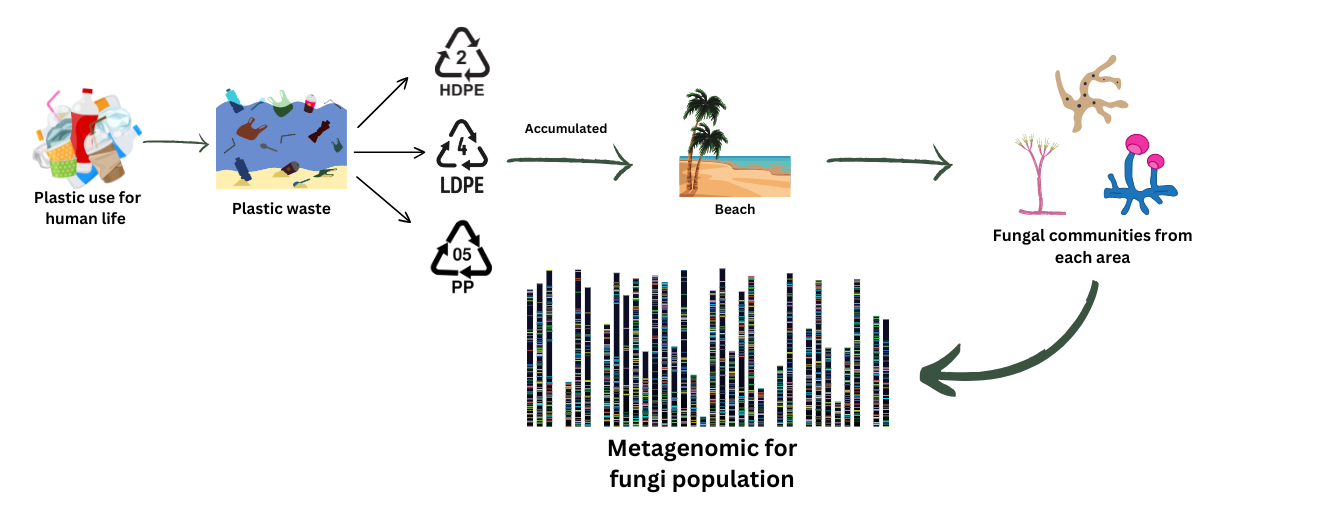
Exploration of fungal communities within the plastisphere reveals a complex interaction between microbial life and plastic pollution. This study investigates the prevalence and distribution of fungal plastisphere from the beach. Plastic samples were obtained at Marunda beach-Jakarta, Cipta beach-Semarang, and Baros beach-Yogyakarta, Java Island, Indonesia. Three type of plastic were high density polyethylene (HDPE), low density polyethylene (LDPE), and polypropylene (PP), which were subjected to scanning electron microscope with energy dispersive X-ray (SEM-EDX) analyzes to determine their surface topography, chemical composition, and adherent biofilms. Internal Transcribed Spacers (ITS) of the ribosomal RNA genes were used in fungal metagenome study. The existence of topographical structures and degrading effects, which promote microbial attachment on the plastic surface, as well as Na, Mg, Cl, Si, Al, S, Ca, Mn, and K element were discovered by SEM-EDX analysis. The results showed the presence and diversity of fungi in plastispheres found on the beach of Java, Indonesia. LDPE is especially suitable for plastisphere than HDPE, and PP. The observed species fungal plastisphere from Baros beach is higher than from Marunda and Cipta beaches. Ascomycota and Saccharomyces were dominant at the phylum and genus taxa, respectively. Moreover, these research results provide for fungal plastisphere ecological importance and also their potential role in bioremediation efforts aimed at addressing the global plastic waste challenge.
HIGHLIGHTS
- The existence of topographical structures and degrading effects, which promote microbial attachment on the plastic surface from the beach.
- The elemental composition of plastisphere from beach consists of C, O, Na, Mg, Cl, Si, Al, S, Ca, Mn, and K.
- The observed species of fungal plastisphere from Baros beach is higher than from Marunda and Cipta beaches.
- Ascomycota was the dominant phylum of fungal plastisphere in all samples.
GRAPHICAL ABSTRACT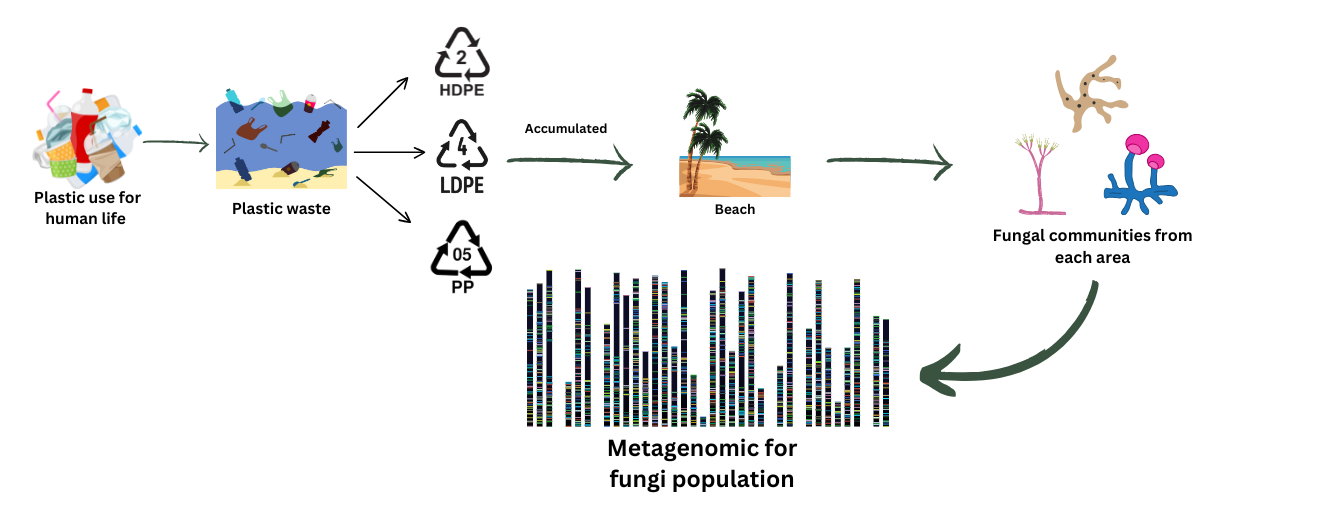
Downloads
References
H Hamdhani, G Ghitarina, R Eryati and DE Eppehimer. Occurrence of microplastic ingestion by commercial fish species from the pangempang estuary in Indonesia. Trends in Sciences 2024; 21(7), 7762.
MM Sari, P Andarani, S Notodarmojo, RK Harryes, MN Nguyen, K Yokota and T Inoue. Plastic pollution in the surface water in Jakarta, Indonesia. Marine Pollution Bulletin 2022; 182, 114023.
Z Arifin, D Falahudin, H Saito, T Hendrawati, M Hafizt and Y Suteja. Indonesian policy and researches toward 70 % reduction of marine plastic pollution by 2025. Marine Policy 2025; 155, 105692.
P Li, X Wang, M Su, X Zou, L Duan and H Zhang. Characteristics of plastic pollution in the environment: A review. Bulletin of Environmental Contamination and Toxicology 2021; 107(4), 577-584.
X Zhai, XH Zhang and M Yu. Microbial colonization and degradation of marine microplastics in the plastisphere: A review. Frontiers in Microbiology 2023; 14, 1-15.
P Vriend, H Hidayat, JV Leeuwen, MR Cordova, NP Purba and AJ Löhr. Plastic pollution research in Indonesia: state of science and future research directions to reduce impacts. Frontiers in Environmental Science 2021; 9, 692907.
M Oliveira and M Almeida. The why and how of micro(nano)plastic research. TrAC Trends in Analytical Chemistry 2019; 114, 196-201.
ALDF Lacerda, JD Taylor, LDS Rodrigues, F Kessler, E Secchi and MC Proietti. Floating plastics and their associated biota in the Western South Atlantic. The Science of the Total Environment 2022; 805, 150186.
A Delacuvellerie, V Cyriaque, S Gobert, S Benali and R Wattiez. The plastisphere in marine ecosystem hosts potential specific microbial degraders including Alcanivorax borkumensis as a key player for the low-density polyethylene degradation. Journal of Hazardous Materials 2019; 380, 120899.
M Latva, CJ Dedman, RJ Wright, M Polin and JA Christie-Oleza. Microbial pioneers of plastic colonisation in coastal seawaters. Marine Pollution Bulletin 2022; 179, 113701.
M González-Pleiter, D Velázquez, MC Casero, B Tytgat, E Verleyen, F Leganés, R Rosal, A Quesada and F Fernández-Piñas. Microbial colonizers of microplastics in an Arctic freshwater lake. Science of The Total Environment 2021; 795, 148640.
A Safdar, F Ismail and M Imran. Biodegradation of synthetic plastics by the extracellular lipase of Aspergillus niger. Environ. Adv., 2024; 17, 100563.
Y Du, X Liu, X Dong and Z Yin. A review on marine plastisphere: Biodiversity, formation, and role in degradation. Computational and Structural Biotechnology Journal 2022; 20(3), 975-988.
MEE Temporiti, L Nicola, E Nielsen and S Tosi. Fungal enzymes involved in plastics biodegradation. Microorganisms 2022; 10(6), 1-27.
ÂM Ribeiro, AD Foote, A Kupczok, B Frazão, MT Limborg, R Piñeiro, S Abalde, S Rocha and RRD Fonseca. Marine genomics: News and views. Marine genomics 2017, 31, 1-8.
I Mani. Metagenomics approach for bioremediation: Challenges and perspectives. Elsevier Inc, New York, 2020, p. 275-285.
R Kirubakaran, KN ArulJothi, S Revathi, N Shameem and JA Parray. Emerging priorities for microbial metagenome research. Bioresource Technology Reports 2020; 11, 100485.
IV Kirstein, A Wichels, E Gullans, G Krohne and G Gerdts. The plastisphere - Uncovering tightly attached plastic ‘specific’ microorganisms. PLoS One 2019, 14(4), e0215859.
ND Takarina, AM Sukma, A Adiwibowo and S Sitaresmi. Water quality and microbial community assessment in artisanal mining- affected sediments of Cikidang River, Banten, Java, Indonesia. Sains Malaysiana 2022, 51(5), 1339-1352.
Y Zhang, J Tao, Y Bai, F Wang and B Xie. Incomplete degradation of aromatic-aliphatic copolymer leads to proliferation of microplastics and antibiotic resistance genes. Environment International 2023; 181(10), 108291.
Y Li, R Yang, L Guo, W Gao, P Su, Z Xu, H Xiao, Z Ma, X Liu, P Gao, B Li, X Sun, G Yan and W Sun. The composition, biotic network, and assembly of plastisphere protistan taxonomic and functional communities in plastic-mulching croplands. Journal of Hazardous Materials 2022; 430, 128390.
Y Yu, L Miao, TM Adyel, K Waldschläger, J Wu and J Hou. Aquatic plastisphere: Interactions between plastics and biofilms. Environmental Pollution 2023; 322, 121196.
MF Fachrul, A Rinanti, S Salmiati and T Sunaryo. Degradation of polyethylene plastic waste by indigenous microbial consortium and fungi. Indonesian Journal of Urban and Environmental Technology 2021; 5(1), 86-103.
J Kapelewska, J Karpińska, U Klekotka and A Piotrowska-Niczyporuk. Effect of polyethylene microplastic biodegradation by algae on their sorption properties and toxicity. Chemosphere 2025; 370, 143993.
A Dąbrowska, M Gniadek and P Machowski. The proposal and necessity of the numerical description of nano- and microplastics’ surfaces (Plastisphere). Polymers 2021; 13(14), 2255.
C Maddison, CI Sathish, D Lakshmi, OC Wayne and T Palanisami. An advanced analytical approach to assess the long-term degradation of microplastics in the marine environment. npj Materials Degradation 2023, 7(1), 1-11.
B Küppers, S Schloegl, G Oreski, R Pomberger and D Vollprecht. Influence of surface roughness and surface moisture of plastics on sensor-based sorting in the near infrared range. Waste Management & Research 2019; 37(8), 843-850.
M Gniadek and A Dąbrowska. The marine nano- and microplastics characterisation by SEM-EDX: The potential of the method in comparison with various physical and chemical approaches. Marine Pollution Bulletin 2019; 148(51), 210-216.
AD Forero-López, A Poza, CV Colombo, NGM Pontet, GN Rimondino, A Toniolo, FE Malanca and SE Bott. Chemical analysis of marine microdebris pollution in macroalgae from the coastal areas of Argentina. Science of the Total Environment 2024; 923(1), 171390.
V Lenoble, AM Cindri, JF Briand, ML Pedrotti, AL Lacerda, S Muniategui-Lorenzo, V Fernandez-Gonzalez, CM Moscoso-Perez, JM Andrade-Garda, R Casotti, C Murano, V Donnarumma, S Frizzi, C Hannon, H Joyce, R Nash and J Frias. Bioaccumulation of trace metals in the plastisphere: Awareness of environmental risk from a European perspective. Environmental Pollution 2024; 348(13), 123808.
ADF López, GE De-la-Torre, MD Fernandez SeveriA, G Prieto, LI Brugnoni, CV Colombo, DC Dioses-Salinas, GN Rimondino and CV Spetter. Chemical-analytical characterization and leaching of heavy metals associated with nanoparticles and microplastics from commercial face masks and the abundance of personal protective equipment (PPE) waste in three metropolitan cities of South America. Marine Pollution Bulletin 2023; 191, 114997.
TŽ Pfeiffer, DS Maroni, F Stevi, AG Balki, N Bek, A Martinovi, T Mandir, R Nikolaˇsevi and D Janji. Plastisphere development in relation to the surrounding biotic communities. Environmental Pollution 2022; 306, 119380.
K Bhalla, X Qu, M Kretschmer and JW Kronstad. The phosphate language of fungi. Trends in Microbiology 2022, 30(4), 338-349.
P Sooriyakumar, N Bolan, M Kumar, L Singh, Y Yu, Y Li, C Weralupitiya, M Vithanage, S Ramanayaka, B Sarkar, F Wang, DB Gleeson, D Zhang, MB Kirkham, J Rinklebe and KHM Siddique. Biofilm formation and its implications on the properties and fate of microplastics in aquatic environments: A review. Journal of Hazardous Materials Advances 2021; 6, 100077.
JA Wallbank, G Lear, JM Kingsbury, L Weaver, F Doake, DA Smith, F Audre´Zet, SDM Maday, V Gambarini, L Donaldson, B Theobald, M Barbier and O Pantos. Into the Plastisphere, where only the generalists thrive: Early insights in plastisphere microbial community succession. Frontiers in Marine Science 2022, 9, 841142.
KHD Tang. Terrestrial and aquatic plastisphere: formation, characteristics, and influencing factors. Sustainability 2024; 16(5), 2163.
R Tavelli, M Callens, C Grootaert, MF Abdallah and A Rajkovic. Foodborne pathogens in the plastisphere: Can microplastics in the food chain threaten microbial food safety? Trends in Food Science & Technology 2022; 129, 1-10.
F Audrézet, A Zaiko, G Lear, S Wood, LA Trembla and Pochon. Biosecurity implications of drifting marine plastic debris: Current knowledge and future research. Marine Pollution Bulletin 2021; 162, 111835.
S Yang, L Li, X Peng and L Song. Leachate microbiome profile reveals bacteria, archaea and eukaryote dynamics and methanogenic function during solid waste decomposition. Bioresource Technology 2021; 320(A), 124359.
NS Harun, MM Hanafiah, NUM Nizam and A Rasool. Water and soil physicochemical characteristics of different rice cultivation areas. Applied Ecology and Environmental Research 2020; 18(5), 6775-6791.
G Pang, X Li, M Ding, S Jiang, P Chen, Z Zhao, R Gao, B Song, X Xu, Q Shen, FM Cai and IS Druzhinina. The distinct plastisphere microbiome in the terrestrial-marine ecotone is a reservoir for putative degraders of petroleum-based polymers. Journal of Hazardous Materials 2023; 453, 131399.
A Philippe, M Salaun, M Quemener, C Noël, K Tallec, C Lacroix, E Coton and G Burgaud. Colonization and biodegradation potential of fungal communities on immersed polystyrene vs. biodegradable plastics: A time series study in a marina environment. Journal of Fungi 2024; 10(6), 428.
K Karkanorachaki, E Syranidou and N Kalogerakis. Extreme weather events as an important factor for the evolution of plastisphere but not for the degradation process. Water Research 2023; 246, 120687.
V Bocci, S Galafassi, C Levantesi, S Crognale, S Amalfitano, R Congestri, B Matturro, S Rossetti and FD Pippo. Freshwater plastisphere: A review on biodiversity, risks, and biodegradation potential with implications for the aquatic ecosystem health. Frontiers in Microbiology 2024; 15, 1395401.
J Rüthi, M Cerri, I Brunner, B Stierli, M Sander and B Frey. Discovery of plastic-degrading microbial strains isolated from the Alpine and Arctic terrestrial plastisphere. Frontiers in Microbiology 2023; 14, 1178474.
K Li, L Xu, X Bai, G Zhang, M Zhang and Y Huang. Differential fungal assemblages and functions between the plastisphere of biodegradable and conventional microplastics in farmland. Science of the Total Environment 2024; 906, 167478.
H Tian, L Wang, X Zhu, M Zhang, L Li, Z Liu and S Abolfathi. Biodegradation of microplastics derived from controlled release fertilizer coating: Selective microbial colonization and metabolism in plastisphere. Science of the Total Environment 2024; 920, 170978.
LY Yang, XR Huang, R Neilson, SYD Zhou, ZL Li, XR Yang and XX Su. Characterization of microbial community, ecological functions and antibiotic resistance in estuarine plastisphere. Science of the Total Environment 2023; 866(3), 161322.
Y Sun, S Xie,J Zang, M Wu, J Tao, S Li, X Du and J Wang. Terrestrial plastisphere as unique niches for fungal communities. Communications Earth & Environment 2024; 5(1), 483.
X Li, X Qi, X Liu, M Khalid, J Ye, M Romantschuk, F Chen, Y Hua and N Hui. PET addition delays the composting mature process and promotes microbiota associated with plastic degradation in plastisphere. Journal of Cleaner Production 2023; 389, 136066.
N Chaimusik, N Sombuttra, Y Nakaramontri, P Sompongchaiyakul, C Charoenpong, B Intra and J Euanorasetr. The comparative plastisphere microbial community profile at Kung Wiman beach unveils potential plastic-specific degrading microorganisms. PeerJ 2024; 12(4), e17165.
RT Kapoor and M Rafatullah. Leveraging biotechnological approaches for the degradation of plastics: A sustainable tool for plastic waste management and environment protection. Journal of Water Process Engineering 2025; 69(1), 106736.
N Xue, Q Fang, X Pan and D Zhang. Distinct fungal plastisphere across different river functional zones: A watershed scale study. Science of the Total Environment 2021; 752(10), 141879.
B Song, Y Li, Z Yu, J Jin, Z Liu, R Yang, JM Adams and BS Razavi. Changes in enzyme activity, structure and growth strategies of the rhizosphere microbiome influenced by elevated temperature and CO2. Science of The Total Environment 2024; 954(1), 176522.
SM Mirsalami and M Mirsalami. Evolutionary adaptation in the laboratory and the process of retrograde engineering augment autotrophic proliferation in Saccharomyces cerevisiae. Biochemical Engineering Journal 2024; 205(1), 109278.
J Sica, B Bovo, C Nadai, M Carlot, A Giacomin and V Corich. Effect of CUP1 copy number and pH on copper resistance of Saccharomyces cerevisiae enological strains. Heliyon 2024; 10(15), e34885.
T Sérvulo, JD Taylor, MC Proietti, LDS Rodrigues, IP Puertas, RA Barutot and ALDF Lacerda. Plastisphere composition in a subtropical estuary: Influence of season, incubation time and polymer type on plastic biofouling. Environmental Pollution 2023; 332, 121873.
Published
How to Cite
Issue
Section
License
Copyright (c) 2025 Walailak University

This work is licensed under a Creative Commons Attribution-NonCommercial-NoDerivatives 4.0 International License.





