
Understanding Tetracycline-Nanoceramic Interactions: A Study Using UV-Vis, Fluorescence Spectroscopy and HPLC
DOI:
https://doi.org/10.48048/tis.2025.9562Keywords:
Absorbance, Antibiotics, Fluorescence, HPLC, Nanoceramics, TetracyclineAbstract
Tetracyclines (TCs) are among the most widely used antibiotics for disease control and livestock feed due to their broad-spectrum therapeutic properties. However, their extensive use, particularly oxytetracycline (OTC) and doxycycline (DC), has led to their widespread presence in water and soil environments, raising ecological and public health concerns. The electron-rich functional groups of TCs, including ketone, carboxyl, amino, and hydroxyl moieties, enable strong complexation with metal oxides, making nanoceramic materials promising adsorbents for their removal. In this study, the adsorption behavior of OTC and DC onto commercial nanoceramics (SiO₂, Al₂O₃, TiO₂, and ZnO) was investigated using UV-Vis absorption, fluorescence spectroscopy, and high-performance liquid chromatography (HPLC). Spectroscopic analyses revealed significant reductions in absorbance and fluorescence intensity upon nanoceramic addition, indicating strong antibiotic adsorption and fluorescence quenching, particularly for ZnO and Al₂O₃. TiO₂ also demonstrated moderate adsorption capacity, while SiO₂ exhibited a distinct behavior, enhancing fluorescence intensity and increasing HPLC peak areas, suggesting weaker adsorption interactions possibly influenced by solvation effects or surface passivation. HPLC results confirmed that DC exhibited a higher adsorption rate than OTC, with TiO₂ and Al₂O₃ achieving over 80 % removal efficiency. The unique behavior of SiO₂ suggests that it does not strongly adsorb tetracyclines but may influence their solubility or molecular stability. These findings provide mechanistic insights into tetracycline-nanoceramic interactions and underscore the importance of material-specific adsorption behaviors for wastewater treatment applications.
HIGHLIGHTS
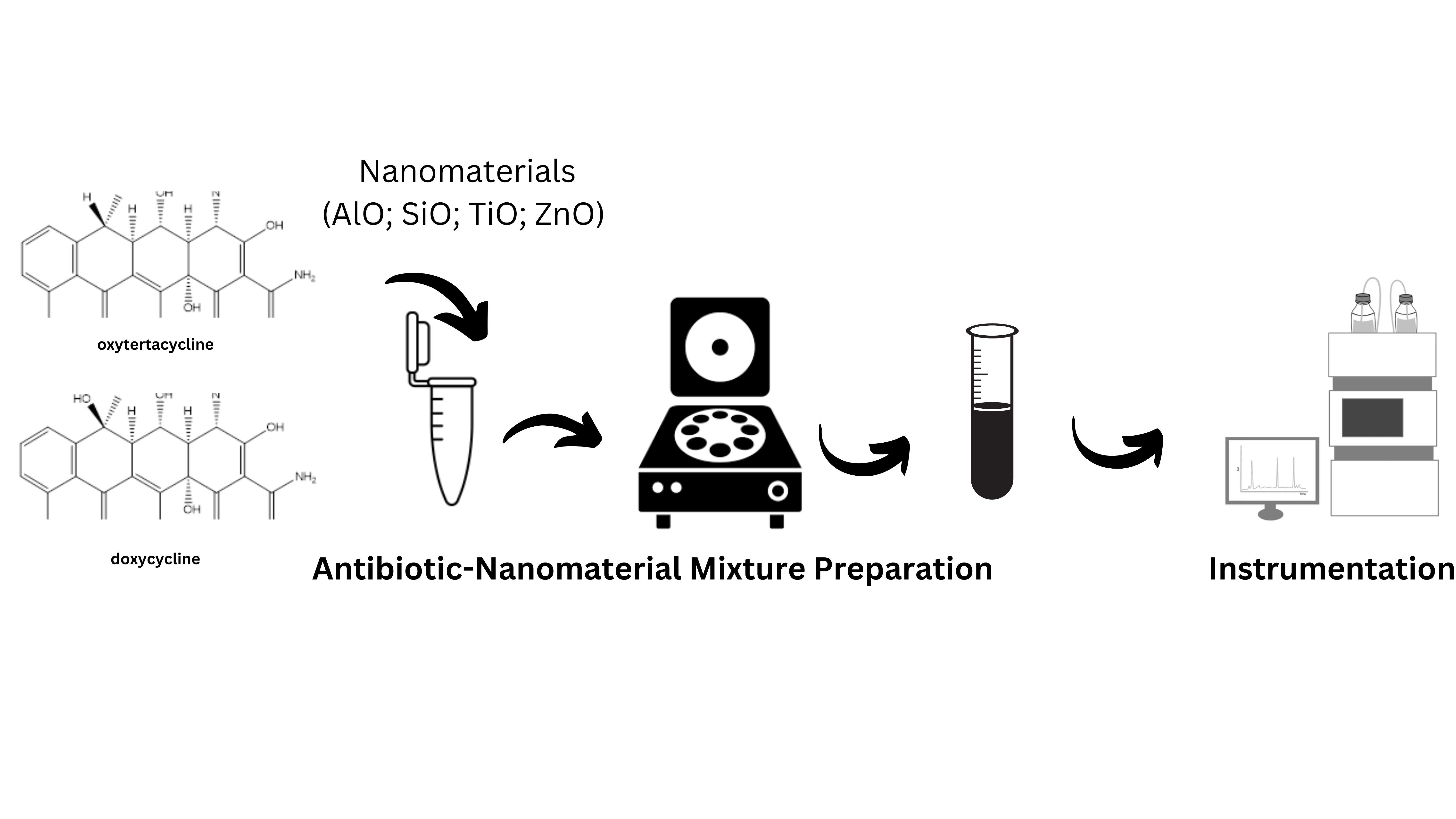
This study uses multiple instruments, including UV-Vis and fluorescence spectrophotometers, as well as high-performance liquid chromatography, to assess the effect of incorporating commercial nanoceramics into tetracycline analogs.
GRAPHICAL ABSTRACT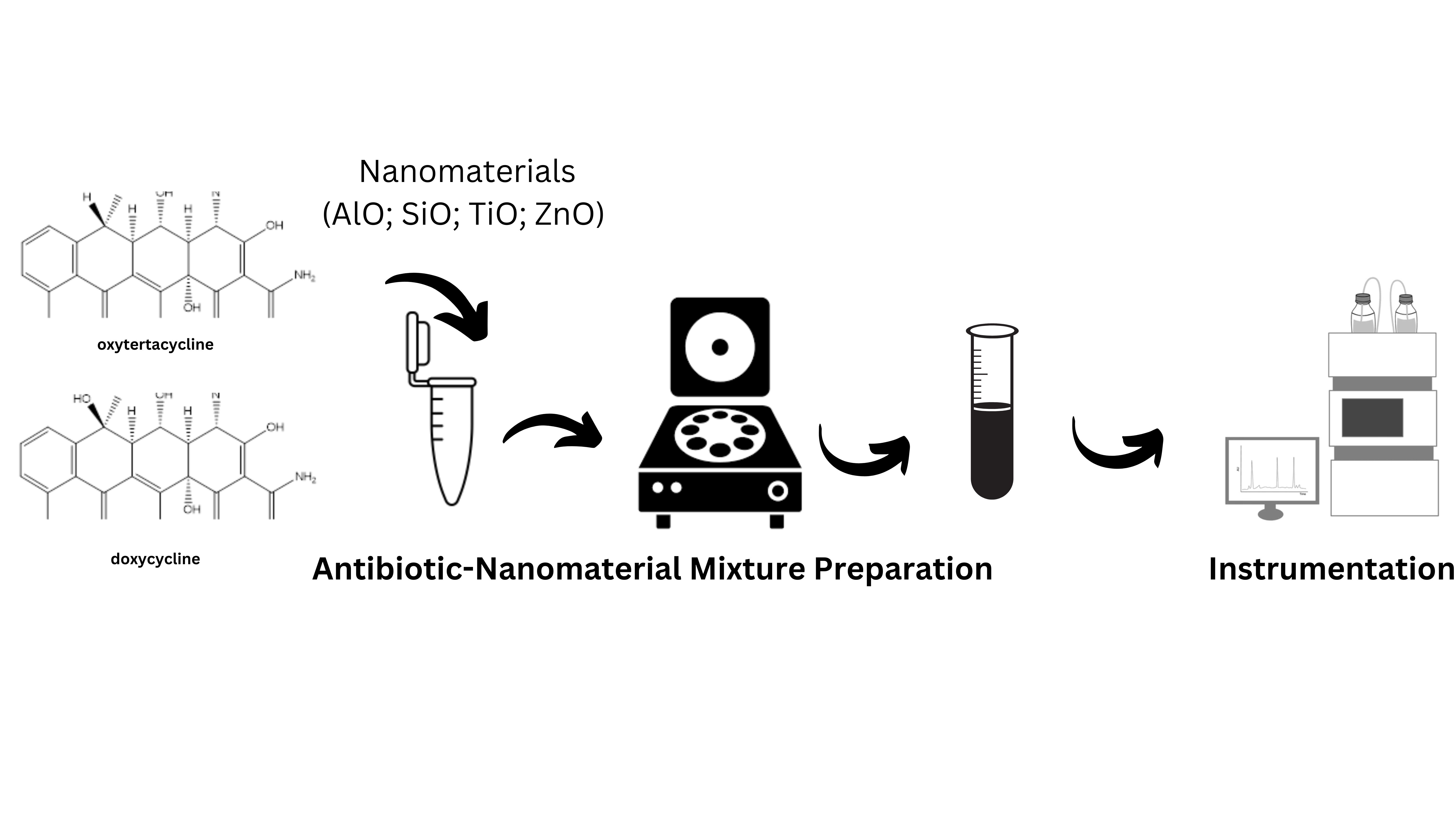
Downloads
References
PP Amador, RM Fernandes, MC Prudêncio, MP Barreto and IM Duarte. Antibiotic resistance in wastewater: occurrence and fate of Enterobacteriaceae producers of class A and class C β-lactamases. Journal of Environmental Science and Health Part A Toxic/Hazardous Substances & Environmental Engineering 2015; 50(1), 26-39.
C Santhosh, V Velmurugan, G Jacob, SK Jeong, AN Grace and A Bhatnagar. Role of nanomaterials in water treatment applications: A review. Chemical Engineering Journal 2016; 306, 1116-1137.
L Liu, YH Liu, CX Liu and X Huang. Accumulation of antibiotics and tet resistance genes from swine wastewater in wetland soils. Environmental Engineering and Management Journal 2016; 15(10), 2137-2145.
AK Sarmah, MT Meyer and ABA Boxall. A global perspective on the use, sales, exposure pathways, occurrence, fate and effects of veterinary antibiotics (VAs) in the environment. Chemosphere 2006; 65(5), 725-759.
H Jufer, L Reilly and ERE Mojica. Antibiotics pollution in soil and water: Potential ecological and human health issues. In: J Nriagu (Ed.). Encyclopedia of environmental health. 2nd Eds. Elsevier, Amsterdam, Netherlands, 2019, p. 118-131.
S Zheng, Y Wang, C Chen, X Zhou, Y Liu, J Yang, Q Geng, G Chen, Y Ding and F Yang. Current progress in natural degradation and enhanced removal techniques of antibiotics in the environment: A review. International Journal of Environmental Research and Public Health 2022; 19(17), 10919.
A Huang, M Yan, J Lin, L Xu, H Gong and H Gong. A review of processes for removing antibiotics from breeding wastewater. International Journal of Environmental Research and Public Health 2021; 18(9), 4909.
L Zhu, X Lin, Z Di, F Cheng and J Xu. Occurrence, risks, and removal methods of antibiotics in urban wastewater treatment systems: A review. Water 2024; 16(23), 3428.
OA Ajala, SO Akinnawo, A Bamisaye, DT Adedipe, MO Adesina, OA Okon-Akan, TA Adebusuyi, AT Ojedokun, KAAdegoke and OS Bello. Adsorptive removal of antibiotic pollutants from wastewater using biomass/biochar-based adsorbents. RSC Advances 2023; 13(7), 4678-4712.
LA Kolahalam, IK Viswanath, BS Diwakar, B Govindh, V Reddy and Y Murthy. Review on nanomaterials: Synthesis and applications. Materials Today Proceedings 2019; 18(4), 2182-2190.
Y Zhang, B Chen, L Zhang, J Huang, F Chen, Z Yang, J Yao and Z Zhang. Controlled assembly of Fe3O4 magnetic nanoparticles on graphene oxide Nanoscale. Nanoscale 2011; 3(4), 1446-1450.
MM Khin, AS Nair, VJ Babu, R Murugana and S Ramakrishna. A review on nanomaterials for environmental remediation. Energy & Environmental Science 2012; 5(8), 8075-8109.
S Ahmed, MG Rasul, R Brown and MA Hashib. Influence of parameters on the heterogeneous photocatalytic degradation of pesticides and phenolic contaminants in wastewater: A short review. Journal of Environmental Management 2011; 92(3), 311-330.
A Gupta, JR Saurav and S Bhattacharya. Solar light based degradation of organic pollutants using ZnO nanobrushes for water filtration. RSC Advances 2015; 5(87), 71472-71481.
Z Alhalili. Metal oxides nanoparticles: General structural description, chemical, physical, and biological synthesis methods, role in pesticides and heavy metal removal through wastewater treatment. Molecules 2023; 28(7), 3086.
AI Osman, EMA El-Monaem, AM Elgarahy, CO Aniagor, M Hosny, M Farghali, E Rashad, MI Ejimofor, EA López-Maldonado, I Ihara, PS Yap, DW Rooney and AS Eltaweil. Methods to prepare biosorbents and magnetic sorbents for water treatment: A review. Environmental Chemistry Letters 2023; 21(4), 2337-2398.
MP Ravele, OA Oyewo and DC Onwudiwe. Controlled synthesis of CuS and Cu9S5 and their application in the photocatalytic mineralization of tetracycline. Catalysts 2021; 11(8), 899.
ERE Mojica, E Nguyen, M Rozov and FV Bright. pH-dependent spectroscopy of tetracycline and its analogs. Journal of Fluorescence 2014; 24(4), 1183-1198.
S Zhao, J Ren, F Zhang, Y He, X Han and R Wang. Fabrication of nano-hammer shaped CuO@HApNWs for catalytic degradation of tetracycline. Environmental Research 2024; 249(1), 118410.
M Beiranvand, S Farhadi and A Mohammadi-Gholami. Adsorptive removal of tetracycline and ciprofloxacin drugs from water by using a magnetic rod-like hydroxyapatite and MIL-101(Fe) metal-organic framework nanocomposite. RSC Advances 2022; 12(53), 34438-34453.
Q Liu, Y Zheng, L Zhong and X Cheng. Removal of tetracycline from aqueous solution by a Fe3O4 incorporated PAN electrospun nanofiber mat. Journal of Environmental Sciences 2015; 28, 29-36.
DW Wang, YX Song, XF Ye, G Qian, SY Wang and Z Cheng. Study on adsorption of two sulfonamide antibiotics by graphene oxide. Chinese Journal of Analytical Chemistry 2018; 46(2), 211-216.
G Safari, M Hoseini, M Seyedsalehi, H Kamani and A Mahvi. Photocatalytic degradation of tetracycline using nanosized titanium dioxide in aqueous solution. International journal of Environmental Science and Technology 2014; 12, 603-616.
XD Zhu, YJ Wang, RJ Sun and DM Zhou. Photocatalytic degradation of tetracycline in aqueous solution by nanosized TiO2. Chemosphere 2013; 92(8), 925-932.
M Addamo, V Augugliaro, A Di Paola, EIG Lopez, V Loddo, G Marci and L Palmisano. Removal of drugs in aqueous systems by photo assisted degradation. Journal of Applied Electrochemistry 2005; 35(7), 765-774.
EE Ghadim, F Manouchehri, G Soleimani, H Hosseini, S Kimiagar and S Nafisi. Adsorption properties of tetracycline onto graphene oxide: equilibrium, kinetic and thermodynamic studies. PLoS ONE 2013; 8(11), e79254.
C Santhosh, V Velmurugan, G Jacob, SK Jeong, AN Grace and A Bhatnagar. Role of nanomaterials in water treatment applications: A review. Chemical Engineering Journal 2016; 306, 1116-1137.
RM Kakhki and H Bolandhemmat. Synthesis of Ag/CuS doped mineral magnetite nanocomposite with improved photocatalytic activity against tetracycline and diclofenac pollutants. Scientific Reports 2024; 14(1), 19009.
Published
How to Cite
Issue
Section
License
Copyright (c) 2025 Walailak University

This work is licensed under a Creative Commons Attribution-NonCommercial-NoDerivatives 4.0 International License.





