
Bioactive Peptides from Sea Cucumbers and Sea Urchins: Therapeutic Roles and Mechanistic Insights
DOI:
https://doi.org/10.48048/tis.2025.9513Keywords:
Bioactive peptides, Echinozoa, Sea urchins, Sea cucumbers, Antioxidant, Anticancer, Antidiabetic, Antimicrobial, ACE inhibitory, Memory-enhancingAbstract
Marine organisms, especially those in the Echinozoa class like sea urchins and sea cucumbers, have received significant attention for their bioactive peptides that exhibit a wide range of therapeutic potential. This review presents recent research findings related to the extraction, identification, and bioactivity of such peptides. Antioxidant peptides from Echinozoa could protect against oxidative damage by reducing the levels of ROS and increasing the generation of antioxidant enzymes. This might be helpful for developing new therapeutic drugs to cure neuropathic pain. Peptides with anticancer properties isolated from species such as sea urchins have been observed to trigger apoptosis and suppress cancer cell growth through the PI3K/AKT signaling pathway. Peptides that combat fatigue boost endurance by stimulating the NRF2 and AMPK pathways, enhancing energy metabolism and lowering fatigue indicators in animal studies. Antidiabetic peptides from sea cucumber regulate blood glucose through their influence on the IRS/Akt and AMPK pathways, enhancement of insulin responsiveness, and acceleration of wound healing in diabetic models. ACE-inhibitory peptides from sea cucumbers and sea urchins have also exhibited an antihypertensive activity by inhibiting the conversion of angiotensin I to angiotensin II. Due to their membranolytic mode of action, sea urchin-derived antimicrobial peptides-strongylocins and centrocins-express a wide range of activities against Gram-positive and Gram-negative bacteria. Other sea cucumber peptides that improve memory can become an experimental therapy for the improvement of cognitive ability. Although these discoveries sound promising, the main barriers toward clinical use are problems of peptide stability, their bioavailability, and lack of efficient delivery. Addressing these difficulties is critical for increasing the therapeutic effectiveness of Echinozoa-derived peptides in both nutraceutical and pharmaceutical applications.
HIGHLIGHTS
- Peptides can be derived from many sources, including Echinozoa.
- Peptides derived from Echinozoa demonstrate several biological activities that can be used in alternative medicine.
- Peptides can be in the form of natural peptides or protein hydrolysates in organisms of interest.
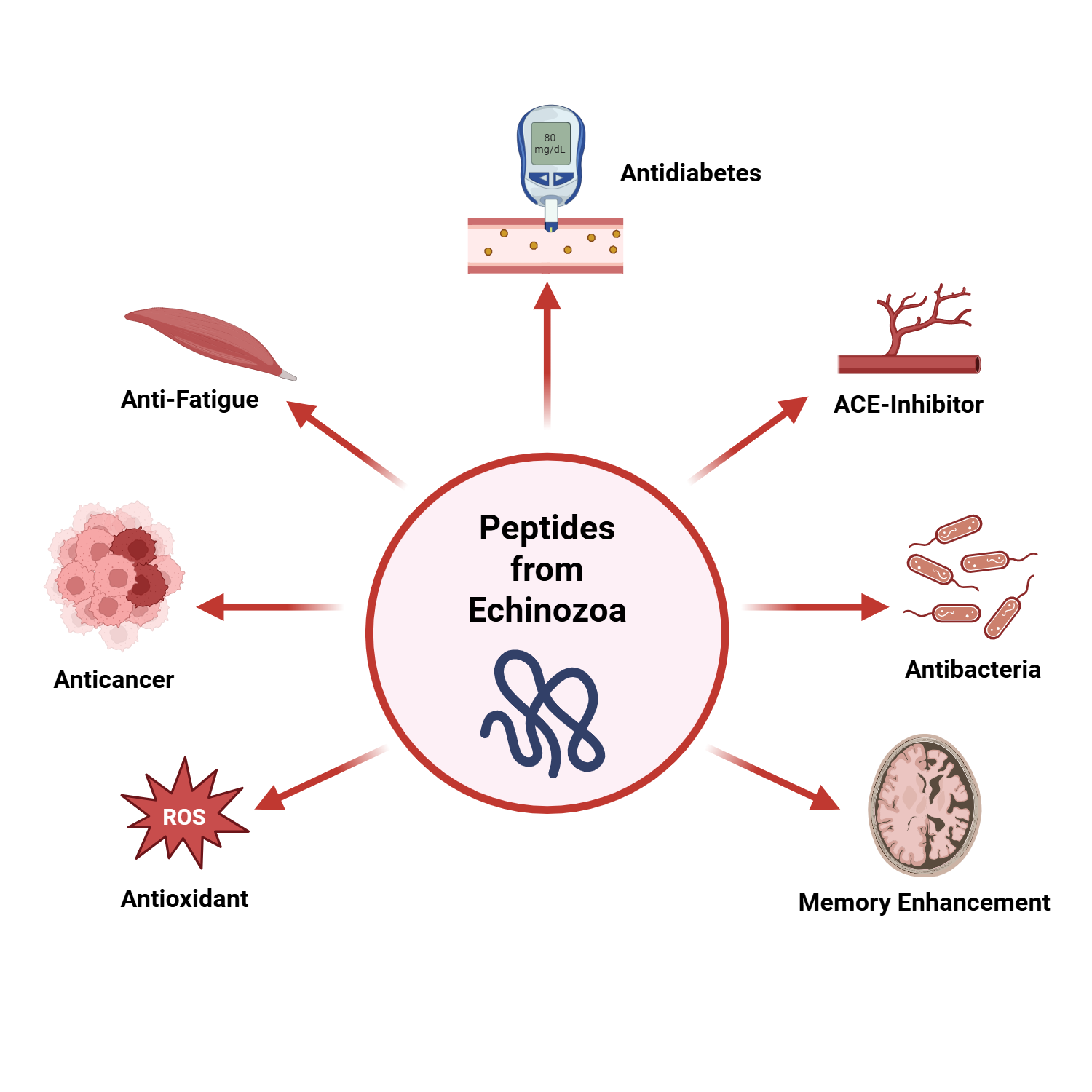
- Echinozoa peptides offer antioxidant, anticancer, antidiabetes, antifatigue, ACE-inhibitor, antibacterial, and memory-boosting properties.
- Isolation of these peptides could be challenging because they are not always show bioactive effects, but some work as biological agents to improve human health.
GRAPHICAL ABSTRACT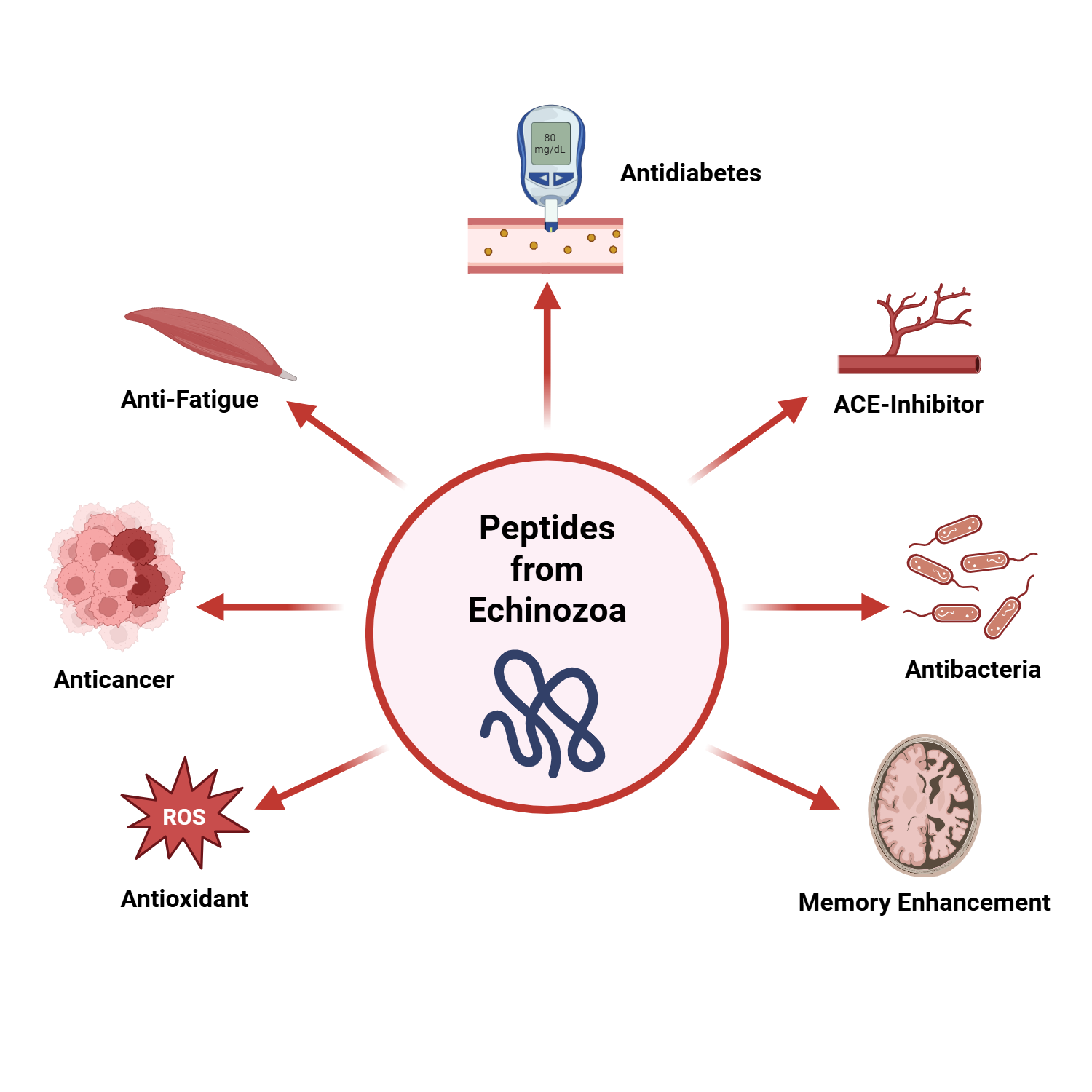
Downloads
References
A Sibiya, J Jeyavani, J Sivakamavalli, C Ravi, M Divya and B Vaseehara. Bioactive compounds from various types of sea urchin and their therapeutic effects - a review. Regional Studies in Marine Science 2021; 44, 101760.
S Kamat, S Kumar, S Philip and M Kumari. Secondary metabolites from marine fungi: Current status and application. In: A Kumar, LFR Ferreira, M Bilal and M Kumari (Eds.). Microbial biomolecules. Academic Press, Massachusetts, 2023, p. 181-209.
K Anjum, SQ Abbas, N Akhter, BI Shagufta, SAA Shah and SSU Hassan. Emerging biopharmaceuticals from bioactive peptides derived from marine organisms. Chemical Biology & Drug Design 2017; 90(1), 12-30.
SU Kadam, BK Tiwari, C Álvarez and CP O’Donnell. Ultrasound applications for the extraction, identification and delivery of food proteins and bioactive peptides. Trends in Food Science & Technology 2015; 46(1), 60-67.
AA Zaky, J Simal-Gandara, JB Eun, JH Shim and AM Abd El-Aty. Bioactivities, applications, safety, and health benefits of bioactive peptides from food and by-products: A review. Frontiers in Nutrition 2022; 8, 815640.
Z Lu, N Sun, L Dong, Y Gao and S Lin. Production of bioactive peptides from sea cucumber and its potential health benefits: A comprehensive review. Journal of Agricultural and Food Chemistry, 2022; 70(25), 7607-7625.
OA Tokede, JM Gaziano, A Yansane, L Djoussé and TA Onabanjo. Soya products and serum lipids: A meta-analysis of randomised controlled trials. British Journal of Nutrition 2015; 14(6), 831-843.
CH Lee, N Hamdan, BB Nyakuma, SL Wong, KY Wong, H Tan, H Jamaluddin and TH Lee. Purification, identification and molecular docking studies of antioxidant and anti-inflammatory peptides from Edible Bird’s Nest. Food Chemistry 2024; 454, 139797.
EE Montuori, DD Pascale and C Lauritano. Recent discoveries on marine organism immunomodulatory activities. Marine Drugs 2022; 20(7), 422.
JM Pang, YC Huang, SP Sun, YR Pan, CY Shen, MC Kao, RH Wang, LH Wang and KT Lin. Effects of synthetic glucocorticoids on breast cancer progression. Steroids 2020; 164, 108738.
J Cai, X Li, H Du, C Jiang, S Xu and Y Cao. Immunomodulatory significance of natural peptides in mammalians: Promising agents for medical application. Immunobiology 2020; 225(3), 151936.
MJ García-Nebot, I Recio and B Hernández-Ledesma. Antioxidant activity and protective effects of peptide lunasin against oxidative stress in intestinal Caco-2 cells. Food and Chemical Toxicology 2013; 65, 155-161.
X Duan, Y Dong, M Zhang, Z Li, G Bu and F Chen. Identification and molecular interactions of novel ACE inhibitory peptides from rapeseed protein. Food Chemistry 2023; 422, 136085.
M Akbarian, A Khani, S Eghbalpour and VN Uversky. Bioactive peptides: Synthesis, sources, applications, and proposed mechanisms of action. International Journal of Molecular Sciences 2022; 23(3), 1445.
YP Huang, FFG Dias, JMLND Moura and D Barile. A complete workflow for discovering small bioactive peptides in foods by LC-MS/MS: A case study on almonds. Food Chemistry 2021; 369, 130834.
G Nayak, RS Bhuyan and A Sahu. Review on biomedical applications of marine algae-derived biomaterials. Universal Journal of Public Health 2022; 10(1), 15-24.
R Dahiya, S Dahiya, NK Fuloria, S Kumar, R Mourya, SV Chennupati, S Jankie, H Gautam, S Singh, SK Karan, S Maharaj, S Fuloria, J Shrivastava, A Agarwal, S Singh, A Kishor, G Jadon and A Sharma. Natural bioactive thiazole-based peptides from marine resources: Structural and pharmacological aspects. Marine Drugs 2020; 18(6), 329.
D Xu, B Liu, J Wang and Z Zhang. Bibliometric analysis of artificial intelligence for biotechnology and applied microbiology: Exploring research hotspots and frontiers. Frontiers in Bioengineering and Biotechnology 2022; 10, 998298.
RCF Cheung, TB Ng and JH Wong. Marine peptides: Bioactivities and applications. Marine Drugs 2015; 13(7), 4006-4043.
R Sable, P Parajuli and S Jois. Peptides, peptidomimetics, and polypeptides from marine sources: A wealth of natural sources for pharmaceutical applications. Marine Drugs 2017; 15(4), 124.
M Faustino, M Veiga, P Sousa, EM Costa, S Silva and M Pintado. Agro-food byproducts as a new source of natural food additives. Molecules 2019; 24(6), 1056.
TV Ovchinnikova. Structure, function, and therapeutic potential of marine bioactive peptides. Marine Drugs 2019; 17(9), 505.
JM Al-Khayri, W Asghar, S Khan, A Akhtar, H Ayub, N Khalid, FM Alessa and MQ Al-Mssallem. Therapeutic potential of marine bioactive peptides against human immunodeficiency virus: Recent evidence, challenges, and future trends. Marine Drugs 2022; 2(8), 477.
HX Jin, HP Xu, Y Li, QW Zhang and H Xie. Preparation and evaluation of peptides with potential antioxidant activity by microwave assisted enzymatic hydrolysis of collagen from sea cucumber Acaudina molpadioides obtained from Zhejiang Province in China. Marine Drugs 2019; 17(3), 169.
C Wang, B Wang and B Li. Bioavailability of peptides from casein hydrolysate in vitro: Amino acid compositions of peptides affect the antioxidant efficacy and resistance to intestinal peptidases. Food Research International 2015; 81, 188-196.
JJ Holst. Glucagon-like peptide-1: Are its roles as endogenous hormone and therapeutic wizard congruent? Journal of Internal Medicine 2022; 291(5), 557-573.
A Rauf, AA Khalil, M Khan, S Anwar, A Alamri, AM Alqarni, A Alghamdi, F Alshammari, KRR Rengasamy and AM Alqarnie. Can be marine bioactive peptides (MBAs) lead the future of foodomics for human health? Critical Reviews in Food Science and Nutrition 2021; 62(25), 7072-7116.
Y He, T Takei, L Moroder and H Hojo. Unexpected diselenide metathesis in selenocysteine-substituted biologically active peptides. Organic & Biomolecular Chemistry 2024; 22(30), 6108-6114.
YK Leong and JS Chang. Proteins and bioactive peptides from algae: Insights into antioxidant, anti-hypertensive, anti-diabetic and anti-cancer activities. Trends in Food Science & Technology 2024; 145, 104352.
NB Janakiram, A Mohammed and CV Rao. Sea cucumbers metabolites as potent anti-cancer agents. Marine Drugs 2015; 13(5), 2909-2923.
W Zhang, M Al-Wraikata, L Li and Y Liu. Physicochemical properties, antioxidant and antidiabetic activities of different hydrolysates of goat milk protein. Journal of Dairy Science 2024; 107(12), 10174-10189.
I Barkia, L Al‐Haj, A Abdul Hamid, M Zakaria, N Saari and F Zadjali. Indigenous marine diatoms as novel sources of bioactive peptides with antihypertensive and antioxidant properties. International Journal of Food Science & Technology 2018; 54(5), 1514-1522.
SY Lee and SJ Hur. Antihypertensive peptides from animal products, marine organisms, and plants. Food Chemistry 2017; 228, 506-517.
M Lu, A Mishra, C Boschetti, J Lin, Y Liu, H Huang, CF Kaminski, Z Huang, A Tunnacliffe and GSK Schierle. Sea cucumber-derived peptides alleviate oxidative stress in neuroblastoma cells and improve survival in C. elegans exposed to neurotoxic paraquat. Oxidative Medicine and Cellular Longevity 2021; 2021(1), 8842926.
TF Moya Moreira, OH Gonçalves, FV Leimann and RP Ribeiro. Fish protein hydrolysates: Bioactive properties, encapsulation and new technologies for enhancing peptides bioavailability. Current Pharmaceutical Design 2023; 29(11), 824-836.
F Rivero-Pino. Bioactive food-derived peptides for functional nutrition: Effect of fortification, processing and storage on peptide stability and bioactivity within food matrices. Food Chemistry 2022; 406, 135046.
C Xu, R Zhang and Z Wen. Bioactive compounds and biological functions of sea cucumbers as potential functional foods. Journal of Functional Foods 2018; 49, 73-84.
Z Lu, N Sun, L Dong, Y Gao and S Lin. Production of bioactive peptides from sea cucumber and its potential health benerfits: A comprehensive review. Journal of Agricultural and Food Chemistry 2022; 70(25), 7607-7625.
W Wei, XM Fan, SH Jia, XP Zhang, Z Zhang, XJ Zhang, JX Zhang, JX Zhang, YW Zhang and YW Zhang. Sea cucumber intestinal peptide induces the apoptosis of MCF-7 cells by inhibiting PI3K/AKT pathway. Frontiers in Nutrition 2021; 8, 763692.
TRL Senadheera, A Hossain, D Dave and F Shahidi. Antioxidant and ACE-inhibitory activity of protein hydrolysates produced from atlantic sea cucumber (Cucumaria frondosa). Molecules 2023; 28(13), 5263.
X Zhou, C Wang and A Jiang. Antioxidant peptides isolated from sea cucumber Stichopus japonicus. European Food Research and Technology 2012; 234(3), 441-447.
N Kabeya, A Sanz-Jorquera, S Carboni, A Davie, A Oboh and O Monroig. Biosynthesis of polyunsaturated fatty acids in sea urchins: Molecular and functional characterisation of 3 fatty acyl desaturases from Paracentrotus lividus (Lamark 1816). PLos One 2017; 12(1), e0169374.
B Zhu, X Dong, D Zhou, Y Gao, J Yang, D Li, X Zhao, T Ren, W Ye, H Tan, H Wu and C Yu. Physicochemical properties and radical scavenging capacities of pepsin-solubilized collagen from sea cucumber Stichopus japonicus. Food Hydrocolloids 2012; 28(1), 182-188.
PX Gong, BK Wang, YC Wu, QY Li, BW Qin and HJ Li. Release of antidiabetic peptides from Stichopus japonicas by simulated gastrointestinal digestion. Food Chemistry 2020; 315, 126273.
TL Wargasetia, H Ratnawati, N Widodo and MH Widyananda. Bioinformatics study of sea cucumber peptides as antibreast cancer through inhibiting the activity of overexpressed protein (EGFR, PI3K, AKT1, and CDK4). Cancer Informatics 2021; 20, 11769351211031864.
X Du, F Lian, Y Li, D Li, D Wu, Q Feng, Z Feng, Y Li, G Bu, F Meng, X Cao, Z Chen and X Zeng. Peptides from Colochirus robustus enhance immune function via activating CD3ζ-and ZAP-70-mediated signaling in C57BL/6 mice. International Journal of Molecular Sciences 2017; 18(10), 2110.
MS Vishkaei, A Ebrahimpour, A Abdul-Hamid, A Ismail and N Saari. Angiotensin-I converting enzyme (ACE) inhibitory and antihypertensive effect of protein hydrolysate from Actinopyga lecanora (Sea cucumber) in rats. Marine Drugs 2016; 14(10), 176.
P Wang, D Wang, J Hu, BK Tan, Y Zhang and S Lin. Natural bioactive peptides to beat exercise-induced fatigue: a review. Food Bioscience 2021; 43, 101298.
WK Amakye, C Hou, L Xie, X Lin, N Gou, E Yuan and J Ren. 2021. Bioactive anti-aging agents and the identification of new antioxidant soybean peptides. Food Bioscience 2021; 42, 101194.
R Pangestuti and Z Arifin. Medicinal and health benefit effects of functional sea cucumbers. Journal of Traditional and Complementary Medicine 2017; 8(3), 341-351.
D Li, L Li, T Xu, T Wang, J Ren, X Liu and Y Li. Effect of low molecular weight oligopeptides isolated from sea cucumber on diabetic wound healing in db/db mice. Marine Drugs 2018; 16(1), 16-22.
C Cui, P Wang, N Cui, S Song, H Liang and A Ji. Sulfated polysaccharide isolated from the sea cucumber stichopus jaonicas promotes the SDF-1α/CXCR4 axis-induced NSC migration via the PI3K/Akt/FOXO3a, ERK/MAPK, and NF-κB signaling pathways. Neuroscience Letters 2016; 616, 57-64.
S Wen, K Zhang, Y Li, J Fan, C Ziming, J Zhang, H Wang and L Wang. A self-assembling peptide targeting VEGF receptors to inhibit angiogenesis. Chinese Chemical Letters 2020; 31(12), 3153-3157.
J Mildenberger, M Remm and M Atanassova. Self-assembly potential of bioactive peptides from Norwegian sea cucumber Parastichopus tremulus for development of functional hydrogels. LWT 2021; 148, 111678.
Z Lu, N Sun, L Dong, Y Gao and S Lin. Production of bioactive peptides from sea cucumber and its potential health benefits: A comprehensive review. Journal of Agricultural and Food Chemistry 2022; 70(25), 7607-7625.
MWFS Macedo, NB Cunha, JA Carneiro, RA Costa, SA Alencar, MH Cardoso, OL Franco and SC Dias. Marine organisms as a rich source of biologically active peptides. Frontiers in Marine Science 2021; 8, 667764.
S Heffernan, L Giblin and N O’Brien. Assessment of the biological activity of fish muscle protein hydrolysates using in vitro model systems. Food Chemistry 2021; 359, 129852.
S El Hajj, R Irankunda, JAC Echavarría, P Arnoux, C Paris, L Stefan, C Gaucher, S Boschi-Muller and L Canabady-Rochelle. Metal-chelating activity of soy and pea protein hydrolysates obtained after different enzymatic treatments from protein isolates. Food Chemistry 2022; 405, 134788.
S Aggarwal, AM Mohite and N Sharma. The maturity and ripeness phenomenon with regard to the physiology of fruits and vegetables: A review. Bulletin of the Transilvania University of Brasov 2018; 11(60), 77-88.
MB Mansour, R Balti, V Ollivier, HB Jannet, F Chaubet and RM Maaroufi. Characterization and anticoagulant activity of a fucosylated chondroitin sulfate with unusually procoagulant effect from sea cucumber. Carbohydrate Polymers 2017; 174, 760-771.
A Navvabi, A Homaei, S Khademvatan, MHK Ansari and M Keshavarz. Combination of TiO2 nanoparticles and Echinometra mathaeis gonad extracts: In vitro and in vivo scolicidal activity against hydatid cysts. Biocatalysis and Agricultural Biotechnology 2019; 22, 101432.
Y Hou, A Carne, M McConnell, AA Bekhit, S Mros, K Amagase and AEDA Bekhit. In vitro antioxidant and antimicrobial activities, and in vivo anti-inflammatory activity of crude and fractionated PHNQs from sea urchin (Evechinus chloroticus). Food Chemistry 2020; 316, 126339.
P Francis and K Chakraborty. Antioxidant and anti-inflammatory cembrane-type diterpenoid from Echinoidea sea urchin Stomopneustes variolaris attenuates pro-inflammatory 5-lipoxygenase. Medicinal Chemistry Research 2020; 29, 656-664.
R Yamamoto, H Minami, H Matsusaki, M Sakashita, N Morita, O Nishimiya and N Tsutsumi. Consumption of the edible sea urchin Mesocentrotus nudus attenuates body weight gain and hepatic lipid accumulation in mice. Journal of Functional Foods 2018; 47, 40-47.
NV Ageenko, KV Kiselev and NA Odintsova. Quinoid pigments of sea urchins Scaphechinus mirabilis and Strongylocentrotus intermedius: Biological activity and potential applications. Marine Drugs 2022; 20(10), 611.
AM Soliman, AS Mohamed and MAS Marie. Echinochrome pigment attenuates diabetic nephropathy in the models of type 1 and type 2 diabetes. Diabetes Mellitus 2016; 19, 464-470.
DM Moreno-García, M Salas-Rojas, E Fernández-Martínez, MDR López-Cuellar, CG Sosa-Gutierrez1, A Peláez-Acero1, N Rivero-Perez1, A Zaragoza-Bastida1 and D Ojeda-Ramírez1. Sea urchins: An update on their pharmacological properties. PeerJ 2022; 10, e13606.
A Salimi, A Motallebi, M Ayatollahi, E Seydi, AR Mohseni, M Nazemi and J Pourahmad. Selective toxicity of persian gulf sea cucumber holothuria parva on human chronic lymphocytic leukemia b lymphocytes by direct mitochondrial targeting. Environmental Toxicology 2017; 32, 1158-1169.
NY Kim, WY Choi, SJ Heo, DH Kang and HY Lee. Anti-skin cancer activities of Apostichopus japonicus extracts from low-temperature ultrasonification process. Journal of Healthcare Engineering 2017; 2017(1), 6504890.
X Liu, J Xu, Y Xue, Z Gao, Z Li, K Leng, J Wang, C Xue and Y Wang. Sea cucumber cerebrosides and long-chain bases from Acaudina molpadioides protect against high fat diet-induced metabolic disorders in mice. Food & Function 2015; 6, 3428-3436.
AR El Barky, SA Hussein, AA Alm-Eldeen, YA Hafez and TM Mohamed. Antidiabetic activity of holothuria thomasi saponin. Biomedicine & Pharmacotherapy 2016; 84, 1472-1487.
TH Nguyen and SM Kim. α-Glucosidase inhibitory activities of fatty acids purified from the internal organ of sea cucumber Stichopus japonicas. Journal of Food Science 2015; 80, 841-847.
H Che, L Du, P Cong, S Tao, N Ding, F Wu, C Xue, J Xu and Y Wang. Cerebrosides from sea cucumber protect against oxidative stress in SAMP8 mice and PC12 cells. Journal of Medical Food 2017; 20, 392-402.
A Shakouri, MR Shoushizadeh and F Nematpour. Antimicrobial activity of sea cucumber (Stichopus variegatus) body wall extract in Chabahar Bay, Oman Sea. Jundishapur Journal of Natural Pharmaceutical Products 2017; 12(1), e32422.
J Mou, C Wang, W Li and J Yang. Purification, structural characterization and anticoagulant properties of fucosylated chondroitin sulfate isolated from Holothuria mexicana. International Journal of Biological Macromolecules 2017; 98, 208-215.
J Zhang, M Li, G Zhang, YU Tian, F Kong, S Xiong, S Zhao, D Jia, A Manyande and H Du. Identification of novel antioxidant peptides from snakehead (Channa argus) soup generated during gastrointestinal digestion and insights into the anti-oxidation mechanisms. Food Chemistry 2021; 337, 127921.
B Xu, Q Dong, C Yu, H Chen, Y Zhao, B Zhang, P Yu and M Chen. Advances in research on the activity evaluation, mechanism and structure-activity relationships of natural antioxidant peptides. Antioxidants 2024; 13(4), 479.
Y Zhu, F Lao, X Pan and J Wu. Food protein-derived antioxidant peptides: Molecular mechanism, stability and bioavailability. Biomolecules 2022; 12(11), 1622.
CW Gruber. Plant-derived peptides: (Neglected) natural products for drug discovery. Planta Medica 2024; 90(7-8), 627-630.
A Moayedi, L Mora, MC Aristoy, M Hashemi, M Safari and F Toldrá. ACE-inhibitory and antioxidant activities of peptide fragments obtained from tomato processing by-products fermented using Bacillus subtilis: Effect of amino acid composition and peptides molecular mass distribution. Applied Biochemistry and Biotechnology 2016; 181(1), 48-64.
M Tian, B Fang, L Jiang, H Guo, JY Cui and F Ren. Structure-activity relationship of a series of antioxidant tripeptides derived from β-Lactoglobulin using QSAR modeling. Dairy Science & Technology 2015; 95(4), 451-463.
V D’Opazo, J Calpe, L Escrivá, TM Nazareth, G Meca and C Luz. Identification and evaluation of antioxidant activity of bioactive casein-derived peptides during in vitro digestion and transepithelial transport in Caco-2 cells. Food Bioscience 2023; 53, 102763.
Y Ma, Y Wu and L Li. Relationship between primary structure or spatial conformation and functional activity of antioxidant peptides from Pinctada fucata. Food Chemistry 2018; 264, 108-117.
TB Zou, TP He, HB Li, HW Tang and EQ Xia. The structure-activity relationship of the antioxidant peptides from natural proteins. Molecules 2016; 21, 72.
L Lin, K Yang, L Zheng, M Zhao, W Sun, Q Zhu and S Liu. Anti-aging effect of sea cucumber (Cucumaria frondosa) hydrolysate on fruit flies and d-galactose-induced aging mice. Journal of Functional Foods 2018; 47, 11-18.
A Hernández-Jabalera, I Cortés-Giraldo, G Dávila-Ortíz, J Vioque, M Alaiz, J Girón-Calle, C Megías and C Jiménez-Martínez. Influence of peptides - phenolics interaction on the antioxidant profile of protein hydrolysates from Brassica napus. Food Chemistry 2014; 178, 346-357.
S Zhao, Q Cheng, Q Peng, X Yu, X Yin, M Liang, CW Ma, Z Huang and W Jia. Antioxidant peptides derived from the hydrolyzate of purple sea urchin (Strongylocentrotus nudus) gonad alleviate oxidative stress in Caenorhabditis elegans. Journal of Functional Foods 2018; 48, 594-604.
Q Wang, Y Huang, C Qin, M Liang, X Mao, S Li, Y Zou, W Jia, H Li, CW Ma and Z Huang. Bioactive peptides from Angelica sinensis protein hydrolysate delay senescence in Caenorhabditis elegans through antioxidant activity. Oxidative Medicine and Cellular Longevity 2016; 1, 8956981.
Y Wu, J Yang, C Xu, Q Li, Y Ma, S Zhao, J Zhuang, F Shen, Q Wang, F Feng and X Zhang. Sea cucumber (Acaudina leucoprocta) peptides extended the lifespan and enhanced antioxidant capacity via DAF-16/DAF-2/SOD-3/OLD-1/PEPT-1 in Caenorhabditis elegans. Frontiers in Nutrition 2022; 9, 1065145.
WH Shang, Y Tang, SY Su, JR Han, JN Yan, HT Wu and BW Zhu. In silico assessment and structural characterization of antioxidant peptides from major yolk protein of sea urchin Strongylocentrotus nudus. Food & Function 2018; 9(12), 6435-6443.
C Doungapai, T Siriwoharn, Y Malila, N Autsavapromporn, S Makkhun, S Yarnpakdee and S Wangtueai. UV-B protective and antioxidant activities of protein hydrolysate from sea cucumber (Holothuria scabra) using enzymatic hydrolysis. Frontiers in Marine Science 2022; 9, 892255.
R Safari and Z Yaghoubzadeh. Antioxidant activity of bioactive peptides extracted from sea cucumber (Holothuria leucospilata). International Journal of Peptide Research and Therapeutics 2020; 26(4), 2393-2398.
K Guo, L Su, Y Wang, H Liu, J Lin, P Cheng, X Yin, M Liang, Q Wang and Z Huang. Antioxidant and anti-aging effects of a sea cucumber protein hydrolyzate and bioinformatic characterization of its composing peptides. Food & Function 2020; 11(6), 5004-5016.
H Yang, Q Zhang, B Zhang, Y Zhao and N Wang. Potential active marine peptides as anti-aging drugs or drug candidates. Marine Drugs 2023; 21(3), 144.
H Yang, Q Zhang, B Zhang, Y Zhao and N Wang. Antimicrobial peptides with anticancer activity: Today status, trends and their computational design. Archives of Biochemistry and Biophysics 2022; 733, 109484.
Q Liang, F Ahmed, M Zhang, N Sperou, CMM Franco, Q Feng and W Zhang. In vivo and clinical studies of sea cucumber-derived bioactives for human health and nutrition from 2012-2021. Frontiers in Marine Science 2022; 9, 917857.
JA Pérez-Vega, L Olivera-Castillo, JA Gómez-Ruiz and B Hernández-Ledesma. Release of multifunctional peptides by gastrointestinal digestion of sea cucumber (Isostichopus badionotus). Journal of Functional Foods 2013; 5(2), 869-877.
OY Althunibat, BH Ridzwan, M Taher, JM Daud, SJA Ichwan and H Qaralleh. Antioxidant and cytotoxic properties of 2 sea cucumbers, Holothuria edulis Lesson and Stichopus horrens Selenka. Acta Biologica Hungarica 2013; 64(1), 10-20.
T Sugawara, N Zaima, A Yamamoto, S Sakai, R Noguchi and T Hirata. Isolation of sphingoid bases of sea cucumber cerebrosides and their cytotoxicity against human colon cancer cells. Bioscience, Biotechnology, and Biochemistry 2006; 70(12), 2906-2912.
R Ru, Y Guo, J Mao, Z Yu, W Huang, X Cao, H Hu, M Meng and L Yuan. Cancer cell inhibiting sea cucumber (Holothuria leucospilota) protein as a novel anti-cancer drug. Nutrients 2022; 14(4), 786.
W Wijesinghe, YJ Jeon, P Ramasamy, MEA Wahid and CS Vairappan. Anticancer activity and mediation of apoptosis in human HL-60 leukaemia cells by edible sea cucumber (Holothuria edulis) extract. Food Chemistry 2013; 139(1-4), 326-331.
MH Widyananda, SK Pratama, RS Samoedra, FN Sari, VD Kharisma, ANM Ansori and Y Atonius. Molecular docking study of sea urchin (Arbacia lixula) peptides as multi-target inhibitor for non-small cell lung cancer (NSCLC) associated proteins. Journal of Pharmacy & Pharmacognosy Research 2021; 9(4), 484-496.
H Cui, W Han, J Zhang, Z Zhang and X Su. Advances in the regulatory effects of bioactive peptides on metabolic signaling pathways in tumor cells. Journal of Cancer 2019; 10(11), 2425.
X Lu, M Wang, H Yue, X Feng, Y Tian, C Xue, T Zhang and Y Wang. Novel peptides from sea cucumber intestines hydrolyzed by neutral protease alleviate exercise-induced fatigue via upregulating the glutaminemediated Ca2+ /Calcineurin signaling pathway in mice. Journal of Food Science 2024; 89(3), 1727-1738.
Q Wang, J Shi, H Zhong, J Zhuang, J Zhang, J Wang, X Zhang and F Feng. High-degree hydrolysis sea cucumber peptides improve exercise performance and exert antifatigue effect via activating the NRF2 and AMPK signaling pathways in mice. Journal of Functional Foods 2021; 86, 104677.
X Wang, Z Ding, Y Zhao, S Prakash, W Liu, J Han and Z Wang. Effects of lutein particle size in embedding emulsions on encapsulation efficiency, storage stability, and dissolution rate of microencapsules through spray drying. LWT 2021; 146, 111430.
L Jia, L Wang, C Liu, Y Liang and Q Lin. Bioactive peptides from foods: Production, function, and application. Food & Function 2021; 12(16), 7108-7125.
J Yan, J Zhao, R Yang and W Zhao. Bioactive peptides with antidiabetic properties: A review. International Journal of Food Science & Technology 2019; 54(6), 1909-1919.
C Gonzalez-Lopez and BS Wojeck. Role of metformin in the management of type 2 diabetes: Recent advances. Polish Archives of Internal Medicine 2023; 133(6), 16511-16511.
RG Solstad, C Li, J Isaksson, J Johansen, J Svenson, K Stensvåg and T Haug. Novel antimicrobial peptides EeCentrocins 1, 2 and EeStrongylocin 2 from the edible sea urchin Echinus esculentus have 6-Br-Trp post-translational modifications. PLos One 2016; 11(3), e0151820.
F Jahandideh and J Wu. A review on mechanisms of action of bioactive peptides against glucose intolerance and insulin resistance. Food Science and Human Wellness 2022; 11(6), 1441-1454.
P Antony and R Vijayan. Bioactive peptides as potential nutraceuticals for diabetes therapy: A comprehensive review. International Journal of Molecular Sciences 2021; 22(16), 9059.
H Admassu, MAA Gasmalla, R Yang and W Zhao. Bioactive peptides derived from seaweed protein and their health benefits: Antihypertensive, antioxidant, and antidiabetic properties. Journal of Food Science 2018; 83(1), 6-16.
ECY Li-Chan. Bioactive peptides and protein hydrolysates: Research trends and challenges for application as nutraceuticals and functional food ingredients. Current Opinion in Food Science 2015; 1, 28-37.
W Zheng, E Tian, Z Liu, C Zhou, P Yang and E Tian. Small molecule angiotensin converting enzyme inhibitors: A medicinal chemistry perspective. Frontiers in Pharmacology 2022; 13, 968104.
M Memarpoor-Yazdi, H Zare-Zardini, N Mogharrab and L Navapour. Purification, characterization and mechanistic evaluation of angiotensin converting enzyme inhibitory peptides derived from Zizyphus jujuba fruit. Scientific Reports 2020; 10(1), 3976.
C Zhong, LC Sun, LJ Yan, YC Lin, GM Li and MJ Cao. Production, optimisation and characterisation of angiotensin converting enzyme inhibitory peptides from sea cucumber (Stichopus japonicus) gonad. Food & Function 2018; 9(1), 594-603.
Y Wang, S Chen, W Shi, S Liu, X Chen, N Pan, X Wang, Y Su and Z Liu. Targeted affinity purification and mechanism of action of Angiotensin-Converting Enzyme (ACE) inhibitory peptides from sea cucumber gonads. Marine Drugs 2024; 22(2), 90.
AS Dewi, G Patantis, YN Fawzya, HE Irianto and S Sa’diah. Angiotensin-converting enzyme (ace) inhibitory activities of protein hydrolysates from Indonesian sea cucumbers. International Journal of Peptide Research and Therapeutics 2020; 26(4), 2485-2493.
ZY Liu, D Chen, YC Su and MY Zeng. Optimization of hydrolysis conditions for the production of the angiotensin-I converting enzyme inhibitory peptides from sea cucumber collagen hydrolysates. Journal of Aquatic Food Product Technology 2011; 20(2), 222-232.
MZ Abedin, AA Karim, CY Gan, FC Ghazali, Z Barzideh, W Zzaman and ISM Zaidul. Identification of angiotensin I converting enzyme inhibitory and radical scavenging bioactive peptides from sea cucumber (Stichopus vastus) collagen hydrolysates through optimization. International Food Research Journal 2015; 22(3), 1074.
EC Alvarenga, MC Fonseca, CC Carvalho, RM Florentino, A França, E Matias, PB Guimarães, C Batista,V Freire, AK Carmona, JB Pesquero, AMD Paula, G Foureaux and MD Fatima Leite. Angiotensin converting enzyme regulates cell proliferation and migration. PLos One 2019; 11(12), e0165371.
K Bush, PR Henry and DS Slusarchyk. Muraceins - muramyl peptides produced by Nocardia orientalis as angiotensin-converting enzyme inhibitors. I. Taxonomy, fermentation and biological properties. The Journal of Antibiotics 1984; 37(4), 330-335.
M Mahlapuu, J Håkansson, L Ringstad and C Björn. Antimicrobial peptides: An emerging category of therapeutic agents. Frontiers in Cellular and Infection Microbiology 2016; 6(S3), 235805.
C Li, T Haug, OB Styrvold, TØ Jørgensen and K Stensvåg. Strongylocins, novel antimicrobial peptides from the green sea urchin, Strongylocentrotus droebachiensis. Developmental & Comparative Immunology 2008; 32(12), 1430-1440.
XH Shang, XY Liu, JP Zhang, Y Gao, BH Jiao and H Zheng. Traditional Chinese medicine - sea urchin. Mini-Reviews in Medicinal Chemistry 2014; 14(6), 537-542.
JM Sciani, AK Emerenciano, JRMC Silva and DC Pimenta. Initial peptidomic profiling of Brazilian sea urchins: Arbacia lixula, Lytechinus variegatus and Echinometra lucunter. Journal of Venomous Animals and Toxins Including Tropical Diseases 2916; 22(1), 17.
RG Solstad and P James. Observations from the hydrolysis of the green sea urchins (Strongylocentrotrus droebachiensis). Global Challenges 2023; 7(5), 2200078.
RG Solstad, C Johansen, K Stensvåg, MB Strøm and T Haug. Structure-activity relationship studies of shortened analogues of the antimicrobial peptide eecentrocin 1 from the sea urchin Echinus esculentus. Journal of Peptide Science 2020; 26(2), e3233.
S Mashjoor and M Yousefzadi. Holothurians antifungal and antibacterial activity to human pathogens in the Persian Gulf. Journal de Mycologie Médicale 2016; 27(1), 46-56.
L Cong, W Liang, Y Wu, C Li, Y Chang, L Dong, W Song and J Ma. High-level soluble expression of the functional peptide derived from the C-terminal domain of the sea cucumber lysozyme and analysis of its antimicrobial activity. Electronic Journal of Biotechnology 2014; 17(6), 2802-2886.
KA Beauregard, NT Truong, H Zhang, W Lin and G Beck. The detection and isolation of a novel antimicrobial peptide from the echinoderm Cucumaria frondosa. In: G Beck, M Sugumaran and EL Cooper (Eds.). Phylogenetic perspectives on the vertebrate immune system, Springer, Boston, p. 55-62.
MG Cusimano, A Spinello, G Barone, D Schillaci, S Cascioferro, A Magistrato, B Parrino and M Vitale. A synthetic derivative of antimicrobial peptide holothuroidin 2 from mediterranean sea cucumber (Holothuria tubulosa) in the control of Listeria monocytogenes. Marine Drugs 2019; 17(3), 159.
QY Zhang, ZB Yan, YM Meng, XY Hong, G Shao, JJ Ma, XR Cheng, J Liu, J Kang and CY Fu. Antimicrobial peptides: Mechanism of action, activity and clinical potential. Military Medical Research 2021; 8(1), 1-25.
GS Dijksteel, MMW Ulrich, E Middelkoop and BKHL Boekema. Review: Lessons learned from clinical trials using antimicrobial peptides (AMPs). Frontiers in Microbiology 2021; 12(837), 616979.
JAF Corrêa, AG Evangelista, TDM Nazareth and FB Luciano. Fundamentals on the molecular mechanism of action of antimicrobial peptides. Materialia 2019; 8, 100494.
M Drayton, JP Deisinger, KC Ludwig, N Raheem, A Müller, T Schneider and SK Straus. Host defense peptides: Dual antimicrobial and immunomodulatory action. International Journal of Molecular Sciences 2021; 22(20), 11172.
M Ouassaf, L Bourougaa, SH Al-Mijalli, EM Abdallah, AR Bhat and SMA Kawsar. Marine-derived compounds as potential inhibitors of Hsp90 for anticancer and antimicrobial drug development: A Comprehensive in silico study. Molecules 2023; 28(24), 8074.
X Xu, R Liang, D Li, C Jiang and S Lin. Evaluation of sea cucumber peptides-assisted memory activity and acetylation modification in hippocampus of test mice based on scopolamine-induced experimental animal model of memory disorder. Journal of Functional Foods 2020; 68, 103909.
Y Zhao, Y Dong, Q Ge, P Cui, N Sun and S Lin. Neuroprotective effects of NDEELNK from sea cucumber ovum against scopolamine-induced PC12 cell damage through enhancing energy metabolism and upregulation of the PKA/BDNF/NGF signaling pathway. Food & Function 2021; 12(17), 7676-7687.
J Pei, X Gao, D Pan, Y Hua, J He, Z Liu and Y Dang. Advances in the stability challenges of bioactive peptides and improvement strategies. Current Research in Food Science 2022; 5, 2162-2170.
Y Yang, R Zhou, Y Wang, Y Zhang, J Yu and Z Gu. Recent advances in oral and transdermal protein delivery systems. Angewandte Chemie 2023; 135(10), e202214795.
M Barati, F Javanmardi, SMH Mousavi Jazayeri, M Jabbari, J Rahmani, F Barati, H Nickho, SH Davoodi, N Roshanravan and AM Khaneghah. Techniques, perspectives, and challenges of bioactive peptide generation: A comprehensive systematic review. Comprehensive Reviews in Food Science and Food Safety 2018; 19(4), 1488-1250.
K Huang, Y Yuan and X Baojun. A critical review on the microencapsulation of bioactive compounds and their application. Food Reviews International 2023; 39(5), 2594-2634.
C Yan and SR Kim. Microencapsulation for pharmaceutical applications: A review. ACS Applied Bio Materials 2024; 7(2), 692-710.
P Chanphai and HA Tajmir-Riahi. Trypsin and trypsin inhibitor bind milk beta-lactoglobulin: Protein-protein interactions and morphology. International Journal of Biological Macromolecules 2017; 96, 754-758.
M Foltz, PCVD Pijl and GS Duchateau. Current in vitro testing of bioactive peptides is not valuable. Journal of Nutrition 2010; 140(1), 117-118.
J Chen, Y Liu, G Wang, S Sun, R Liu, B Hong, R Gao and K Bai. Processing optimization and characterization of angiotensin-i-converting enzyme inhibitory peptides from lizardfish (Synodus macrops) scale gelatin. Marine Drugs 2018; 16(7), 228.
S Piovesana, AL Capriotti, C Cavaliere, GL Barbera, CM Montone, R Zenezini Chiozzi and A Laganà. Recent trends and analytical challenges in plant bioactive peptide separation, identification and validation. Analytical and Bioanalytical Chemistry 2018; 410(15), 3425- 3444.
AB Nongonierma and RJ FitzGerald. Strategies for the discovery and identification of food protein-derived biologically active peptides. Trends in Food Science & Technology 2017; 69, 289-305.
EC Li-Chan. Bioactive peptides and protein hydrolysates: Research trends and challenges for application as nutraceuticals and functional food ingredients. Current Opinion in Food Science 2017; 1, 28-37.
CG Rizzello, D Tagliazucchi, E Babini, GS Rutella, DLT Saa and A Gianotti. Bioactive peptides from vegetable food matrices: Research trends and novel biotechnologies for synthesis and recovery. Journal of Functional Foods 2016; 27, 549-569.
Published
How to Cite
Issue
Section
License
Copyright (c) 2025 Walailak University

This work is licensed under a Creative Commons Attribution-NonCommercial-NoDerivatives 4.0 International License.





