
The Pivotal Role of Thioredoxin-Interacting Protein in Joint Degenerative Diseases
DOI:
https://doi.org/10.48048/tis.2025.9422Keywords:
TXNIP, Osteoarthritis, Intervertebral disc degeneration, Oxidative stress, InflammationAbstract
Thioredoxin-Interacting Protein (TXNIP) is a multifaceted protein that regulates oxidative stress (OS) and redox balance by inhibiting the antioxidant protein thioredoxin (TRX). TXNIP also activates the NOD-like receptor family, pyrin domain containing (NLRP3), promoting pro-inflammatory cytokines that exacerbate inflammation. Elevated TXNIP levels promote apoptosis in nucleus pulposus cells and chondrocytes, leading to accelerated tissue degeneration in intervertebral disc degeneration (IVDD) and osteoarthritis (OA) are articular degeneration diseases characterized by the degradation of cartilaginous tissues, primarily driven by oxidative stress, apoptosis, and extracellular matrix (ECM) remodeling. Recently, there has been a growing body of research focused on the mechanisms of TXNIP and its regulation in the OA and IVDD. Importantly, strategies that regulate TXNIP have demonstrated beneficial effects in preclinical experiments. Given the significance and novelty of TXNIP's role in articular degeneration diseases, we present an overview of its mechanisms and discuss its contributions to IVDD and OA. Additionally, we highlight the effectiveness of targeting TXNIP as a valuable strategy for improving our insight into and treatment of degenerative joint diseases.
HIGHLIGHTS
- Thioredoxin-Interacting Protein (TXNIP) inhibits the antioxidant protein thioredoxin (TRX), playing a vital role in regulating oxidative stress and redox balance.
- TXNIP activates the Nod-Like Receptor Protein3 (NLRP3) inflammasome, stimulating pro-inflammatory cytokines that worsen inflammation in joint tissues.
- Elevated levels of TXNIP result in apoptosis of nucleus pulposus cells and chondrocytes, contributing to tissue degeneration in intervertebral disc degeneration (IVDD) and osteoarthritis (OA).
- There is an increasing focus on the mechanisms of TXNIP in OA and IVDD, with promising approaches to modulate TXNIP demonstrating beneficial effects in preclinical studies.
- Targeting TXNIP is proposed as an important strategy for enhancing the understanding and treatment of degenerative joint diseases.
GRAPHICAL ABSTRACT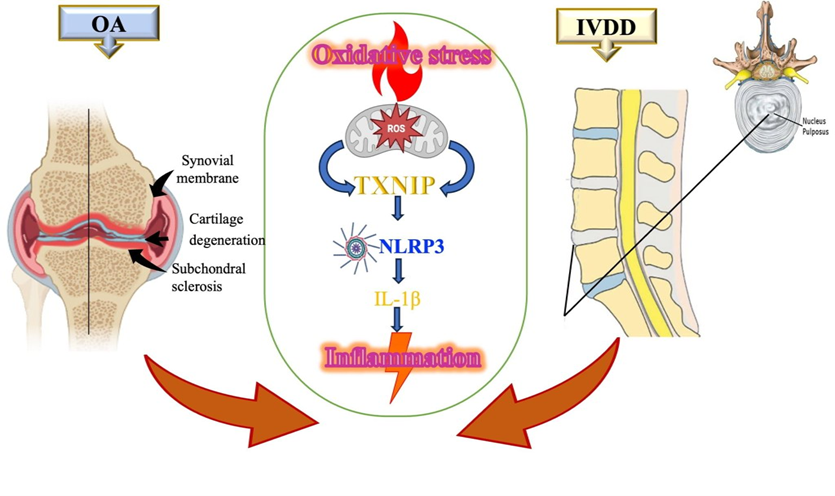
Downloads
References
IN Mohamed, L Li, S Ismael, T Ishrat and AB El-Remessy. Thioredoxin interacting protein, a key molecular switch between oxidative stress and sterile inflammation in cellular response. World Journal of Diabetes 2021; 12(12), 1979-1999.
E Choi and S Park. TXNIP: A key protein in the cellular stress response pathway and a potential therapeutic target. Experimental & Molecular Medicine 2023; 55(7), 1348-1356.
R Altahla and X Tao. Thioredoxin-interacting protein’s role in NLRP3 activation and osteoarthritis pathogenesis by pyroptosis pathway: In Vivo study. Metabolites 2024; 14(9), 488.
F Chen, X Sheng, H Sun, Q Guo, H Wang, L Wu, B Ni and J Yang. Advanced glycation end products induce nucleus pulposus cell apoptosis by upregulating TXNIP via inhibiting glycolysis pathway in intervertebral disc degeneration. Journal of Biochemical and Molecular Toxicology 2024; 38(1), e23515.
DW Hukins. Disc structure and function. Taylor & Francis Group, Abingdon, 1988.
AJ Hayes and J Melrose. Glycosaminoglycan and proteoglycan biotherapeutics in articular cartilage protection and repair strategies: novel approaches to visco‐supplementation in orthobiologics. Advanced Therapeutics 2019; 2(8), 1900034.
S Zhang, W Liu, S Chen, B Wang, P Wang, B Hu, X Lv and Z Shao. Extracellular matrix in intervertebral disc: Basic and translational implications. Cell and Tissue Research 2022; 390(1), 1-22.
X Zheng, J Qiu, J Ye, Y Gong, T Jiang, N Gao, C Jiang, B Chu, W Zhang, Z Li and X Wu. Macrophage-derived PDGF-BB modulates glycolytic enzymes expression and pyroptosis in nucleus pulposus cells via PDGFR-β/TXNIP pathway. Osteoarthritis and Cartilage 2024; 32(10), 1245-1260.
H Ma, C Xie, Z Chen, G He, Z Dai, H Cai, H Zhang, H Lu, H Wu, X Hu and K Zhou. MFG-E8 alleviates intervertebral disc degeneration by suppressing pyroptosis and extracellular matrix degradation in nucleus pulposus cells via Nrf2/TXNIP/NLRP3 axis. Cell Death Discovery 2022; 8, 209.
X Li, X Yu, Y Tao, Y Xu, X Li, J Wang, L Zhang, Y Wang and P Fan. Polyphenols as potential antioxidants for the treatment of intervertebral disc degeneration. Current Medicinal Chemistry 2024; 32(42), 267454543.
X Ren, Z Wu, X Huang and W Jia. Gambogic acid relieves neuropathic pain in rats by regulating CXCR4-TXNIP/NLRP3 pathway. Current Topics in Nutraceutical Research 2022; 20(1), 141-146.
F Colella, JP Garcia, M Sorbona, A Lolli, B Antunes, D D’Atri, FPY Barre, J Oieni, ML Vainieri, L Zerrillo, S Capar, S Hackel, Y Cai and LB Creemers. Drug delivery in intervertebral disc degeneration and osteoarthritis: Selecting the optimal platform for the delivery of disease-modifying agents. Journal of Controlled Release 2020; 328, 985-999.
AD Diwan and J Melrose. Intervertebral disc degeneration and how it leads to low back pain. Jor Spine 2023; 6(1), e1231.
GA Hawker and LK King. The burden of osteoarthritis in older adults. Clinics in Geriatric Medicine 2022; 38(2), 181-192.
R Altahla, J Alshorman and X Tao. Ferroptosis plays a role in osteoarthritis. All Life 2024; 17(1), 2391292.
Z Jiang, C Cao, Y Zhang, M Yan, Z Song, G Shang, H Kou, H Liu, Y Li and S Chen. Cell reprogramming strategies for treating osteoarthritis and intervertebral disc degeneration. Aging and Disease 2025; 15(1), 1-8.
R Chianese and R Pierantoni. Mitochondrial reactive oxygen species (ROS) production alters sperm quality. Antioxidants 2021; 10(1), 92.
DB Zorov, IA Vorobjev, VA Popkov, VA Babenko, LD Zorova, IB Pevzner, DN Silachev, SD Zorov, NV Andrianova and EY Plotnikov. Lessons from the discovery of mitochondrial fragmentation (fission): A review and update. Cells 2019; 8(2), 175.
H Tsubaki, I Tooyama and DG Walker. Thioredoxin-interacting protein (TXNIP) with focus on brain and neurodegenerative diseases. International Journal of Molecular Sciences 2020; 21(24), 9357.
S Kim, JY Choe and KY Park. TXNIP-mediated nuclear factor-κB signaling pathway and intracellular shifting of TXNIP in uric acid-induced NLRP3 inflammasome. Biochemical and Biophysical Research Communications 2019; 511(4), 725-731.
D Almarzouq and M Al-Maghrebi. NADPH oxidase-mediated testicular oxidative imbalance regulates the TXNIP/NLRP3 inflammasome Axis activation after ischemia reperfusion injury. Antioxidants 2023; 12(1), 145.
P Tang, J Gu, Z Xie, Y Gu, Z Jie, K Huang, J Wang, S Fan, X Jiang and Z Hu. Honokiol alleviates the degeneration of intervertebral disc via suppressing the activation of TXNIP-NLRP3 inflammasome signal pathway. Free Radical Biology and Medicine 2018; 120, 368-379.
U Wilden, S Hall and H Kuhn. Phosphodiesterase activation by photoexcited rhodopsin is quenched when rhodopsin is phosphorylated and binds the intrinsic 48-kDa protein of rod outer segments. Proceedings of the National Academy of Sciences 1986; 83(5), 1174-1178.
CE Alvarez. On the origins of arrestin and rhodopsin. BMC Evolutionary Biology 2008; 8, 222.
S Huang, LJ Hsu and N Chang. Functional role of WW domain‐containing proteins in tumor biology and diseases: Insight into the role in ubiquitin‐proteasome system. FASEB BioAdvances 2020; 2(4), 234-253.
S Kumar, IM Adjei, SB Brown, O Liseth and B Sharma. Manganese dioxide nanoparticles protect cartilage from inflammation-induced oxidative stress. Biomaterials 2019; 224, 119467.
M Marozzi, A Parnigoni, A Negri, M Viola, D Vigetti, A Passi, E Karousou and F Rizzi. Inflammation, extracellular matrix remodeling, and proteostasis in tumor microenvironment. International Journal of Molecular Sciences 2021; 22(15), 8102.
V Francisco, J Pino, MA Gonzalez-Gay, F Lago, J Karppinen, O Tervonen, A Mobasheri and O Gualillo. A new immunometabolic perspective of intervertebral disc degeneration. Nature Reviews Rheumatology 2022; 18(1), 47-60.
N Fine, S Lively, CA Seguin, AV Perruccio, M Kapoor and R Rampersaud. Intervertebral disc degeneration and osteoarthritis: A common molecular disease spectrum. Nature Reviews Rheumatology 2023; 19, 136-152.
Y Sonoda. Structural and functional analysis of a sporulation protein Spo0M from bacillus subtilis. Kyoto University, Kyoto, Japan, 2016.
S Kim, J Ge, D Kim, JJ Lee, YJ Choi, W Chen, JW Bowman, S Foo, L Chang, Q Liang, D Hara, I Choi, MH Kim, H Eoh and JU Jung. TXNIP-mediated crosstalk between oxidative stress and glucose metabolism. Plos One 2024; 19(2), e0292655.
E Junn, SH Han, JY Im, Y Yang, EW Cho, HD Um, DK Kim, KW Lee, PL Han, SG Rhee and I Choi. Vitamin D3 up-regulated protein 1 mediates oxidative stress via suppressing the thioredoxin function. The Journal of Immunology 2000; 164(12), 6287-6295.
H Yamanaka, F Maehira, M Oshiro, T Asato, Y Yanagawa, H Takei and Y Nakashima. A possible interaction of thioredoxin with VDUP1 in HeLa cells detected in a yeast two-hybrid system. Biochemical and Biophysical Research Communications 2000; 271(3), 796-800.
MAAE Maaty, F Almouhanna and S Wolfl. Expression of TXNIP in cancer cells and regulation by 1, 25 (OH) 2D3: Is it really the vitamin D3 upregulated protein? International Journal of Molecular Sciences 2018; 19(3), 796.
E Yoshihara, S Masaki, Y Matsuo, Z Chen, H Tian and J Yodoi. Thioredoxin/Txnip: Redoxisome, as a redox switch for the pathogenesis of diseases. Frontiers in Immunology 2014; 4, 514.
B Yang, Y Lin, Y Huang, YQ Shen and Q Chen. Thioredoxin (Trx): A redox target and modulator of cellular senescence and aging-related diseases. Redox Biology 2024; 70, 103032.
N Kondo, H Nakamura, H Masutani and J Yodoi. Redox regulation of human thioredoxin network. Antioxidants & Redox Signaling 2006; 8(9-10), 1881-1890.
W Xu, L Wang, J Li, Y Cai and Y Xue. TXNIP mediated the oxidative stress response in glomerular mesangial cells partially through AMPK pathway. Biomedicine & Pharmacotherapy 2018; 107, 785-792.
X Zhang, J Zhang, X Chen, Q Hu, M Wang, R Jin, Q Zhang, W Wang, R Wang, L Kang, J Li, M Li, Y Pan, J Huang and L Kong. Reactive oxygen species-induced TXNIP drives fructose-mediated hepatic inflammation and lipid accumulation through NLRP3 inflammasome activation. Antioxidants & redox Signaling 2015; 22(10), 848-870.
RH Pirzada, N Javaid and S Choi. The roles of the NLRP3 inflammasome in neurodegenerative and metabolic diseases and in relevant advanced therapeutic interventions. Genes 2020; 11(2), 131.
FM Amin, RR Abdelaziz, MF Hamed, MA Nader and GSG Shehatou. Dimethyl fumarate ameliorates diabetes-associated vascular complications through ROS-TXNIP-NLRP3 inflammasome pathway. Life Sciences 2020; 256, 117887.
SJ Park, JM Kim, J Kim, J Hur, S Park, K Kim, HJ Shin and YJ Chwae. Molecular mechanisms of biogenesis of apoptotic exosome-like vesicles and their roles as damage-associated molecular patterns. Proceedings of the National Academy of Sciences 2018; 115(50), E11721-E11730.
R Zhou, AS Yazdi, P Menu and J Tschopp. A role for mitochondria in NLRP3 inflammasome activation. Nature 2011; 469, 221-225.
T Luo, X Zhou, M Qin, Y Lin, J Lin, G Chen, A Liu, D Ouyang, D Chen and H Pan. Corilagin restrains NLRP3 inflammasome activation and pyroptosis through the ROS/TXNIP/NLRP3 pathway to prevent inflammation. Oxidative Medicine and Cellular Longevity 2022; 2022(1), 1652244.
J Zhou, J Qiu, Y Song, T Liang T, S Liu, C Ren, X Song, L Cui and Y Sun. Pyroptosis and degenerative diseases of the elderly. Cell Death & Disease 2023; 14, 94.
N Qayyum, M Haseeb, MS Kim and S Choi. Role of thioredoxin-interacting protein in diseases and its therapeutic outlook. International Journal of Molecular Sciences 2021; 22(5), 2754.
NM Alhawiti, SA Mahri, MA Aziz, SS Malik and S Mohammad. TXNIP in metabolic regulation: Physiological role and therapeutic outlook. Current Drug Targets 2017; 18(9), 1095-1103.
Y Zhou, Z Chen, X Yang, X Cao, Z Liang, H Ma and J Zhao. Morin attenuates pyroptosis of nucleus pulposus cells and ameliorates intervertebral disc degeneration via inhibition of the TXNIP/NLRP3/Caspase-1/IL-1β signaling pathway. Biochemical and Biophysical Research Communications 2021; 559, 106-112.
Y Chen, X Cao, B Pan, H Du, B Li, X Yang, X Chen, X Wang, T Zhou, A Qin, C Zhao and J Zhao. Verapamil attenuates intervertebral disc degeneration by suppressing ROS overproduction and pyroptosis via targeting the Nrf2/TXNIP/NLRP3 axis in four-week puncture-induced rat models both in vivo and in vitro. International Immunopharmacology 2023; 123, 110789.
F Wang, K Guo, L Nan, S Wang, J Lu, Q Wang, Z Ba, Y Huang and D Wu. Kartogenin-loaded hydrogel promotes intervertebral disc repair via protecting MSCs against reactive oxygen species microenvironment by Nrf2/TXNIP/NLRP3 axis. Free Radical Biology and Medicine 2023; 204, 128-150.
H Yin, K Wang, A Das, G Li, Y Song, R Luo, JPY Cheung, T Zhang, S Li and C Yang. The REDD1/TXNIP complex accelerates oxidative stress‐induced apoptosis of nucleus pulposus cells through the mitochondrial pathway. Oxidative Medicine and Cellular Longevity 2021; 2021(1), 7397516.
Q Xu, H Xing, J Wu, W Chen and N Zhang. miRNA-141 induced pyroptosis in intervertebral disk degeneration by targeting ROS generation and activating TXNIP/NLRP3 signaling in nucleus pulpous cells. Frontiers in Cell and Developmental Biology 2020; 8, 871.
L Yu, Y Hao, C Xu, G Zhu and Y Cai. LINC00969 promotes the degeneration of intervertebral disk by sponging miR‐335‐3p and regulating NLRP3 inflammasome activation. IUBMB Life 2019; 71(5), 611-618.
S Xu, W Lin, W Lin, C Lin and W Guo. Blocking TXNIP reduced IL-1β Induced chondrocyte cell inflammation. Cellular and Molecular Biology 2023; 69(15), 174-179.
X Gu and T Xie. LncRNA AC005165.1 alleviates IL-1β-induced osteoarthritis via miR-199a-3p/TXNIP axis. Biochemical Genetics 2024. https://doi:10.1007/s10528-024-10720-w
G Zhao and W Gu. Effects of miR-146a-5p on chondrocyte interleukin-1 β-induced inflammation and apoptosis involving thioredoxin interacting protein regulation. Journal of International Medical Research 2020; 48(11), 1-12.
Y Gu, K Ren, C Jiang, L Wang and Q Yao. Regulation of cartilage damage caused by lack of Klotho with thioredoxin/peroxiredoxin (Trx/Prx) system and succedent NLRP3 activation in osteoarthritis mice. American Journal of Translational Research 2019; 11(12), 7338-7350.
J Sui, F Dai, J Shi and C Zhou. Ubiquitin-specific peptidase 25 exacerbated osteoarthritis progression through facilitating TXNIP ubiquitination and NLRP3 inflammasome activation. Journal of Orthopaedic Surgery and Research 2023; 18, 762.
Z Liu, T Liao, N Yang, L Ding, X Li, P Wu and P Wang. Interventional efects of the topical of “Sanse Powder” essential oils nanoemulsion on knee osteoarthritis in rats by targeting the ERS/TXNIP/NLRP3 signaling axis. Frontiers in Pharmacology 2021; 12, 739644.
F Gao and S Zhang. Loratadine alleviates advanced glycation end product-induced activation of NLRP3 inflammasome in human chondrocytes. Drug Design, Development and Therapy 2020; 14, 2899-2908
CME Rustenburg, KS Emanuel, M Peeters, WF Lems, PA Vergroesen and TH Smit. Osteoarthritis and intervertebral disc degeneration: Quite different, quite similar. JOR Spine 2018; 1(4), e1033.
Y Li, S Zhou, X Hu and S Lu. The pathological mechanisms of circRNAs in mediating intervertebral disc degeneration: A review. Non-coding RNA Research 2023; 8(4), 633-640.
F Lyu, H Cui, H Pan, KM Cheung, X Cao, JC Iatridis and Z Zheng. Painful intervertebral disc degeneration and inflammation: From laboratory evidence to clinical interventions. Bone Research 2021; 9, 7.
MC Chang and D Park. The effect of intradiscal platelet-rich plasma injection for management of discogenic lower back pain: A meta-analysis. Journal of Pain Research 2021; 14, 505-512.
Y Hao, G Zhu, L Yu, Z Ren, P Zhang, J Zhu and S Cao. Extracellular vesicles derived from mesenchymal stem cells confer protection against intervertebral disc degeneration through a microRNA-217-dependent mechanism. Osteoarthritis and Cartilage 2022; 30(11), 1455-1467.
Downloads
Published
How to Cite
Issue
Section
License
Copyright (c) 2024 Walailak University

This work is licensed under a Creative Commons Attribution-NonCommercial-NoDerivatives 4.0 International License.





