
Efficient Synthesis using One-Pot Method and In Silico Analysis of Pyridazinone Derivatives as Inhibitor for Aldose Reductase Enzymes
DOI:
https://doi.org/10.48048/tis.2025.9396Keywords:
ADMET, Aldose reductase, In silico analysis, Molecular docking, One-pot synthesis, PyridazinoneAbstract
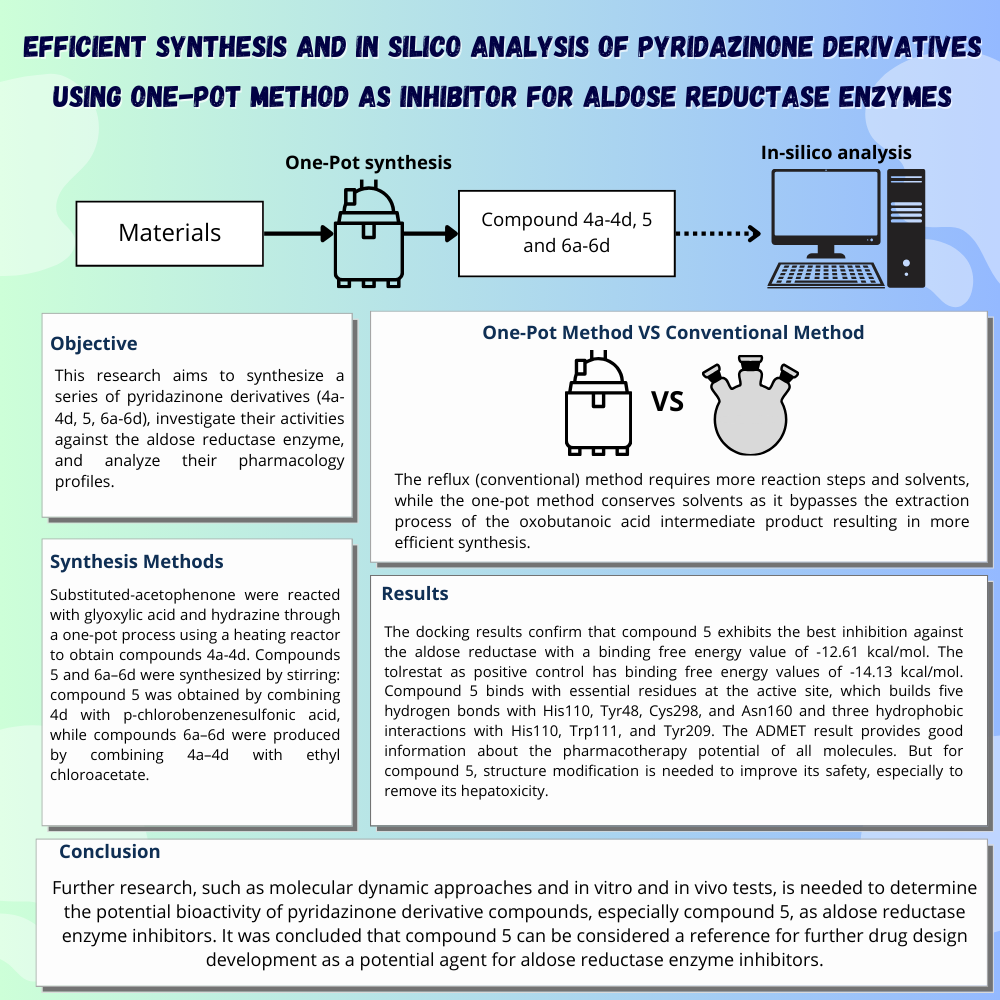
This research aims to synthesize a series of pyridazinone derivatives (4a-4d, 5, 6a-6d), investigate their activities against the aldose reductase enzyme, and analyze their pharmacology profiles. Substituted-acetophenone were reacted with glyoxylic acid and hydrazine through a one-pot process using a heating reactor to obtain compounds 4a - 4d. Meanwhile, compounds 5 and 6a - 6d using a stirring technique, were synthesized combining compound 4d with p-chloro benzene sulphonic acid for compound 5 and combining compounds 4a - 4d with ethyl chloro acetate to produce compounds 6a - 6d. The MOE 2021.010 software package was taken to perform the molecular docking analysis. The ADMET profiles were performed using online pre-ADME and ProTox II. In this research, 9 pyridazinone derivatives (4a-4d, 5, and 6a-6d) were synthesized. Three of them are new compounds, namely 6a, 6b, and 5. The docking results predicted that compound 5 exhibits the best inhibition against the aldose reductase with a binding free energy value of 12.61 kcal/mol. The tolrestat as positive control has binding free energy values of 14.13 kcal/mol. Compound 5 binds with essential residues at the active site, which builds 5 hydrogen bonds with His110, Tyr48, Cys298, and Asn160 and 3 hydrophobic interactions with His110, Trp111, and Tyr209. The ADMET result provides information about the pharmacotherapy potential of all molecules. But for compound 5, structure modification is needed to improve its safety, especially to remove its hepatoxicity. This information could support that compound 5 can be considered as a reference for further drug design development to be a potential agent for aldose reductase enzymes inhibitor.
HIGHLIGHTS
- The research demonstrates an efficient synthesis of Pyridazinone Derivatives using a one-pot reactor method.
- The compound structures were confirmed by IR, H-NMR, and MS spectrophotometers.
- The molecular docking results confirm that new compound 5 exhibits the best inhibition against the aldose reductase with a binding free energy value of −12.61 kcal/mol.
- Based on Lipinski’s rule of five and ADMET profiles, pyridazinone derivatives (5 and 6a-6d) have exhibited safe properties as drug candidates.
GRAPHICAL ABSTRACT
Downloads
References
R Kumar, P Saha, Y Kumar, S Sahana, A Dubey and P Om. A Review on diabetes mellitus: Type1 & type2. World Journal of Pharmacy and Pharmaceutical Sciences 2020; 9(10), 838-850.
SA Antar, NA Ashour, M Sharaky, M Khattab, NA Ashour, RT Zaid, EJ Roh, A Elkamhawy and AA Al-Karmalawy. Diabetes mellitus: Classification, mediators, and complications; A gate to identify potential targets for the development of new effective treatments. Biomedicine and Pharmacotherapy 2023; 168, 115734.
IW Suryasa, M Rodriguez-Gamez and T Koldoris. Health and treatment of diabetes mellitus. International Journal of Health Sciences 2021; 5(1), 1-5.
L Cloete. Diabetes mellitus: an overview of the types, symptoms, complications and management. Nursing Standard 2022; 37(1), 61-66.
D Tomic, JE Shaw and DJ Magliano. The burden and risks of emerging complications of diabetes mellitus. Nature Reviews Endocrinology 2022; 18(9), 525-539.
S Jannapureddy, M Sharma, G Yepuri, AM Shcmidt and R Ramasamy. Aldose reductase: An emerging target for development of interventions for diabetic cardiovascular complications. Frontiers in Endocrinology 2021; 12, 636267.
M Singh, A Kapoor and A Bhatnagar. Physiological and pathological roles of aldose reductase. Metabolites 2021; 11(10), 655.
M Bekhit and W Gorski. Determination of sorbitol dehydrogenase in microsamples of human serum. Talanta 2021; 235, 122730.
S Thakur, SK Gupta, V Ali, P Singh and M Verma. Aldose reductase: A cause and a potential target for the treatment of diabetic complications. Archives of Pharmacal Research 2021; 44(7), 655-667.
AS Grewal, S Bhardwaj, D Pandita, V Lather and BS Sekhon. Updates on aldose reductase inhibitors for management of diabetic complications and non-diabetic diseases. Mini-Reviews in Medicinal Chemistry 2016; 16(2), 120-162.
C Iacobini, M Vitale, C Pesce, G Pugliese and S Menini. Diabetic complications and oxidative stress: A 20‐year voyage back in time and back to the future. Antioxidants 2021; 10(5), 727.
Q Jin and RCW Ma. Metabolomics in diabetes and diabetic complications: Insights from epidemiological studies. Cells 2021; 10(11), 2832.
S Ahmad, MFA Ahmad, S Khan, S Alouffi, M Khan, C Prakash, MWA Khan and IA Ansari. Exploring aldose reductase inhibitors as promising therapeutic targets for diabetes-linked disabilities. International Journal of Biological Macromolecules 2024; 280, 135761.
A Danila, LA Ghenciu, ER Stoicescu, SL Bolintineanu, R Iacob, M Sandesc and AC Faur. Aldose reductase as a key target in the prevention and treatment of diabetic retinopathy: A comprehensive review. Biomedicines 2024; 12(4), 747.
P Kumari, R Kohal, Bhavana, GD Gupta and SK Verma. Selectivity challenges for aldose reductase inhibitors: A review on comparative SAR and interaction studies. Journal of Molecular Structure 2024; 1318, 139207.
M Imran and Abida. 6-(4-aminophenyl)-4,5-dihydro-3(2H)-pyridazinone - an important chemical moiety for development of cardioactive agents: A review. Tropical Journal of Pharmaceutical Research 2016; 15(7), 1579-1590.
MMF Ismail, DHS Soliman, MHA Elmoniem and GARA Jaleel. Synthesis, molecular modeling of novel substituted pyridazinones and their vasorelaxant activities. Medicinal Chemistry 2020; 17(2), 171-186.
AF Selim, FA Yassin and AM Salama. Green synthesized pyridazinone derivatives as promising biologically active and anticancer drugs. Egyptian Journal of Chemistry 2022; 65(3), 435-445.
MKS El-Nagar, MI Shahin, MF El-Behairy, ES Taher, MF El-Badawy, M Sharaky, DAAE Ella, KAM Abouzid and M Adel. Pyridazinone-based derivatives as anticancer agents endowed with anti-microbial activity: Molecular design, synthesis, and biological investigation. RSC Medicinal Chemistry 2024; 15(10), 3529-3557.
S Daoui, S Direkel, MM Ibrahim, B Tuzun, T Chelfi, M Al-Ghorbani, M bouatia, ME Karbane, A Doukkali, N Benchat and K Karrouchi. Synthesis, spectroscopic characterization, antibacterial activity, and computational studies of novel pyridazinone derivatives. Molecules 2023; 28(2), 678.
MM Almehmadi, AA Alsaiari and M Asif. Synthesis and in-vitro antimycobacterial evaluation of 4-Arylidene-2-Phenyl-6-(Aryl)-4,5-Dihydropyridazin-3(2H)-One derivatives. Pharmaceutical Chemistry Journal 2023; 57(2), 265-273.
EM Ahmed, AE Kassab, AA El-Malah and MSA Hassan. Synthesis and biological evaluation of pyridazinone derivatives as selective COX-2 inhibitors and potential anti-inflammatory agents. European Journal of Medicinal Chemistry 2019; 171, 25-37.
EO Osman, NA Khalil, A Magdy and Y El-Dash. Pyridazine and pyridazinone derivatives: Synthesis and in vitro investigation of their anti-inflammatory potential in LPS-induced RAW264.7 macrophages. Drug Development Research 2024; 85(2), e22173.
I Allart-Simon, A Moniot, N Bisi, M Ponce-Vargas, S Audonnet, M Laronze-Cochard, J Sapi, E Henon, F Velard and S Gerard. Pyridazinone derivatives as potential anti-inflammatory agents: synthesis and biological evaluation as PDE4 inhibitors. RSC Medicinal Chemistry 2021; 12(4), 584-592.
A Kotynia, E Krzyzak, J Zadło, M Witczak, L Szczukowski, J Mucha, P Swiatek and A Marciniak. Anti-Inflammatory and antioxidant pyrrolo[3,4-d]pyridazinone derivatives interact with dna and bind to plasma proteins—spectroscopic and in silico studies. International Journal of Molecular Sciences 2024; 25(3), 1784.
Z Ozdemir, MA Alagoz, AG Akdemir, AB Ozcelik, B Ozçelik and M Uysal. Studies on a novel series of 3(2H)-pyridazinones: Synthesis, molecular modelling, antimicrobial activity. Journal of Research in Pharmacy 2019; 23(5), 960-972.
HA Allam, AA Kamel, M El-Daly and RF George. Synthesis and vasodilator activity of some pyridazin-3(2H)-one based compounds. Future Medicinal Chemistry 2020; 12(1), 37-50.
F Chaudhry, AQ Ather, MJ Akhtar, A Shaukat, M Ashraf, M Al-Rashida, MA Munawar and MA Khan. Green synthesis, inhibition studies of yeast α-glucosidase and molecular docking of pyrazolylpyridazine amines. Bioorganic Chemistry 2017; 71, 170-180.
M Krasavin, A Shetnev, S Baykov, S Kalinin, A Nocentini, V Sharoyko, G Poli, T Tuccinardi, M Korsakov, TB Tennikova and CT Supuran. Pyridazinone-substituted benzenesulfonamides display potent inhibition of membrane-bound human carbonic anhydrase IX and promising antiproliferative activity against cancer cell lines. European Journal of Medicinal Chemistry 2019; 168, 301-314.
MF Sahin, B Badiccoglu, M Gokce, E Kupeli and E Yesilada. Synthesis and analgesic and antiinflammatory activity of methyl 6-substituted-3(2H)-pyridazinone-2-ylacetate derivatives. Archiv der Pharmazie 2004; 337(8), 445-452.
F Balestri, R Moschini, U Mura, M Cappiello and AD Corso. In search of differential inhibitors of aldose reductase. Biomolecules 2022; 12(4), 485.
Y Demir, FS Tokalı, E Kalay, C Turkes, P Tokalı, ON Aslan, K Sendil and S Beydemir. Synthesis and characterization of novel acyl hydrazones derived from vanillin as potential aldose reductase inhibitors. Molecular Diversity 2023; 27, 1713-1733.
K Askarova, S Mammadova, V Farzaliyev, A Sujayev, N Sadeghian, P Taslimi, N Kilinc, M Akkus, AR Sahin, S Alwasel and I Gulcin. Novel regioselective sulfamidomethylation of phenols: Synthesis, characterization, biological effects, and molecular docking study. Journal of the Indian Chemical Society 2024; 101(10), 101318.
GE Said, HM Metwally, E Abdel-Latif, MR Elnagar, HS Ibrahim and MA Ibrahim. Development of non-acidic 4-methylbenzenesulfonate-based aldose reductase inhibitors; Design, synthesis, biological evaluation and in-silico studies. Bioorganic Chemistry 2024; 151, 107666.
C Turkes, Y Demir, A Bicer, GT Cin, MS Gultekin and S Beydemir. Exploration of some bis-sulfide and bis-sulfone derivatives as non-classical aldose reductase inhibitors. ChemistrySelect 2023; 8(5), e202204350.
Y Dundar, O Kuyrukcu, G Eren, FSS Deniz, T Onkol and IE Orhan. Novel pyridazinone derivatives as butyrylcholinesterase inhibitors. Bioorganic Chemistry 2019; 92, 103304.
S Cruz, D Cifuentes, N Hurtado and M Roman. Sintesis de piridazin-3(2H)-onas asistida por microondas en condiciones libre de disolvente. Informacion Tecnologica 2016; 27(5), 57-62.
D Kweon, H Kim, J Kim, HA Chung, Y Yoon, WS Lee and S Kim. Arenesulfonylheterocycles (I): Synthesis and reactions of 2-benzenesulfonyl-4, 5-dichloropyridazin-3-ones with amines. Journal of Heterocyclic Chemistry 2002; 39(1), 203-211.
H Steuber, M Zentgraf, A Podjarny, A Heine and G Klebe. High-resolution crystal structure of aldose reductase complexed with the novel sulfonyl-pyridazinone inhibitor exhibiting an alternative active site anchoring group. Journal of Molecular Biology 2006; 356(1), 45-56.
D Obermayer, D Znidar, G Glotz, A Stadler, D Dallinger and CO Kappe. Design and performance validation of a conductively heated sealed-vessel reactor for organic synthesis. Journal of Organic Chemistry 2016; 81(23), 11788-11801.
R Cachau, E Howard, P Barth, A Mitschler, B Chevrier, V Lamour, A Lamour, A Joachimiak, R Sanishvili, MV Zandt, E Sibley, D Moras and A Podjarny. Model of the catalytic mechanism of human aldose reductase based on quantum chemical calculations. Journal de Physique IV 2000; 10(10), Pr10-3 - Pr10-13.
M Yaeghoobi, N Frimayanti, CF Chee, KK Ikram, BO Najjar, SM Zain, Z Abdullah, HA Wahab and NA Rahman. QSAR, in silico docking and in vitro evaluation of chalcone derivatives as potential inhibitors for H1N1 virus neuraminidase. Medicinal Chemistry Research 2016; 25(10), 2133-2142.
A Urzhumtsev, F Tete-Favier, A Mitschler, J Barbanton, P Barth, L Urzhumtseva, J Biellmann, AD Podjarny and D Moras. A “specificity” pocket inferred from the crystal structures of the complexes of aldose reductase with the pharmaceutically important inhibitors tolrestat and sorbinil. Structure 1997; 5(5), 601-612.
M Meyer, P Wilson and D Schomburg. Hydrogen bonding and molecular surface shape complementarity as a basis for protein docking. Journal of Molecular Biology 1996; 264(1), 199-210.
YS Lee, M Hodoscek, BR Brooks and PF Kador. Catalytic mechanism of aldose reductase studied by the combined potentials of quantum mechanics and molecular mechanics. Biophysical Chemistry 1998; 70(3), 203-216.
MG Salem, YAA Aziz, M Elewa, MS Nafie, HA Elshihawy and MM Said. Synthesis, molecular modeling, selective aldose reductase inhibition and hypoglycemic activity of novel meglitinides. Bioorganic Chemistry 2021; 111, 104909.
A Kousaxidis, A Petrou, V Lavrentaki, M Fesatidou, I Nicolaou and A Geronikaki. Aldose reductase and protein tyrosine phosphatase 1B inhibitors as a promising therapeutic approach for diabetes mellitus. European Journal of Medicinal Chemistry 2020; 207, 112742.
M Rashid. Design, synthesis and ADMET prediction of bis-benzimidazole as anticancer agent. Bioorganic Chemistry 2020; 96, 103576.
S Tian, J Wang, Y Li, D Li, L Xu and T Hou. The application of in silico drug-likeness predictions in pharmaceutical research. Advanced Drug Delivery Reviews 2015; 86, 2-10.
CM Chagas, S Moss and L Alisaraie. Drug metabolites and their effects on the development of adverse reactions: Revisiting lipinski’s rule of five. International Journal of Pharmaceutics 2018; 549(1-2), 133-149.
MA Ramirez and NL Borja. Epalrestat: An aldose reductase inhibitor for the treatment of diabetic neuropathy. Pharmacotherapy 2008; 28(5), 646-655.
H Yaribeygi, M Ashrafizadeh, NC Henney, T Sathyapalan, T Jamialahmadi and A Sahebkar. Neuromodulatory effects of anti-diabetes medications: A mechanistic review running. Pharmacological Research 2020; 152, 104611.
WA Banks. The blood-brain barrier interface in diabetes mellitus: Dysfunctions, mechanisms and approaches to treatment. Current Pharmaceutical Design 2020; 26(13), 1438-1447.
X Li, H Wu, H Huo, F Ma, M Zhao, Q Han, L Hu, Y Li, H Zhang, J Pan, Z Tang and J Guo. N-acetylcysteine combined with insulin alleviates the oxidative damage of cerebrum via regulating redox homeostasis in type 1 diabetic mellitus canine. Life Sciences 2022; 308, 120958.
SK Singh, GR Valicherla, AK Bikkasani, SH Cheruvu, Z Hossain, I Taneja, H Ahmad, KSR Raju, NS Sangwan, SK Singh, AK Dwiedi, M Wahajuddin and JR gayen. Elucidation of plasma protein binding, blood partitioning, permeability, CYP phenotyping and CYP inhibition studies of Withanone using validated UPLC method: An active constituent of neuroprotective herb Ashwagandha. Journal of Ethnopharmacology 2021; 270, 113819.
J Qiu, J Zhang and A Li. Cytotoxicity and intestinal permeability of phycotoxins assessed by the human Caco-2 cell model. Ecotoxicology and Environmental Safety 2023; 249, 114447.
BL Bernardoni, I D’Agostino, F Sciano and CL Motta. The challenging inhibition of aldose reductase for the treatment of diabetic complications: A 2019-2023 update of the patent literature. Expert Opinion on Therapeutic Patents 2024; 34(11), 1085-1103.
S Ryder, B Sarokhan, DG Shand and JF Mullane. Human safety profile of tolrestat: An aldose reductase inhibitor. Drug Development Research 1987; 11(2), 131-143.
B Sever, MD Altıntop, Y Demir, N Yılmaz, GA Ciftci, S Beydemir and A Ozdemir. Identification of a new class of potent aldose reductase inhibitors: Design, microwave-assisted synthesis, in vitro and in silico evaluation of 2-pyrazolines. Chemico-Biological Interactions 2021; 345, 109576.
G Yapar, HE Duran, N Lolak, S Akocak, C Turkes, M Durgun, M Isik and S Beydemir. Biological effects of bis-hydrazone compounds bearing isovanillin moiety on the aldose reductase. Bioorganic Chemistry 2021; 117, 105473.

Downloads
Published
How to Cite
Issue
Section
License
Copyright (c) 2024 Walailak University

This work is licensed under a Creative Commons Attribution-NonCommercial-NoDerivatives 4.0 International License.





