
Effect of Filler Size on the Properties of Oil Palm Empty Fruit Bunch High-Load Filler Biocomposite
DOI:
https://doi.org/10.48048/tis.2025.9374Keywords:
Biocomposite, Epoxy resin, Empty palm oil fruit bunches, Filler size, Physical property, Mechanical property, Thermal propertyAbstract
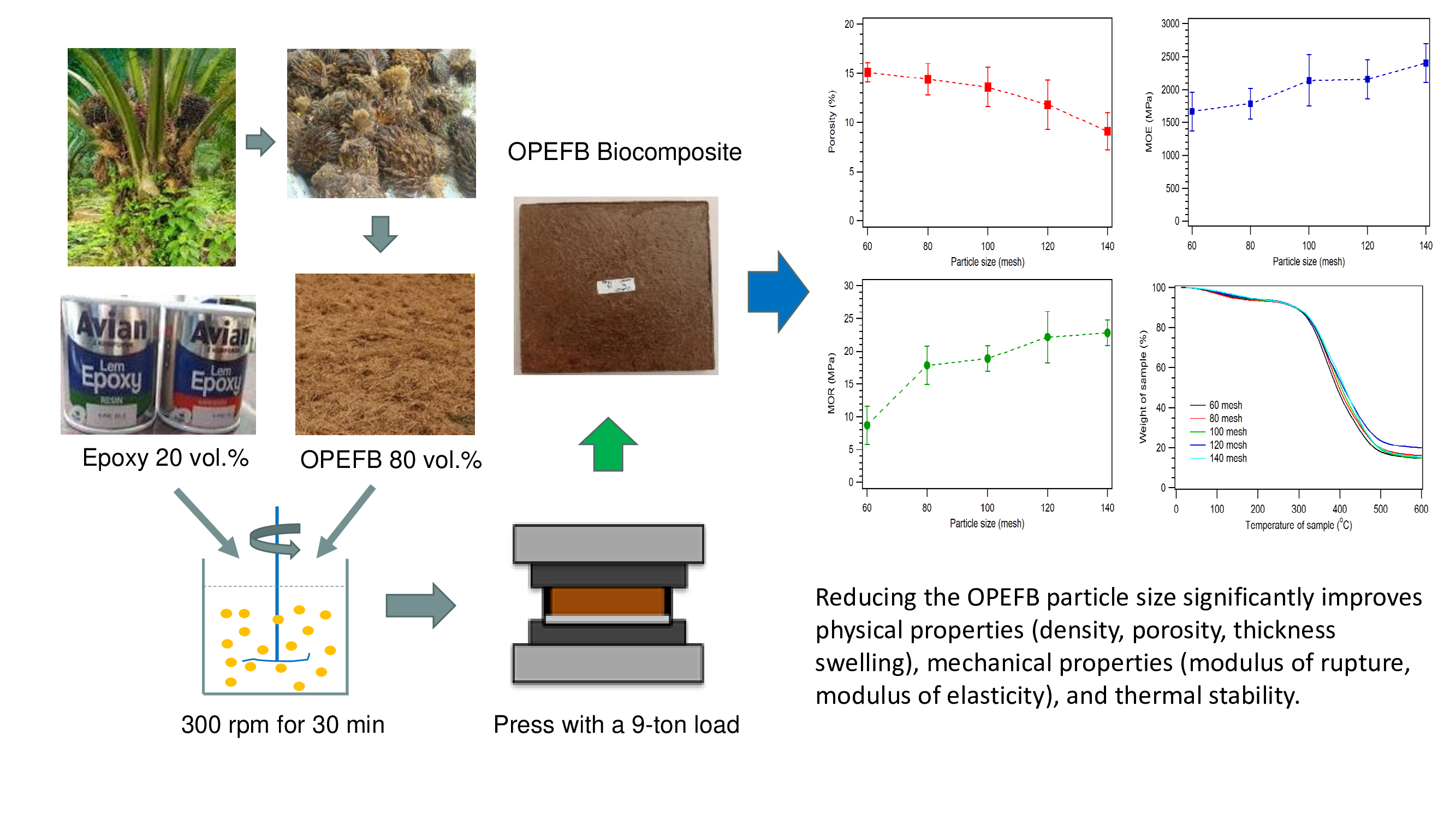
This work aimed to study the effect of filler size on the performance of an empty palm oil fruit bunch (OPEFB) high-load filler epoxy resin biocomposite (80 vol.% OPEFB and 20 vol.% epoxy resin). The particle sizes of OPEFBs used to prepare the biocomposites were 60, 80, 100, 120 and 140 mesh. The biocomposite samples were prepared by the press method. The physical (density, porosity, thickness swelling), mechanical, and thermal properties of the biocomposite were evaluated. A universal testing machine, thermogravimetric analysis, and scanning electron microscopy were utilized to characterize the biocomposite samples. The results show that the physical, mechanical, and thermal properties of the OPEFB epoxy resin biocomposite are significantly affected by the particle size of OPEFBs. As the particle size was reduced from 0.250 to 0.105 mm, the density improved from 0.974 to 1.101 g/cm3, the porosity decreased from 15.1 to 9.1 %, and the thickness swelling decreased from 14.2 to 7.4 %. The modulus of rupture and modulus of elasticity improved from 9.7 to 22.8 MPa and 1,667 to 2,403 MPa, respectively. Thermal analysis indicated that finer fillers enhanced thermal stability. The OPEFB biocomposite remained stable up to 300 °C. Smaller filler sizes exhibited improved biocomposite properties, which were attributed to better interfacial bonding and uniform dispersion within the matrix. The results of this study demonstrate that the performance of biocomposites can be significantly enhanced by reducing the size of the fillers. These findings indicate that filler size is crucial for high-load filler biocomposites.
HIGHLIGHTS
- A biocomposite consisting of 80 vol.% empty palm oil fruit bunch (OPEFB) filler and 20 vol.% epoxy resin has been successfully prepared.
- The performance of high-load filler biocomposites is critically dependent on filler size.
- Reducing the OPEFB particle size significantly improves physical properties (density, porosity, thickness swelling), mechanical properties (modulus of rupture, modulus of elasticity), and thermal stability.
- The 140-mesh OPEFB biocomposite meets ANSI 208.1 requirements for particle board type H-1, while 80- to 140-mesh sizes meet grade M-1 requirements, indicating potential for practical applications.
GRAPHICAL ABSTRACT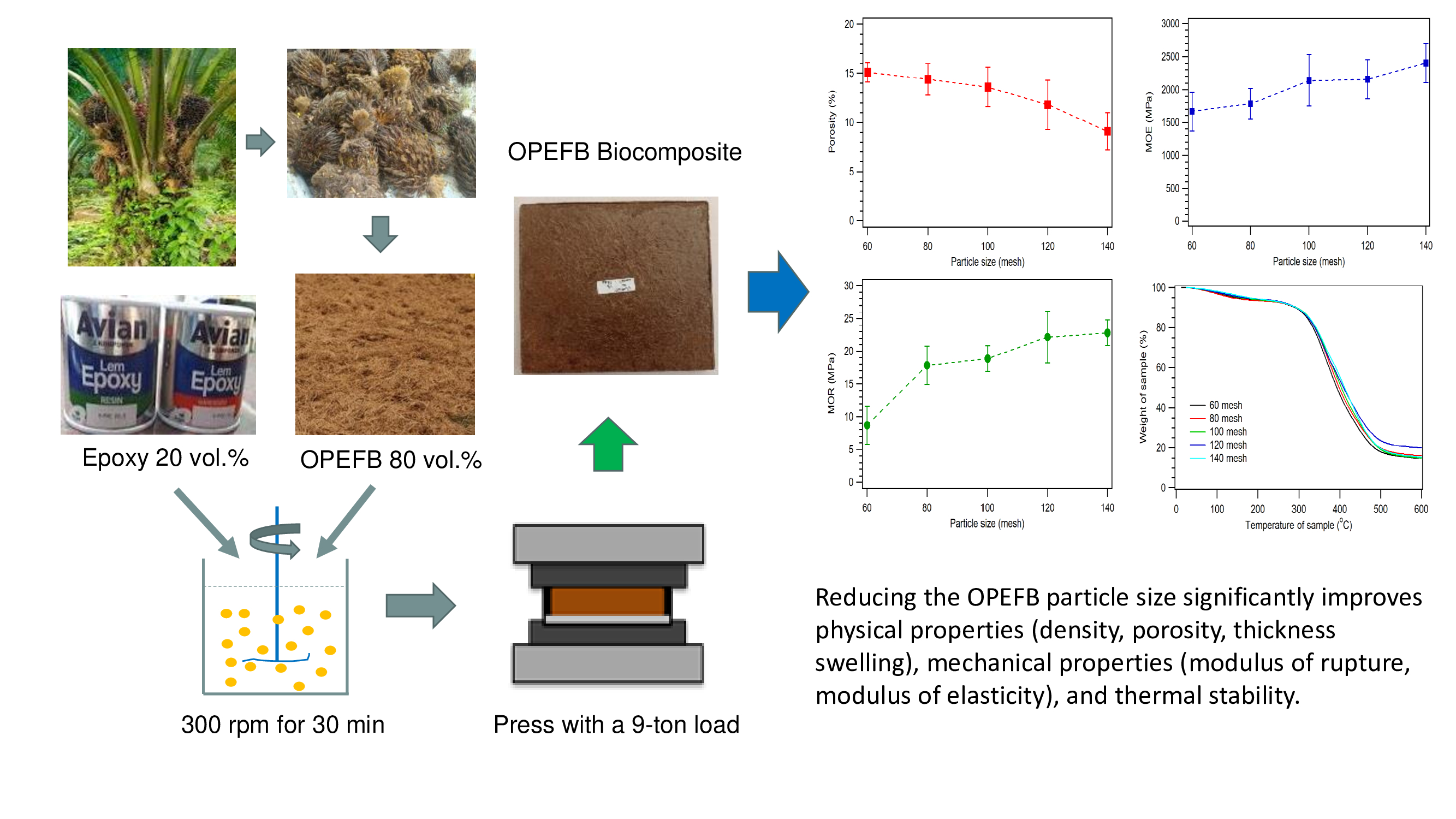
Downloads
References
AK Mohanty, M Misra and LT Drzal. Sustainable biocomposites from renewable resources: Opportunities and challenges in the green materials world. Journal of Polymers and the Environment 2002; 10(1), 19-26.
KL Pickering, MGA Efendy and TM Le. A review of recent developments in natural fibre composites and their mechanical performance. Composites Part A: Applied Science and Manufacturing 2016; 83, 98-112.
R Dungani, M Karina, Subyakto, A Sulaeman, D Hermawan and A Hadiyane. Agricultural waste fibers towards sustainability and advanced utilization: A review. Asian Journal of Plant Sciences 2016; 15(1), 42-55.
AK Mohanty, S Vivekanandhan, JM Pin and M Misra. Composites from renewable and sustainable resources: Challenges and innovations. Science 2018; 362(6414), 536-542.
F Ortega, F Versino, OV López and MA Garcia. Biobased composites from agro-industrial wastes and by-products. Emergent Materials 2021; 5(3), 873-921.
R Mahjoub, JBM Yatim and ARM Sam. A review of structural performance of oil palm empty fruit bunch fiber in polymer composites. Advances in Materials Science and Engineering 2013; 2013(4), 9.
MK Faizi, SA Bakar, MSA Majid, SBM Tamrin, HA Israr, AA Rahman, NY Guan, ZM Razlan, NA Kamis and W Khairunizam. Tensile characterizations of oil palm empty fruit bunch (OPEFB) fibres reinforced composites in various Epoxy/Fibre fractions. Biointerface Research in Applied Chemistry 2022; 12(5), 6148-6163.
K Thiruppathi, R Saravanan, SM Rangappa and S Siengchin. Effect of filler content and size on the mechanical properties of graphene-filled natural fiber-based nanocomposites. Biomass Conversion and Biorefinery 2023; 13(12), 11311-11320.
LO Ejeta, Y Zheng and Y Zhou. The influence of filler concentrations and processing parameters on the mechanical properties of uncompatibilized CS/HDPE biocomposites. Mechanics of Composite Materials 2024; 60(2), 659-670.
H Jaya, MF Omar, HM Akil, ZA Ahmad and NN Zulkepli. Effect of particle size on mechanical properties of sawdust-high density polyethylene composites under various strain rates. BioResources 2016; 11(3), 6489-6504.
G Ma, D Wang, B Xiao and Z Ma. Effect of particle size on mechanical properties and fracture behaviors of age-hardening SiC/Al-Zn-Mg-Cu composites. Acta Metallurgica Sinica 2021; 34(10), 1447-1459.
M Ramesh, LR Kumar, N Srinivasan, DV Kumar and D Balaji. Influence of filler material on properties of fiber-reinforced polymer composites: A review. E-Polymers 2022; 22(1), 898-916.
I Ismail, Q Aini, CK Maulida, M Mursal, Z Jalil and SHSM Fadzullah. Thermal properties of spent coffee ground biocomposite using epoxy resin matrix. AIP Conference Proceedings 2023; 2613(1), 020009.
AAA Abdelmagid, AIB Idriss and CM Yang. Effects of particle size on mechanical properties and forming accuracy of Prosopis chilensis Powder/Polyethersulfone composites produced via selective laser sintering. Polymers 2024; 16(13), 1786.
I Ismail, Q Aini, Zulfalina, Z Jalil and SHSM Fadzullah. Particle size effect on mechanical and physical properties of rice straw epoxy resin particleboard. International Journal on Advanced Science, Engineering and Information Technology 2020; 10(3), 1221-1227.
R Kamarudzaman, A Kalam, NN Ahmad, NWA Razak and Z Salleh. Effects of oil palm empty fruit bunch (OPEFB) fibre size on fracture toughness of OPEFB filled polymer nanocomposite. Advanced Materials Research 2014; 871, 189-193.
MTF Garcia, AF Garcia, TG Ortuño, CEF Garcia and MF Villena. Influence of particle size on the properties of boards made from Washingtonia palm rachis with citric acid. Sustainability 2020; 12(12), 4841.
H Sharma, I Singh and JP Misra. Effect of particle size on physical, thermal and mechanical behaviour of epoxy composites reinforced with food waste fillers. Proceedings of the Institution of Mechanical Engineers, Part C: Journal of Mechanical Engineering Science 2020; 235(16), 3029-3035.
N Abdullah and F Sulaiman. The properties of the washed empty fruit bunches of oil palm. Journal of Physical Science 2013; 24(2), 117-137.
MZM Yusoff, MS Salit, N Ismail and R Wirawan. Mechanical properties of short random oil palm fibre reinforced epoxy composites. Sains Malaysiana 2010; 39(1), 87-92.
ALA Ghazilan, H Mokhtar, MSI Dawood, Y Aminanda and JSM Ali. Tensile mechanical property of oil palm empty fruit bunch fiber reinforced epoxy composites. IOP Conference Series Materials Science and Engineering 2017; 184(1), 012046.
A Kalam, BB Sahari, YA Khalid and SV Wong. Fatigue behaviour of oil palm fruit bunch fibre/epoxy and carbon fibre/epoxy composites. Composite Structures 2005; 71(1), 34-44.
F Hanan, M Jawaid, MT Paridah and J Naveen. Characterization of hybrid oil palm empty fruit bunch/woven kenaf fabric-reinforced epoxy composites. Polymers 2020; 12(9), 2052.
MRM Asyraf, MR Ishak, A Syamsir, NM Nurazzi, FA Sabaruddin, SS Shazleen, MNF Norrrahim, M Rafidah, RA Ilyas, MZA Rashid and MR Razman. Mechanical properties of oil palm fibre-reinforced polymer composites: A review. Journal of Materials Research and Technology 2022; 17, 33-65.
HA Aisyah, E Hishamuddin, AW Noorshamsiana, Z Ibrahim and RA Ilyas. Oil palm fiber hybrid composites: A recent review. Journal of Renewable Materials 2024; 12(10), 1661-1689.
AM Clayton. Epoxy resins: Chemistry and technology. Marcel Dekker Inc., New York, 1987.
Y Sudiyani, D Styarini, E Triwahyuni, Sudiyarmanto, KC Sembiring, Y Aristiawan, H Abimanyu and MH Han. Utilization of biomass waste empty fruit bunch fiber of palm oil for bioethanol production using pilot-scale unit. Energy Procedia 2013; 32, 31-38.
R Lusiani and YS Ardiansah. Utilization of empty oil palm bunch waste as composite board with fiber length variations. Jurnal Teknik Mesin Untirta 2015; 1(1), 46-54.
M Karina, H Onggo, AHD Abdullah and A Syampuradi. Effect of oil palm empty fruit bunch fiber on the physical and mechanical properties of fiber glass reinforced polyester resin. Journal of Biological Sciences 2008; 8(1), 101-106.
I Ismail, Arliyani, Z Jalil, Mursal, NG Olaiya, CK Abdullah, MRN Fazita and HPSA Khalil. Properties and characterization of new approach organic nanoparticle‐based biocomposite board. Polymers 2020; 12(10), 2236.
T W Fang, NSSN Asyikin, HPSA Khalil, MHM Kassim and MI Syakir. Water absorption and thickness swelling of oil palm empty fruit bunch (OPEFB) and seaweed composite for soil erosion mitigation. Journal of Physical Science 2017; 28(2), 1-17.
M Khalid, CT Ratnam, TG Chuah, S Ali and TSY Choong. Comparative study of polypropylene composites reinforced with oil palm empty fruit bunch fiber and oil palm derived cellulose. Materials and Design 2008; 29(1), 173-178.
RS Ayu, A Khalina, AS Harmaen, K Zaman, T Isma, Q Liu, RA Ilyas and CH Lee. Characterization study of empty fruit bunch (EFB) fibers reinforcement in poly(Butylene) succinate (PBS)/starch/glycerol composite sheet. Polymers 2020; 12(7), 1571.
Downloads
Published
How to Cite
Issue
Section
License
Copyright (c) 2025 Walailak University

This work is licensed under a Creative Commons Attribution-NonCommercial-NoDerivatives 4.0 International License.





