
Ability of Fourier Transform-Near Infrared Spectroscopy to Detect Organophosphate (OP) Pesticides and Reduction of OP using a Washing Process
DOI:
https://doi.org/10.48048/tis.2025.9359Keywords:
NIR spectroscopy, DESIR, Organophosphate, Pesticide residues, Washing, Food safetyAbstract
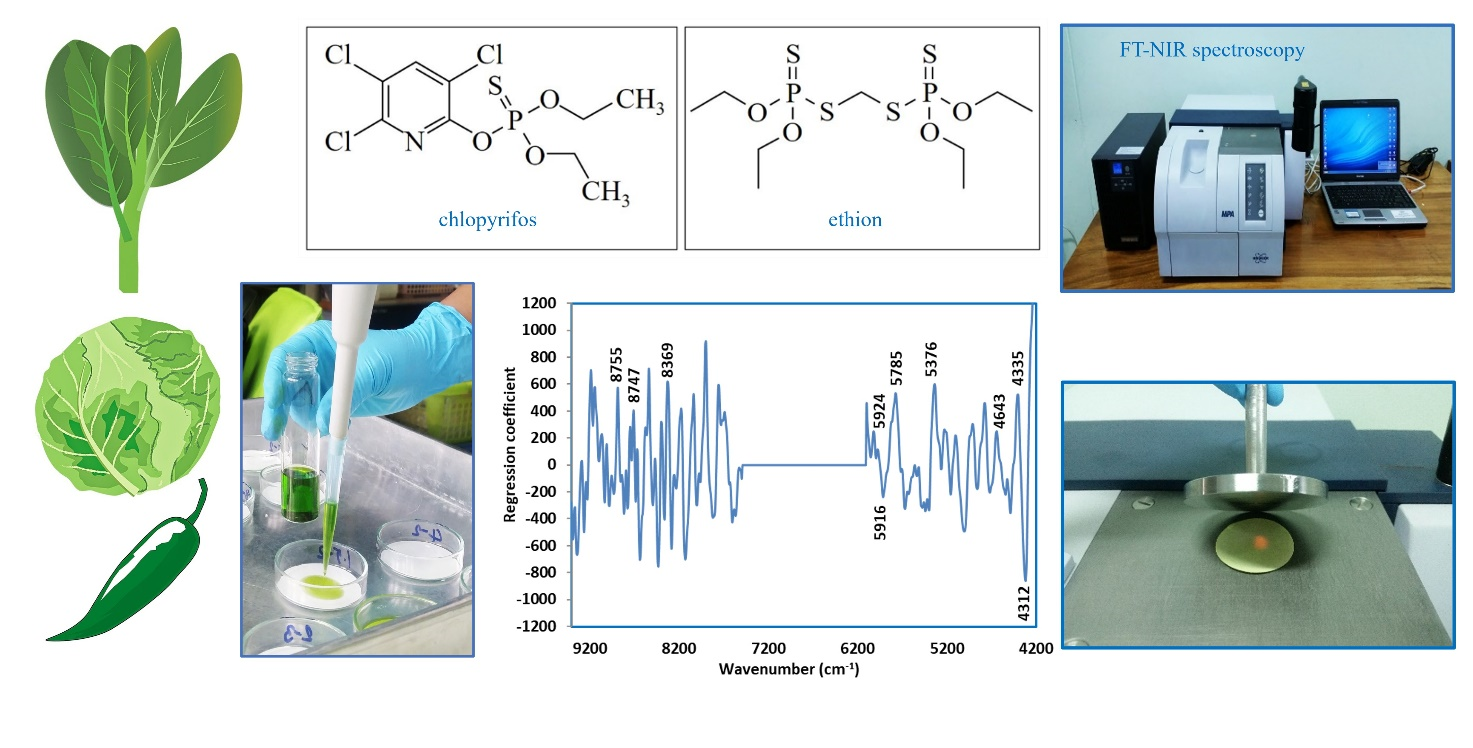
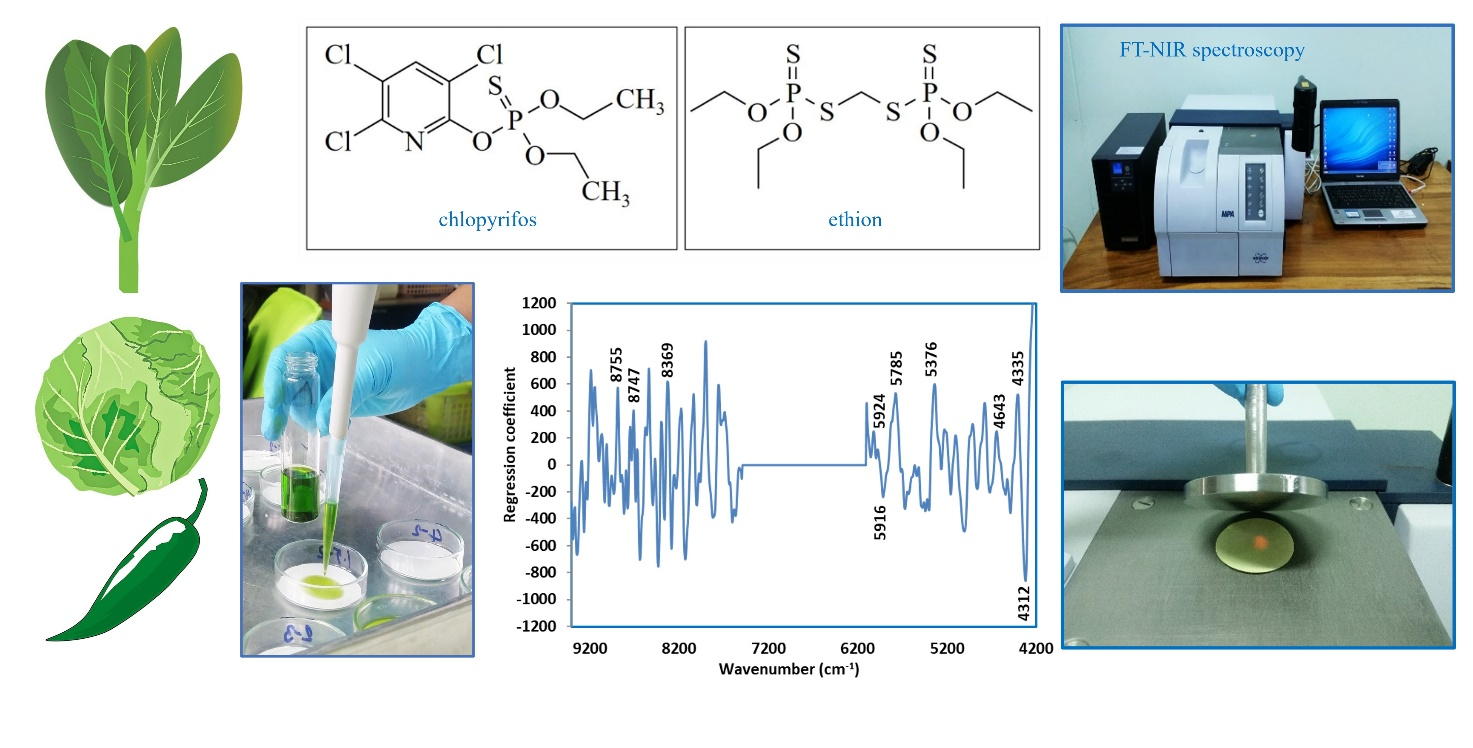
Since December 2020, the Thai Department of Agriculture (Thai DOA) placed chlorpyrifos on the banned chemical list, based on evidence the organophosphate (OP) class of pesticides was shown adverse effects on human health and environment. However, the use of this organophosphate class of pesticides have been found contamination in vegetable and fruit such as grave imported from China. The Fourier transform-near infrared (FT-NIR) spectroscopy combined with the dry extract system for infrared (DESIR) technique have been succeeded on detecting chlorpyrifos and ethion residues in spiked Chinese kale, head cabbage and green chili spur pepper employed as a vegetable model. Chinese kale, head cabbage and green chili spur pepper was spiked with chlorpyrifos and ethion at 0.44 - 111.29 mg/kg were detected using the quick, easy, cheap, effective, rugged and safe (QuEChERS) method coupled with gas chromatography-mass spectrometry (GC-MS). Partial least squares regression (PLSR) was used to develop a calibration equation. FT-NIR combined with DESIR and PLSR produced an equation that showed good performance and provided the best calibration equations based on values for R2 (0.88 - 0.94), SEP (7.65 - 11.36 mg/kg), RMSEP (7.68 - 11.80 mg/kg), bias (−3.83 to 3.32 mg/kg) and RPD (3.03 - 4.10). These statistics revealed no significant difference between FT-NIR-predicted values and actual values at a confidence interval of 95 %. After applying ozonated water (1 mg/L) and EO water (available free Cl2 at 70 mg/L) for 10 min resulted in 67 % reduction in chlorpyrifos and ethion levels in Chinese kale, head cabbage and green chili spur pepper. Since this developed method was limit to predict the amounts of residues (≤ 30 mg/kg) but it could be applied to monitor pesticide residues at harvesting, or inspection of incoming raw materials before entering food chain to ensure the safety of the vegetable for human consumption.
HIGHLIGHTS
- Common Thai fresh produce: Chinese kale (Brassica oleracea var alboglabra), head cabbage (Brassica oleracea capitate) and green chili spur pepper (Capsicum annuum Linn. var acuminatum Fingerh) are common green, and top 10 leafy vegetable for consumption in Thailand.
- Organophosphate (OP) pesticides contamination: OP pesticides are a class of insecticides have been approved in vegetable crop production in Thailand. Since 2020, they were prohibited to use but the OP residue contamination in Thai fresh vegetable have still been reported. Due to their acute toxicity and widespread use, there are global concerns about trace residues may pose significant long-term health risks.
- Detection of OP pesticide residues in vegetable by Fourier transform-near infrared (FT-NIR) spectroscopy: FT-NIR combined with the dry-extract system for near infrared (DESIR) technique and Partial least squares regression (PLSR) showed good performance in detecting chlorpyrifos and ethion residues in vegetable. The best calibration equations provided good prediction based on values for R2, SEP, RMSEP, bias and RPD. No significant difference between FT-NIR-predicted values and actual values at a confidence interval of 95 %, with agreeable results presented at pesticides residue levels of more than 30 mg/kg.
- Washing process with oxidizing water: Ozonated water (1 mg/L) and electrolyzed oxidizing (EO) water (available free Cl2 at 70 mg/L) for 10 min were applied to wash spiked samples and resulted in 67 % reduction of chlorpyrifos and ethion levels in Chinese kale, head cabbage and green chili spur pepper.
GRAPHICAL ABSTRACT
Downloads
References
Department of Agricultural Extension Thailand. Chinese kale, Available at: http://www.agriinfo.doae.go.th/year60/plant/rortor/veget/17.pdf, accessed January 2019.
MK Kim, JH Jang, P Potchanasin, WB Chae, EH Yoo and KT Ryoun. Current status and breeding perspectives of major vegetable crops in Thailand. Journal of the Korean Society of International Agriculture 2019; 31(1), 67-75.
Rapid Alert System for Food and Feed. The rapid alert system for food and feed annual report 2019, Available at: https://op.europa.eu/en/publication-detail/-/publication/2c5c7729-0c31-11eb-bc07-01aa75ed71a1/language-en/format-PDF/source-174742448, accessed May 2021.
Thai Pesticide Alert Network, Available at: https://thaipan.org/, accessed September 2024.
The United States Food and Drug Administration. Pesticide residue monitoring program fiscal year 2017 pesticide report, Available at: https://www.fda.gov/media/130291/download, accessed May 2021.
A Sankom, W Mahakarnchanakul, R Rittiron, T Sajjaanantakul and T Thongket. Detection of profenofos in Chinese kale, cabbage, and chili spur pepper using fourier transform near-infrared and fourier transform mid-infrared spectroscopies. ACS Omega 2021; 6(40), 26404-26415.
Bangkok Post. Alarm raised about contaminated grapes-Hazardous chemicals above legal limit found in many samples of Shine Muscat grapes, Available at: https://www.bangkokpost.com /thailand/general/2890277/alarm-raised-about-contaminated-grapes, accessed October 2024.
National Bureau of Agricultural Commodity and Food Standards of Thailand. Thai agricultural standard: Pesticides residues-maximum residue limits, Available at: https://www.acfs.go.th/ standard/download/MAXIMUM-RESIDUE-LIMITS.pdf, accessed May 2021.
Office of Agricultural Economics of Thailand. Quantity and value of pesticides imports to Thailand, Available at: https://www.doa.go.th/ard /?page_id=386, accessed May 2021.
The Ministry of Agriculture and Cooperatives (Thailand). Notification of the Ministry of Agriculture and Cooperatives: Restrictions on use, labeling and container for hazardous substances related chlorpyrifos (in Thai), Available at: https://www.doa.go.th/ard/wp-content/uploads/ 2019/11/HAMOA09_-chlorpyrifos.pdf, accessed May 2021.
T Silipunyo, S Hongsibsong, C Phalaraksh, S Laoyang, T Kerdnoi, V Patarasiriwong and T Prapamontol. Determination of organophosphate pesticides residues in fruits, vegetables and health risk assessment among consumers in Chiang Mai province, Northern Thailand. Research Journal of Environmental Toxicology 2017; 11, 20-27.
A Duangchinda, B Anurugsa and N Hungspreug. The use of organophosphate and carbamate pesticides on paddy fields and cholinesterase levels of farmers in Sam Chuk District, Suphan Buri province, Thailand. Science and Technology Asia 2014; 19(1), 39-51.
S Ooraikul, W Siriwong, S Siripattanakul, S Chotpantarat and M Robson. Risk assessment of organophosphate pesticides for chili consumption from chili farm area, Ubon Ratchathani province, Thailand. Journal of Health Research 2011; 25, 141-146.
S Wanwimolruk, O Kanchanamayoon, K Phopin and V Prachayasittikul. Food safety in Thailand 2: Pesticide residues found in Chinese kale (Brassica oleracea), a commonly consumed vegetable in Asian countries. Science of the Total Environment 2015; 532, 447-455.
R Sapbamrer and S Hongsibsong. Organophosphorus pesticide residues in vegetables from farms, markets, and a supermarket around Kwan Phayao Lake of Northern Thailand. Archives of Environmental Contamination and Toxicology 2014; 67, 60-67.
S Wanwimolruk, K Phopin, S Boonpangrak and V Prachayasittikul. Food safety in Thailand 4: Comparison of pesticide residues found in 3 commonly consumed vegetables purchased from local markets and supermarkets in Thailand. Peer J 2016; 4, e2432.
Y Ozaki, WF McClure and A Christy. Near-infrared spectroscopy in food science and technology. Wiley, New Jersey, 2006.
I Saranwong and S Kawano. Rapid determination of fungicide contaminated on tomato surfaces using the DESIR-NIR: A system for ppm-order concentration. Journal of Near Infrared Spectroscopy 2005; 13(3), 169-175.
DW Sun. Infrared spectroscopy for food quality analysis and control. 1st ed. Academic Press, Massachusetts, 2009.
LS Chaparro, AJ Gaitán-Jurado, V Ortiz-Somovilla and F Peña-Rodríguez. Feasibility of using NIR spectroscopy to detect herbicide residues in intact olives. Food Control 2013; 30(2), 504-509.
D Fen, H Tiansheng, Z Kun and H Ya. Nondestructive detection of pesticide residue on longan surface based on near infrared spectroscopy. In: Proceedings of the International Conference on Intelligent Computation Technology and Automation, Changsha, China. 2010, p. 781-783.
MT Sánchez, KF Rojas, JE Guerrero, AG Varo and DP Marín. Measurement of pesticide residues in peppers by near-infrared reflectance spectroscopy. Pest Management Science 2010; 66(6), 580-586.
L Xue, J Cai, J Li and M Liu. Application of particle swarm optimization (PSO) algorithm to determine dichlorvos residue on the surface of Navel orange with Vis-NIR spectroscopy. Procedia Engineering 2012; 29, 4124-4128.
B Jamshidi, E Mohajerani, J Jamshidi, S Minaei and A Sharifi. Non-destructive detection of pesticide residues in cucumber using visible/near-infrared spectroscopy. Food Additives and Contaminants: Part A 2015; 32(6), 857-863.
A Lerdkuson, P Duangsuwan, N Komonsing, P Khuwijitjaru and B Mahayothee. Development of a rapid method for chlorpyrifos residue determination in yard long bean using near infrared spectroscopy (in Thai). Agricultural Science Journal 2015; 46, 347-350.
S Rungchang, S Numthuam, R Charoensook, P Thongkum and C Junmatong. Method development for pesticide determination in paddy rice using near infrared spectroscopy. International Journal of Agricultural Technology 2018; 14, 123-129.
P Theanjumpol, W Maneewan, P Noimanee and D Boonyakiat. Identification of pesticide residues by NIR spectroscopy (in Thai). Agricultural Science Journal 2011; 42, 25-28.
J Hao, H Liu, T Chen, Y Zhou, YC Su and L Li. Reduction of pesticide residues on fresh vegetables with electrolyzed water treatment. Journal of Food Science 2011; 76(4), C520-C524.
A Heshmati and F Nazemi. Dichlorvos (DDVP) residue removal from tomato by washing with tap and ozone water, a commercial detergent solution and ultrasonic cleaner. Food Science and Technology 2018; 38(3), 441-446.
H Qi, Q Huang and YC Hung. Effectiveness of electrolyzed oxidizing water treatment in removing pesticide residues and its effect on produce quality. Food Chemistry 2018; 239, 561-568.
A Sankom. 2012, Application of oxidizing agents on washing process to reduce organophosphate pesticides residues on fresh vegetable. Master Thesis. Kasetsart University, Bangkok, Thailand.
M Anastassiades, SJ Lehotay, D Štajnbaher and FJ Schenck. Fast and easy multiresidue method employing acetonitrile extraction/partitioning and dispersive solid-phase extraction for the determination of pesticide residues in produce. Journal of the Association of Official Analytical Chemists International 2003; 86(2), 412-431.
M Araoud, W Douki, A Rhim, MF Najjar and N Gazzah. Multiresidue analysis of pesticides in fruits and vegetables by gas chromatography-mass spectrometry. Journal of Environmental Science and Health Part B 2007; 42(2), 179-187.
SHG Brondi, AN De MacEdo, GHL Vicente and ARA Nogueira. Evaluation of the QuEChERS method and gas chromatography-mass spectrometry for the analysis pesticide residues in water and sediment. Bulletin of Environmental Contamination and Toxicology 2011; 86, 18-22.
D Lu, Y Yang, X Luo and C Sun. A fast and easy GC-MS/MS method for simultaneous analysis of 73 pesticide residues in vegetables and fruits. Analytical Methods 2013; 5(7), 1721-1732.
M Clavaud, Y Roggo, K Dégardin, PY Sacré, P Hubert and E Ziemons. Global regression model for moisture content determination using near-infrared spectroscopy. European Journal of Pharmaceutics and Biopharmaceutics 2017; 119, 343-352.
P Williams and K Norris. Near-infrared analysis technology in the agricultural and food industry. 2nd ed. American Association of Cereal Chemists, Minnesota, United States, 2004, p. 145-169.
International Standard. Statistics for performance measurement. ISO 12099:2017(E): Animal feeding stuffs, cereals and milled cereal products - guidelines for application of near infrared spectrometer. International Standard, Geneva, Switzerland, 2017, p. 5-12.
BM Nicolai, K Beullens, E Bobelyn, A Peirs, W Saeys, KI Theron and J Lammertyn. Nondestructive measurement of fruit and vegetable quality by means of NIR spectroscopy: A review. Postharvest Biology and Technology 2007; 46, 99-118.
LS Magwaza, UL Opara, LA Terry, S Landahl, PJ Cronje, H Nieuwoudt, AM Mouazen, W Saeys and BM Nicolaï. Prediction of ‘Nules Clementine’mandarin susceptibility to rind breakdown disorder using Vis/NIR spectroscopy. Postharvest Biology and Technology 2012; 74, 1-10.
JJ Workman and L Weyer. Practical guide and spectral atlas for interpretive near-infrared spectroscopy. 2nd ed. CRC Press, Boca Raton, United States, 2012.
N Arias, S Arazuri and C Jarén. Ability of NIRS technology to determine pesticides in liquid samples at maximum residue levels. Pest Management Science 2013; 69(4), 471-477.
G Tang, K Tian, X Song, Y Xiong and S Min. Comparison of several supervised pattern recognition techniques for detecting additive methamidophos in rotenone preparation by near-infrared spectroscopy. Spectrochimica Acta Part A: Molecular and Biomolecular Spectroscopy 2014; 121, 678-684.
Y Zhang, B Xiang, Y Dong and J Xu. Rapid determination of prochloraz in orange juice by near-infrared spectroscopy. Analytical Letters 2013; 46(17), 2739-2751.
S Wang, B Xiang, Y Su and Q Tang. Direct determination of dichlorvos in water by partial least square-discriminant analysis. Environmental Chemistry Letters 2012; 10, 383-387.
JME Beseos, KF Yaptenco, EB Esguerra and EK Peralta. Evaluation of dry extract system involving NIR spectroscopy (DESIR) for pesticide residues detection on fresh Carabao mango (Mangifera indica L. cv ‘Carabao’) fruit. Journal of Advanced Agricultural Technologies 2018; 5(1), 24-30.
S Saranwong, S Kawano, CM Amari and M Yoshida. The reliability of pesticide determinations using near infrared spectroscopy and the dry-extract system for infrared (DESIR) technique. Journal of Near Infrared Spectroscopy 2007; 15(4), 227-236.
PC Ayala, MG El-Din and DW Smith. Kinetics and mechanism of the degradation of 2 pesticides in aqueous solutions by ozonation. Chemosphere 2010; 78(5), 557-562.
S Hongsibsong and R Sapbamrer. Removal of organophosphorus pesticide residues in leaf and non-leaf vegetables by using ozone water. Chiang Mai Journal of Science 2018; 45(4), 1759-1769.
S Wang, J Wang, T Wang, C Li and Z Wu. Effects of ozone treatment on pesticide residues in food: A review. International Journal of Food Science & Technology 2019; 54, 301-312.
FF Heleno, MEL de Queiroz, LR Faroni, AA Neves, AF de Oliveira, LP Costa and GG Pimenta. Aqueous ozone solutions for pesticide removal from potatoes. Food Science and Technology International 2016; 22(8), 752-758.
B Lozowicka, M Jankowska, I Hrynko and P Kaczynski. Removal of 16 pesticide residues from strawberries by washing with tap and ozone water, ultrasonic cleaning and boiling. Environmental Monitoring and Assessment 2016; 188, 51.
UK Acharya, PP Subedi and KB Walsh. Evaluation of a dry extract system involving NIR spectroscopy (DESIR) for rapid assessment of pesticide contamination of fruit surfaces. American Journal of Analytical Chemistry 2012; 3(8), 524-533.
Y Zhou, B Xiang, Z Wang and C Chen. Determination of chlorpyrifos residue by near-infrared spectroscopy in white radish based on interval partial least square (iPLS) model. Analytical Letters 2009; 42(10), 1518-1526.
J Wu, C Liu, Y Chen, Y Chen and Y Xu. Study on detection technology of pesticide residues in vegetables based on NIR. In: Proceedings of the International Conference on Computer and Computing Technologies in Agriculture II, Beijing, China. 2008, p. 2217-2222.
Downloads
Published
How to Cite
Issue
Section
License
Copyright (c) 2024 Walailak University

This work is licensed under a Creative Commons Attribution-NonCommercial-NoDerivatives 4.0 International License.





