
Evaluation of Antioxidant and Anti-Aging Activities of Thai Rice Germ Extracts
DOI:
https://doi.org/10.48048/tis.2025.9348Keywords:
Phytochemicals, Rice germ extract, Antioxidant, Anti-aging, LongevityAbstract
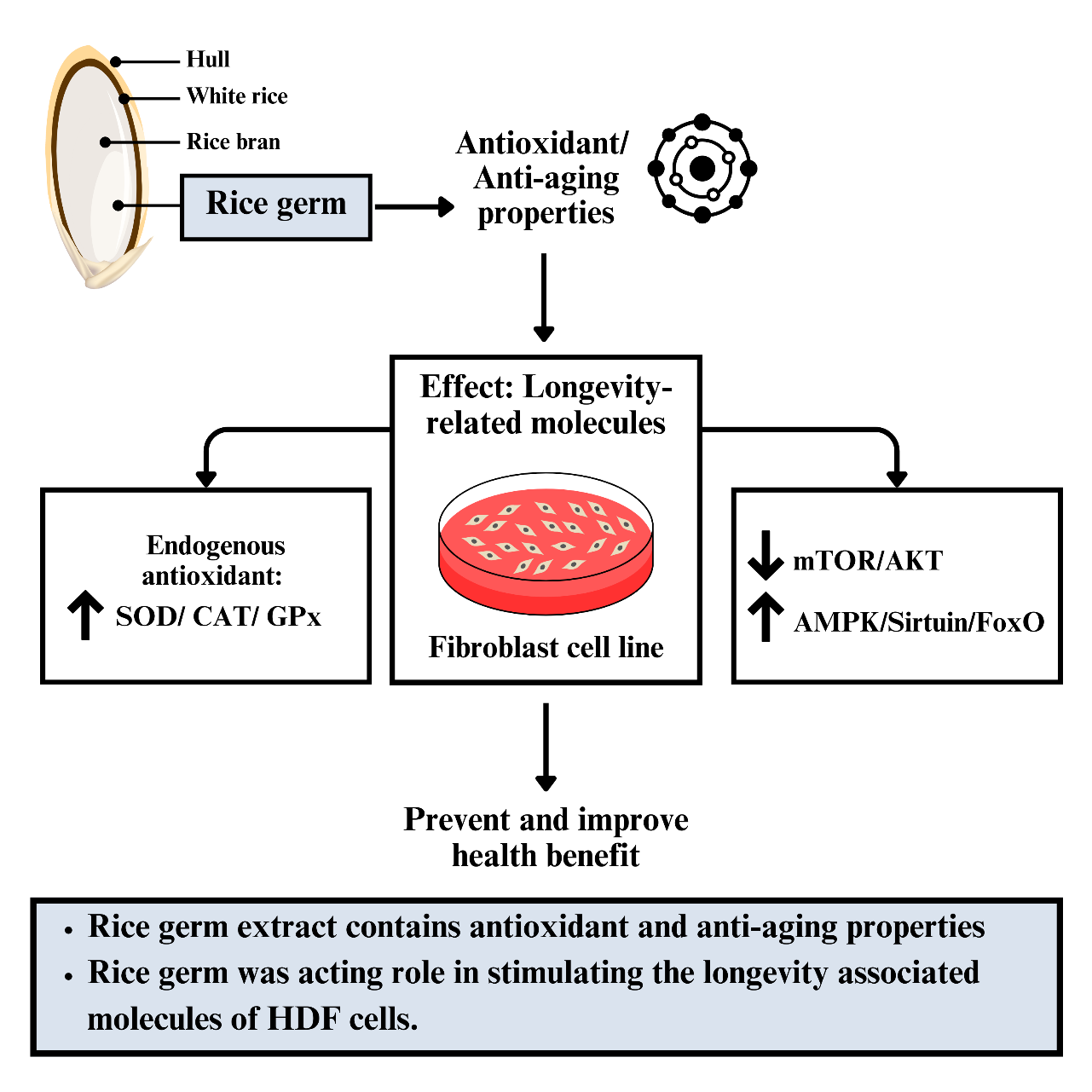
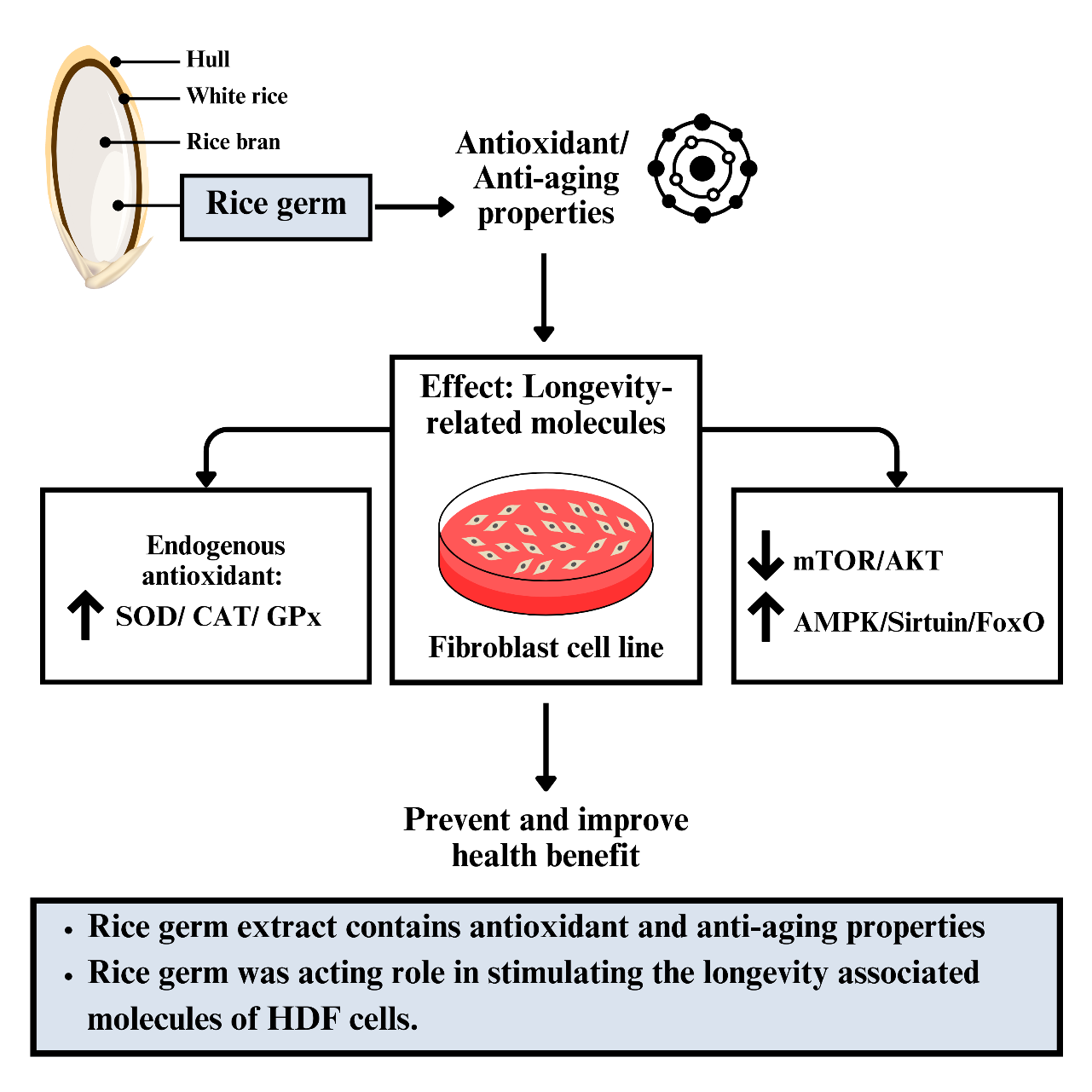
Aging in humans is a natural process characterized by the accumulation of oxygen-derived free radicals, leading to cellular and tissue damage and aging-related diseases. Bioactive compounds from plants, known for their antioxidant properties, can mitigate the effects of aging by scavenging these free radicals. The present study aimed to explore the antioxidant and anti-aging properties of commercial rice germ extracts. Fifteen types of extensively commercial rice germ (RG) products from Thailand were coded as RG1 - RG15. These products were assessed for phenolic content and antioxidant activity. The rice germ with the highest phenolic content and antioxidant activity was further investigated for anti-aging properties and endogenous antioxidant activities (SOD, CAT and GPx). Additionally, protein expressions related to longevity were analyzed using western blot analysis. Among the 15 RG products, RG1 exhibited the highest total phenolic content (21.07 ± 0.54 mg GAE/g dry weight) and significant antioxidant activities in ORAC, FRAP and DPPH scavenging assays, showing approximately 748.22 ± 20.30 µmol Trolox/g dry weight, 3.82 ± 0.10 mg GAE/g dry weight and 75.10 ± 0.19 % inhibition of free radicals, respectively, compared to RG2 - RG15. Consequently, RG1 was selected for further anti-aging and in vitro studies. The anti-aging assays demonstrated that rice germ extract significantly inhibited collagenase, elastase and hyaluronidase in a dose-dependent manner (62.5 - 500 µg/mL). The extract also enhanced endogenous antioxidant activities (SOD, CAT and GPx) in H2O2-treated cells in a dose-dependent manner. Moreover, RG1 extract induced the expression of longevity-related proteins such as AMPK, FoxO and SIRT, while reducing the expression of mTOR and Akt proteins. Rice germ extract has high phenolic content and provides antioxidant and antiaging activities. In addition, rice germ can inhibit aging-related enzymes via inducing endogenous antioxidants and the longevity-related protein expression.
HIGHLIGHTS
- Rice germ extract exhibits exceptionally high phenolic content and powerful antioxidant activity, making it a potent agent against oxidative stress.
- Rice germ extract demonstrates anti-aging potential by enhancing endogenous antioxidant systems, promoting cellular protection and longevity.
- Rice germ extract regulates key longevity-related pathways by inducing AMPK, FoxO and SIRT proteins while suppressing the expression of mTOR and Akt, which are associated with aging and cellular stress.
GRAPHICAL ABSTRACT
Downloads
References
T Flatt. A new definition of aging? Frontiers in Genetics 2012; 3, 148.
RB McDonald and RC Ruhe. Aging and longevity: Why knowing the difference is important to nutrition research. Nutrients 2011; 3(3), 274-282.
M Niso-Santano, RA Gonzalez-Polo, M Paredes-Barquero, JM Fuentes and M Aschner. Natural products in the promotion of healthspan and longevity. Clinical Pharmacology and Translational Medicine 2019; 3(1), 149-151.
C Forni, F Facchiano, M Bartoli, S Pieretti, A Facchiano, D D’Arcangelo, S Norelli, G Valle, R Nisini, S Beninati, C Tabolacci and RN Jadeja. Beneficial role of phytochemicals on oxidative stress and age-related diseases. BioMed Research International 2019; 2019(1), 8748253.
AJ Ding, SQ Zheng, XB Huang, TK Xing, GS Wu, HY Sun, SH Qi and HR Luo. Current perspective in the discovery of anti-aging agents from natural products. Natural Products and Bioprospecting 2017; 7(5), 335-404.
A Gadnayak and B Dehury. Phytochemicals: Recent trends in food, pharmacy, and biotechnology. In: S Pati, T Sarkar and D Lahiri (Eds.). Recent frontiers of phytochemicals. Elsevier, Amsterdam, Netherlands, 2023, p. 85-93.
RCG Correa, RM Peralta, CWI Haminiuk, GM Maciel, A Bracht and I Ferreira. New phytochemicals as potential human anti-aging compounds: Reality, promise, and challenges. Critical Reviews in Food Science and Nutrition 2018; 58(6), 942-957.
M Timm, LC Offringa, BJ van Klinken and J Slavin. Beyond insoluble dietary fiber: Bioactive compounds in plant foods. Nutrients 2023; 15(19), 4138.
C Thepthanee, CC Liu, HS Yu, HS Huang, CH Yen, YH Li, MR Lee and ET Liaw. Evaluation of phytochemical contents and in vitro antioxidant, anti-inflammatory, and anticancer activities of black rice leaf (Oryza sativa L.) extract and its fractions. Foods 2021; 10(12), 2987.
N Saji, N Francis, LJ Schwarz, CL Blanchard and AB Santhakumar. The antioxidant and anti-inflammatory properties of rice bran phenolic extracts. Foods 2020; 9(6), 829.
T Pattananandecha, S Apichai, S Sirilun, J Julsrigival, K Sawangrat, F Ogata, N Kawasaki, B Sirithunyalug and C Saenjum. Anthocyanin profile, antioxidant, anti-inflammatory, and antimicrobial against foodborne pathogens activities of purple rice cultivars in Northern Thailand. Molecules 2021; 26(17), 5234.
A Moongngarm, N Daomukda and S Khumpika. Chemical compositions, phytochemicals, and antioxidant capacity of rice bran, rice bran layer, and rice germ. APCBEE Procedia 2012; 2, 73-79.
SS Smuda, SM Mohsen, K Olsen and MH Aly. Bioactive compounds and antioxidant activities of some cereal milling by-products. Journal of food science and technology 2018; 55(3), 1134-1142.
S Mapoung, W Semmarath, P Arjsri, P Thippraphan, Srisawad K, Umsumarng S, K Phromnoi, S Jamjod, C Prom-u-Thai and P Dejkriengkraikul. Comparative analysis of bioactive-phytochemical characteristics, antioxidants activities, and anti-inflammatory properties of selected black rice germ and bran (Oryza sativa L.) varieties. European Food Research and Technology 2023; 249(2), 451-464.
C Chaiyasut, BS Sivamaruthi, N Pengkumsri, W Keapai, P Kesika, Saelee M, P Tojing, S Sirilun, K Chaiyasut, S Peerajan and N Lailerd. Germinated Thai black rice extract protects experimental diabetic rats from oxidative stress and other diabetes-related consequences. Pharmaceuticals 2016; 10(1), 3.
SF Pasaribu, B Wiboworini and LR Kartikasari. Effect of germinated black rice krisna extract on fasting blood glucose and body weight in diabetes mellitus rats. International Journal of Nutrition Sciences 2021; 6(4), 194-200.
P Aimvijarn, W Payuhakrit, N Charoenchon, S Okada and P Suwannalert. Riceberry rice germination and UVB radiation enhance protocatechuic acid and vanillic acid to reduce cellular oxidative stress and suppress B16F10 melanogenesis relating to F-actin rearrangement. Plants 2023; 12(3), 484.
S Yu, ZT Nehus, TM Badger and N Fang. Quantification of vitamin E and γ-oryzanol components in rice germ and bran. Journal of Agricultural and Food Chemistry 2007; 55(18), 7308-7313.
YH Cho, SY Lim, A Rehman, M Farooq and DJ Lee. Characterization and quantification of γ-oryzanol in Korean rice landraces. Journal of Cereal Science 2019; 88, 150-156.
P Klongpityapong, R Supabphol and A Supabphol. Antioxidant effects of gamma-oryzanol on human prostate cancer cells. Asian Pacific Journal of Cancer Prevention 2013; 14(9), 5421-5425.
K Srikaeo. Organic rice bran oils in health. In: RR Watson, VR Preedy and S Zibadi (Eds.). Wheat and rice in disease prevention and health. Academic Press, San Diego, 2014, p. 453-465.
MJ Cloarec, GM Perdriset, FA Lamberdiere, JF Colas-Belcour, JP Sauzieres, HN Neufeld and U Goldbourt. Alpha-tocopherol: Effect on plasma lipoproteins in hypercholesterolemic patients. Israel Journal of Medical Sciences 1987; 23(8), 869-872.
D Mafra, FR Santos, JC Lobo, D de Mattos Grosso, AL Barreira, LGC Velarde, DSP Abdalla and M Leite. Alpha-tocopherol supplementation decreases electronegative low-density lipoprotein concentration (LDL (−)) in haemodialysis patients. Nephrology Dialysis Transplantation 2009; 24(5), 1587-1592.
I Sadowska-Bartosz and G Bartosz. Effect of antioxidants supplementation on aging and longevity. BioMed Research International 2014; 2014(1), 404680.
V Warunee, T Patcharee, S Vipa, W Ladda and L Wang. Effects of water soaking on gamma-aminobutyric acid (GABA) in germ of different Thai rice varieties. Agriculture and Natural Resources 2005; 39(3), 411-415.
M Koubaa, F Delbecq, S Roohinejad and K Mallikarjunan. Gamma-aminobutyric acid. In: L Melton, F Shahidi and P Varelis (Eds.). Encyclopedia of food chemistry. Academic Press, Oxford, London, 2019, p. 528-534.
IFF Benzie and JJ Strain. The ferric reducing ability of plasma (FRAP) as a measure of “antioxidant power”: The FRAP assay. Analytical Biochemistry 1996; 239(1), 70-76.
B Promraksa, J Phetcharaburanin, N Namwat, A Techasen, P Boonsiri and W Loilome. Evaluation of anticancer potential of Thai medicinal herb extracts against cholangiocarcinoma cell lines. PloS One 2019; 14(5), e0216721.
G Cao and RL Prior. Measurement of oxygen radical absorbance capacity in biological samples. Methods in Eenzymology 1999; 299, 50-62.
TSA Thring, P Hili and DP Naughton. Anti-collagenase, anti-elastase and anti-oxidant activities of extracts from 21 plants. BMC Complementary and Alternative Medicine 2009; 9, 27.
W Widowati, H Herdiman, M Afni, E Afifah, H Kusuma, H Nufus, S Arumwardana and D Rihibiha. Antioxidant and anti-aging assays of Oryza sativa extracts, vanillin and coumaric acid. Journal of Natural Remedies 2016; 16(3), 88-99.
B Parikh and VH Patel. Total phenolic content and total antioxidant capacity of common Indian pulses and split pulses. Journal of Food Science and Technology 2018; 55(4), 1499-1507.
İ Gülçin, AC Gören, P Taslimi, SH Alwasel, O Kılıc and E Bursal. Anticholinergic, antidiabetic and antioxidant activities of Anatolian pennyroyal (Mentha pulegium)-analysis of its polyphenol contents by LC-MS/MS. Biocatalysis and Agricultural Biotechnology 2020; 23, 101441.
TM Djordjevic, SS Šiler-Marinkovic and SI Dimitrijevic-Brankovic. Antioxidant activity and total phenolic content in some cereals and legumes. International Journal of Food Properties 2011; 14(1), 175-184.
C Jiratchayamaethasakul, Y Ding, O Hwang, ST Im, Y Jang, SW Myung, JM Lee, HS Kim, SC Ko and SH Lee. In vitro screening of elastase, collagenase, hyaluronidase, and tyrosinase inhibitory and antioxidant activities of 22 halophyte plant extracts for novel cosmeceuticals. Fisheries and Aquatic Sciences 2020; 23, 6.
C Vives‐Bauza, A Starkov and E Garcia‐Arumi. Measurements of the antioxidant enzyme activities of superoxide dismutase, catalase, and glutathione peroxidase. Methods in Cell Biology 2007; 80, 379-393.
O Nakchat, N Nalinratana, D Meksuriyen and S Pongsamart. Tamarind seed coat extract restores reactive oxygen species through attenuation of glutathione level and antioxidant enzyme expression in human skin fibroblasts in response to oxidative stress. Asian Pacific Journal of Tropical Biomedicine 2014; 4(5), 379-385.
BT Tung, E Rodriguez-Bies, HN Thanh, H Le-Thi-Thu, P Navas, VM Sanchez and G López-Lluch. Organ and tissue-dependent effect of resveratrol and exercise on antioxidant defenses of old mice. Aging Clinical and Experimental Research 2015; 27(6), 775-783.
NM Esa, KKA Kadir, Z Amom and A Azlan. Antioxidant activity of white rice, brown rice and germinated brown rice (in vivo and in vitro) and the effects on lipid peroxidation and liver enzymes in hyperlipidaemic rabbits. Food Chemistry 2013; 141(2), 1306-1312.
F Wu, N Yang, A Touré, Z Jin and X Xu. Germinated brown rice and its role in human health. Critical Reviews in Food Science and Nutrition 2013; 53(5), 451-463.
N Barzilai, DM Huffman, RH Muzumdar and A Bartke. The critical role of metabolic pathways in aging. Diabetes 2012; 61(6), 1315-1322.
H Pan and T Finkel. Key proteins and pathways that regulate lifespan. Journal of Biological Chemistry 2017; 292(16), 6452-6460.
M Yu, H Zhang, B Wang, Y Zhang, X Zheng, B Shao, Q Zhuge and K Jin. Key signaling pathways in aging and potential interventions for healthy aging. Cells 2021; 10(3), 660.
JH Jessica, JHR Stéphane, I Ben-Sahra and DM Brendan. A growing role for mTOR in promoting anabolic metabolism. Biochemical Society Transactions 2013; 41(4), 906-912.
P Kapahi, BM Zid, T Harper, D Koslover, V Sapin and S Benzer. Regulation of lifespan in Drosophila by modulation of genes in the TOR signaling pathway. Current Biology 2004; 14(10), 885-890.
RA Miller, DE Harrison, CM Astle, E Fernandez, K Flurkey, M Han, MA Javors, X Li, NL Nadon, JF Nelson, S Pletcher, AB Salmon, ZD Sharp, S van Roekel, L Winkleman and R Strong. Rapamycin-mediated lifespan increase in mice is dose and sex dependent and metabolically distinct from dietary restriction. Aging Cell 2014; 13(3), 468-477.
X Sun, WD Chen and YD Wang. DAF-16/FOXO transcription factor in aging and longevity. Frontiers in Pharmacology 2017; 8, 548.
S Du and H Zheng. Role of FoxO transcription factors in aging and age-related metabolic and neurodegenerative diseases. Cell & Bioscience 2021; 11, 188.
JM Sarah, A Martin-Montalvo, MM Evi, HP Hector, MW Theresa, G Abulwerdi, RK Minor, GP Vlasuk, JL Ellis, DA Sinclair, J Dawson, DB Allison, Y Zhang, KG Becker, M Bernier and RD Cabo. The SIRT1 activator SRT1720 extends lifespan and improves health of mice fed a standard diet. Cell Reports 2014; 6(5), 836-843.
Downloads
Published
How to Cite
Issue
Section
License
Copyright (c) 2024 Walailak University

This work is licensed under a Creative Commons Attribution-NonCommercial-NoDerivatives 4.0 International License.





