
Peeling Back Immunity: Citrus Peel Extract as A Potential Natural Immunomodulator for Systemic Lupus Erythematosus
DOI:
https://doi.org/10.48048/tis.2025.9235Keywords:
Orange peel extract, immunomodulator, anti-inflammation, SLEAbstract
Systemic Lupus Erythematosus (SLE) is a complex autoimmune disease characterized by chronic inflammation and dysregulation of the immune system. Current treatments for SLE often involve general immunosuppressants and antimalarial medications, which can have significant side effects and may not be effective for all patients. This has led researchers to explore alternative therapeutic options, including natural compounds with anti-inflammatory and immunomodulatory properties. Citrus peel extract has emerged as a promising candidate for SLE treatment due to its rich content of bioactive compounds, mainly polyphenols. In various studies, various studies have shown that these compounds possess potent anti-inflammatory and immunomodulatory effects. This study investigated Citrus peel extract’s anti-inflammatory and immunomodulatory effects on peripheral blood mononuclear cells (PBMCs) from SLE patients. PBMCs from ANA-positive SLE patients were treated with Citrus peel extract at 25, 50, and 100 μg/mL. Flow cytometry was used to analyze Th1 (CD4+IFNγ+), Th17 (CD4+IL17A+), and Treg (CD4+CD25+Foxp3+) cell populations. Citrus peel extract significantly decreased Th1 and Th17 cells while increasing Treg cells dose-dependently by inducing interleukin-10 anti-inflammatory cytokine. At 100 μg/mL, the extract reduced Th1 cells from 12.70 to 7.83 % and Th17 cells from 18.47 to 11.67 % while increasing Treg cells from 0.14 to 3.67 %. Phytochemical screening revealed the presence of flavonoids, which likely mediate these immunomodulatory effects through suppression of inflammatory cytokines and transcription factors. These results suggest Citrus peel extract can help restore immune balance in SLE by suppressing pathogenic Th1/Th17 responses and promoting regulatory T cells and IL-10. The extract shows promise as a potential natural immunomodulatory adjuvant therapy for autoimmune conditions like SLE. Further research is needed to elucidate the molecular mechanisms and evaluate clinical efficacy.
HIGHLIGHTS
- Citrus peel extract significantly modulates immune cell populations in SLE patients by decreasing pro-inflammatory, Th1 and Th17 cells.
- Citrus peel extract regulates immune responses in SLE by upregulating regulatory T cells.
- Immunomodulatory effects are likely mediated by flavonoids present in the extract.
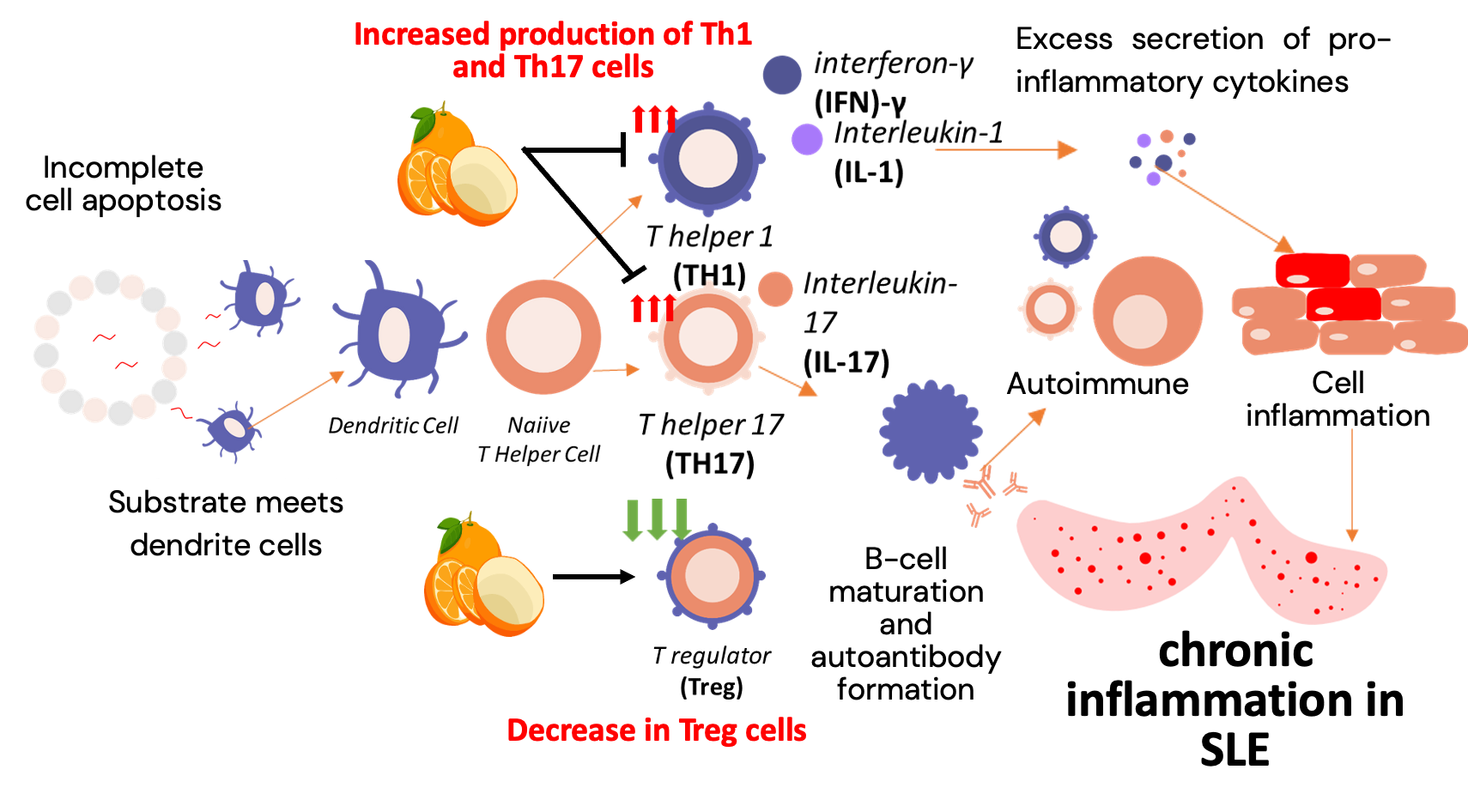
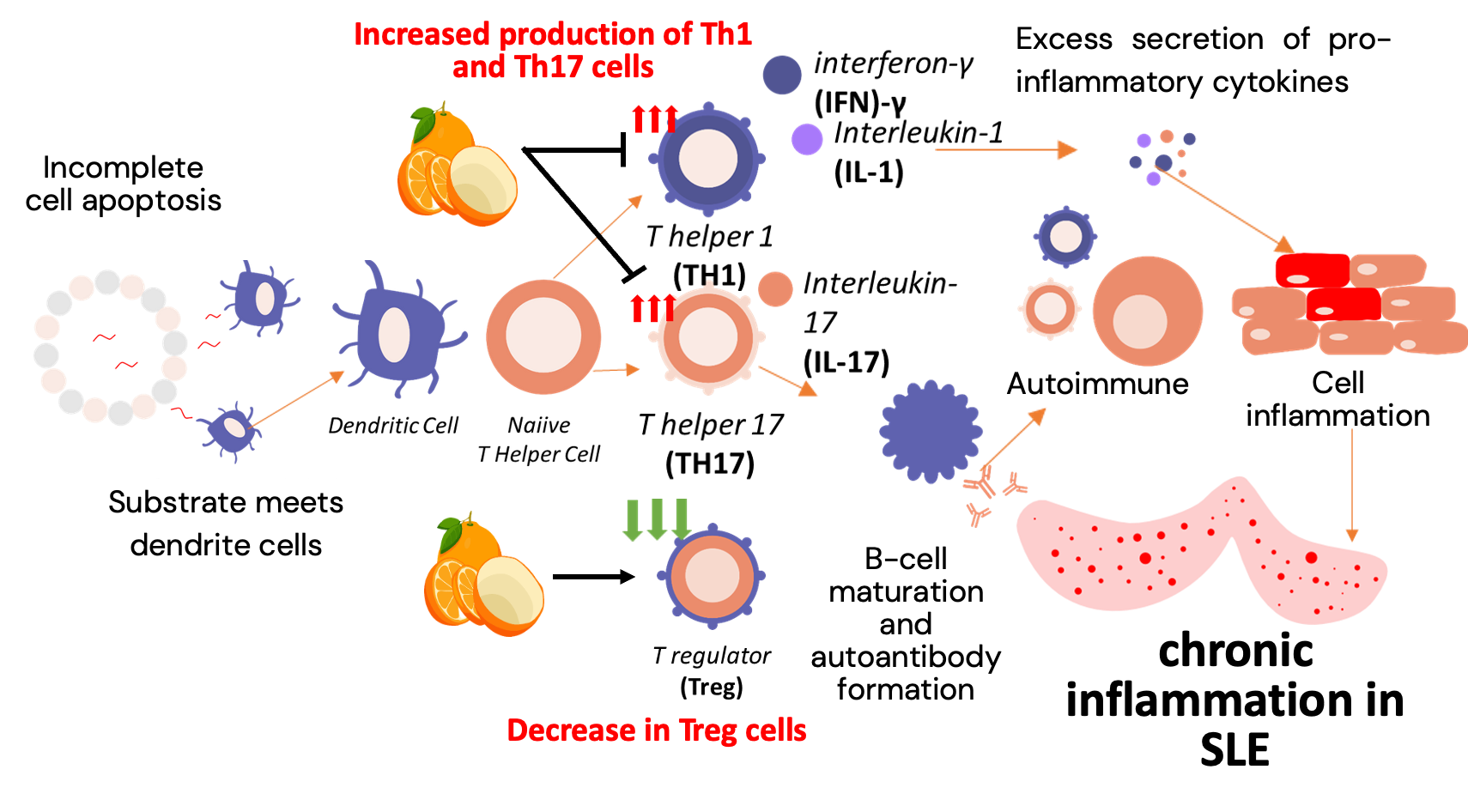
GRAPHICAL ABSTRACT
Downloads
References
VR Moulton, A Suarez-Fueyo, E Meidan, H Li, M Mizui and GC Tsokos. Pathogenesis of human systemic lupus erythematosus: A cellular perspective. Trends in Molecular Medicine 2017; 23(7), 615-635.
MRW Barber, C Drenkard, T Falasinnu, A Hoi, A Mak, NY Kow, E Svenungsson, J Peterson, AE Clarke and R Ramsey-Goldman. Global epidemiology of systemic lupus erythematosus. Nature Review Rheumatology 2021; 17(9), 515-532.
V Ocampo-Piraquive, I Nieto-Aristizabal, CA Canas and GJ Tobon. Mortality in systemic lupus erythematosus: Causes, predictors and interventions. Expert Review of Clinical Immunology 2018; 14(12), 1043-1053.
J Bakshi, BT Segura, C Wincup and A Rahman. Unmet needs in the pathogenesis and treatment of systemic lupus erythematosus. Clinical Reviews in Allergy & Immunology 2018; 55(3), 352-367.
AR Kustiyah, A Putra, T Nasihun and R Ramasamy. The normal ratio of Th17 and Th1 post-mesenchymal stem cells coculture with PBMCs of systemic lupus erythematosus patients. Open Access Macedonian Journal of Medical Sciences 2021; 9, 169-176.
DM Darlan, D Munir, A Putra, I Alif, ND Amalina, NK Jusuf and IB Putra. Revealing the decrease of indoleamine 2,3-dioxygenase as a major constituent for B cells survival post-mesenchymal stem cells co-cultured with peripheral blood mononuclear cell (PBMC) of systemic lupus erythematosus (SLE) patients. Medicinski Glasnik 2022; 19(1), 0.
DM Darlan, D Munir, NK Jusuf, A Putra, R Ikhsan and I Alif. In vitro regulation of IL-6 and TGF-ß by mesenchymal stem cells in systemic lupus erythematosus patients. Medicinski Glasnik 2020; 17(2), 408-413.
A Tsanaktsi, EE Solomou and SNC Liossis. Th1/17 cells, a subset of Th17 cells, are expanded in patients with active systemic lupus erythematosus. Clinical Immunology 2018; 195, 101-106.
JS Kornienko, IS Smirnova, NA Pugovkina, JS Ivanova, MA Shilina, TM Grinchuk, AN Shatrova, ND Aksenov, VV Zenin, NN Nikolsky and OG Lyublinskaya. High doses of synthetic antioxidants induce premature senescence in cultivated mesenchymal stem cells. Scientific Reports 2019; 9, 1296.
N Koolaji, B Shammugasamy, A Schindeler, Q Dong, F Dehghani and P Valtchev. Citrus peel flavonoids as potential cancer prevention agents. Current Developments in Nutrition 2020; 4(5), nzaa025.
DDP Putri, GG Maran, Y Kusumastuti, RA Susidarti, E Meiyanto and M Ikawati. Acute toxicity evaluation and immunomodulatory potential of hydrodynamic cavitation extract of citrus peels. Journal of Applied Pharmaceutical Science 2022; 12(4), 136-145.
SS Liew, WY Ho, SK Yeap and SAB Sharifudin. Phytochemical composition and in vitro antioxidant activities of citrus sinensis peel extracts. PeerJ 2018; 6, e5331.
ND Amalina, S Wahyuni and Harjito. Cytotoxic effects of the synthesized citrus aurantium peels extract nanoparticles against MDA-MB-231 breast cancer cells. Journal of Physics: Conference Series 2021; 1918, 032006.
M Suzery, B Cahyono and ND Amalina. Citrus sinensis (L) peels extract inhibits metastasis of breast cancer cells by targeting the downregulation matrix metalloproteinases-9. Open Access Macedonian Journal of Medical Sciences 2021; 9, 464-469.
X Yu, H Lin, Y Wang, W Lv, S Zhang, Y Qian, X Deng, N Feng, H Yu and B Qian. D-limonene exhibits antitumor activity by inducing autophagy and apoptosis in lung cancer. Onco Targets and Therary 2018; 11, 1833-1847.
NE Omari, HN Mrabti, T Benali, R Ullah, A Alotaibi, ADI Abdullah, KW Goh and A Bouyahya. Expediting multiple biological properties of limonene and α-pinene: Main bioactive compounds of pistacia lentiscus L., essential oils. Frontiers in Bioscience - Landmark 2023; 28(9), 229.
D Mandal, P Patel, SK Verma, BR Sahu and T Parija. Proximal discrepancy in intrinsic atomic interaction arrests G2/M phase by inhibiting Cyclin B1/CDK1 to infer molecular and cellular biocompatibility of d-limonene. Scientifc Reports 2022; 12, 18184.
B Salehi, L Machin, L Monzote, J Sharifi-Rad, SM Ezzat, MA Salem, RM Merghany, NME Mahdy, CS Klllç, O Sytar, M Sharifi-Rad, F Sharopov, N Martins, M Martorell and WC Cho. Therapeutic potential of quercetin: New insights and perspectives for human health. ACS Omega 2020; 5(20), 11849-11872.
B Baby, P Antony, WA Halabi, ZA Homedi and R Vijayan. Structural insights into the polypharmacological activity of quercetin on serine/threonine kinases. Drug Design, Development and Therapy 2016; 10, 3109-3123.
C Liu, Y Sun, J Sun, J Ma and C Cheng. Protective role of quercetin against lead-induced inflammatory response in rat kidney through the ROS-mediated MAPKs and NF-κB pathway. Biochimica et Biophysica Acta (BBA) - General Subjects 2012; 1820(10), 1693-1703.
N Andarwulan, D Kurniasih, RA Apriady, H Rahmat, AV Roto and BW Bolling. Polyphenols, carotenoids, and ascorbic acid in underutilized medicinal vegetables. Journal of Functional Foods 2012; 4(1), 339-347.
D Lipsa, P Leva, J Barrero-Moreno and M Coelhan. Inflammatory effects induced by selected limonene oxidation products: 4-OPA, IPOH, 4-AMCH in human bronchial (16HBE14o-) and alveolar (A549) epithelial cell lines. Toxicology Letters 2016; 262, 70-79.
NP Kumar, K Moideen, PJ George, C Dolla, P Kumaran and S Babu. Coincident diabetes mellitus modulates Th1-, Th2-, and Th17-cell responses in latent tuberculosis in an IL-10- and TGF-β-dependent manner. European Journal of Immunology 2016; 46(2), 390-399.
TV Nguyen, CH Piao, YJ Fan, D Shin, SY Kim, H Song, CH Song, HS Shin and OH Chai. Anti-allergic rhinitis activity of α-lipoic acid via balancing Th17/Treg expression and enhancing Nrf2/HO-1 pathway signaling. Scientific Reports 2020; 10, 12528.
R Cheng, Z Wu, M Li, M Shao and T Hu. Interleukin-1β is a potential therapeutic target for periodontitis: A narrative review. International Journal of Oral Science 2020; 12, 2.
S Mursiti, ND Amalina and A Marianti. Inhibition of breast cancer cell development using Citrus maxima extract through increasing levels of reactive oxygen species (ROS). Journal of Physics: Conference Series 2021; 1918, 052005.
D Hermansyah, DA Paramita, AM Muhar and ND Amalina. Curcuma longa extract inhibits migration by reducing MMP-9 and Rac-1 expression in highly metastatic breast cancer cells. Research in Pharmaceutical Sciences 2024; 19(2), 157-166.
M Suzery, B Cahyono and ND Amalina. Antiproliferative and apoptosis effect of hyptolide from Hyptis pectinata (L.) Poit on human breast cancer cells. Journal of Applied Pharmaceutical Science 2020; 10(2), 1-6.
YW Prajoko, A Putra, BT Dirja, AM Muhar and ND Amalina. The ameliorating effects of MSCs in controlling treg-mediated B-Cell depletion by Indoleamine 2, 3-dioxygenase induction in PBMC of SLE patients. Open Access Macedonian Journal of Medical Sciences 2022; 10, 6-11.
K Sharma, N Mahato and YR Lee. Extraction, characterization and biological activity of citrus flavonoids. Reviews in Chemical Engineering 2019; 35(2), 265-284.
A Kottaiswamy, A Kizhakeyil, AM Padmanaban, FB Mirza, VR Vijay, PS Lee, NK Verma, P Kalaiselvan and S Samuel. The Citrus flavanone hesperetin induces apoptosis in CTCL Cells via STAT3/Notch1/NFκB-Mediated signaling axis. Anti-Cancer Agents in Medicinal Chemistry 2020; 20(12), 1459-1468.
J Lim, B Kim, D Ryu, TW Kim, G Park and C Min. The therapeutic efficacy of mesenchymal stromal cells on experimental colitis was improved by the IFN-γ and poly (I:C) priming through promoting the expression of indoleamine 2,3-dioxygenase. Stem Cell Research & Therapy 2021; 12, 37.
FK Hartati, SB Widjanarko, TD Widyaningsih and M Rifa’i. Anti-Inflammatory evaluation of black rice extract inhibits TNF-α, IFN-γ and IL-6 cytokines produced by immunocompetent cells. Food and Agricultural Immunology 2017; 28(6), 1116-1125.
CK Rahardja, SP Mulyani and A Putra. Secretome of hypoxic mesenchymal stem cells improves fluconazole-induced alopecia in rats via immunoregulatory modulation of IL-15 and IFN-γ. Journal of Biology & Biology Education 2024; 16(1), 23-36.
SR Bailey, MH Nelson, RA Himes, Z Li, S Mehrotra and CM Paulos. Th17 cells in cancer: The ultimate identity crisis. Frontiers in Immunology 2014; 5, 1-13.
J Tabarkiewicz, K Pogoda, A Karczmarczyk, P Pozarowski and K Giannopoulos. The role of IL-17 and Th17 lymphocytes in autoimmune diseases. Archivum Immunologiae et Therapiae Experimentalis 2015; 63, 435-449.
AN Kamali, SM Noorbakhsh, H Hamedifar, F Jadidi-Niaragh, R Yazdani, JM Bautista and G Azizi. A role for Th1-like Th17 cells in the pathogenesis of inflammatory and autoimmune disorders. Molecular Immunology 2019; 105, 107-115.
R Ginwala, R Bhavsar, DGI Chigbu, P Jain and ZK Khan. Potential role of flavonoids in treating chronic inflammatory diseases with a special focus on the anti-inflammatory activity of apigenin. Antioxidants 2019; 8(2), 35.
CS Ma and TG Phan. Here, there and everywhere: T follicular helper cells on the move. Immunology 2017; 152(3), 382-387.
AG Zaretsky, C Konradt, F Depis, JB Wing, DG Atria, JS Silver, S Cho, AI Wolf, J Quinn, JB Engiles, DC Brown, D Beiting, J Erikson, MP Cancro, S Sakaguchi, L Lu, CO Benoist and CA Hunter. T regulatory cells support plasma cell populations in the bone marrow. Cell Reports 2017; 18(8), 1906-1916.
S Veenbergen, P Li, HC Raatgeep, DJ Lindenbergh-Kortleve, Y Simons-Oosterhuis, A Farrel, LMM Costes, ME Joosse, LAV Berkel, LFD Ruiter, MA Leeuwen, D Winter, SM Holland, AF Freeman, Y Wakabayashi, J Zhu, LD Ridder, GJ Driessen, JC Escher, WJ Leonard and JN Samsom. IL-10 signaling in dendritic cells controls IL-1β-mediated IFNγ secretion by human CD4+ T cells: Relevance to inflammatory bowel disease. Mucosal Immunology 2019; 12(5), 1201-1211.
D Schmidt-Arras and S Rose-John. Endosomes as signaling platforms for IL-6 family cytokine receptors. Frontiers in Cell and Developmental Biology 2021; 9, 688314.
L Xie, W Gong, J Chen, H Xie, M Wang, X Yin and W Wu. The flavonoid kurarinone inhibits clinical progression of EAE through inhibiting Th1 and Th17 cell differentiation and proliferation. International Immunopharmacology 2018; 62, 227-236.
JM Al-Khayri, GR Sahana, P Nagella, BV Joseph, FM Alessa and MQ Al-Mssallem. Flavonoids as potential Anti-inflammatory molecules: A review. Molecules 2022; 279(90), 2901.
K Hirahara and T Nakayama. CD4+ T-cell subsets in inflammatory diseases: Beyond the Th1/Th2 paradigm. International Immunology 2016; 28, 163-171.
DM Darlan, D Munir, A Putra and NK Jusuf. MSCs-released TGFβ1 generate CD4+CD25+Foxp3+ in T-reg cells of human SLE PBMC. Journal of the Formosan Medical Association 2021; 120(1), 602-608.
L Han, Q Fu, C Deng, L Luo, T Xiang and H Zhao. Immunomodulatory potential of flavonoids for the treatment of autoimmune diseases and tumour. Scandinavian Journal of Immunology 2022; 95(1), e13106.
Downloads
Published
How to Cite
Issue
Section
License
Copyright (c) 2024 Walailak University

This work is licensed under a Creative Commons Attribution-NonCommercial-NoDerivatives 4.0 International License.





