
Gold-Modified Electrochemical Sensor for Rapid Detection of Muscarine in Mushroom Poisoning
DOI:
https://doi.org/10.48048/tis.2025.9206Keywords:
Muscarine, Electrochemical sensor, Gold-modified SPCE, Potassium dichromate, Neurotoxic mushroomsAbstract
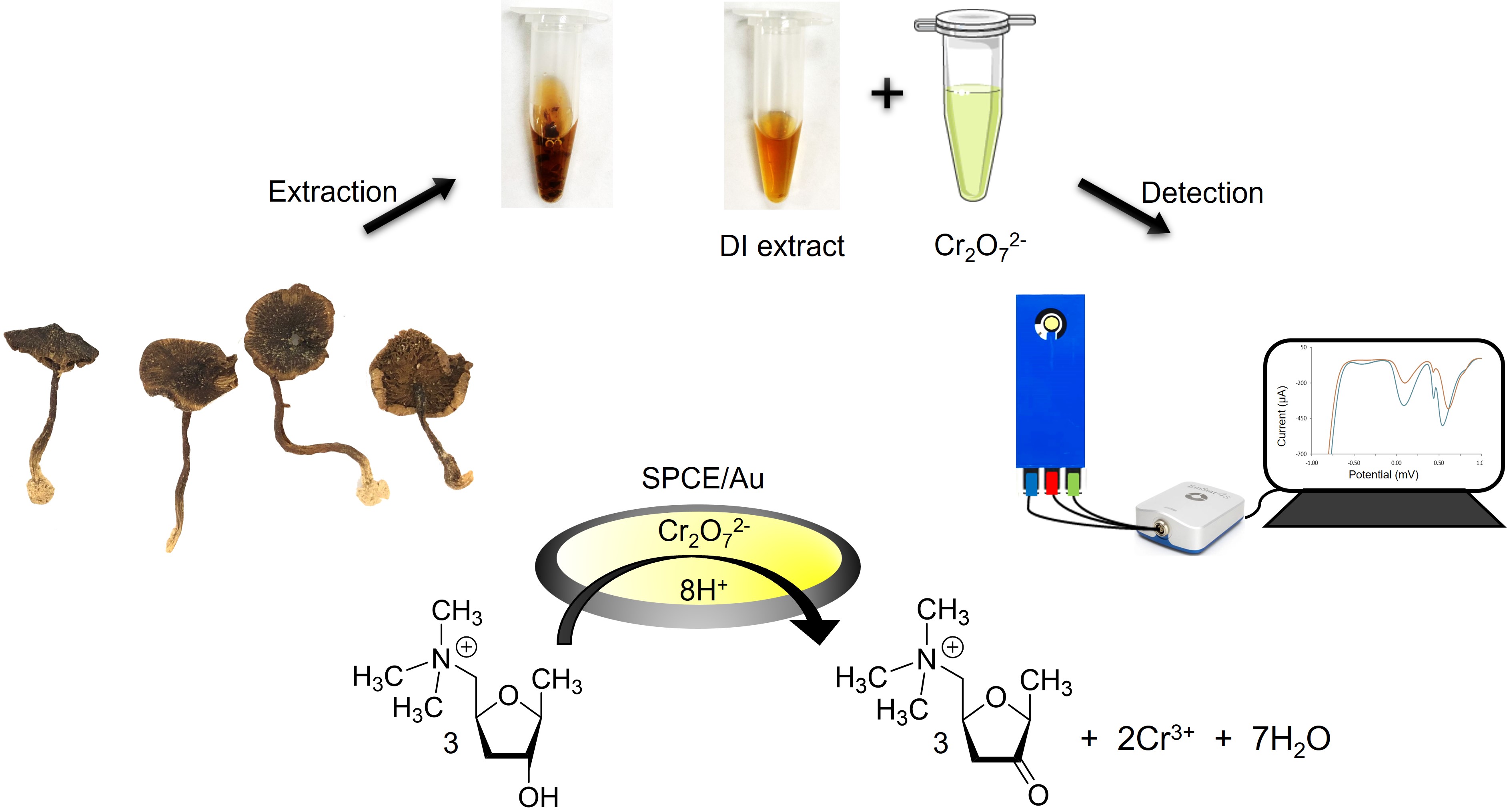
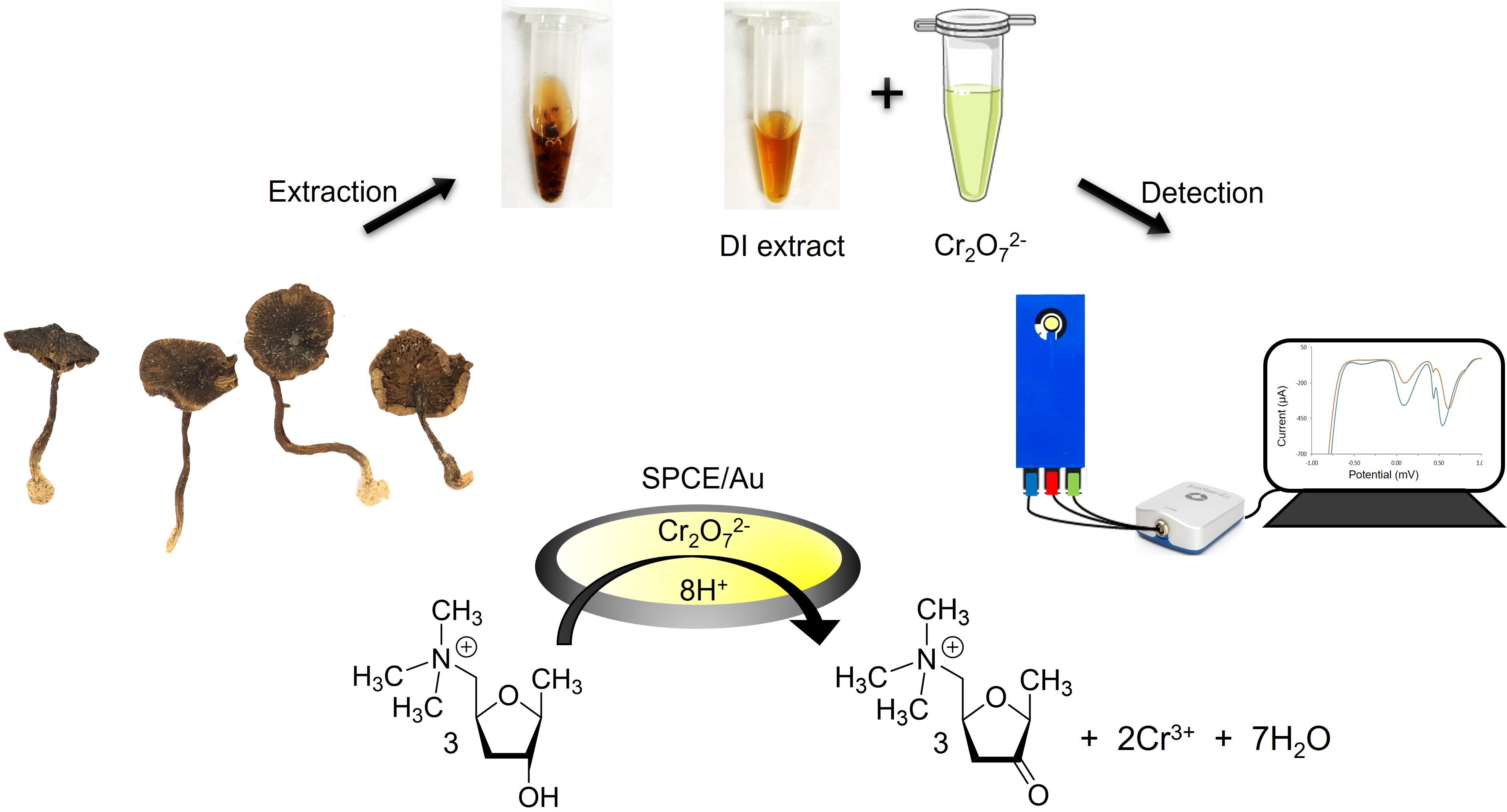
Muscarine is a toxic alkaloid produced by neurotoxic mushrooms, known for its heat stability. Ingesting muscarine-containing mushrooms rapidly stimulates the parasympathetic nervous system within 15 min, leading to mushroom poisoning. To address this issue, we developed an electrochemical sensor using a screen-printed carbon electrode (SPCE) modified with gold to detect muscarine. The electrochemical behavior of muscarine was studied in acidic conditions using 10 mM potassium dichromate (K2Cr2O7) as an oxidizing agent and DI water as the supporting solution. The cathodic current responded to the muscarine concentration which was detected in 2 min of reaction time by differential pulse voltammetry. Under optimal conditions, the detection limit was 4.07 µg/mL. The developed muscarine electrochemical sensor was tested on mushroom samples, and the results were compared with chemical and morphological identification. The gold-modified SPCE, combined with dichromate (Cr2O72−) as a reagent, showed promise for development as a point-of-care testing electrochemical sensor capable of detecting muscarine in mushroom samples.
HIGHLIGHTS
A screen-printed carbon electrode (SPCE) modified with gold and using dichromate (Cr2O72−) as an oxidizing agent was developed as a muscarine electrochemical sensor, and the muscarine concentration correlated with the reduction in peak current of Cr2O72−. This electrochemical sensor demonstrated high sensitivity, low cost, low reagent consumption, and rapid analysis for detecting muscarine in mushroom samples with analytical uses in the toxicology field.
GRAPHICAL ABSTRACT
Downloads
References
S Parnmen, N Nooron, S Leudang, S Sikaphan, D Polputpisatkul, O Pringsulaka, S Binchai and A Rangsiruji. Foodborne illness caused by muscarine-containing mushrooms and identification of mushroom remnants using phylogenetics and LC-MS/MS. Food Control 2021; 128, 108182.
S Parnmen, S Sikaphan, S Leudang, T Boonpratuang, A Rangsiruji and K Naksuwankul. Molecular identification of poisonous mushrooms using nuclear ITS region and peptide toxins: A retrospective study on fatal cases in Thailand. Journal of Toxicological Sciences 2016; 41(1), 65-76.
SE Unger, A Vincze, RG Cooks, R Chrisman and LD Rothman. Identification of quaternary alkaloids in mushroom by chromatography/secondary ion mass spectrometry. Analytical Chemistry 1981; 53(7), 976-981.
S Ramchiun, S Sikaphan, S Leudang, D Polputpisatkul, N Nantachaiphong, T Khaentaw, N Nooron, C Uttawichai and S Parnmen. Molecular characterization and liquid chromatography-mass spectrometric multiple reaction monitoring-based detection in case of suspected phalloides syndrome poisoning. Journal of Associated Medical Sciences 2019; 52(1), 48-55.
B Merova, P Ondra, M Stankova, M Soural, J Stribrny, L Hebka and K Lemr. Determination of muscarine in human urine by electrospray liquid chromatographic–mass spectrometric. Journal of Chromatography B 2011; 879(25), 2549-2553.
N Yoshioka, S Akamatsu, T Mitsuhashi, C Todo, M Asano and Y Ueno. A simple method for the simultaneous determination of mushroom toxins by liquid chromatography–time-of-flight mass spectrometry. Forensic Toxicology 2014; 32, 89-96.
J Tomkova, P Ondra and I Valka. Simultaneous determination of mushroom toxins α-amanitin, β-amanitin and muscarine in human urine by solid-phase extraction and ultra-high-performance liquid chromatography coupled with ultra-high-resolution TOF mass spectrometry. Forensic Science International 2015; 251, 209-213.
F Xu, Y Zhang, Y Zhang, G Guan, K Zhang, H Li and J Wang. Mushroom poisoning from Inocybe serotina: A case report from Ningxia, northwest China with exact species identification and muscarine detection. Toxicon 2020; 179, 72-75.
P Ginterova, B Sokolova, P Ondra, J Znaleziona, J Petr, J Sevcik and V Maier. Determination of mushroom toxins ibotenic acid, muscimol and muscarine by capillary electrophoresis coupled with electrospray tandem mass spectrometry. Talanta 2014; 125, 242-247.
JA DeGrasse. A single-stranded DNA aptamer that selectively binds to staphylococcus aureus enterotoxin B. PLoS One 2012; 7(3), e33410.
X Chen, Y Huang, X Ma, F Jia, X Guo and Z Wang. Impedimetric aptamer-based determination of the mold toxin fumonisin B1. Microchimica Acta 2015; 182, 1709-1714.
Q Zhu, R Li, X Sun, and L Zaijun. Highly sensitive and selective electrochemical aptasensor with gold-aspartic acid, glycine acid-functionalized and boron-doped graphene quantum dot nanohybrid for detection of α-amanitin in blood. Analytica Chimica Acta 2022; 1219, 340033.
L Ruiyi, Z Qiyue, S Xiulan, Z Li and L Xiaohao. Electrochemical biosensor based on the integration of maple leaf-like gold nanocrystal and truncated aptamer for detection of α-amanitin with high sensitivity, selectivity and rapidity. Food Chemistry 2024; 453, 139639.
C Thunkhamrak, P Chuntib, K Ounnunkad, P Banet, P Aubert, G Saianand, A Gopalan and J Jakmunee. Highly sensitive voltammetric immunosensor for the detection of prostate specific antigen based on silver nanoprobe assisted graphene oxide modified screen printed carbon electrode. Talanta 2020; 208, 120389.
J Zhou, X Qiu, K Su, G Xu and P Wang. Disposable poly (o-aminophenol)-carbon nanotubes modified screen print electrode-based enzyme sensor for electrochemical detection of marine toxin okadaic acid. Sensors and Actuators B: Chemical 2016; 235, 170-178.
IA Quintela and VCH Wu. A sandwich-type bacteriophage-based amperometric biosensor for the detection of Shiga toxin-producing Escherichia coli serogroups in complex matrices. RSC Advances 2020; 10(59), 35765-35775.
AS Elewi, SAW Al-Shammaree and AKMAA Sammarraie. Hydrogen peroxide biosensor based on hemoglobin-modified gold nanoparticles–screen printed carbon electrode. Sensing and Bio-sensing Research 2020; 28, 100340.
K Partanen, Y Pei, P Hillen, M Hassan, K McEleney, G Schatte, SJ Payne, R Oleschuk and Z She. Investigating electrochemical deposition of gold on commercial off-the-shelf 3-D printing materials towards developing sensing applications. RSC Advances 2022; 12(51), 33440-33448.
LC Brazaca, AH Imamura, NO Gomes, MB Almeida, DT Scheidt, PA Raymundo-Pereira, ON Oliveira, BC Janegitz, SAS Machado and E Carrilho. Electrochemical immunosensors using electrodeposited gold nanostructures for detecting the S proteins from SARS-CoV and SARS-CoV-2. Analytical and Bioanalytical Chemistry 2022; 414, 5507-5517.
LMC Ferreira, IF Reis, PR Martins, LH Marcolino-Junior, MF Bergamini, JR Camargo, BC Janegitz and FC Vicentini. Using low-cost disposable immunosensor based on flexible PET screen-printed electrode modified with carbon black and gold nanoparticles for sensitive detection of SARS-CoV-2. Talanta Open 2023; 7, 100201.
Z Shi, Y Lu, Z Chen, C Cheng, J Xu, Q Zhang, Z Yan, Z Luo and Q Liu. Electrochemical non-enzymatic sensing of glycoside toxins by boronic acid functionalized nano-composites on screen-printed electrode. Sensors and Actuators B: Chemical 2021; 329, 129197.
R Das, AK Goel, MK Sharma and S Upadhyay. Electrochemical DNA sensor for anthrax toxin activator gene atxA-detection of PCR amplicons. Biosensors and Bioelectronics 2015; 74, 939-946.
M Pal and R Khan. Graphene oxide layer decorated gold nanoparticles based immunosensor for the detection of prostate cancer risk factor. Analytical Biochemistry 2017; 536, 51-58.
M Hassan, AN Al-Hakimi and M Alahmadi. Kinetics of oxidation of aliphatic alcohols by potassium dichromate in aqueous and micellar media. South African Journal of Chemistry 2011; 64, 237-240.
R Shimpi. Relative kinetic study of oxidation of ethanol by potassium dichromate and potassium permanganate in aqueous acidic media. International Journal Science and Research 2023; 12(12), 686-691.
Downloads
Published
How to Cite
Issue
Section
License
Copyright (c) 2024 Walailak University

This work is licensed under a Creative Commons Attribution-NonCommercial-NoDerivatives 4.0 International License.





