
Validation of Wavelength-Dispersive X-Ray Fluorescence Technique for Rapid Screening Iron and Zinc Concentration in Rice Seed
DOI:
https://doi.org/10.48048/tis.2025.9068Keywords:
Iron, Zinc, Method validation, WD-XRF, Rice, Rapid screening, CalibrationAbstract
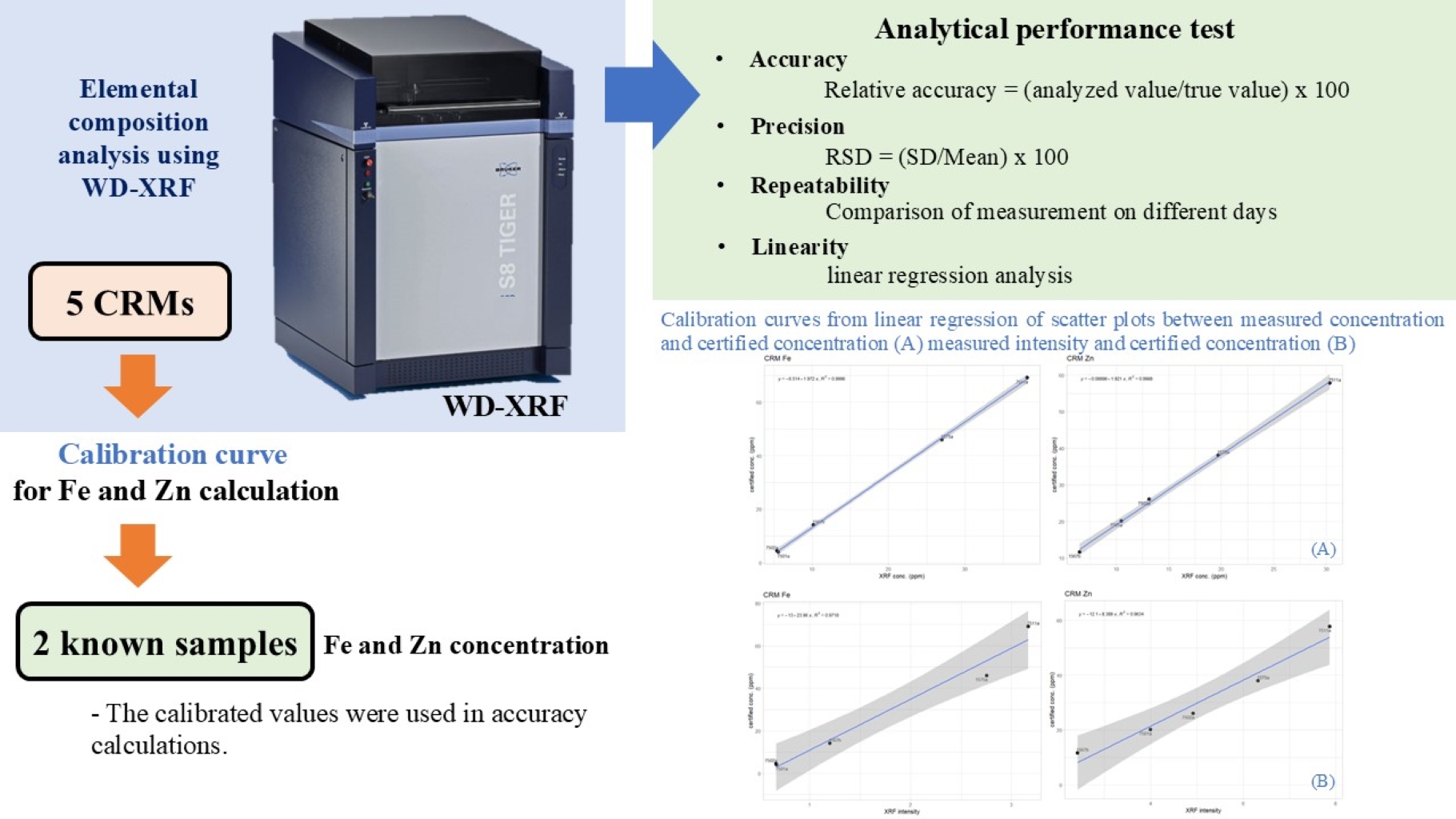
This study focuses on the validation of a wavelength dispersive X-ray fluorescence (WD-XRF) spectrometer for the rapid determination of iron (Fe) and zinc (Zn) concentrations in certified reference materials (CRMs). Five CRMs were used to establish calibration curves. The results were analyzed in terms of accuracy, precision, repeatability and linearity to assess the performance of the WD-XRF method. Accuracy was evaluated by comparing measured values to certified values, with relative accuracy calculated for each sample. Precision was determined through repeatability, where samples were measured in at least 7 replicates across different days, and relative standard deviation (RSD) was calculated. Linearity was assessed by plotting measured intensities and concentrations against certified concentrations, with the correlation coefficient (R2) values close to 1, indicating a strong linear relationship. Additionally, the WD-XRF method demonstrated high repeatability, with low RSD values across multiple measurements. The study concluded that WD-XRF is a reliable method for the rapid analysis of elemental composition, providing strong accuracy, precision and linearity for Fe and Zn determination in CRMs and can be applied as a valuable method for rapid and non-destructive analysis in various agricultural and food-related applications.
HIGHLIGHTS
- The effectiveness of wavelength dispersive X-ray fluorescence (WD-XRF) method was evaluated to confirm its reliability for determining the elemental composition, specifically iron (Fe) and zinc (Zn), in plant-based certified reference materials (CRMs).
- Five CRMs were used for calibration and 2 known samples were used as the test samples to determine the analytical performance of WD-XRF.
- The linearity and correlation with the certified values of WD-XRF results revealed strong correlation with R-square being greater than 0.95 and the recovery percentage of 2 known samples were range from 98.75 - 109.66 for Fe and Zn concentration.
- WD-XRF spectrometer can be used as a rapid method for determination of Fe and Zn concentrations in rice seeds.
GRAPHICAL ABSTRACT
Downloads
References
M Jarošová, D MilDe and M Kuba. Elemental analysis of coffee: A comparison of ICP-MS and AAS methods. Czech Journal of Food Sciences 2014; 32(4), 354-359.
A Szymczycha-Madeja, M Welna and P Pohl. Method validation for multi-elemental analysis of dialyzable and non-dialyzable fractions of coffee brews by F AAS and ICP OES: A bioaccessibility study. Food Analytical Methods 2019; 12, 198-216.
A Umaz, F Aydin, O Tokul Olmez, M Firat, M Ozturk, A Ertas and I Aydin. Determination and comparison of metal contents in simulated body fluid medium conditions of the plant species by flame atomic absorption spectrometry (FAAS). Journal of Research in Pharmacy 2022; 25(6), 1281-1294.
C de Aragão Tannus, F de Souza Dias, FB Santana, DCMBD Santos, HIF Magalhaes, F de Souza Dias and A de Fretas Santos Junior. Multielement determination in medicinal plants and herbal medicines containing Cynara scolymus L., Harpagophytum procumbens D.C., and Maytenus ilifolia (Mart.) ex Reiss from Brazil using ICP OES. Biological Trace Element Research 2021; 199, 2330-2341.
F Vezzulli, MC Fontanella, M Lambri and GM Beone. Specialty and high-quality coffee: Discrimination through elemental characterization via ICP-OES, ICP-MS, and ICP-MS/MS of origin, species, and variety. Journal of the Science of Food and Agriculture 2023; 103(9), 4303-4316.
J Zhang, R Yang, R Chen, YC Li, Y Peng and X Wen. Geographical origin discrimination of pepper (Capsicum annuum L.) based on multi-elemental concentrations combined with chemometrics. Food Science and Biotechnology 2019; 28, 1627-1635.
W Srinuttrakul and V Permnamtip. Geographical origin of Thai Hom Mali rice based on elemental and stable isotopic compositions. Journal of Physics: Conference Series 2019; 1285, 012004.
AM Calvo Salamanca, OL Mayorga Mogollon, N Chaali, C Ariza-Nieto, JI Beltran-Medina, RE Ortiz Cuadros and EN Duran Cruz. ICP-OES analysis of total As and Cd in Columbian Oryza sativa L. rice. Food Additives & Contaminants: Part B 2023; 17(1), 16-27.
Y Lavrinenko, A Plieva, O Chaligava, D Grozdov, M Frontasyeva, K Tkachenko and I Zinicovscaia. Elemental analysis of five medicinal plants species growing in North Ossetia using neutron activation analysis. Agronomy 2024; 14(6), 1269.
P Seeprasert, P Anurakpongsatorn, S Laoharojanaphand and A Busamongkol. Instrumental neutron activation analysis to determine inorganic elements in paddy soil and rice and evaluate bioconcentration factors in rice. Agriculture and Natural Resources 2017; 51(3), 154-157.
C Kukusamude and S Kongsri. Method validation for determination of some rare-earth elements in rice using ICP-MS. Journal of Physics: Conference Series 2019; 1285, 012020.
NC Andriopoulou and GE Christidis. Multi-analytical characterisation of wheat biominerals: Impact of methods of extraction on the mineralogy and chemistry of phytoliths. Archaeological and Anthropological Sciences 2020; 12(8), 186.
B Nedjimi. Trace element quantification in two algerian thymes (Thymus algeriensis Boiss & Reut. and Thymus capitatus (L.) Hoffm. & Link) using EDXRF spectrometry. Biological Trace Element Research 2023; 201, 455-463.
M Hall. X-ray fluorescence-energy dispersive (ED-XRF) and wavelength dispersive (WD-XRF) spectrometry. In: AMW Hunt (Ed.). The Oxford handbook of archaeological ceramic analysis. Oxford University Press, Oxford, England, 2017, p. 343-381.
CE Guardiola-Márquez, ER López-Mena, ME Segura-Jiménez, I Gutierrez-Marmolejo, MA Flores-Matzumiya, S Mora-Godínez, C Hernández-Brenes and DA Jacobo-Velázquez. Development and evaluation of zinc and iron nanoparticles functionalized with Plant Growth-Promoting Rhizobacteria (PGPR) and microalgae for their application as bio-nanofertilizers. Plants 2023; 12(20), 3657.
AAT Johnson, B Kyriacou, DL Callahan, L Carruthers, J Stangoulis, E Lombi and M Tester. Constitutive overexpression of the OsNAS gene family reveals single-gene strategies for effective iron- and zinc-biofortification of rice endosperm. PLoS One 2011; 6(9), e24476.
S Kappara, S Neelamraju and R Ramanan. Down regulation of a heavy metal transporter gene influences several domestication traits and grain Fe-Zn content in rice. Plant Science 2018; 276, 208-219.
C Prom-U-Thai, C Sanchai, B Rerkasem, S Jamjod, S Fukai, ID Godwin and L Huang. The effect of grain morphology on degree of milling and iron loss in rice. Cereal Chemistry 2007; 84(4), 384-388.
C Saenchai, C Thebault Prom-U-Thai, S Jamjod, B Dell and B Rerkasem. Genotypic variation in milling depression of iron and zinc concentration in rice grain. Plant and Soil 2012; 361, 271-278.
S Maganti, R Swaminathan and A Parida. Variation in iron and zinc content in traditional rice genotypes. Agricultural Research 2020; 9, 316-328.
K Hamm. 1.4 Accuracy and Precision of Measurements. Biomechanics of Human Movement, Pressbooks. 2020.
H Akoglu. User’s guide to correlation coefficients. Turkish Journal of Emergency Medicine 2018; 18(3), 91-93.
P Schober, C Boer and LA Schwarte. Correlation coefficients: Appropriate use and interpretation. Anesthesia & Analgesia 2018; 126(5), 1763-1768.
AOAC International. Guidelines for standard method performance requirements - AOAC official methods of analysis; Appendix F. AOAC International, Maryland, United States, 2016, p. 1-18.
TJ Morgan, A George, AK Boulamanti, P Álvarez, I Adanouj, C Dean, SV Vassilev, D Baxter and LK Andersen. Quantitative X-ray fluorescence analysis of biomass (switchgrass, corn stover, eucalyptus, beech, and pine wood) with a typical commercial multi-element method on a WD-XRF spectrometer. Energy & Fuels 2015; 29(3), 1669-1685.
Downloads
Published
How to Cite
Issue
Section
License
Copyright (c) 2024 Walailak University

This work is licensed under a Creative Commons Attribution-NonCommercial-NoDerivatives 4.0 International License.





