
Rapid Micro-Propagation of Disease-Free Hemp (Cannabis sativa L.) to Improve Industrial Production
DOI:
https://doi.org/10.48048/tis.2025.9057Keywords:
Hemp, Micropropagation, Thidiazuron, Shoot multiplication, Root inductionAbstract
Hemp (Cannabis sativa L.) is widely used in industrial production due to its pharmacological properties, particularly cannabidiol (CBD). For commercial production, it is essential to have a large-scale propagation that is consistently disease-free and rapid. Thus, this study aims to establish a protocol for exponentially increasing the amount of high CBD hemp variety CA-UP1 by nodal segment via tissue culture method. Initially, with 10-minute surface sterilization with 0.1 % HgCl2, the microbial contamination rate was reduced to its lowest level (approximately 16.67 %) within 7 days. The nodal segments exhibited optimal response to MS media supplemented with 0.5 mg/L TDZ, resulting in a 100 % shoot multiplication rate. The average number of shoots per explant was 4.7 ± 1.57, and the average shoot height was 2.30 ± 0.42 cm at 4 weeks. Following the induction of elongation in MS medium supplemented with charcoal, the seedlings were acclimatized and dipped in a 1,000 ppm IBA solution mixed with talcum powder. The cultivation resulted in a 100 % rooting rate, with an average of 5.6 ± 1.94 roots/explant, an average root length of 5.78 ± 1.96 cm, and an average explant height of 4.32 ± 1.52 cm. The tissue culture protocol can produce over 190 times the quantity of hemp plants compared with the stem cutting technique. The researchers anticipate that this micropropagation protocol will be useful as a rapid and economical alternative for the industrial production of effective C. sativa L.
HIGHLIGHTS
- A 10-minute surface cleaning protocol with a minimal microbiological contamination rate of 16.67 % in the nodal segment.
- Thidiazuron (TDZ) can stimulate the most significant increase in shoot growth in Cannabis sativa L. variety CA-UP1 when grown on a semi-solid medium.
- Dispensing talcum powder combined with IBA results in a 70 - 100 % survival percentage by effectively preventing root during the acclimation stage.
- The following procedures can be implemented micropropagation of hemp for the production of a large quantity of high-quality, disease-free hemp plants with approximately 190 times more than stem cutting method.
GRAPHICAL ABSTRACT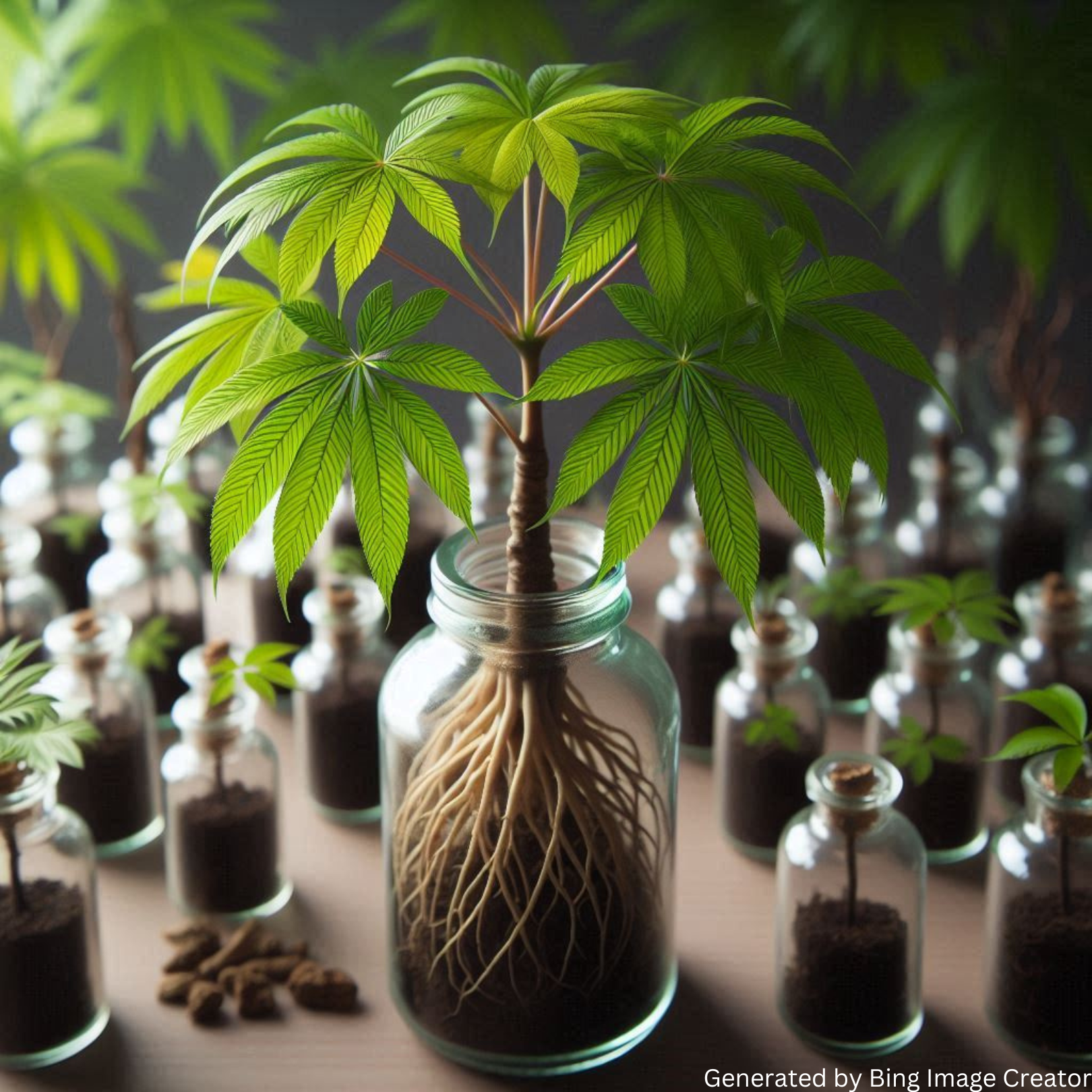
Downloads
References
M Rehman, S Fahad, G Du, X Cheng, Y Yang, K Tang, K Tang, L Liu, FH Liu and G Deng. Evaluation of hemp (Cannabis sativa L.) as an industrial crop: A review. Environmental Science and Pollution Research International 2021; 28(38), 52832-52843.
A Trajkovska, O Tushevski, VS Gjorgievska, IC Karanfilova, M Karapandzova, G Stefkov, S Kulevanova and SG Simic. Biomass production and cannabinoid accumulation in Cannabis (Cannabis sativa L.) callus cultures. Macedonian Pharmaceutical Bulletin 2022; 68, 211-212.
C Chaohua, Z Gonggu, Z Lining, G Chunsheng, T Qing, C Jianhua, G Xinbo, P Dingxiang and S Jianguang. A rapid shoot regeneration protocol from the cotyledons of hemp (Cannabis sativa L.). Industrial Crops and Products 2016; 83, 61-65.
BM Twaij, ZH Jazar and MN Hasan. Trends in the use of tissue culture, applications and future aspects. International Journal of Plant Biology 2020; 11(1), 8385.
RM Moraes, AL Cerdeira and MV Lourenço. Using micropropagation to develop medicinal plants into crops. Molecules 2021; 26(6), 1752.
S Govindaraghavan and NJ Sucher. Quality assessment of medicinal herbs and their extracts: Criteria and prerequisites for consistent safety and efficacy of herbal medicines. Epilepsy & Behavior 2015; 52, 363-371
R Hameg, TA Arteta, M Landin, PP Gallego and ME Barreal. Modeling and optimizing culture medium mineral composition for in vitro propagation of Actinidia arguta. Frontiers in Plant Science 2020; 11, 554905.
S Klaocheed, S Rittirat, S Kalawong and K Thammasiri. Maximization of micropropagule production in an attractive ornamental plant, Oxalis triangularis A.st.-Hil. Trends in Sciences 2024; 21(8), 7917.
Y Meksuwan and P Sutthinon. In vitro propagation and histochemical analysis of Launaea sarmentosa (Willd.) Kuntze. Trends in Sciences 2023; 20(5), 5729.
LD Thiesson, T Schappe, S Cochran, K Hicks and AR Post. Surveying for potential diseases and abiotic disorders of industrial hemp (Cannabis sativa) production. Plant Health Progress 2020; 21(4), 321-332.
MA Şevik. Virus-induced diseases in hemp (Cannabis sativa L.) plants. Turkish Journal of Agricultural Research 2020; 7(1), 111-119.
R Creamer, A Simpson, HT Rheay and CE Brewer. Interactions of beet leafhopper (Hemiptera: Cicadellidae), vector of beet curly top virus, and hemp in New Mexico. Environmental Entomology 2024; 53(1), 11-17.
N Abdalla, H El-Ramady, MK Seliem, ME El-Mahrouk, N Taha, Y Bayoumi, TA Shalaby and J Dobránszki. An academic and technical overview on plant micropropagation challenges. Horticulturae 2022; 8(8), 677.
T Murashige and F Skoog. A revised medium for rapid growth and bio assays with tobacco tissue cultures. Physiologia Plantarum 1962; 15(3), 473-497.
MF El-Banna, NBB Farag, HY Massoud and MM Kasem. Exogenous IBA stimulated adventitious root formation of Zanthoxylum beecheyanum K. Koch stem cutting: Histo-physiological and phytohormonal investigation. Plant Physiology and Biochemistry 2023; 197, 107639.
JU Agogbua and BE Okoli. Procedure for in vitro seed sterilization, germination and aseptic seedling establishment of Zehneria capillacea (Schumach) C. Jeffrey. GSC Biological and Pharmaceutical Sciences 2022; 19(1), 143-148.
A Yadav, Y Prasad, M Kumar, S Pandey, R Maurya and P Pandey. Effects of mercuric chloride and ethanol for surface sterilization under in vitro plant growth in banana (Musa paradisiaca L.) variety “Udhayam”. Journal of Pharmacognosy and Phytochemistry 2021; 10(1), 2281-2283.
SN Hashim, SZ Ghazali, NJ Sidik, T Chia-Chay and A Saleh. Surface sterilization method for reducing contamination of Clinacanthus nutans nodal explants intended for in-vitro culture. E3S Web of Conferences 2021; 306, 01004.
D Dinçer and H Dündar. The use of fungicides and antibiotics in in vitro sterilization of ornamental plants. In: A Biçen (Ed.). New Frontiers in Architecture, Planning and Design. Duvar Yayınları, Turkey, 2023, p. 31-44.
SC Redlin and LM Carris. Endophytic fungi in grasses and woody plants. systematics, ecology and evolution. Forest Science 1997; 43(3), 458-459.
SA Mng’Omba, ESD Toit, FK Akinnifesi and G Sileshi. Efficacy and utilization of fungicides and other antibiotics for aseptic plant cultures. In: D Dhanasekaran (Ed.). Fungicides for plant and animal diseases. InTech, England, 2012, p. 245-254.
M Gu, Y Li, H Jiang, S Zhang, Q Que, X Chen and W Zhou. Efficient in vitro sterilization and propagation from stem segment explants of Cnidoscolus aconitifolius (Mill.) I.M. Johnst, a multipurpose woody plant. Plants 2022; 11(15), 1937.
SM Mubi, S Svetik, M Flajšman and J Murovec. In vitro tissue culture and genetic analysis of two high-CBD medical cannabis (Cannabis sativa L.) breeding lines. Genetika 2020; 52(3), 925-941.
T Wróbel, M Dreger, K Wielgus and R Słomski. Modified nodal cuttings and shoot tips protocol for rapid regeneration of Cannabis sativa L. Journal of Natural Fibers 2022; 19(2), 536-545.
DWS Mok and MC Mok. Cytokinin metabolism and action. Annual Review of Plant Biology 2001; 52, 1-28.
H Ali, T Khan, MA Khan and N Ullah. The multipotent thidiazuron: A mechanistic overview of its roles in callogenesis and other plant cultures in vitro. Biotechnology and Applied Biochemistry 2022; 69(6), 2624-2640.
BNS Murthy, SJ Murch and PK Saxena. Thidiazuron: A potent regulator of in vitro morphogenesis. In Vitro Cellular & Developmental Biology - Plant 1998; 34, 267-275.
YY Li, ZG Hao, S Miao, X Zhang, JQ Li, SX Guo and YI Lee. Profiles of cytokinins metabolic genes and endogenous cytokinins dynamics during shoot multiplication in vitro of Phalaenopsis. International Journal of Molecular Sciences 2022; 23(7), 3755.
AV Deepa, M Anju and TD Thomas. The applications of TDZ in medicinal plant tissue culture. In: N Ahmad and M Faisal (Eds.). Thidiazuron: From Urea Derivative to Plant Growth Regulator. Springer, Singapore, 2018, p. 297-316.
A McLeod, K Vining, T Hoskins and R Contreras. Impact of indole-3-butyric acid concentration and formulation and propagation environment on rooting success of ‘I3’ hemp by stem cuttings. HortTechnology 2022; 32(3), 321-324.
K Ioannidis, I Tomprou and V Mitsis. An alternative in vitro propagation protocol of Cannabis sativa L. (Cannabaceae) presenting efficient rooting, for commercial production. Plants 2022; 11(10), 1333.
KA Kumar, M Sreenivas, J Cheena, G Vidya and SP Kumar. Effect of different concentrations of auxin hormone (IBA) upon promoting root development of stem cuttings in the ‘Scented Geranium’, Pelargonium graveolens L. International Journal of Environment and Climate Change 2023; 13(11), 2863-2869.
AR Saudagar, HM Khobragade, SA Thakre, E Bagde, GV Borkar and AG Mane. Effect of IBA and types of cuttings on rooting of Ixora. International Journal of Chemical Studies 2023; 9(1), 2594-2596.
BE Haissig. Metabolism during adventitious root primordium initiation and development. New Zealand Journal of Forestry Science 1973; 4(2), 324-337.
JD Lubell-Brand, LE Kurtz and MH Brand. An in vitro-ex vitro micropropagation system for hemp. HortTechnology 2021; 31(2), 199-207.
D Adhikary, M Kulkarni, A El-Mezawy, S Mobini, M Elhiti, R Gjuric, A Ray, P Polowick, JJ Slaski, MP Jones and P Bhowmik. Medical cannabis and industrial hemp tissue culture: Present status and future potential. Frontiers in Plant Science 2021; 12, 627240.
ZK Punja and JE Holmes. Hermaphroditism in marijuana (Cannabis sativa L.) inflorescences - Impact on floral morphology, seed formation, progeny sex ratios, and genetic variation. Frontiers in Plant Science 2020; 11, 718.
ZK Punja. Emerging diseases of Cannabis sativa and sustainable management. Pest Management Science 2021; 77(9), 3857-3870.
M Moher, M Jones and Y Zheng. Photoperiodic response of in vitro Cannabis sativa plants. Preprints 2020; 56(1), 108-113.
JE Holmes, S Lung, D Collyer and ZK Punja. Variables affecting shoot growth and plantlet recovery in tissue cultures of drug-type Cannabis sativa L. Frontiers in Plant Science 2021; 12, 732344.
Y Long, Y Yang, G Pan and Y Shen. New insights into tissue culture plant-regeneration mechanisms. Frontiers in Plant Science 2022; 13, 926752.
P Boonsnongcheep and B Pongkitwitoon. Factors affecting micropropagation of Cannabis sativa L.: A review. Pharmaceutical Sciences Asia 2020; 47(1), 21-29.
Downloads
Published
How to Cite
Issue
Section
License
Copyright (c) 2024 Walailak University

This work is licensed under a Creative Commons Attribution-NonCommercial-NoDerivatives 4.0 International License.





