
Preparation and Characterization of CuO/ZnO Nanostructures Thin Films using Thermal Evaporation for Advanced Gas Sensing Applications
DOI:
https://doi.org/10.48048/tis.2025.9002Keywords:
Nanocomposites, Thin films, Thermal evaporation, XRD, FESEM, Gas sensorAbstract
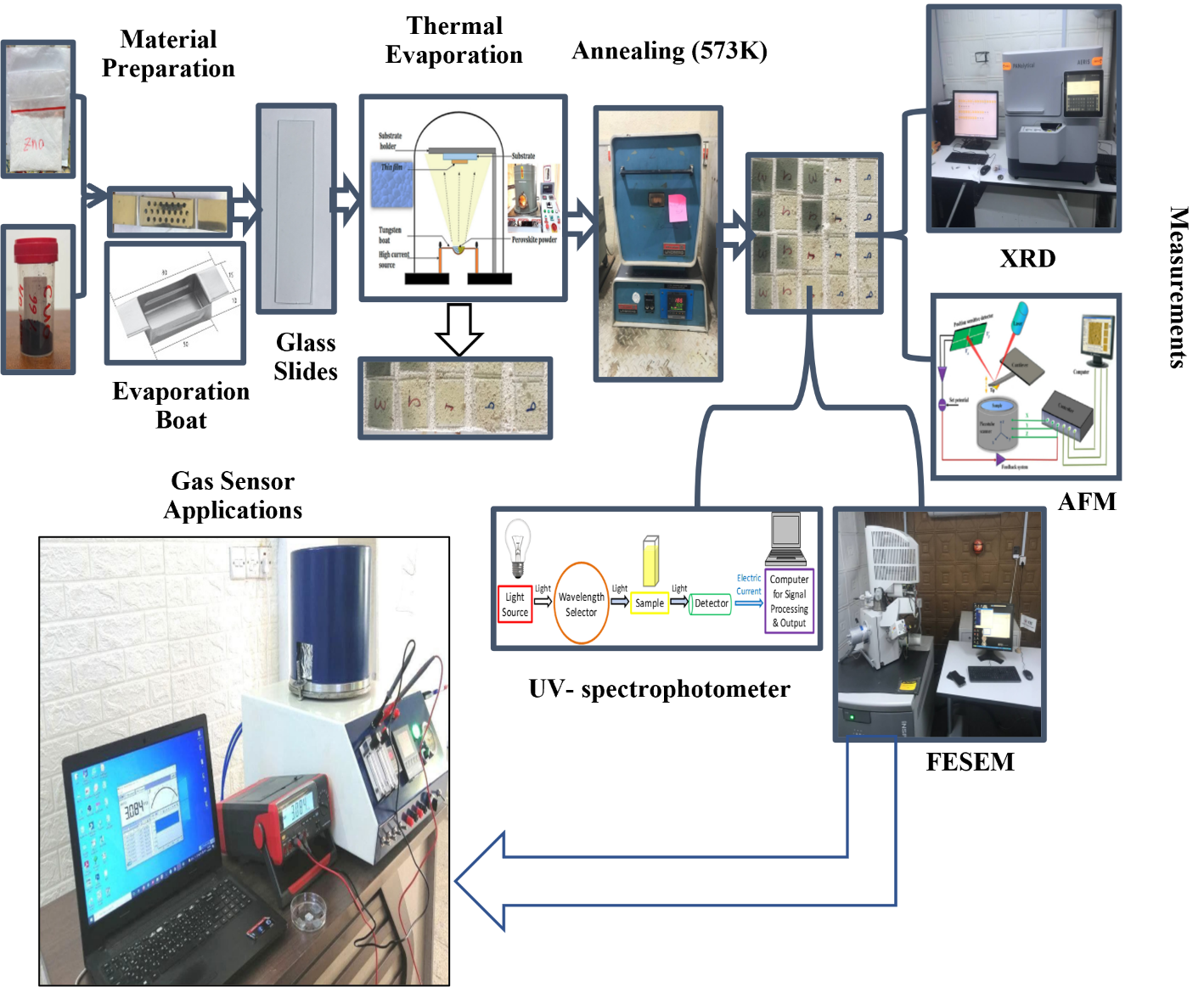
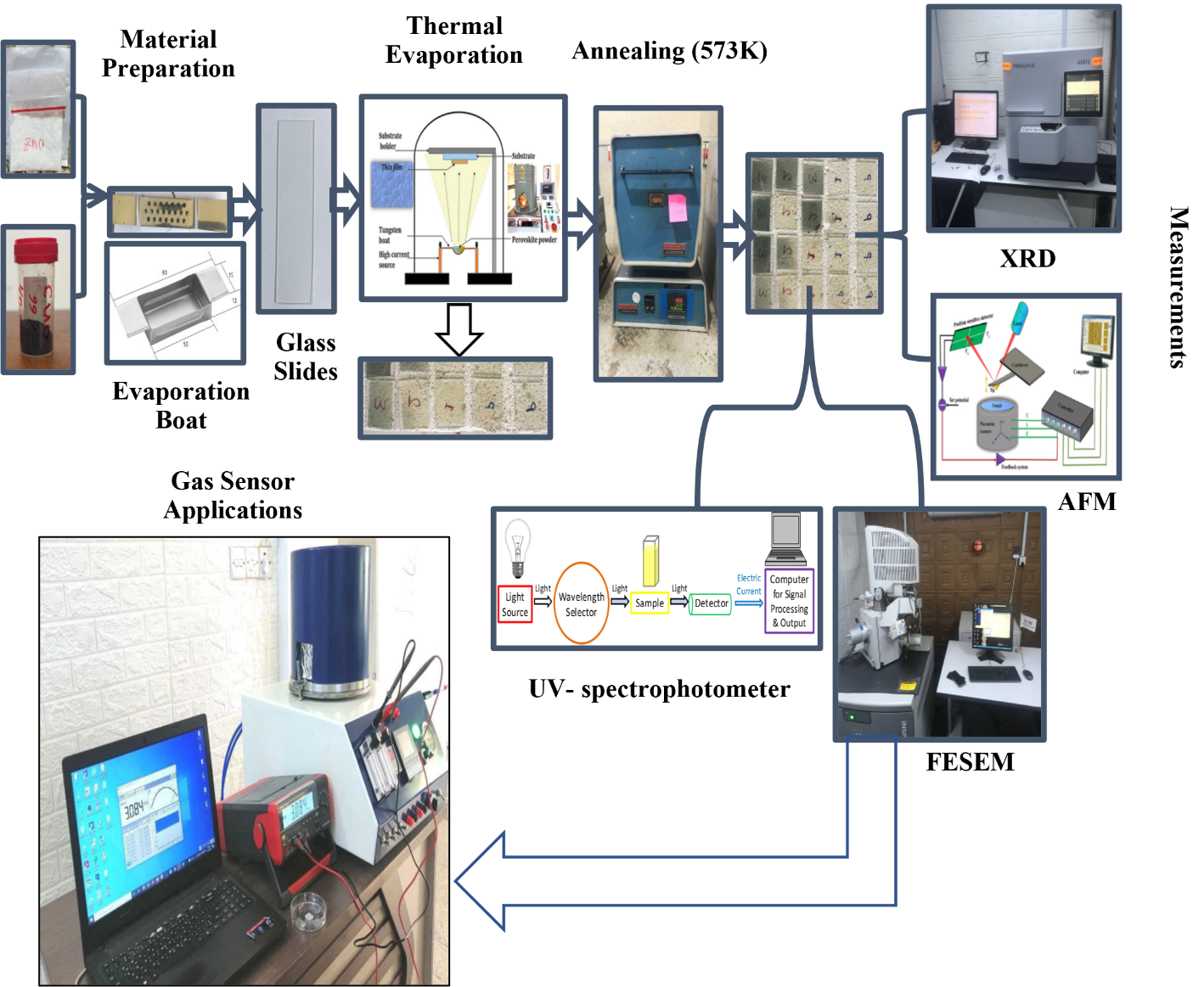
In the current study, thin films of copper oxide (CuO-based) and zinc oxide (ZnO-doped) were fabricated using the thermal evaporation technique. The evaporation process occurs at 1×10⁻⁷ bar pressure and 0.5 nm s–1deposition rate. At room temperature (RT), the film thickness is (50 ± 0.2) nm and is deposited on glass substrates. After deposition, films are annealed at 573 K for 2 h. XRD analysis proved that CuO is monoclinic wurtzite-type with the presence of ZnO in the prepared films. This process yielded films with a homogeneous surface, as confirmed by AFM. As ZnO doping increased, roughness increased by 25 %, the root mean square value increased by 23.55 %, and the average grain diameter increased by 65.94 %. The FE-SEM analysis showed equally scattered (CuO/ZnO) nanoparticles (NPs). The optical characteristics of (CuO/ZnO) show that the absorbance and absorption coefficient increase with ZnO content. Transmittance and energy band gaps reduced from 0.889 to 0.742 at λ = 360 nm and 3.608 to 3.504 eV, respectively, as ZnO concentrations increased. The greatest reported sensitivity to NO2 at a concentration of 0.20 wt.% was 47.06 % at operating temperature of 100 °C. This sensitivity was achieved within a reaction time of 36 s and a recovery time of 19.8 s. The sensitivity of the sample (0.20 wt.%) normally decreases with increasing temperature. This suggests that the gas sensor can interact with NO2 gas without needing any activation energy and that the interaction is based on physical adsorption and polarity. Nevertheless, the sensitivity of the (Pure, 0.08, and 0.14) wt.% samples exhibited a positive correlation with temperature within a specific range. The findings regarding the structural and conductive properties of (CuO/ZnO) thin films have potential applications in diverse optoelectronics devices and gas sensors.
HIGHLIGHTS
- Fabrication of (CuO/ZnO) nanostructures using thermal evaporation method.
- Study and analysis of the structural and morphological properties of the nanocomposites.
- Description of the optical properties of (CuO/ZnO) thin films.
- Fabrication of (CuO/ZnO) a gas sensor for the detection of NO2.
- Obtaining the best sensitivity, response time and recovery time for nitrogen oxide gas for (CuO/ZnO) thin films.
GRAPHICAL ABSTRACT
Downloads
References
MH Meteab, A Hashim and BH Rabee. Synthesis and structural properties of (PS-PC/Co2O3-SiC) nanocomposites for antibacterial applications, nanosistemi, nanomater. Nanosistemi Nanomateriali Nanotehnologii 2023; 21, 451-460.
MG Lines. Nanomaterials for practical functional uses. Journal of Alloys and Compunds 2008; 449(1-2), 242-245.
A Fadaka, O Aluko, S Awawu and K Theledi. Green synthesis of gold nanoparticles using pimenta dioica leaves aqueous extract and their application as photocatalyst, antioxidant, and antibacterial agents. Journal of Multidisciplinary Applied Natural Science 2021; 1(2), 78-88.
LA Kolahalam, IVK Viswanath, BS Diwakar, B Govindh, V Reddy and YKN Murthy. Review on nanomaterials: Synthesis and applications. Materials Today: Proceedings 2019; 18, 2182-2190.
HS Nalwa. Handbook of nanostructured materials and nanotechnology. Academic Press, Cambridge, 1999.
S Logothetidis. Nanostructured materials and their applications. Springer Berlin, Heidelberg, Germany, 2012.
E Omanović-Mikličanin, A Badnjević, A Kazlagić and M Hajlovac. Nanocomposites: A brief review. Health and Technology 2020; 10, 51-59.
V Khoramshahi, M Azarang, M Nouri, A Shirmardi and R Yousefi. Metal oxide/g-C3N4 nanocomposites chemiresistive gas sensors: A review on enhanced performance. Talanta Open 2024; 9, 100290.
KMMA El-Nour, A Eftaiha, A Al-Warthan and RAA Ammar. Synthesis and applications of silver nanoparticles. Arabian Journal of Chemistry 2010; 3(3), 135-140.
NA Ibrahim. Nanomaterials for antibacterial textiles. In: M Rai and K Kon (Eds.). Nanotechnology in diagnosis, treatment and prophylaxis of infectious diseases. Academic Press, Cambridge, 2015, p. 191-216.
Z Yang, H Peng, W Wang and T Liu. Crystallization behavior of poly(ε‐caprolactone)/layered double hydroxide nanocomposites. Journal of Applied Polymer Science 2010; 116(5), 2658-2667.
MH Abbas, H Ibrahim, A Hashim and A Hadi. Fabrication and tailoring structural, optical, and dielectric properties of PS/CoFe2O4 nanocomposites films for nanoelectronics and optics applications. Transactions on Electrical and Electronic Materials 2024; 25, 449-457.
S Murthy, P Effiong and CC Fei. Metal oxide nanoparticles in biomedical applications. In: Y Al-Douri (Ed.). Metal oxide powder technologies: Fundamentals, processing methods and applications. Elsevier, Amsterdam, The Netherlands, 2020, p. 233-251.
GA Kontos, AL Soulintzis, PK Karahaliou, GC Psarras, SN Georga, CA Krontiras and MN Pisanias. Electrical relaxation dynamics in TiO2 - polymer matrix composites. Express Polymer Letters 2007; 1(12), 781-789.
S Laurent, S Boutry and RN Muller. Metal oxide particles and their prospects for applications. In: M Mahmoudi and S Laurent (Eds.). Iron oxide nanoparticles for biomedical applications: Synthesis, functionalization and application. Elsevier, Amsterdam, The Netherlands, 2018, p. 3-42.
J Lillo-Ramiro, JM Guerrero-Villalba, MDL Mota-González, FS Aguirre-Tostado, G Gutiérrez-Heredia, I Mejía-Silvan and A Carrillo-Castillo. Optical and microstructural characteristics of CuO thin films by sol gel process and introducing in non-enzymatic glucose biosensor applications. Optik 2021; 229, 166238.
R Nayak, FA Ali, DK Mishra, D Ray, VK Aswal, SK Sahoo and B Nanda. Fabrication of CuO nanoparticle: An efficient catalyst utilized for sensing and degradation of phenol. Journal of Materilals Research and Technology 2020; 9(5), 11045-11059.
ME Grigore, ER Biscu, AM Holban, MC Gestal and AM Grumezescu. Methods of synthesis, properties and biomedical applications of CuO nanoparticles. Pharmaceuticals 2016; 9(4), 75.
C Wang, XQ Fu, XY Xue, YG Wang and TH Wang. Surface accumulation conduction controlled sensing characteristic of p-type CuO nanorods induced by oxygen adsorption. Nanotechnology 2007; 18(14), 145506.
N Mukherjee, B Show, SK Maji, U Madhu, SK Bhar, BC Mitra, GG Khan and A Mondal. CuO nano-whiskers: Electrodeposition, Raman analysis, photoluminescence study and photocatalytic activity. Materilats Letters 2011; 65(21-22), 3248-3250.
N Mukherjee, A Mondal and U Madhu. Chemical bath deposition of thin films of CuO nanorods and their characterisation. International Journal of Nanomanufacturing 2010; 5(1-2), 16-24.
SK Maji, N Mukherjee, A Mondal, B Adhikary and B Karmakar. Chemical synthesis of mesoporous CuO from a single precursor: Structural, optical and electrical properties. Journal of Solid State Chemistry 2010; 183(8), 1900-1904.
J Morales, L Sánchez, F Martín, JR Ramos-Barrado and M Sánchez. Use of low-temperature nanostructured CuO thin films deposited by spray-pyrolysis in lithium cells. Thin Solid Films 2005; 474(1-2), 133-140.
T Itoh and K Maki. Growth process of CuO(111) and Cu2O(001) thin films on MgO(001) substrate under metal-mode condition by reactive dc-magnetron sputtering. Vacuum 2007; 81(9), 1068-1076.
IY Erdoǧan and Ö Güllü. Optical and structural properties of CuO nanofilm: Its diode application. Journal of Alloys and Compounds 2010; 492(1-2), 378-383.
A Moezzi, AM McDonagh and MB Cortie. Zinc oxide particles: Synthesis, properties and applications. Chemical Engineering Journal 2012; 185-186, 1-22.
R Chen, Z Li and W Gao. Effect of substrate on the morphology, crystal structure and property of ZnO thin films. Asia-Pacific Journal of Chemical Engineering 2007; 2(5), 388-393.
HS Suhail and AR Abdulridha. Synthesis, optical and AC electrical characteristics of nanocomposites (Bi2O3/ZnO) films prepared by thermal evaporation technique. Digest Journal of Nanomaterials and Biostructures 2023; 18(2), 437-450.
S Liu, B Yu, H Zhang, T Fei and T Zhang. Enhancing NO2 gas sensing performances at room temperature based on reduced graphene oxide-ZnO nanoparticles hybrids. Sensors and Actuators B: Chemical 2014; 202, 272-278.
TT Tung, NV Chien, NV Duy, NV Hieu, MJ Nine, CJ Coghlan, DNH Tran and D Losic. Magnetic iron oxide nanoparticles decorated graphene for chemoresistive gas sensing: The particle size effects. Journal of Colloid and Interface Science 2019; 539, 315-325.
SM Mali, SS Narwade, YH Navale, SB Tayade, RV Digraskar, VB Patil, AS Kumbhar and BR Sathe. Heterostructural CuO-ZnO Nanocomposites: A highly selective chemical and electrochemical NO2 sensor. ACS Omega 2019; 4(23), 20129-20141.
S Jain, N Karmakar, A Shah and NG Shimpi. Development of Ni doped ZnO/polyaniline nanocomposites as high response room temperature NO2 sensor. Materials Science and Engineering: B 2019; 247, 114381.
NA Hassan and IH Khudayer. Study of the structural and optical properties of CuAlxIn1-xTe2 thin film. AIP Conference Proceedings 2019; 2190(1), 20050.
N Hayder, A Hashim, MA Habeeb, BH Rabee, AG Hadi and MK Mohammed. Analysis of dielectric properties of PVA/PEG/In2O3 nanostructures for electronics devices. Journal of Composite and Advanced Materials 2022; 32(5), 261-264.
MK Mohammed, TN Khudhair, KS Sharba, A Hashim, QM Hadi and MH Meteab. Tuning the morphological and optical characteristics of SnO2/ZrO2 nanomaterials doped PEO for promising optoelectronics applications. Journal of Composite and Advanced Materials 2024; 34(4), 495-503.
GW Luckey. Introduction to solid state physics. Journal of the American Chemical Society 1957; 79(12), 3299.
L Leontie, M Caraman, M Delibaş and GI Rusu. Optical properties of bismuth trioxide thin films. Materials Research Bulletin 2001; 36(9), 1629-1637.
L Zhang, Y Hashimoto, T Taishi, I Nakamura and QQ Ni. Fabrication of flower-shaped Bi2O3 superstructure by a facile template-free process. Applied Surface Science 2011; 257, 6577-6582.
WK Mahmood, TM Rashid, MI Rahmah, AM Jasim, MQ Fahem, MS Jabir, DA Abid, RA Majed, DM Awaid and HM Yosif. Empowering NO2 detection: Synthesis of highly responsive Au/Cu-doped iron oxide nanoparticles as gas sensors through laser ablation. Plasmonics 2024. https://doi.org/10.1007/s11468-024-02235-2.
MH Sarfi, M Ghadimi and A Babaee. H2S gas sensor based on SnO2 and CuO nanoparticles. STEM Fellowship Journal 2015; 1(2), 21-26.
NH Harb and FAH Mutlak. Gas sensing characteristics of WO3NPs sensors fabricated by pulsed laser deposition on PS n-type. Journal of Optics 2022; 52, 323-331.
KH Abass and MK Mohammed. Fabrication of ZnO:Al/Si solar cell and enhancement its efficiency via AI-doping. Nano Biomedicine and Engineering 2019; 11(2), 170-177.
SS Zahirullah, JJ Prince and PFH Inbaraj. Structural and optical properties of Cu-doped ZnO nanorods by silar method. Materials Technology 2017; 21, 38.
HK Obayes, MH Meteab and BA Al-Kareem. Modified dosimetric features of new type of lithium borate glass system: Role of magnesium and gold Co-doping. Transactions on Electrical and Electronic Materials 2024; 25, 708-721.
M Yasin, M Saeed, M Muneer, M Usman, AU Haq, M Sadia and M Altaf. Development of Bi2O3-ZnO heterostructure for enhanced photodegradation of rhodamine B and reactive yellow dyes. Surfaces and Interfaces 2022; 30, 101846.
MH Naeem, SHH Al-Nesrawy and MH Al-Maamori. Influence of lead nanoparticles on structural, morphological, and mechanical characteristics of (SiR-PU/Micro-Pb) composites and radiation shielding applications. East European Journal of Physics 2023; 3(3), 539-545.
RO Yathisha, YA Nayaka, P Manjunatha, HT Purushothama, MM Vinay and KV Basavarajappa. Study on the effect of Zn2+ doping on optical and electrical properties of CuO nanoparticles. Physica E: Low-Dimensional Systems and Nanostructures 2019; 108, 257-268.
R Grazziotin-Soares, MH Nekoofar, TE Davies, A Bafail, E Alhaddar, R Hübler, ALS Busato and PMH Dummer. Effect of bismuth oxide on white mineral trioxide aggregate: Chemical characterization and physical properties. International Endodontic Joournal 2014; 47(6), 520-533.
MK Khalaf, BT Chiad, AF Ahmed and FAH Mutlak. Thin film technique for preparing nano-ZnO gas sensing (O2, NO2) using Plasma Deposition. International Journal of Application or Innovation in Engineering & Management 2013; 2(6), 178-184.
W Gao and Z Li. ZnO thin films produced by magnetron sputtering. Ceramics International 2004; 30, 1155-1159.
Ü Özgür, YI Alivov, C Liu, A Teke, MA Reshchikov, S Doǧan, V Avrutin, SJ Cho and H Morko̧. A comprehensive review of ZnO materials and devices. Journal of Applied Physics 2005; 98(4), 41301.
L Cong, X Zheng, P Hu and S Dan‐Feng. Bi2O3 vaporization in microwave‐sintered ZnO varistors. Journal of the American Ceramic Society 2007; 90(9), 2791-2794.
VS Kalyamwar, FC Raghuwanshi, NL Jadhao and AJ Gadewar. Zinc oxide nanostructure thick films as H2S gas sensors at room temperature. Journal of Sensor Technology 2013; 3, 31-35.
GS Ahmed, TH Mahmoud, HI Mohammed and AA Hussein. Fabrication and study of ZnO thin films using thermal evaporation technique. Egyptian Journal Chemistry 2021; 64, 5189-5197.
I Dhahri, M Ellouze, S Labidi, QM Al-Bataineh, J Etzkorn, H Guermazi, A Telfah, CJ Tavares, R Hergenröder and T Appel. Optical and structural properties of ZnO NPs and ZnO-Bi2O3 nanocomposites. Ceramics Interational 2022; 48, 266-277.
GA Somorjai and Y Li. Introduction to surface chemistry and catalysis. John Wiley & Sons, New Jersey, 2010.
MH Meteab, A Hashim and BH Rabee. Synthesis and tailoring the morphological, optical, electronic and photodegradation characteristics of PS-PC/MnO2-SiC quaternary nanostructures. Optical and Quantum Electronics 2023; 55, 187.
M Rizwan, A Shoukat, A Ayub, B Razzaq and MB Tahir. Types and classification of nanomaterials. In: Nanomaterials: Synthesis, characterization, hazards and safety. Elsevier, Amsterdam, The Natherlands, 2021, p. 31-54.
F Teimoori, K Khojier and NZ Dehnavi. On the dependence of H2 gas sensitivity of ZnO thin films on film thickness. Procedia Materials Science 2015; 11, 474-479.
TT Liu, MH Wang and HP Zhang. Synthesis and characterization of ZnO/Bi2O3 core/shell nanoparticles by the sol-gel method. Journal of Electronic Materials 2016; 45, 4412-4417.
RA Abdul-Nabi and E Al-Bermany. Performers of Si3N4 concentrations on morphology and electrical behavior for new quinary fabrication PEO-CMC-PANI/GO@Si3N4 nanocomposites for electronic devise and gas sensor application. Silicon 2024; 16, 5583-5601.
WK Mahmood and AN Naje. Fabrication of room temperature NO2 gas sensor based on silver nanoparticles-decorated carbon nanotubes. Journal of Nano-Electronic Physics 2018; 10(5), 5020.
HS Suhail and AR Abdulridha. Investigation of the morphological, optical, and D.C electrical characteristics of synthesized (Bi2O3/ZnO) nanocomposites, as well as their potential use in hydrogen sulfide gas sensor. Transactions on Electrical and Electronic Materials 2023; 24, 205-216.
Downloads
Published
How to Cite
Issue
Section
License
Copyright (c) 2024 Walailak University

This work is licensed under a Creative Commons Attribution-NonCommercial-NoDerivatives 4.0 International License.





