
Optimizing Solvent Extraction for Potent Antioxidant and Antidiabetic Activities: A Study on Ampelocissus martini Root
DOI:
https://doi.org/10.48048/tis.2025.8998Keywords:
α-amylase inhibitory, Ampelocissus martini, Antidiabetic, Antimicrobial, Antioxidant, Fractionation, Solvent extractionAbstract
The selection of extraction solvents is a critical factor influencing the composition and concentration of phytochemicals in plant extracts, thereby leading to variations in their biological activities. In this study, Ampelocissus martini Planch., an edible plant traditionally used for its medicinal properties, was investigated for its phytochemical profile and biological activities. We assessed the impact of different solvents used in fractionating the aqueous methanolic root extract of the plant on its phytochemical content, as well as its antioxidant, antidiabetic, and antibacterial properties. Among the 3 fractions—ethyl acetate, butanol, and water-soluble—the butanol fraction exhibited significantly higher levels of total phenolics and proanthocyanidins, while the ethyl acetate fraction contained the highest levels of total flavonoids and saponins. The water-soluble fraction showed lower concentrations of these compounds compared to the other 2 fractions. The butanol fraction demonstrated superior antioxidant activity, outperforming other fractions and several standard antioxidants, as evidenced by DPPH, ABTS, FRAP, and CUPRAC assays. Additionally, the butanol fraction showed greater antidiabetic activity, indicated by a lower IC50 value, although it was still less effective than acarbose, a synthetic antidiabetic drug. Correlation analysis revealed a significant association between total proanthocyanidin content and the observed levels of antioxidant and antidiabetic activities across the fractions. All fractions also exhibited antibacterial activity against Gram-positive bacteria. Based on these findings, butanol emerges as the optimal solvent for extracting specific phytochemicals with potent antioxidant, antidiabetic, and antibacterial activities from the aqueous methanolic extract of A. martini root. The butanol fraction holds promise as a natural source of antioxidants for managing diabetes and its associated complications.
HIGHLIGHTS
- Butanol extract showed strong antioxidant and antidiabetic activities, rich in proanthocyanidins.
- Strong link was found between proanthocyanidins and bioactivities in A. martini.
- Butanol fraction showed promise as a natural antioxidant for diabetes management.
GRAPHICAL ABSTRACT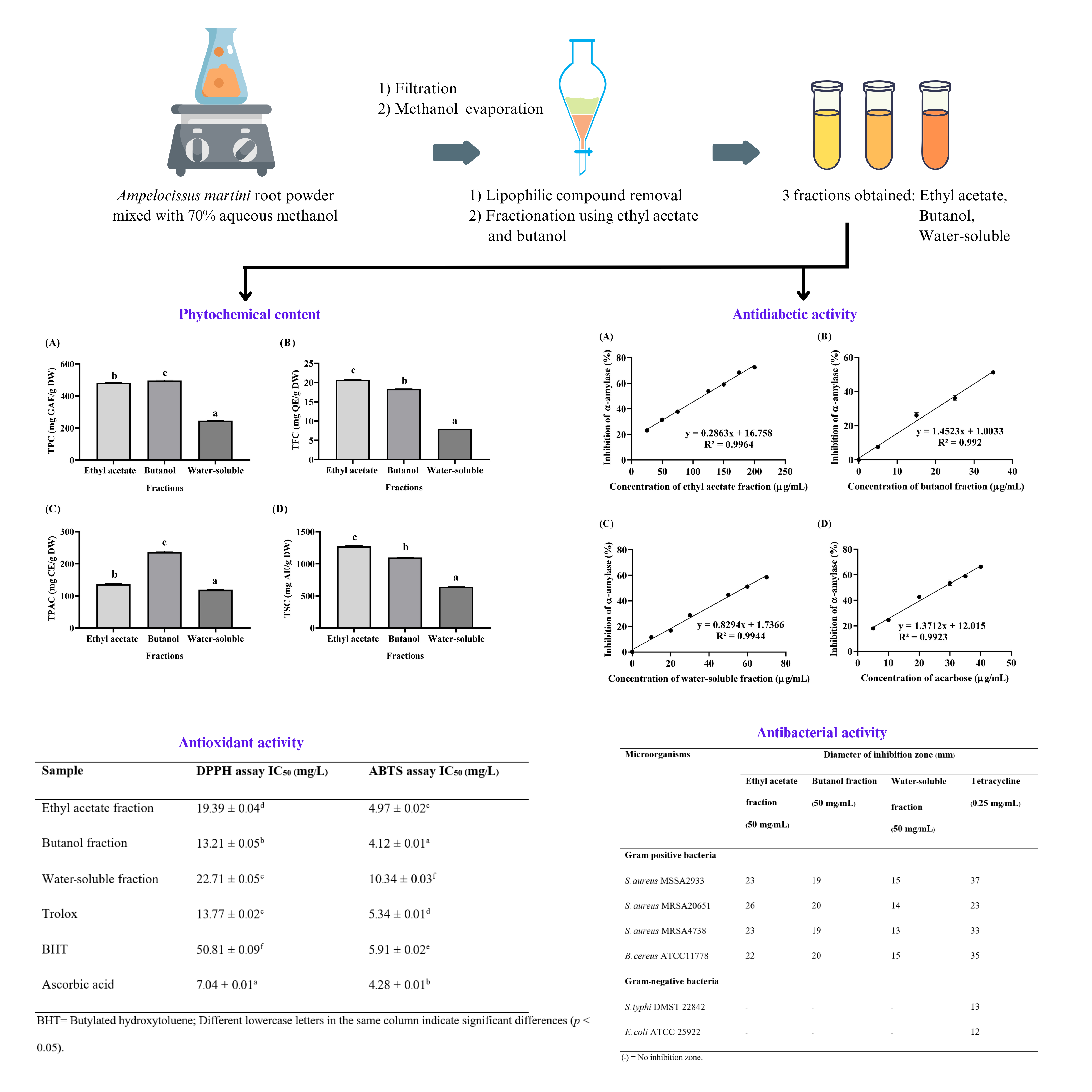
Downloads
References
S Shohag, S Akhter, S Islam, T Sarker, MK Sifat, MM Rahman, MR Islam and R Sharma. Perspectives on the molecular mediators of oxidative stress and antioxidant strategies in the context of neuroprotection and neurolongevity: An extensive review. Oxidative Medicine and Cellular Longevity 2022; 2022, 7743705.
A Rosengren and P Dikaiou. Cardiovascular outcomes in type 1 and type 2 diabetes. Diabetologia 2023; 66(3), 425-437.
MA Darenskaya, LI Kolesnikova and SI Kolesnikova. Oxidative stress: Pathogenetic role in diabetes mellitus and its complications and therapeutic approaches to correction. Bulletin of Experimental Biology and Medicine 2021; 171(2), 136-149.
MU Sohail, F Mashood, A Oberbach, S Chennakkandathil and F Schmidt. The role of pathogens in diabetes pathogenesis and the potential of immunoproteomics as a diagnostic and prognostic tool. Frontiers in Microbiology 2022; 13, 1042362.
EA Makinde, C Ovatlarnporn, AE Adekoya, OF Nwabor and OJ Olatunji. Antidiabetic, antioxidant and antimicrobial activity of the aerial part of Tiliacora triandra. South African Journal of Botany 2019; 125, 337-343.
D Cheng, P Wang, J Huang, B Yang, M Ma, P Yu, Z Zeng, D Gong and S Deng. Antioxidant, antidiabetic and identification of phenolic constituents from Potentilla discolor Bge. European Food Research and Technology 2020; 246, 2007-2016.
TF Rakotondrabe, M Fan and M Guo. Exploring potential antidiabetic and anti-inflammatory flavonoids from Euphorbia humifusa with an integrated strategy. Frontiers in Pharmacology 2022; 13, 980945.
X Li, J Liu, Q Change, Z Zhou, R Han and Z Liang. Antioxidant and antidiabetic activity of proanthocyanidins from Fagopyrum dibotrys. Molecules 2021; 26(9), 2417.
MO Nafiu and AOT Ashafa. Antioxidant and inhibitory effects of saponin extracts from Dianthus basuticus Burtt Davy on key enzymes implicated in type 2 diabetes in vitro. Pharmacognosy Magazine 2017; 13(52), 576-582.
T Venkatesan, YW Choi and YK Kim. Impact of different extraction solvents on phenolic content and antioxidant potential of Pinus densiflora bark extract. BioMed Research International 2019; 29, 3520675.
J Jirum, A Sangdee and P Srihanam. Phytochemical and biological activities in fresh juice extracts of wild grape (Ampelocissus martini Planch) Fruits. International Journal of Research in Ayurveda and Pharmacy 2013; 4(3), 337-341.
L Vittaya, S Khongsai, J Ui-Eng, C Chalad and N Leesakul. Effect of total phenolic and flavonoid contents of Ampelocissus martini in radical scavenging and antibacterial activities. Agriculture and Natural Resources 2019; 53(2), 154-160.
P Siripipatthana, P Srihanam and A Sangdee. Natural phytochemicals and biological activities of wild grape (Ampelocissus martinii Planch.) root extract. Asian Journal of Chemistry 2021; 33(3), 545-550.
P Siripipatthana. Alpha-amylase inhibitory and antioxidant activities in aqueous acetone extract and its fractions from Ampelocissus martini root. Indian Journal of Pharmaceutical Sciences 2022; 84(4), 929-937.
EJ Park and DY Jhon. The antioxidant, angiotensin converting enzyme inhibition activity, and phenolic compounds of bamboo shoot extracts. LWT - Food Science and Technology 2010; 43(4), 655-659.
K Farhadi, F Esmaeilzadeh, M Hatami, M Forough and R Molaie. Determination of phenolic compounds content and antioxidant activity in skin, pulp, seed, cane and leaf of five native grape cultivars in West Azerbaijan province, Iran. Food Chemistry 2016; 199, 847-855.
Y Li, C Guo, J Yang, J Wei, J Xu and S Cheng. Evaluation of antioxidant properties of pomegranate peel extract in comparison with pomegranate pulp extract. Food Chemistry 2006; 96(2), 254-260.
A Pekal and K Pyrzynska. Evaluation of aluminium complexation reaction for flavonoid content assay. Food Analytical Methods 2014; 7, 1776-1782.
S Hiai, H Oura and T Nakajima. Color reaction of some sapogenins and saponins with vanillin and sulfuric acid. Planta Medica 1976; 29(2), 116-122.
R Re, N Pellegrini, A Proteggente, A Pannala, M Yang and C Rice-Evans. Antioxidant activity applying an improved ABTS radical cation decolorization assay. Free Radical Biology and Medicine 1999; 26(9-10), 1231-1237.
R Apak, K Güçlü, M Özyürek and SE Karademir. Novel total antioxidant capacity index for dietary polyphenols and vitamins C and E, using their cupric ion reducing capability in the presence of neocuproine: CUPRAC method. J. Agric. Food Chem. 2004; 52(26), 7970-7981.
LL Zhang and YM Lin. Tannins from Canarium album with potent antioxidant activity. J. Zhejiang Univ. Sci. B 2008; 9(5), 407-415.
MN Wickramaratne, JC Punchihewa and DBM Wickramaratne. In-vitro alpha amylase inhibitory activity of the leaf extracts of Adenanthera pavonine. BMC Complementary and Alternative Medicine 2016; 16, 466.
K Sangdee, W Nakbanpote and A Sangdee. Isolation of the entomopathogenic fungal strain Cod-MK1201 from a Cicada nymph and assessment of its antibacterial activities. Int. J. Med. Mushrooms 2015; 17(1), 51-63.
R San Miguel-Chavez. Phenolic antioxidant capacity: A review of the state of the art. In: M Soto-Hernandez, M Palma-Tenango and MdR Garcia-Mateos (Eds.). Phenolic compounds-Biological activity. IntechOpen, Rijeka, 2017, p. 59-74.
Z Zreen, A Hameed, S Kiran, T Farooq and MS Zaroog. A Comparative Study of Diospyros malabarica (Gaub) extracts in various polarity-dependent solvents for evaluation of phytoconstituents and biological activities. BioMed Research International 2022; 2022, 746223.
M Casagrande, J Zanela, A Wagner Júnior, C Busso, J Wouk, G Iurckevicz, PF Montanher, F Yamashita and CRM Malfatti. Influence of time, temperature and solvent on the extraction of bioactive compounds of Baccharis dracunculifolia: In vitro antioxidant activity, antimicrobial potential, and phenolic compound quantification. Industrial Crops and Products 2018; 125, 207-219.
IG Munteanu and C Apetrei. Analytical methods used in determining antioxidant activity: A review. International Journal of Molecular Sciences 2021; 22(7), 3380.
G Zengin, YS Cakmak, GO Guler and A Aktumsek. In vitro antioxidant capacities and fatty acid compositions of three Centaurea species collected from Central Anatolia region of Turkey. Food and Chemical Toxicology 2010; 48(10), 2638-2641.
G Oboh, AT Isaac, AJ Akinyemi and RA Ajani. Inhibition of key enzymes linked to type 2 Diabetes and sodium nitroprusside induced lipid peroxidation in rats’ pancreas by phenolic extracts of avocado pear leaves and fruit. International Journal of Biomedical Science 2014; 10(3), 208-216.
MA Asgar. Anti-diabetic potential of phenolic compounds: A review. International Journal of Food Properties 2013; 16(1), 91-103.
B Khameneh, NAM Eskin, M Iranshahy and BSF Bazzaz. Phytochemicals: A promising weapon in the arsenal against antibiotic-resistant bacteria. Antibiotics 2021; 10(9), 1044.
R Bahri-Sahloul, RB Fredj, N Boughalleb, J Shriaa, S Saguem, JL Hilbert, F Trotin, S Ammar, S Bouzid and F Harzallah-Skhiri. Phenolic composition and antioxidant and antimicrobial activities of extracts obtained from Crataegus azarolus L. var.aronia (Willd.) Batt. ovaries calli. Journal of Botany 2014; 2014, 623651.
T Tamura, M Ozawa, N Tanaka, S Arai and K Mura. Bacillus cereus response to a proanthocyanidin trimer, a transcriptional and functional analysis. Current Microbiology 2016; 73(1), 115-123.
MI Khan, A Ahhmed, JH Shin, JS Baek, MY Kim and JD Kim. Green tea seed isolated saponins exerts antibacterial effects against various strains of gram positive and gram negative bacteria, a comprehensive study in vitro and in vivo. Evidence-Based Complementary and Alternative Medicine 2018; 26, 3486106.
M Takó, EB Kerekes, C Zambrano, A Kotogán, T Papp, J Krisch and C Vágvölgyi. Plant phenolics and phenolic-enriched extracts as antimicrobial agents against food-contaminating microorganisms. Antioxidants 2020; 9(2), 165.
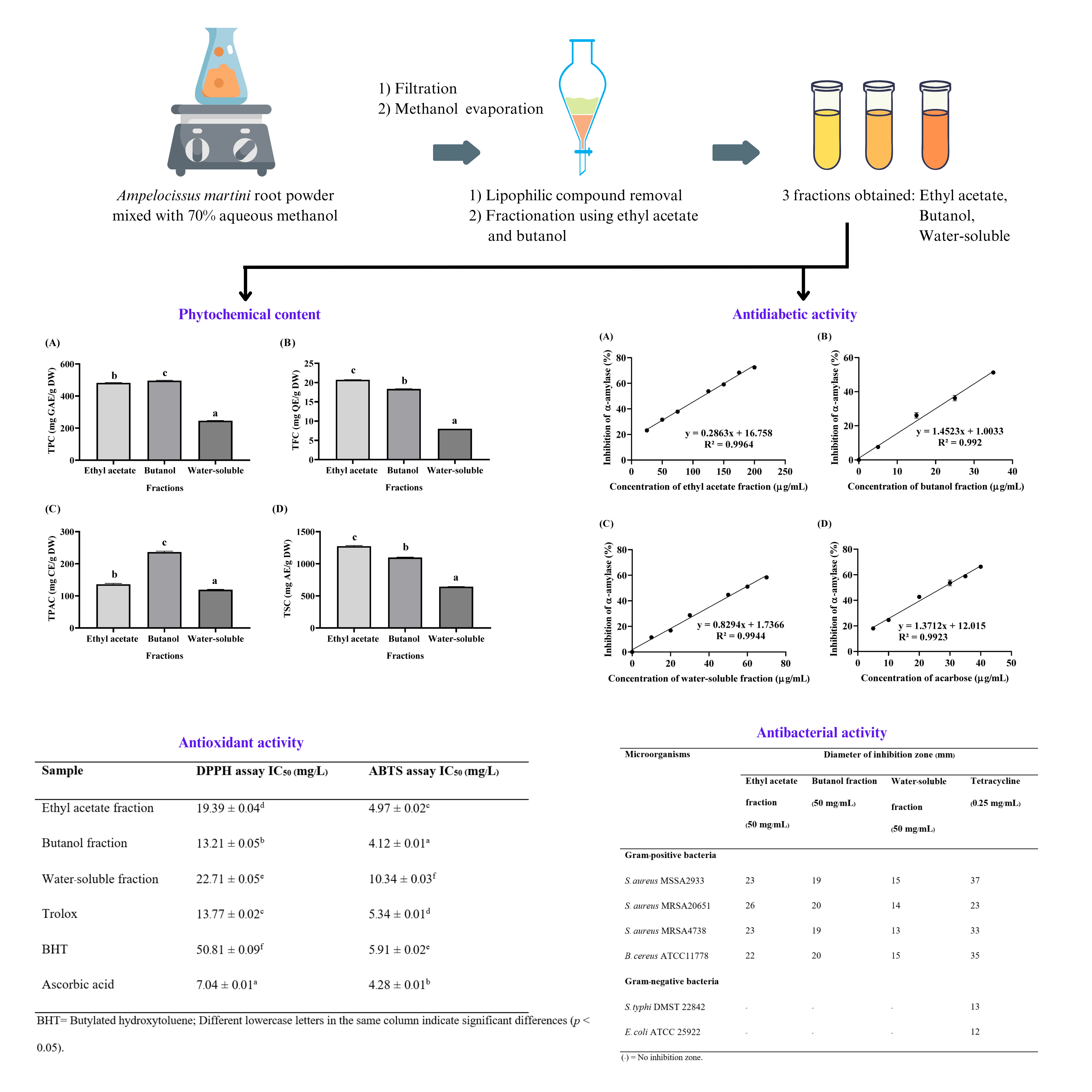
Downloads
Published
How to Cite
Issue
Section
License
Copyright (c) 2024 Walailak University

This work is licensed under a Creative Commons Attribution-NonCommercial-NoDerivatives 4.0 International License.





