
Genetic Diversity and Demographic History of Wax Moths, Galleria mellonella Linnaeus, 1758 and Achroia grisella Fabricius, 1794 (Lepidoptera: Pyralidae)
DOI:
https://doi.org/10.48048/tis.2025.8946Keywords:
Wax moth, Galleria mellonella, Achroia grisella, Genetic diversity, Population expansion, COI, ThailandAbstract
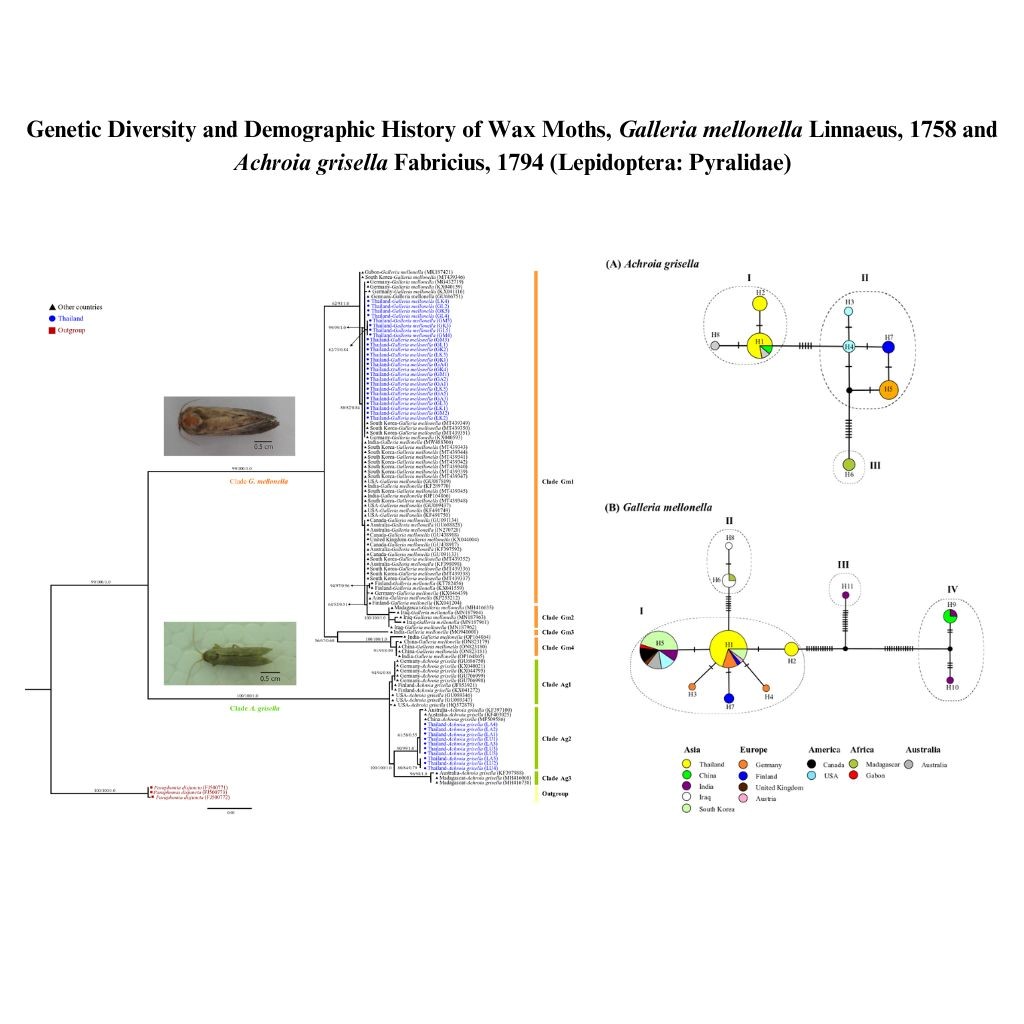
Wax moths, Galleria mellonella Linnaeus, 1758 and Achroia grisella Fabricius, 1794 are the key pests of honeybee colonies worldwide. They cause wax comb damages which lead to colony perishing and absconding. To control these pests, their genetic background and evolution should be considered. In this study, genetic diversity and demographic history of 2 species of wax moth were explored based on mitochondrial genes (COI). Wax moths were collected from northeatern part of Thailand for morphological and DNA analyses. G. mellonella and A. grisella sequences from GenBank were included for genetic diversity and demographic history analyses (total of 80 and 26 sequences, respectively). Overall genetic diversity for A. grisella samples from Northeastern Thailand was relatively low (h = 0.467 ± 0.132 and π = 0.00150 ± 0.00042). Likewise, low genetic diversity was also observed in G. mellonella samples (h = 0.280 ± 0.101 and π = 0.00046 ± 0.00017). Among samples from different global regions, the haplotype and nucleotide diversity of A. grisella were 0.834 ± 0.050 and 0.00996 ± 0.00124, respectively. The haplotype and nucleotide diversity of G. mellonella were 0.709 ± 0.034 and 0.01084 ± 0.00279, respectively. The ML tree revealed that these 2 species were separated into 2 major clades (G. mellonella clade and A. grisella clade). All sequences corresponding to G. mellonella formed to a single monophyletic clade, while all the sequences corresponding to A. grisella formed another single monophyletic clade. Clade G. mellonella was divided into 4 subclades designated as Clade Gm1, Gm2, Gm3 and Gm4, whereas A. grisella clade was divided into 3 subclades designated as Clade Ag1, Ag2 and Ag3. The sum of squares deviation (SSD) and Harpending’s raggedness index (rg) and the results of Tajima’s D and Fu’s Fs tests indicated population expansion was not found in either species.
HIGHLIGHTS
- This study highlighted the genetic diversity of wax moths Galleria mellonella Linnaeus, 1758 and Achroia grisella Fabricius, 1794 in Thailand and other parts of the world.
- Population expansion was not observed in either species.
- The results will be useful to predict directions of population distribution of wax moths under certain factors.
GRAPHICAL ABSTRACT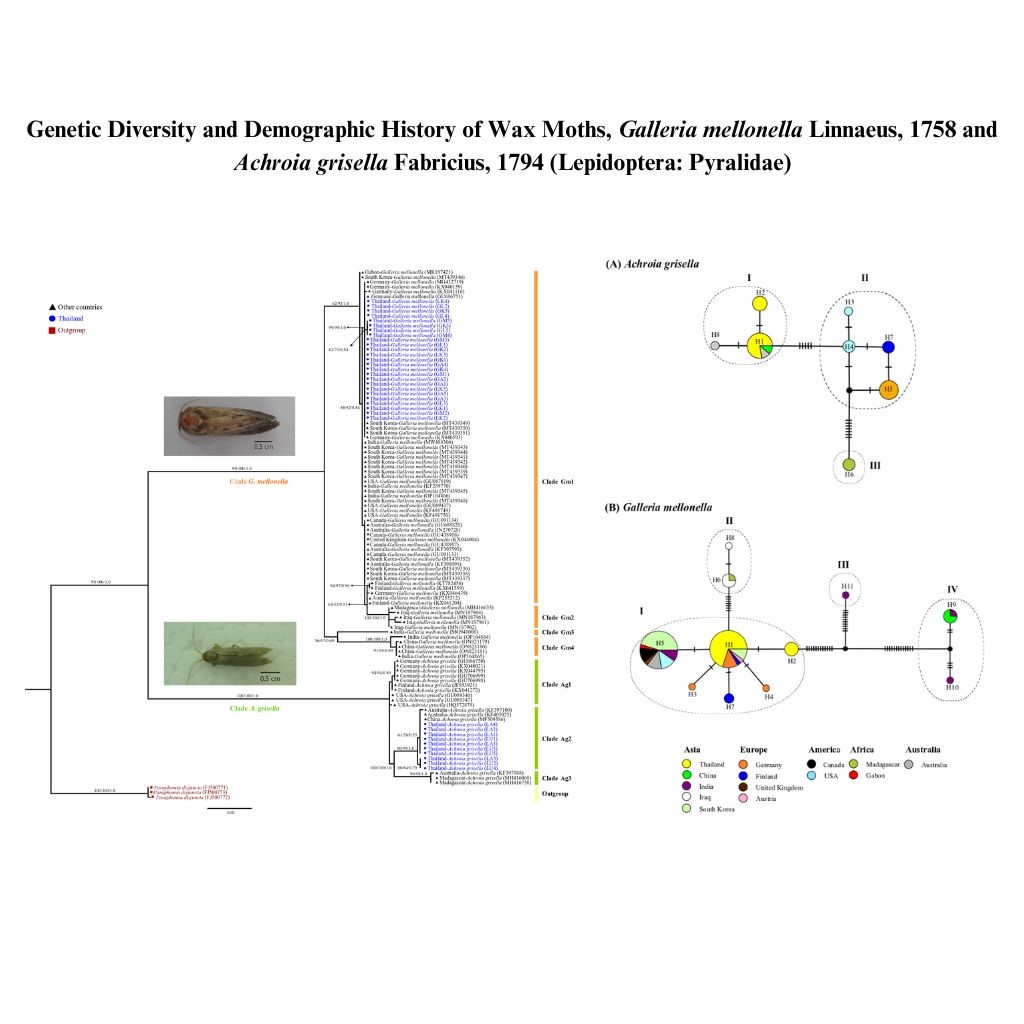
Downloads
References
EM Hosni, AA Al-Khalaf, MG Nasser, HF Abou-Shaara and MH Radwan. Modeling the potential global distribution of honeybee pest, Galleria mellonella under changing climate. Insects 2022; 13(5), 484.
AK Mishra, D Kurre, SK Mishra and B Tiwari. Greater wax moth, Galleria mellonella (Lepidoptera: Pyralidae) (L.): Its beneficial and harmful approaches. Vigyan Varta 2023; 4(12), 135-138.
JD Ellis, JR Graham and A Mortensen. Standard methods for wax moth research. Journal of Apicultural Research 2003; 52(1), 1-17.
M Mathialagan, YS Johnson Thangaraj Edward and PMM David. Wax moth infestation and its management in indian honey bee, Apis cerana F. colonies in Tamil Nadu. Madras Agricultural Journal 2019, 106(4-6), 400-405.
S Bhatnagar, RK Suman, N Sharma and M Sankhla. Infestation of greater wax moth Galleria mellonella in Apis mellifera colonies in Jodhpur (Rajasthan). Journal of Entomology and Zoology Studies 2020; 8(5), 1194-1197.
V Hosamani, BC Hanumantha Swamy, KN Kattimani and CM Kalibavi. Studies on biology of greater wax moth (Galleria mellonella L.). International Journal of Current Microbiology and Applied Sciences 2017; 6(11), 3811-3815.
I Serrano, C Verdial, L Tavares and M Oliveira. The virtuous Galleria mellonella model for scientific experimentation. Antibiotics 2023; 12, 505.
SJ Roh, H Park, SH Kim, SY Kim, YS Choi1 and JH Song. A new species of Galleria Fabricius (Lepidoptera, Pyralidae) from Korea based on molecular and morphological characters. ZooKeys 2020; 970, 51-61.
RY Chen and BA Keddie. Galleria mellonella (Lepidoptera: Pyralidae) hemocytes release extracellular traps that confer protection against bacterial infection in the hemocoel. Journal of Insect Science 2021; 21(6), 17.
I Wojda, B Staniec, M Sułek and J Kordaczuk. The greater wax moth Galleria mellonella: biology and use in immune studies. Pathogens and Disease 2020; 78(9), ftaa057.
YJ Park, CE Park, SJ Hong, BK Jung, JC Ibal, GS Park and JH Shin. The complete mitochondrial genome sequence of the greater wax moth Galleria mellonella (Insecta, Lepidoptera, Pyralidae): sequence and phylogenetic analysis comparison based on whole mitogenome. Mitochondrial DNA Part B 2017; 2(2), 714-715.
Y Liu, G Li and J Long. The complete mitochondrial genome of small wax moth, Achroia grisella (Pyralidae: Galleriinae). Mitochondrial DNA Part B 2022; 7(5), 738-740.
SJ Wei, LJ Cao, YJ Gong, BC Shi, S Wang, F Zhang, XJ Guo, YM Wang and XX Chen. Population genetic structure and approximate Bayesian computation analyses reveal the southern origin and northward dispersal of the oriental fruit moth Grapholita molesta (Lepidoptera: Tortricidae) in its native range. Molecular Ecology 2015; 24(16), 4094-4111.
CS Silva, EMG Cordeiro, JB de Paiva, PM Dourado, RA Carvalho, GHS Martinelli and AS Correa. Population expansion and genomic adaptation to agricultural environments of the soybean looper, Chrysodeixis includens. Evolutionary Applications 2020; 13(8), 2071-2085.
S Buala and PN Sopaladawan. Geometric morphometric analysis of forewings of Apis mellifera Linnaeus, 1758 (Hymenoptera: Apidae) populations in Thailand. Tropical Natural History 2022; 22, 56-66.
O Folmer, M Black, W Hoeh, R Lutz and R Vrijenhoek. DNA primers for amplification of mitochondrial cytochrome c oxidase subunit I from diverse metazoan invertebrates. Molecular Marine Biology and Biotechnology 1994; 3(5), 294-299.
J Rivera and DC Currie. Identification of Nearctic black flies using DNA barcodes (Diptera: Simuliidae). Molecular Ecology Resources 2009; 9(S1), 224-236.
G Kumar and MS Khan. Study of the life cycle of greater wax moth (Galleria mellonella) under storage conditions in relation to different weather conditions. Journal of Entomology and Zoology Studies 2018; 6(3), 444-447.
P Librado and J Rozas. DnaSP v5: A software for comprehensive analysis of DNA polymorphism data. Bioinformatics 2009; 25(11), 1451-1452.
LT Nguyen, T Schmidt, HAV Haeseler and BQ Minh. IQ-TREE: A fast and effective stochastic algorithm for estimating maximum-likelihood phylogenies. Molecular Biology and Evolution 2015; 32(1), 268-274.
S Kalyaanamoorthy, BQ Minh, TKF Wong, AV Haeseler and LS Jermiin. ModelFinder: Fast model selection for accurate phylogenetic estimates. Nature Methods 2017; 14(6), 587-589.
DT Hoang, O Chernomor, AV Haeseler, BQ Minh and LS Vinh. UFBoot2: Improving the ultrafast bootstrap approximation. Molecular Biology and Evolution 2018; 35(2), 518-522.
JP Huelsenbeck and FR Ronquist. MRBAYES: Bayesian inference of phylogeny. Bioinformatics 2001; 17(8), 754-755.
A Rambaut. FigTree: Tree figure drawing tool. Version 1.4.0. Institute of Evolutionary Biology, University of Edinburgh. Edinburgh, Scotland, 2012.
JW Leigh and D Bryant. POPART: Full-feature software for haplotype network construction. Methods in Ecology and Evolution 2015; 6(9), 1110-1116.
L Excoffier and HEL Lischer. Arlequin suite ver 3.5: A new series of programs to perform population genetic analyses under Linux and Windows. Molecular Ecology Resources 2010; 10(3), 564-567.
AR Rogers and H Harpending. Population-growth makes waves in the distribution of pairwise genetic-differences. Molecular Ecology Resources 1992; 9(3), 552-569.
FM Mendez-Harclerode, RE Strauss, CF Fulhorst, ML Milazzo, DC Ruthven III and RD Bradley. Molecular evidence for high levels of intrapopulation genetic diversity in woodrats (Neotoma Micropus). Journal of Mammalogy 2007; 88(2), 360-370.
M Sohail, MA Aqueel, JD Ellis, AM Raza and S Ullah. Consumption, digestion, and utilization of beeswax by greater wax moths (Galleria mellonella L.). Journal of Apicultural Research 2020; 59, 876-882.
DM Makori, AT Fombong, EM Abdel-Rahman, K Nkoba, J Ongus, J Irungu, G Mosomtai, S Makau, O Mutanga, J Odindi, S Raina and T Landmann. Predicting spatial distribution of key honeybee pests in Kenya using remotely sensed and bioclimatic variables: Key honeybee pests distribution models. ISPRS International Journal of Geo-Information 2017; 6(3), 66.
Downloads
Published
How to Cite
Issue
Section
License
Copyright (c) 2024 Walailak University

This work is licensed under a Creative Commons Attribution-NonCommercial-NoDerivatives 4.0 International License.





