
Lignin-Glyoxal Bio-Adhesive Based on Lignin from Sugarcane Bagasse: Characterization and Application
DOI:
https://doi.org/10.48048/tis.2025.8915Keywords:
Alkali treatment, Bio-adhesives, Glyoxal, Lignin, Lignin-glyoxal, Sugarcane bagasseAbstract
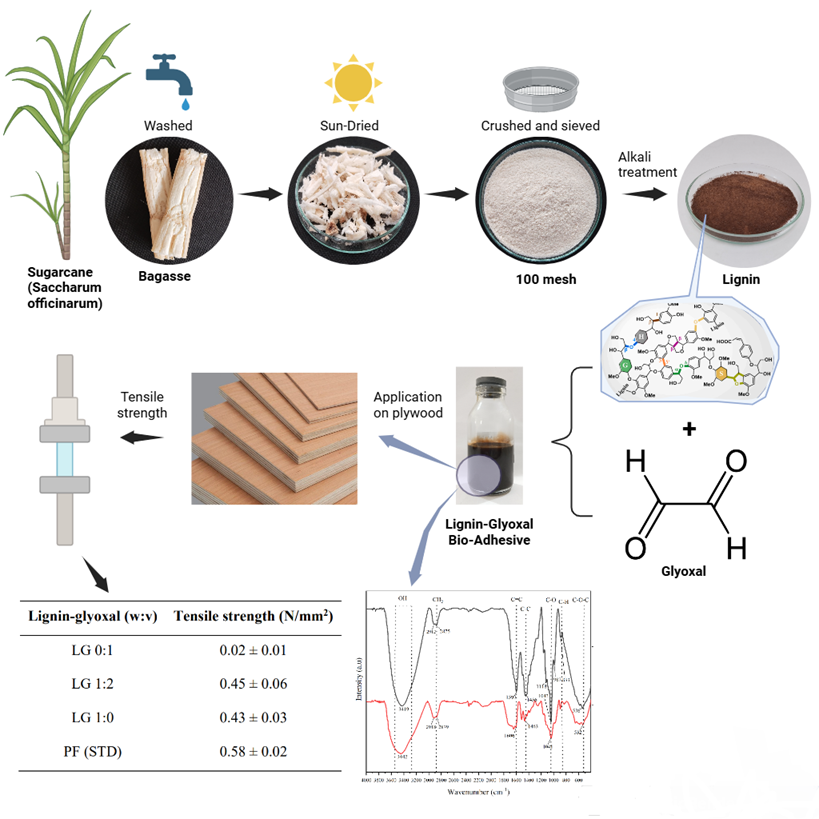
This study explores the potential of lignin extracted from sugarcane bagasse as an eco-friendly alternative to petroleum-derived phenol-formaldehyde (PF) adhesives. PF adhesives are widely used in plywood manufacturing, but their reliance on non-renewable resources and the toxicity of phenol and formaldehyde pose sustainability and health concerns. The researchers aimed to develop a lignin-glyoxal (LG) bio-adhesive that could match the performance of commercial PF adhesives. Lignin was isolated through alkali treatment, yielding 17.46 ± 3.61 %. FT-IR spectrophotometry and GPC characterization confirmed typical lignin functional groups, with Mn and Mw values of 1068.0 and 1196.0 g/mol, respectively. UV-Vis spectrophotometry revealed active sites with a total phenolic hydroxyl content of 0.35 ± 0.01 mmol/g. The optimal LG bio-adhesive composition was 1:2, achieving a tensile strength of 0.45 ± 0.06 N/mm², comparable to PF standards. While the LG 1:2 bio-adhesive exhibited suitable physicochemical properties and passed water resistance tests, it failed wet tensile strength tests, indicating its potential for interior wood product applications. This research contributes to the development of sustainable industrial applications utilizing lignin-based bio-adhesives.
HIGHLIGHTS
- Sustainable use of sugarcane bagasse: Successfully isolated lignin from sugarcane bagasse, demonstrating a valuable use of agricultural waste for producing bio-
- Advanced characterization techniques: Employed FT-IR, GPC, and UV-Vis spectroscopy to comprehensively characterize lignin, providing insights into its structure and suitability for bio-adhesive applications.
- Effective bio-adhesive formulation: Developed a lignin-glyoxal bio-adhesive with promising adhesive properties comparable to commercial adhesives, showcasing the potential for industrial applications.
- Improved tensile properties: The 1:2 lignin-glyoxal bio-adhesive achieved optimal tensile properties, indicating higher cross-linking and better polymerization.
- Environmental benefits: Developing a bio-adhesive from renewable resources reduces dependency on fossil-fuel-based adhesives and promotes environmental sustainability.
GRAPHICAL ABSTRACT

Downloads
References
A Dorieh, N Ayrilmis, MF Pour, SG Movahed, MV Kiamahalleh, MH Shahavi, H Hatefnia and M Mehdinia. Phenol formaldehyde resin modified by cellulose and lignin nanomaterials: Review and recent progress. International Journal of Biological Macromolecules 2022; 222, 1888-1907.
G Foyer, BH Chanfi, D Virieux, G David and S Caillol. Aromatic dialdehyde precursors from lignin derivatives for the synthesis of formaldehyde-free and high char yield phenolic resins. European Polymer Journal 2016; 77, 65-74.
M Siahkamari, S Emmanuel, DB Hodge and M Nejad. Lignin-glyoxal: A fully biobased formaldehyde-free wood adhesive for interior engineered wood products. ACS Sustainable Chemistry & Engineering 2022; 10(11), 3430-3441.
IV Nieuwenhove, T Renders, J Lauwaert, TD Roo, JD Clercq and A Verberckmoes. Biobased resins using lignin and glyoxal. ACS Sustainable Chemistry & Engineering 2020; 8(51), 18789-18809.
C Huang, Z Peng, J Li, X Li, X Jiang and Y Dong. Unlocking the role of lignin for preparing the lignin-based wood adhesive: A review. Industrial Crops and Products 2022; 18, 115388.
Y Chen, X Gong, G Yang, Q Li and N Zhou. Preparation and characterization of a nanolignin phenol formaldehyde resin by replacing phenol partially with lignin nanoparticles. RSC Advances 2019; 9(50), 29255-29262.
FC Moreira-Vilar, RDC Siqueira-Soares, A Finger-Teixeira, DMD Oliveira, AP Ferro, GJD Rocha, MDLL Ferrarese, WDD Santos and O Ferrarese-Filho. The acetyl bromide method is faster, simpler and presents best recovery of lignin in different herbaceous tissues than klason and thioglycolic acid methods. PLoS One 2014; 9(10), e110000.
JCD Río, AG Lino, JL Colodette, CF Lima, A Gutiérrez, ÁT Martínez, F Lu, J Ralph and J Rencoret. Differences in the chemical structure of the lignins from sugarcane bagasse and straw. Biomass and Bioenergy 2015; 81, 322-338.
A Boussetta, AA Benhamou, FJ Barba, ME Idrissi, N Grimi and A Moubarik. Experimental and theoretical investigations of lignin-urea-formaldehyde wood adhesive: Density functional theory analysis. International Jornal of Adhesion and Adhesives 2021; 104, 102737.
S Kalami, M Arefmanesh, E Master and M Nejad. Replacing 100 % of phenol in phenolic adhesive formulations with lignin. Journal of Applied Polymer Science 2017; 134(30), 45124.
Z Pan, Y Li, Z Zhang, F Xu, S Ramaswamy, A Abdulkhani and X Zhang. Fractionation of light-colored lignin via lignin-first strategy and enhancement of cellulose saccharification towards biomass valorization. Industrial Crops and Products 2022; 186, 115173.
WM Goldmann, J Ahola, O Mankinen, AM Kantola, S Komulainen, VV Telkki and J Tanskanen. Determination of phenolic hydroxyl groups in technical lignins by ionization difference ultraviolet spectrophotometry (∆ε-IDUS method). Periodica Polytechnica Chemical Engineering 2017; 61(2), 93-101.
M Jablonský, J Kočiš, A Ház and J Šima. Characterization and comparison by UV spectroscopy of precipitated lignins and commercial lignosulfonates. Cellulose Chemistry and Technology 2015; 49(3-4), 267-274.
LP Devendra and RK Sukumaran. Comparative evaluation of lignin derived from different sugarcane bagasse pretreatments in the synthesis of wood adhesive. Bioenergy Research 2023; 16(1), 151-162.
S Kalami, N Chen, H Borazjani and M Nejad. Comparative analysis of different lignins as phenol replacement in phenolic adhesive formulations. Industrial Crops and Products 2018; 125, 520-528.
JA Carvalho, MDS Miranda, MFF Pego, E Francisquini, DR Resende and ML Bianchi. Sugarcane bagasse lignin obtained by different extraction methods. Cellulose Chemistry and Technology 2021; 55(1-2), 55-62.
M Mennani, AA Benhamou, M Kasbaji, A Boussetta, EH Ablouh, Z Kassab, ME Achaby, N Boussetta, N Grimi and A Moubarik. Insights on the physico-chemical properties of alkali lignins from different agro-industrial residues and their use in phenol-formaldehyde wood adhesive formulation. International Journal of Biological Macromolecules 2022; 221, 149-162.
GI Bolio-López, RE Ross-Alcudia, L Veleva, JAA Barrios, MM Hernández-Villegas, PDLC Burelo and SS Córdova. Extraction and characterization of cellulose from agroindustrial waste of pineapple (Ananas comosus L. Merrill) crowns. Chemical Science Review and Letters 2016; 5(17), 198-204.
H Lange, F Rulli and C Crestini. Gel permeation chromatography in determining molecular weights of lignins: Critical aspects revisited for improved utility in the development of novel materials. ACS Sustainable Chemistry Engineering 2016; 4(10), 5167-5180.
K Saha, P Dwibedi, A Ghosh, J Sikder, S Chakraborty and S Curcio. Extraction of lignin, structural characterization and bioconversion of sugarcane bagasse after ionic liquid assisted pretreatment. 3 Biotech 2018; 8(8), 374.
G Xu, Z Shi, Y Zhao, J Deng, M Dong, C Liu, V Murugadoss, X Mai and Z Guo. Structural characterization of lignin and its carbohydrate complexes isolated from bamboo (Dendrocalamus sinicus). International Journal of Biological Macromolecules 2019; 126, 376-384.
RJ Young and PA Lovell. Introduction to polymers. 3rd eds. CRC press, Florida, 2011.
S Sain, L Matsakas, U Rova, P Christakopoulos, T Öman and M Skrifvars. Spruce bark‐extracted lignin and tannin‐based bioresin‐adhesives: Effect of curing temperatures on the thermal properties of the resins. Molecules 2021; 26(12), 3523.
M Culebras, MJ Sanchis, A Beaucamp, M Carsí, BK Kandola, AR Horrocks, G Panzetti, C Birkinshaw and MN Collins. Understanding the thermal and dielectric response of organosolv and modified kraft lignin as a carbon fibre precursor. Green Chemistry 2018; 20(19), 4461-4472.
MRT Esfandiyari, MT Pour, H Khademieslam, SAM Shokraei and B Bazyar. Investigating the possibility of making lignin-glyoxal resins as adhesives in the production of plywood. BioResources 2020; 14(3), 7122-7133.
PLD Hoyos-Martínez, E Robles, A Khoukh, FCE Bouhtoury and J Labidi. Formulation of multifunctional materials based on the reaction of glyoxalated lignins and a nanoclay/nanosilicate. Biomacromolecules 2019; 20(9), 3535-3546.
AF Ang, Z Ashaari, ES Bakar and NA Ibrahim. Possibility of enhancing the dimensional stability of jelutong (Dyera costulata) wood using glyoxalated alkali lignin-phenolic resin as bulking agent. European Journal of Wood and Wood Products 2018; 76, 269-282.
Downloads
Published
How to Cite
Issue
Section
License
Copyright (c) 2024 Walailak University

This work is licensed under a Creative Commons Attribution-NonCommercial-NoDerivatives 4.0 International License.





