
Effect of Pre-Treatment on Bitterness and Quality of Osmodehydrated Lemons
DOI:
https://doi.org/10.48048/tis.2025.8889Keywords:
Lemon fruit, Osmodehydrated lemon, Bitterness, Naringin, Limonin, Hesperidin, BlanchingAbstract
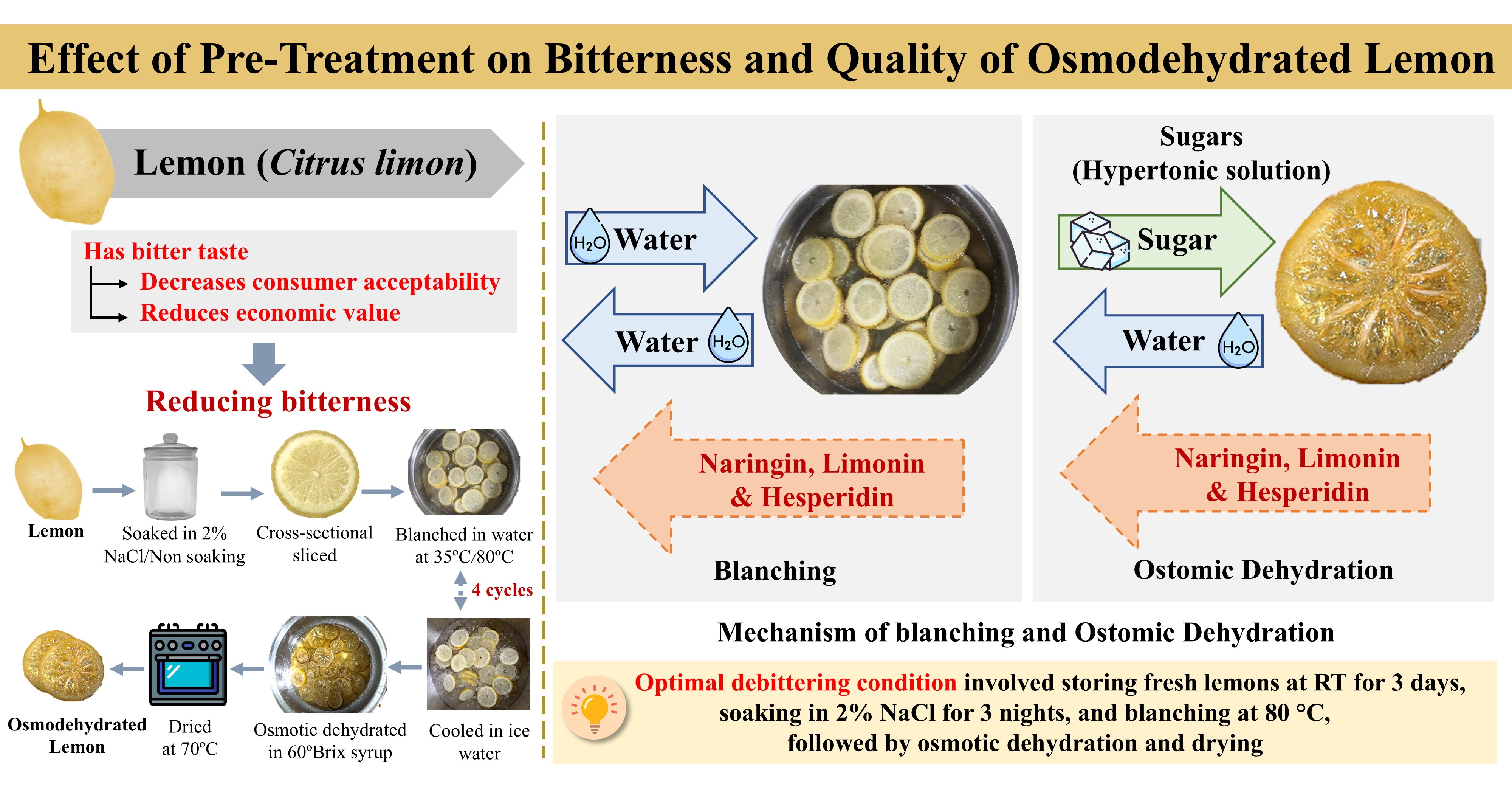
Lemons are rich in beneficial phytochemicals and antioxidants, including phenolic compounds and flavonoids. However, some of these compounds impart a bitterness that can limit its application in food products and affect consumer acceptance. This study aimed to reduce the bitterness of osmodehydrated lemon using a combination of pre-treatment, osmotic dehydration, and drying processes. Fresh lemons, lemons immersed in 2 % NaCl for 3 nights, and lemons stored at room temperature for 3 days were analyzed for bitter compounds. These samples underwent 4 cycles of blanching at either 35 or 80 °C, followed by cooling, osmotic dehydration in a 60 °Brix sugar solution with heating at 80 °C for 45 min and soaking in syrup for an additional 30 min, and finally drying at 70 °C until reaching a water activity below 0.6. Results indicated that the optimal condition for reducing bitterness involved storing fresh lemons at room temperature for 3 days, soaking them in 2 % NaCl solution for 3 nights, and blanching at 80 °C, followed by osmotic dehydration and drying. The naringin, limonin, and hesperidin contents were reduced by 34-fold, 24-fold, and 10-fold, respectively, compared to those in fresh lemons. Additionally, its sensory properties were well accepted by panelists. Although the production cost at the laboratory scale was high, it is expected to be lower at pilot or commercial scales. The production method is deemed suitable for entrepreneurial ventures in the lemons processing industry.
HIGHLIGHTS
- Value Addition: The study explored effective methods to value added and utilize lemon fruits by employing pre-treatment, blanching and cooling cycles, osmotic dehydration, and drying.
- Bitterness Reduction: The optimized production process significantly reduced the bitterness of the osmodehydrated lemon product.
- High Quality Process: The optimized production process resulted in high-quality osmodehydrated lemon products.
- Pre-Processing Storage: Storing fresh lemons at room temperature for 3 days before processing was effective in reducing bitterness.
- Consumer Approval: Panelists rated the osmodehydrated lemon favorably, indicating strong consumer preference.
GRAPHICAL ABSTRACT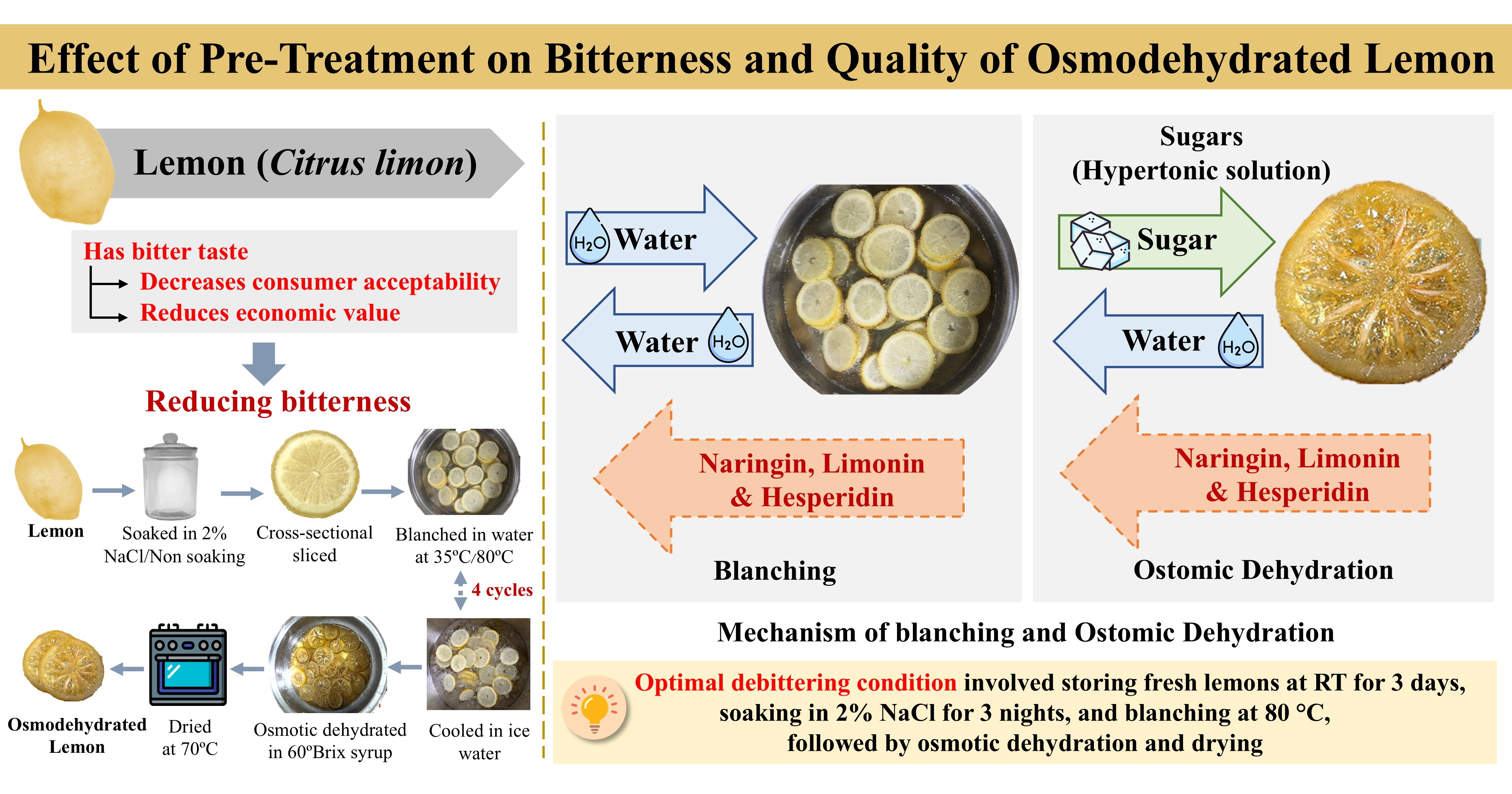
Downloads
References
H Zhao, Z Dong, B Liu, H Xiong, C Guo, P Lakshmanan, X Wang, X Chen, X Shi, F Zhang and Y Zhang. Can citrus production in China become carbon-neutral? A historical retrospect and prospect. Agriculture, Ecosystems & Environment 2023; 348, 108412.
KL Penniston, SY Nakada, RP Holmes and DG Assimos. Quantitative assessment of citric acid in lemon juice, lime juice, and commercially-available fruit juice products. Journal of Endourology 2008; 22(3), 567-570.
M Igual, E Garcıa-Martınez, MM Camacho and N Martınez-Navarrete. Jam processing and storage effects on b-carotene and flavonoids content in grapefruit. Journal of Functional Foods 2013; 5(2), 736-744.
O Benavente-Garcia, J Castillo, FR Marin, A Ortuno and JAD Rio. Uses and properties of citrus flavonoids. Journal of Agricultural and Food Chemistry 1997; 45(12), 4505-4515.
L Ram and S Singh. Medicinal importance of citrus products and by-products - a review. Agricultural Reviews 2006; 27(3), 170-180.
C Kanadaswami, LT Lee, PP Lee, JJ Hwang, FC Ke, YT Huang and MT Lee. The antitumor activities of flavonoids. In Vivo 2005; 19(5), 895-910.
RA Baker. Potential dietary benefits of citrus pectin and fiber. Food Technology 1994; 48(11), 133-139.
JJ Peterson, GR Beecher, SA Bhagwat, JT Dwyer, SE Gebhardt, DB Haytowitz and JM Holden. Flavanones in grapefruit, lemons, and limes: A compilation and review of the data from the analytical literature. Journal of Food Composition and Analysis 2006; 19, S74-S80.
G Gattuso, D Barreca, C Gargiulli, U Leuzzi and C Caristi. Flavonoid composition of citrus juices. Molecules 2007; 12(8), 1641-1673.
W Stuetz, T Prapamontol, S Hongsibsong and H Biesalski. Polymethoxylated flavones, flavanone glycosides, carotenoids, and antioxidants in different cultivation types of tangerines (Citrus reticulata Blanco cv. Sainampueng) from Northern Thailand. Journal of Agricultural and Food Chemistry 2010; 58(10), 6069-6074.
N Singh, RM Sharma, AK Dubey, OP Awasthi, R Porat, S Saha, C Bharadwaj, AM Sevanthi, A Kumar, N Sharma and N Carmi. Harvesting maturity assessment of newly developed citrus hybrids (Citrus maxima Merr.×Citrus sinensis (L.) Osbeck) for pptimum juice quality. Plants 2023; 12(23), 3978.
SS Purewal and KS Sandhu. Debittering of citrus juice by different processing methods: A novel approach for food industry and agro-industrial sector. Scientia Horticulturae 2021; 276(2), 109750.
S Hasegawa, P Ou, CH Fong, Z Herman, CW Coggins and DR Atkin. Changes in the limonoate a-ring lactone and limonin 17-beta-D-glucopyranoside content of navel oranges during fruit growth and maturation. Journal of Agricultural and Food Chemistry 1991; 39(2), 262-265.
VT Kore and I Chakraborty. Efficacy of various techniques on biochemical characteristics and bitterness of pummelo juice. Journal of Food Science and Technology 2015; 52(9), 6073-6077.
S Thaweesang. Antioxidant activity and total phenolic compounds of fresh and blanching banana blossom (Musa ABB CV. Kluai “Namwa”) in Thailand. IOP Conference Series: Materials Science and Engineering 2019; 639(1), 012047.
V Dewanto, X Wu, KK Adom and RH Liu. Thermal processing enhances the nutritional value of tomatoes by increasing total antioxidant activity. Journal of Agricultural and Food Chemistry 2002; 50(10), 3010-3014.
N Wuttisin and W Boonsook. Total phenolic, flavonoid contents and antioxidant activity of Siraitia grosvenorii fruits extracts. Food and Applied Bioscience Journal 2019; 7(3), 131-141.
S Nipornram, W Tochampa, P Rattanatraiwong and R Singanusong. Optimization of low power ultrasound-assisted extraction of phenolic compounds from mandarin (Citrus reticulata Blanco cv. Sainampueng) peel. Food Chemistry 2018; 241, 338-345.
V Chinapongtitiwat, S Jongaroontaprangsee, N Chiewchan and S Devahastin. Important flavonoids and limonin in selected Thai citrus residues. Journal of Functional Foods 2013; 5(3), 1151-1158.
H Bilal, W Akram, SA Hassan, S Sahar and MM Iqbal. Determination of limonin and nomilin contents in different citrus cultivars using high performance liquid chromatography: Limonoids in citrus cultivars. Pakistan Journal of Scientific and Industrial Research 2013; 56(1), 36-40.
W Horwitz and GW Latimer. Official methods of analysis. Association of Official Analytical Chemists, Maryland, 2005.
BH Salueña, CS Gamasa, JMD Rubial and CA Odriozola. CIELAB color paths during meat shelf life. Meat Science 2019; 157, 107889.
V Vichaibun and P Kanchanaphu. Study on the effects of lemon juice on chemical and functional properties of some fruit juices. Food Technology 2019; 23(2), 187-192.
W Xi, J Lu, J Qun and B Jiao. Characterization of phenolic profile and antioxidant capacity of different fruit part from lemon (Citrus limon Burm.) cultivars. Journal of Food Science and Technology 2017; 54(5), 1108-1118.
V Kumar and BK Roy. Population authentication of the traditional medicinal plant Cassia tora L. based on ISSR markers and FTIR analysis. Scientific Reports 2018, 8(1), 10714.
S Huang, X Liu, B Xiong, X Qiu, G Sun, X Wang, X Zhang, Z Dong and Z Wang. Variation in limonin and nomilin content in citrus fruits of eight varieties determined by modified HPLC. Food Science and Biotechnology 2019; 28(3), 641-647.
DG Guadagni, VP Maier and JG Turnbaugh. Effect of some citrus juice constituents on taste thresholds for limonin and naringin bitterness. Journal of the Science of Food and Agriculture 1973; 24(10), 1277-1288.
GA Barthe, PS Jourdan, CA McIntosh and RL Mansell. Radioimmunoassay for the quantitative determination of hesperidin and analysis of its distribution in Citrus sinensis. Phytochemistry 1988; 27(1), 249-254.
Y Nogata, K Sakamoto, H Shiratsuchi, T Ishii, M Yano and H Ohta. Flavonoid composition of fruit tissues of citrus species. Bioscience, Biotechnology, and Biochemistry 2006; 70(1), 178-192.
MF Rehman, AI Batool, R Qadir and M Aslam. Hesperidin and naringenin. In: M Mushtaq and F Anwar (Eds.). A centum of valuable plant bioactives, Elsevier Inc., Massachusetts, 2021, p. 403-444.
L Diamante, M Durand, G Savage and L Vanhanen. Effect of temperature on the drying characteristics, colour and ascorbic acid content of green and gold kiwifruits. International Food Research Journal 2010; 17(2), 441-451.
G Kresic, V Lelas and B Simundic. Effects of processing on nutritional composition and quality evaluation of candied celeriac. Sadhana 2004; 29(1), 1-12.
HW Xiao, CL Law, DW Sun and ZJ Gao. Color change kinetics of American ginseng (Panax quinquefolium) slices during air impingement drying. Drying Technology 2014; 32(4), 418-427.
HW Xiao, JW Bai, L Xie, DW Sun and ZJ Gao. Thin-layer air impingement drying enhances drying rate of American ginseng (Panax quinquefolium L.) slices with quality attributes considered. Food and Bioproducts Processing 2015; 94(8), 581-591.
HW Xiao, Z Pan, LZ Deng, HM El-Mashad, XH Yang, AS Mujumdar, ZJ Gao and Q Zhang. Recent developments and trends in thermal blanching - A comprehensive review. Information Processing in Agriculture 2017; 4(2), 101-127.
A Jagannath and M Kumar. Monitoring blanching induced debittering and storage losses of naringin in orange subjected to osmotic dehydration. International Journal of Fruit Science 2016; 16(4), 410-422.
CA Zainun. Processing of dehydrated candied guava. Teknologi Makanan 1995; 4, 63-66.
P Fellows and A Hampton. Small-scale food processing - A guide for appropriate equipment. Intermediate Technology Publications, London, 1992.
J Wichaphon, J Judphol, W Tochampa and R Singanusong. Effect of frying conditions on properties of vacuum fried banana bracts. LWT 2023; 184, 115022.
J Chirife and MDP Buera. Water activity, glass transition and microbial stability in concentrated/ semimoist food systems. Journal of Food Science 1994; 59(5), 921-927.
SV Jangam, VS Joshi, AS Mujumdar and BN Thorat. Studies on dehydration of sapota (Achras zapota). Drying Technology 2008; 26(3), 369-377.
I Ioannou, L Chekir and M Ghoul. Effect of heat treatment and light exposure on the antioxidant activity of flavonoids. Processes 2020; 8(9), 1078.
Downloads
Published
How to Cite
Issue
Section
License
Copyright (c) 2024 Walailak University

This work is licensed under a Creative Commons Attribution-NonCommercial-NoDerivatives 4.0 International License.





