
Effect of Brittleness in Rice Straw on Rumen Fermentation by In vitro Gas Production Technique
DOI:
https://doi.org/10.48048/tis.2024.8794Keywords:
Brittleness rice straw, In vitro study, Rumen fermentation, Wild-type riceAbstract
The objective of this study was to examine the impact of rice straw brittleness on its efficacy as roughage for ruminants, in comparison to a wild-type variety, utilizing an in vitro study approach. The experimental design was a complete randomized design (CRD). The experimental treatments included various breeds of rice straw (RS), such as the wild-type (WT, T1), the green brittle bred line 8 and line 13 with brittleness level-3 (GBL8-B3, T2 and GBL13-B3, T3), and the purple brittle bred line 8 with brittleness level-5 (PBL8-B5, T4). The findings revealed that the brittleness RS group had higher levels of crude protein and hemicellulose, and lower levels of cellulose compared to the wild-type group. Brittleness RS varieties showed a significantly greater gas production accumulation (p = 0.001) and IVDMD (p = 0.003) compared to the WT group. At 8 h post-incubation, the brittleness RS group showed significantly higher (p = 0.004) total of volatile fatty acids concentration compared to the WT group. After 1 h of post-incubation, GBL8-B3 exhibited the highest (p = 0.032) proportion of propionate and the lowest (0.009) C2:C3 ratio. Additionally, the brittleness RS did not have any effect on the population of ruminal microorganisms. Based on the brittleness of RS, it can be deduced that it has a greater potential as a roughage source when compared to the wild-type variety, consequently enhancing the quality of RS for roughage intake by ruminants.
HIGHLIGHTS
- Brittleness RS exhibited elevated levels of CP, high hemicellulose content, and lower cellulose levels compared to the WT group.
- The brittleness RS group displayed a rapid degradation rate impacting the total VFAs concentration and C2:C3 ratio, with the GBL8-B3 group demonstrating superior utilization efficiency.
- The brittleness of RS is indicative of a higher potential as a roughage source when compared to the wild-type variety, thereby improving the quality of rice straw for roughage consumption by ruminants.
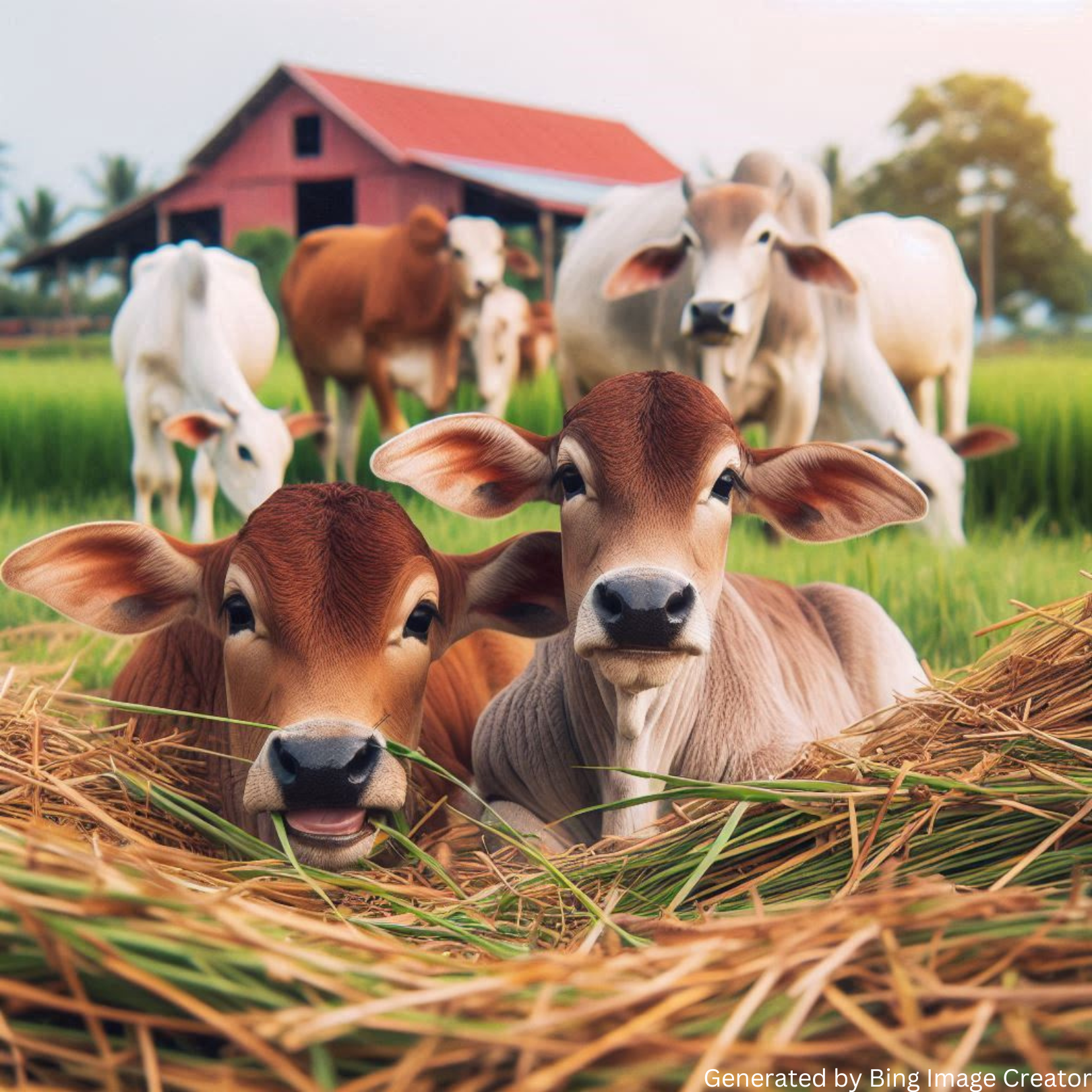
GRAPHICAL ABSTRACT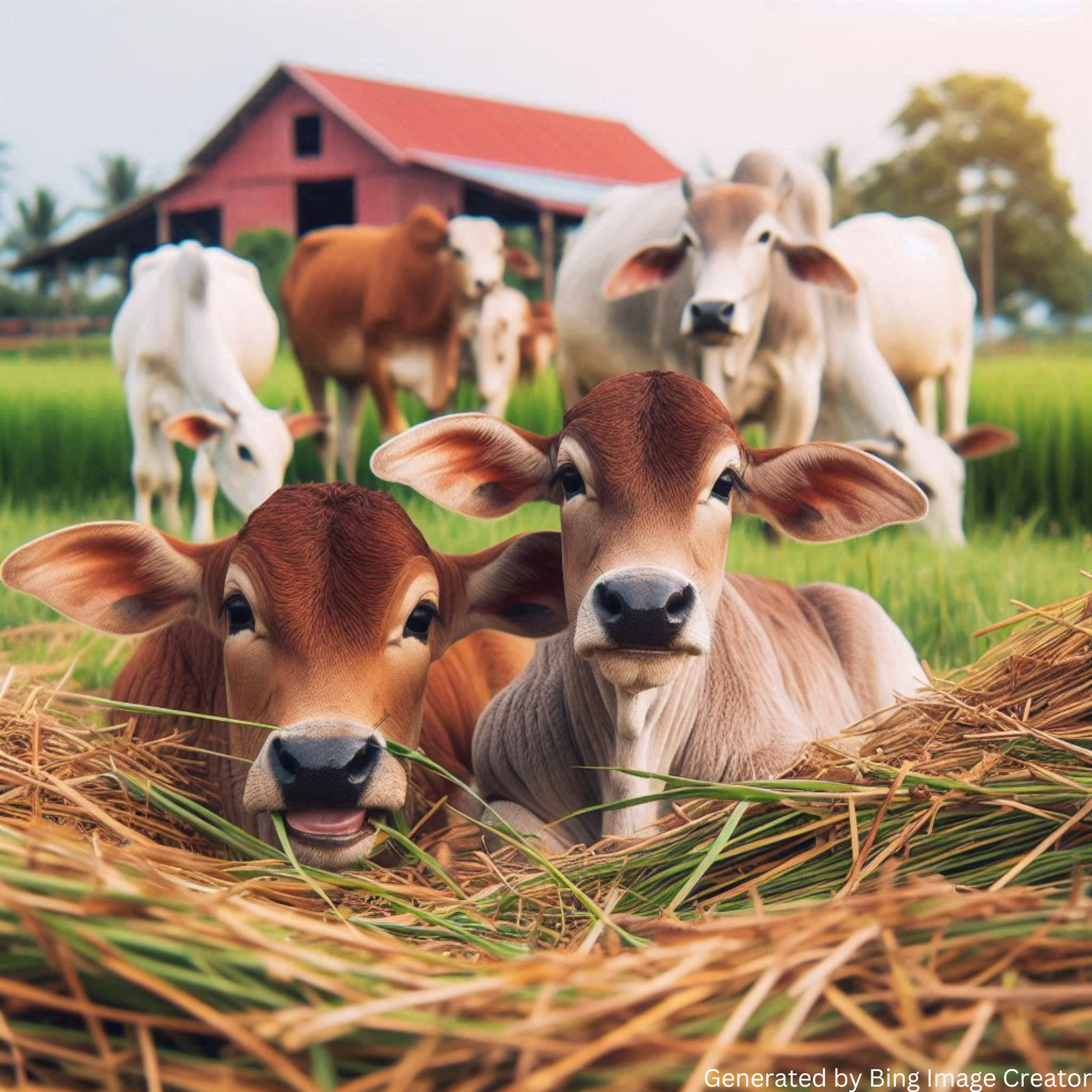
Downloads
References
LR Sarker, MRI Khan and SK Das. Wet rice straw ensiling with biogas slurry: A prospective feed preservation technique for higher protein content and metabolizable energy. Journal of Bioscience and Agriculture Research 2018; 18(2), 1539-1548.
GG Sheikh, AM Ganai, PA Reshi, S Bilal, S Mir and D Masood. Improved paddy straw as ruminant feed: A review. Agricultural Reviews 2018; 39(2), 137-143.
Y Yanuartono, H Purnamaningsih, S Indarjulianto and A Nururrozi. Potensi jerami sebagai pakan ternak ruminansia. Jurnal Ilmu-Ilmu Peternakan 2017; 27(1), 40-62.
D Aquino, AD Barrio, NX Trach, NT Hai, DN Khang, NT Toan and NV Hung. Rice straw-based fodder for ruminants. In: M Gummert, N Hung, P Chivenge and B Douthwaite (Eds.). Sustainable rice straw management. Springer, Switzerland, 2020, p. 111-129.
YY Kyawt, M Aung, Y Xu, Z Sun, Y Zhou, W Zhu, V Padmakumar, Z Tan and Y Cheng. Dynamic changes of rumen microbiota and serum metabolome revealed increases in meat quality and growth performances of sheep fed bio-fermented rice straw. Journal of Animal Science and Biotechnology 2024; 15, 34.
O Datsomor, Q Yan, K Wang, S Mohamed, L Opoku-Mensah, G Zhao and L Miao. Effect of ammoniated and/or Basidiomycete white-rot fungi treatment on rice straw proximate composition, cell wall component, and in vitro rumen fermentation characteristics. Fermentation 2022; 8(5), 228.
Y Ma, X Chen, MZ Khan, J Xiao and Z Cao. A combination of novel microecological agents and molasses role in digestibility and fermentation of rice straw by facilitating the ruminal microbial colonization. Frontiers in Microbiology 2022; 13, 948049.
V Peripolli, JOJ Barcellos, ÊR Prates, C McManus, LA Stella, CM Camargo, JBGJ Costa and C Bayer. Additives on in vitro ruminal fermentation characteristics of rice straw. Revista Brasileira de Zootecnia 2017; 46(3), 240-250.
S Saphaphan, KT Rangubhet and P Kongmun. The effects of monosodium glutamate by product treated rice straw in total mixed rations on rumen fermentation and ruminal microbial populations using an in vitro gas technique. Advances in Animal and Veterinary Sciences 2024; 12(6), 1157-1165.
Y Su, G Zhao, Z Wei, C Yan and S Liu. Mutation of cellulose synthase gene improves the nutritive value of rice straw. Asian-Australasian Journal of Animal Sciences 2012; 25(6), 800-805.
A Sawasdee. Screening and characterization of brittle mutants from the mutation pools of TNG67 and IR64 rice varieties and breeding to improve bacterial blight resistance. National Chung Hsing University, Taichung, Taiwan, 2017.
A Sawasdee, TH Tsai, WC Liao and CS Wang. Identification of the CesA7 gene encodes brittleness mutation derived from IR64 variety and breeding for ruminant feeding. Agriculture 2024; 14(5), 706.
X Ma, C Li, R Huang, K Zhang, Q Wang, C Fu, W Liu, C Sun, P Wang, F Wang and X Deng. Rice Brittle Culm19 encoding cellulose synthase subunit CESA4 causes dominant brittle phenotype but has no distinct influence on growth and grain yield. Rice 2021; 14(1), 95.
PVV Soest, JB Robertson and BA Lewis. Methods for dietary fiber, neutral detergent fiber, and nonstarch polysaccharides in relation to animal nutrition. Journal of Dairy Science 1991; 74(10), 3583-3597.
HH Menke and H Steingass. Estimation of the energetic feed value obtained from chemical analysis and in vitro gas production using rumen fluid. Animal Research and Development 1988; 28, 7-55.
ER Orskov and I McDonal. The estimation of protein degradability in the rumen from incubation measurements weighted according to rate of passage. The Journal of Agricultural Science 1979; 92(2), 499-503.
AL Chaney and EP Marbach. Modified reagents for determination of urea and ammonia. Clinical Chemistry 1962; 8, 130-132.
Z Yu and M Morrison. Improved extraction of PCR-quality community DNA from digesta and fecal samples. Biotechniques 2004; 36(5), 808-812.
PV Soest and JB Robertson. A laboratory manual for animal science. Cornell University Press, New York, 1985.
PSM Harinder and CS McSweeney. Methods in guts microbial ecology for ruminants. Springer, Dordrecht, Netherlands, 2005.
S Koike and Y Kobayashi. Development and use of competitive PCR assays for the rumen cellulolytic bacteria: Fibrobacter succinogenes, Ruminococcus albus and Ruminococcus flavefaciens. FEMS Microbiology Letters 2001; 204(2), 361-366.
Z Yu, FCJ Michel, G Hansen, T Wittum and M Morrison. Development and application of real-time PCR assays for quantification of genes encoding tetracycline resistance. Applied and Environmental Microbiology 2005; 71(11), 6926-6933.
RGD Steel and JH Torrie. Principles and procedures of statistics: A biometerial approach. McGraw-Hill, New York, 1980.
F Yong-Qing, Z Wei-Hua, L Feng-Cheng, Z Jing and Z Hui. Studies on biological characterization of rice brittle culm mutants and their biomass degradation efficiency. Journal of Agricultural Science and Technology 2013; 15, 77-83.
H Wang, Y Wu, J Liu and Q Qian. Morphological fractions, chemical compositions and in vitro gas production of rice straw from wild and brittle culm1 variety harvested at different growth stages. Animal Feed Science and Technology 2006; 129(1-2), 159-171.
ZQ Duan, JM Wang, L Bai, ZG Zhao and KM Chen. Anatomical and chemical alterations but not photosynthetic dynamics and apoplastic transport changes are involved in the brittleness culm mutation of rice. Journal of Integrative Plant Biology 2008; 50(12), 1508-1517.
R Crang, S Lyons-Sobaski and R Wise. Plant anatomy: A concept-based approach to the structure of seed plants. Springer International Publishing, Switzerland, 2018, p. 181-213.
S López, SD Murison, AJ Travis and A Chesson. Degradability of parenchyma and sclerenchyma cell walls isolated at different developmental stages from a newly extended maize internode. Acta Botanica Neerlandica 1993; 42(2), 165-174.
N Ahmad and D Wilman. The degradation of the cell walls of lucerne, Italian ryegrass and wheat straw when fed to cattle, sheep and rabbits. The Journal of Agricultural Science 2001; 137(3), 337-349.
HG Jung and DA Deetz. Cell wall lignification and degradability. In: HG Jung, DR Buxton, RD Hatfield and J Ralph (Eds.). Forage cell wall structure and digestibility. John Wiley and Sons, New Jersey, 1993.
DA Ferreira, LC Gonçalves and JAS Rodrigues. Ruminal degradability of brown-midrib sorghum-sudangrass hybrids for cutting and grazing. Revista Ciência Agronômica 2018; 49(1), 141-149.
E Artiles-Ortega, PYDL Fé-Rodríguez, B Reguera-Barreto, R Lima-Orozco and V Fievez. In vitro rumen degradability of tropical legumes and their secondary metabolites depends on inoculum source. Tropical Animal Health and Production 2022; 54(5), 330.
S Jumrus, S Yamuangmorn, J Veeradittakit, S Kamthai, S Lordkaew, T Suwan, S Jamjod and C Prom-U-Thai. Variation of anthocyanin, phenol, and antioxidant capacity in straw among rice varieties and growing locations as a potential source of natural bioactive compounds. Plants 2022; 11(21), 2903.
J Gao, BB Cheng, YF Liu, MM Li and GY Zhao. Effects of red cabbage extract rich in anthocyanins on rumen fermentation, rumen bacterial community, nutrient digestion, and plasma indices in beef bulls. Animal 2022; 16(5), 100510.
VH Varel and HJ Jung. Influence of forage phenolics on ruminal fibrolytic bacteria and in vitro fiber degradation. Applied and Environmental Microbiology 1986; 52, 275-280.
WS Borneman, DE Akin and WP VanEseltine. Effect of phenolic monomers on ruminal bacteria. Applied and Environmental Microbiology 1986; 52(6), 1331-1339.
S Yi, X Zhang, J Zhang, Z Ma, R Wang, D Wu, Z Wei, Z Tan, B Zhang and M Wang. Brittle Culm 15 mutation alters carbohydrate composition, degradation and methanogenesis of rice straw during in vitro ruminal fermentation. Frontiers in Plant Science 2022; 13, 975456.
GY Chen, HN Cao, XQ Fan, YC Sun, J Wang, JZ Dong and P Wu. Investigating the effect of compaction on the anaerobic digestion process of rice straw. BioEnergy Researc 2022; 15, 1213-1224.
Y Cheng, Y Wang, Y Li, Y Zhang, T Liu, Y Wang, TJ Sharpton and W Zhu. Progressive colonization of bacteria and degradation of rice straw in the rumen by illumina sequencing. Frontiers in Microbiology 2017; 8, 2165.
Downloads
Published
How to Cite
Issue
Section
License
Copyright (c) 2024 Walailak University

This work is licensed under a Creative Commons Attribution-NonCommercial-NoDerivatives 4.0 International License.





