
Reusable Immobilized Lactobacillus futsaii CS3 for Enhanced GABA Synthesis using Low-Cost Substrates in Fermenter-Scale Batch and Fed-Batch Fermentations
DOI:
https://doi.org/10.48048/tis.2024.8514Keywords:
Biosynthesis compound formation, Fermentation technology, Gamma-aminobutyric acid, Lactic acid bacteria, Microbial encapsulation, Renewable waste substrate, Tuna condensate wasteAbstract
On the industrial scale, the cost of commercial culture media for the production of gamma-aminobutyric acid (GABA) is a very important factor. This study employed a low-cost substrates and by-product from agri-food industry for GABA synthesis by Lact. futsaii CS3 at the fermenter-scale. Lact. futsaii CS3 cells were immobilized in 3 % (w/v) sodium alginate and employed for GABA synthesis in the optimal modified MRS medium (3.48 % (w/v) cane sugar, 3.84 % (w/v) tuna condensate waste and 10.77 % (w/v) monosodium glutamate (MSG)) with the initial pH medium of 5, fermentation temperature at 37 °C and agitation speed at 30 rpm. During the 60th h of batch fermentation without pH control, immobilized Lact. futsaii CS3 efficiently transformed MSG into the highest GABA of 19.05 g/L, achieving the volumetric productivity of 0.32 g/L/h with a bioconversion rate of 29.01 %. To further enhance GABA production, MSG (7.5 % w/v) was fed into the fermenter during the 48th h of fed-batch fermentation, aiming to amplify GABA synthesis. The maximum GABA (26.28 g/L) was synthesized at 84 h of fed-batch fermentation, and the volumetric productivity and a bioconversion rate of 0.31 g/L/h and 23.59 %, respectively, were obtained. Fed-batch fermentation significantly outperformed batch fermentation, resulting in a 37.95 % increase in GABA production. Moreover, immobilized Lact. futsaii CS3 cells could be reused in 2 batch cycles. In the 1st reusability, the maximum GABA synthesis reached 25.94 g/L, and the volumetric productivity and a bioconversion rate of 0.31 g/L/h and 23.29 %, respectively, were achieved at 84 h of fed-batch fermentation. While in the 2nd reusability, GABA synthesis decreased to 23.29 g/L, with the volumetric productivity and a bioconversion rate of 0.28 g/L/h and 20.91 %, respectively, at 84 h of fed-batch fermentation.
HIGHLIGHTS
- GABA production utilizing agri-food industry by-product.
- GABA production was enhanced by cane sugar and tuna condensate waste.
- Immobilized futsaii CS3 produced GABA 19.05 g/L (batch).
- Immobilized futsaii CS3 produced GABA 26.28 g/L (fed-batch).
- Immobilized futsaii CS3 could be reused in 2 batch cycles on GABA production.
GRAPHICAL ABSTRACT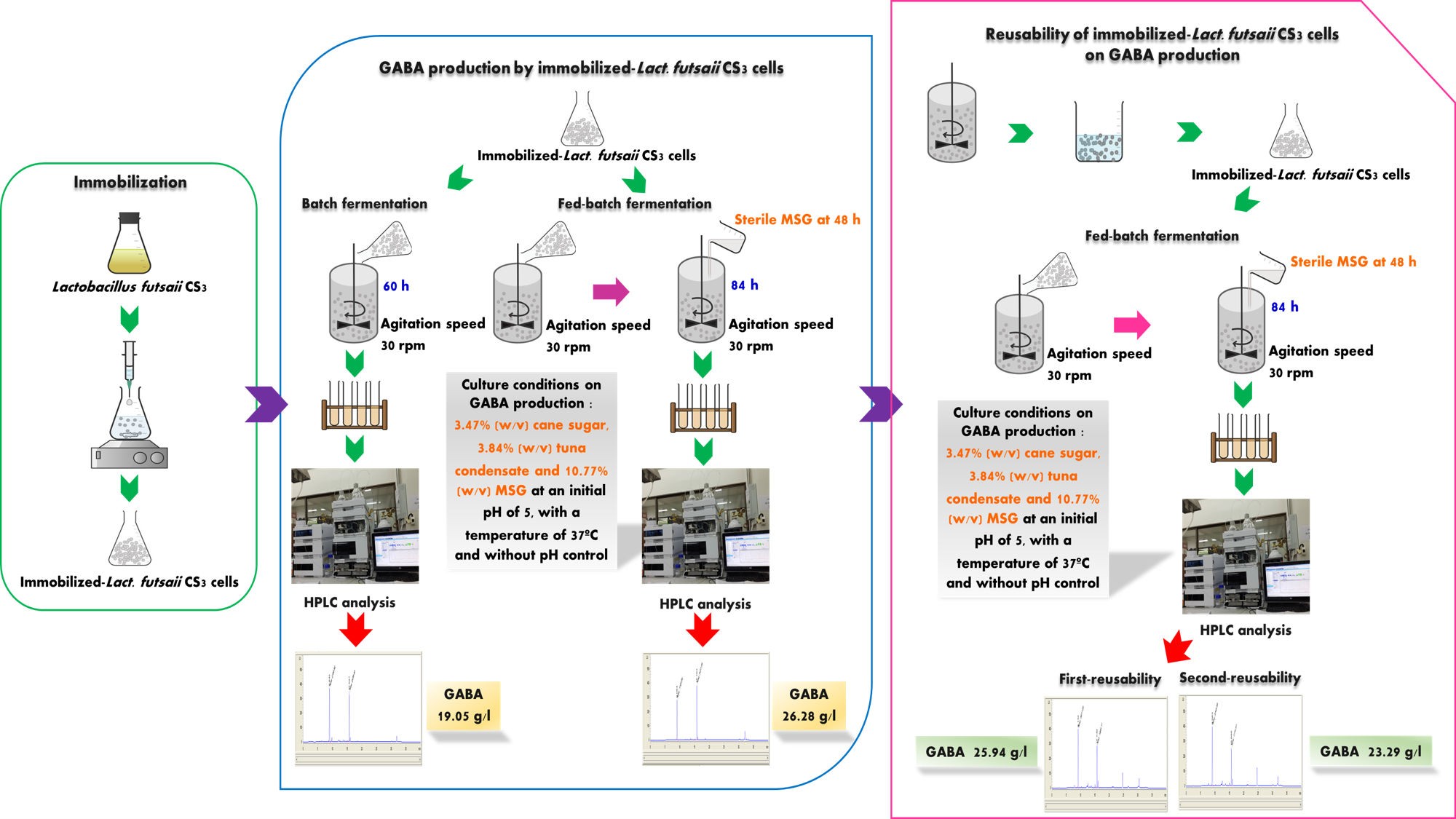
Downloads
References
Y Cui, K Miao, S Niyaphorn and X Qu. Production of gamma-aminobutyric acid from lactic acid bacteria: A systematic review. Int. J. Mol. Sci. 2020; 21, 995.
SB Sarasa, R Mahendran, G Muthusamy, B Thankappan, DRF Selta and J Angayarkanni. A brief review on the non protein amino acid, gamma amino butyric acid (GABA): Its production and role in microbes. Curr. Microbiol. 2020; 77, 534-44.
J Kim, YW Yoon, MS Kim, MH Lee, GA Kim, K Bae and SS Yoon. Gamma-aminobutyric acid fermentation in MRS-based medium by the fructophilic Lactiplantibacillus plantarum Y7. Food Sci. Biotechnol. 2022; 31, 333-41.
V Tanamool, P Hongsachart and W Soemphol. Screening and characterization of gamma-aminobutyric acid (GABA) producing lactic acid bacteria isolated from Thai fermented fish (Plaa-som) in Nong Khai and its application in Thai fermented vegetables (Som-pak). Food Sci. Tech. 2020; 40, 483-90.
H Altaib, T Kozakai, Y Badr, H Nakao, MAM El Nouby, E Yanase, I Nomura and T Suzuki. Cell factory for γ-aminobutyric acid (GABA) production using Bifdobacterium adolescentis. Microb. Cell Fact. 2022; 21, 33.
A Santos-Espinosa, LM Beltrán-Barrientos, R Reyes-Díaz, MÁ Mazorra-Manzano, A Hernández-Mendoza, GA González-Aguilar, SG Sáyago-Ayerdi, B Vallejo-Cordoba and AF González-Córdova. Gamma-aminobutyric acid (GABA) production in milk fermented by specific wild lactic acid bacteria strains isolated from artisanal Mexican cheeses. Ann. Microbiol. 2020; 70, 12.
Q Wang, X Liu, J Fu, S Wang, Y Chen, K Chang and H Li. Substrate sustained release-based high efficacy biosynthesis of GABA by Lactobacillus brevis NCL912. Microb. Cell Fact. 2018; 17, 80.
IBA Yogeswara, S Maneerat and D Haltrich. Glutamate decarboxylase from lactic acid bacteria - A key enzyme in GABA synthesis. Microorganisms 2020; 8, 1923.
Y Zhang, M Zhu, W Lu, C Zhang, D Chen, NP Shah and C Xiao. Optimizing Levilactobacillus brevis NPS-QW 145 fermentation for gamma-aminobutyric acid (GABA) production in soybean sprout yogurt-like product. Foods 2023; 12, 977.
SJ Park, DH Kim, HJ Kang, M Shin, SY Yang, J Yang and YH Jung. Enhanced production of γ-aminobutyric acid (GABA) using Lactobacillus plantarum EJ2014 with simple medium composition. LWT Food Sci. Tech. 2021; 137, 110443.
CJ Lyu, L Liu, J Huang, WR Zhao, S Hu, LH Mei and SJ Yao. Biosynthesis of ɣ-aminobutyrate by engineered Lactobacillus brevis cells immobilized in gellan gum gel beads. J. Biosci. Bioeng. 2019; 128, 123-8.
S Thangrongthong, N Puttarat, B Ladda, T Itthisoponkul, W Pinket, K Kasemwong and M Taweechotipatr. Microencapsulation of probiotic Lactobacillus brevis ST-69 producing GABA using alginate supplemented with nanocrystalline starch. Food Sci. Biotechnol. 2020; 29, 1475-82.
G Divyashri and SG Prapulla. Mass transfer characterization of gamma-aminobutyric acid production by Enterococcus faecium CFR 3003: Encapsulation improves its survival under simulated gastro-intestinal conditions. Bioprocess Biosyst. Eng. 2015; 38, 569-74.
J Huang, LH Mei, H Wu and DQ Lin. Biosynthesis of γ-aminobutyric acid (GABA) using immobilized whole cells of Lactobacillus brevis. World J. Microbiol. Biotechnol. 2007; 23, 865-71.
P Pandey and HN Mishra. Co-microencapsulation of γ-aminobutyric acid (GABA) and probiotic bacteria in thermostable and biocompatible exopolysaccharides matrix. LWT Food Sci. Tech. 2021; 136, 110293.
Y Zhang, W Cong and SY Shi. Repeated fed-batch lactic acid production in a packed bed-stirred fermentor system using a pH feedback feeding method. Bioprocess Biosyst. Eng. 2011; 34, 67-73.
S Datta, LR Christena and YRS Rajaram. Enzyme immobilization: An overview on techniques and support materials. 3 Biotech 2013; 3, 1-9.
J Burgain, C Gaiani, M Linder and J Scher. Encapsulation of probiotic living cells: From laboratory scale to industrial applications. J. Food Eng. 2011; 104, 467-83.
V Chandramouli, K Kailasapathy, P Peiris and M Jones. An improved method of microencapsulation and its evaluation to protect Lactobacillus spp. in simulated gastric conditions. J. Microbiol. Methods 2004; 56, 27-35.
T Nguyen-Sy, GY Yew, KW Chew, TDP Nguyen, TNT Tran, TDH Le, CT Vo, HKP Tran, M Mubashir and PL Show. Potential cultivation of Lactobacillus pentosus from human breastmilk with rapid monitoring through the spectrophotometer method. Processes 2020; 8, 902.
P Prasertsan, M Jaturapornpipat and C Siripatana. Utilization and treatment of tuna condensate by photosynthetic bacteria. Pure Appl. Chem. 1997; 69, 2439-45.
K Thongruck and S Maneerat. Enhanced production of gamma-aminobutyric acid (GABA) from Lactobacillus futsaii CS3 using agri-food industries by-products under batch and fed-batch fermentation. Indian J. Microbiol. 2023; 63, 467-82.
C Sanchart, O Rattanaporn, D Haltrich, P Phukpattaranont and S Maneerat. Lactobacillus futsaii CS3, a new GABA-producing strain isolated from Thai fermented shrimp (Kung-Som). Indian J. Microbiol. 2016; 57, 211-7.
A Picot and C Lacroix. Encapsulation of bifidobacteria in whey protein-based microcapsules and survival in simulated gastrointestinal conditions and in yoghurt. Int. Dairy J. 2004; 14, 505-15.
C Sanchart, O Rattanaporn, D Haltrich, P Phukpattaranont and S Maneerat. Technological and safety properties of newly isolated GABA-producing Lactobacillus futsaii strains. J. Appl. Microbiol. 2016; 121, 734-45.
IBA Yogeswara, S Kittibunchakul, ES Rahayu, KJ Domig, D Haltrich and TH Nguyen. Microbial production and enzymatic biosynthesis of γ-aminobutyric acid (GABA) using Lactobacillus plantarum FNCC 260 isolated from Indonesian fermented foods. Processes 2021; 9, 22.
SH Han, KB Hong and HJ Suh. Biotransformation of monosodium glutamate to gamma-aminobutyric acid by isolated strain Lactobacillus brevis L-32 for potentiation of pentobarbital-induced sleep in mice. Food Biotechnol. 2017; 31, 80-93.
H Li, T Qiu, G Huang and Y Cao. Production of gamma-aminobutyric acid by Lactobacillus brevis NCL912 using fed-batch fermentation. Microb. Cell Fact. 2010; 9, 85.
DTB Thuy, AT Nguyen, KS Khoo, KW Chew, M Cnockaert, P Vandamme, YC Ho, ND Huy, HH Cocoletzi and PL Show. Optimization of culture conditions for gamma-aminobutyric acid production by newly identified Pediococcus pentosaceus MN12 isolated from ‘mam nem’, a fermented fish sauce. Bioengineered 2021; 12, 54-62.
DH Kim, C Dasagrandhi, SK Park, SH Eom, MK Huh, JS Mok and YM Kim. Optimization of gamma-aminobutyric acid production using sea tangle extract by lactic acid bacterial fermentation. LWT Food Sci. Tech. 2018; 90, 636-42.
TTT Binh, WT Ju, WJ Jung and RD Park. Optimization of γ-amino butyric acid production in a newly isolated Lactobacillus brevis. Biotechnol. Lett. 2013; 36, 93-8.
W Krasaekoopt, B Bhandari and H Deeth. Evaluation of encapsulation techniques of probiotics for yoghurt. Int. Dairy J. 2003; 13, 3-13.
XH Chen, XT Wang, WY Lou, Y Li, H Wu, MH Zong, TJ Smith and XD Chen. Immobilization of Acetobacter sp. CCTCC M209061 for efficient asymmetric reduction of ketones and biocatalyst recycling. Microb. Cell Fact. 2012; 11, 119.
AG Peredo, CI Beristain, LA Pascual, E Azuara and M Jimenez. The effect of probiotics on the viability of encapsulated probiotic bacteria. LWT Food Sci. Tech. 2016; 73, 191-6.
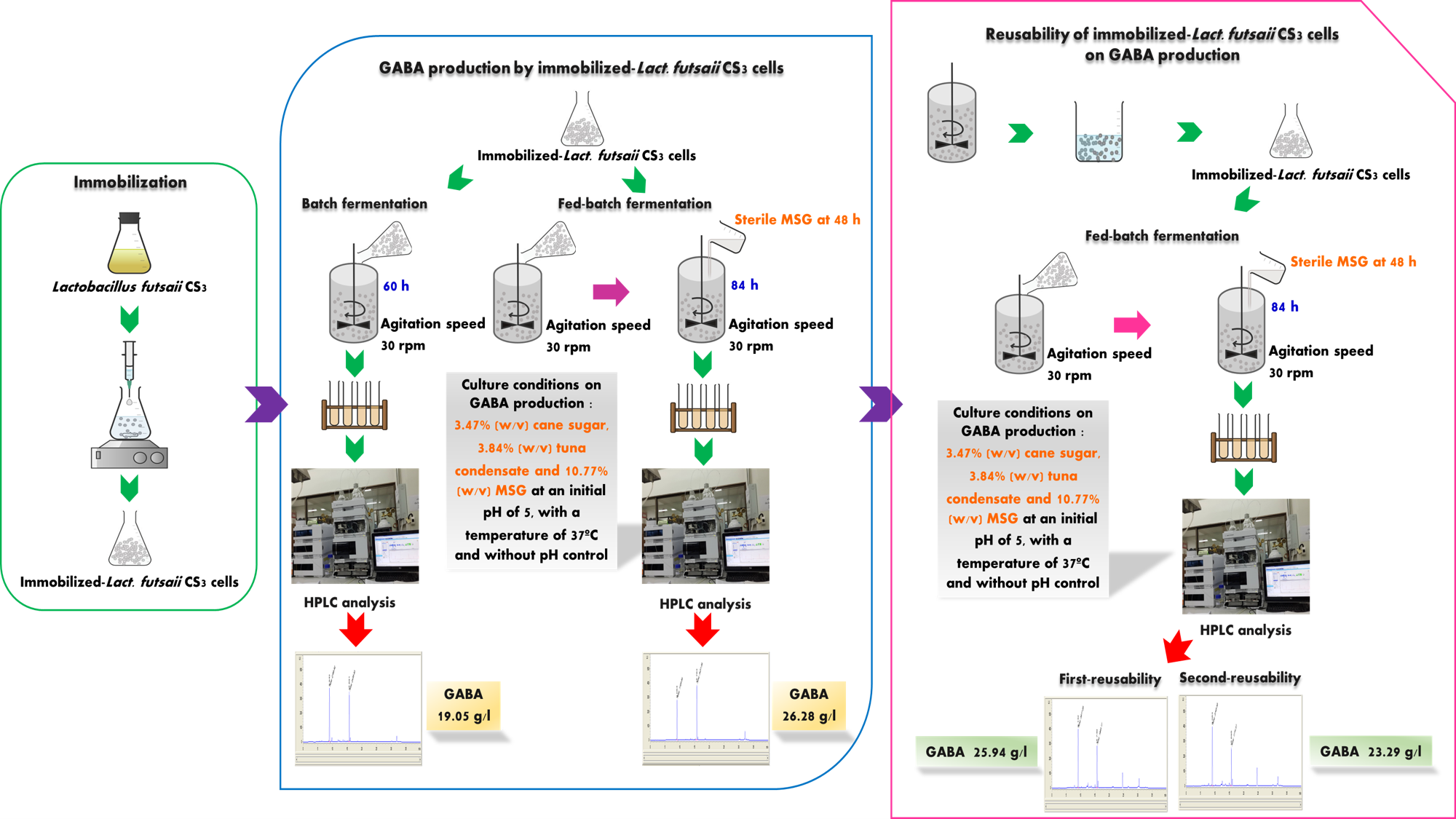
Downloads
Published
How to Cite
Issue
Section
License
Copyright (c) 2024 Walailak University

This work is licensed under a Creative Commons Attribution-NonCommercial-NoDerivatives 4.0 International License.





