
Ultrasonic Fabrication of Catechin Nanoemulsions from Green Tea with Enhanced Stability and Antioxidant Activity Optimized by Box-Behnken Design
DOI:
https://doi.org/10.48048/tis.2024.8508Keywords:
Catechin, Nanoemulsions, Green tea, Ultrasonication, Box-Behnken design, Response surface methodology, AntioxidantAbstract
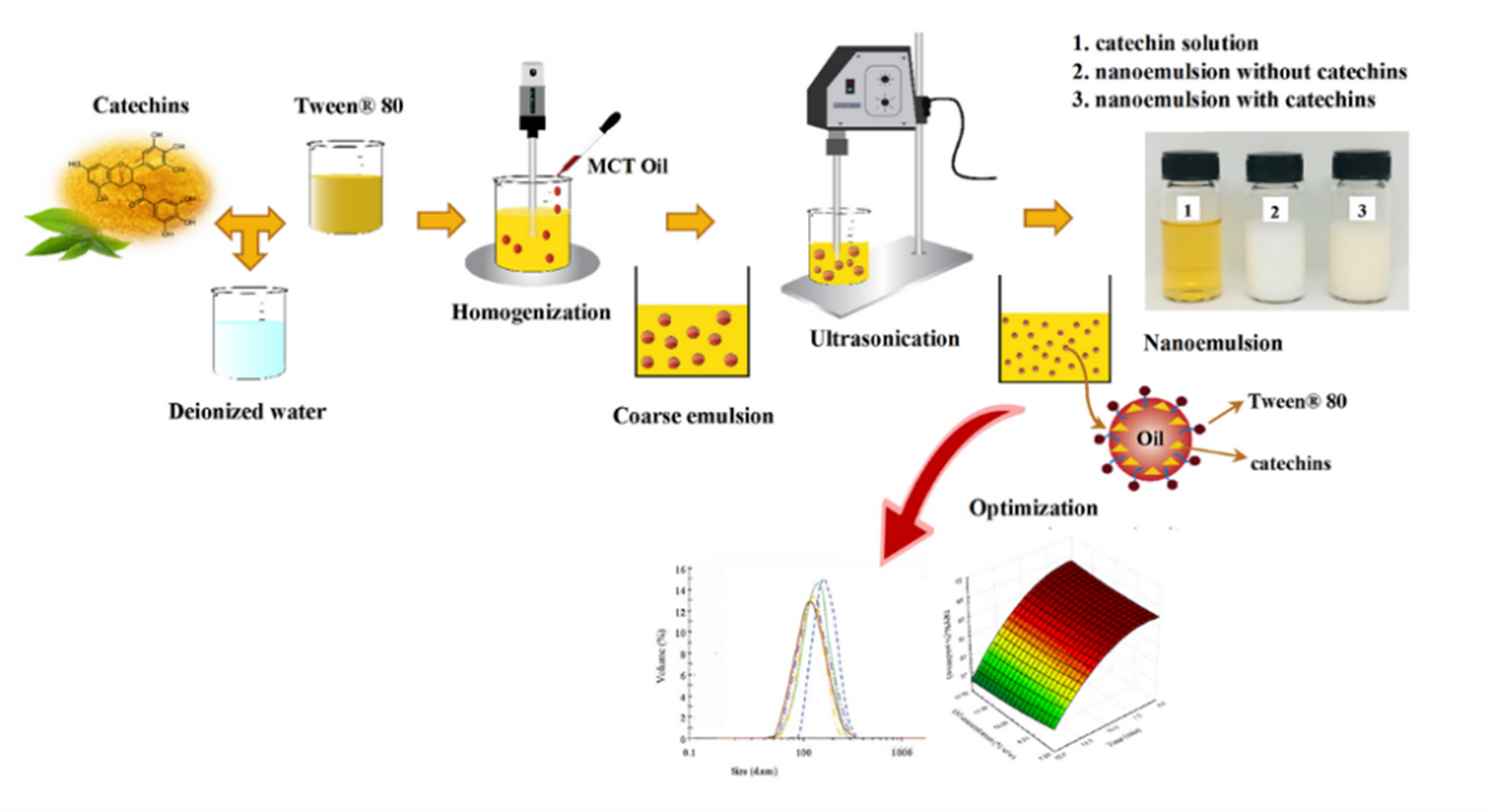
Nanoemulsions are emulsions, either O/W (oil in water) or W/O (water in oil), with droplet diameters typically ranging from 50 to 1,000 nm. Research indicates that nanoemulsions are highly effective in enhancing the bioavailability, bioactivity, digestibility, stability, safety, quality and sensory attributes of food components. The study aimed to determine the optimum formulation and ultrasonic condition for fabricating catechin nanoemulsion (Ca-NE) from green tea with improved physical stability and antioxidant activity using response surface methodology. The effects of Medium Chain Triglyceride oil concentration (7.5 - 12.5 % w/w), Tween® 80 concentration (1 - 5 % w/w) and sonication time (5 - 15 min) on the droplet size, polydispersity index (PDI) and antioxidant activity presented by DPPH value of the Ca-NE were investigated using Box-Behnken design (BBD). The results found that droplet size and antioxidant activity of the Ca-NE were significantly (p < 0.05) affected by the proposed parameters, whereas the PDI value was slightly affected by those factors. The BBD results suggested that the Ca-NE fabrication condition was optimized with 7.5 % (w/w) oil concentration, 5 % (w/w) Tween® 80 concentration and a sonication time of 10.87 min. The optimum nanoemulsion showed good physical stability in terms of droplet size and PDI and had higher antioxidant activity than unencapsulated catechins when stored at 4 and 30 °C for 90 days. This study showed that catechin nanoemulsions fabricated by ultrasonication had good stability and antioxidant activity and, hence, had high potential for food and beverage applications in the food industry.
HIGHLIGHTS
- The optimum nanoemulsion had good physical stability regarding droplet size and PDI when stored at 4 and 30 °C for 90 days.
- The ultrasonic fabrication of Ca-NE results in better retention of antioxidant activity than unencapsulated catechins.
- The ultrasonic fabrication provided the Ca-NE with good stability and high antioxidant activity.
- The results suggest that the obtained nanoemulsion of catechins has great potential in food or pharmaceutical applications.
GRAPHICAL ABSTRACT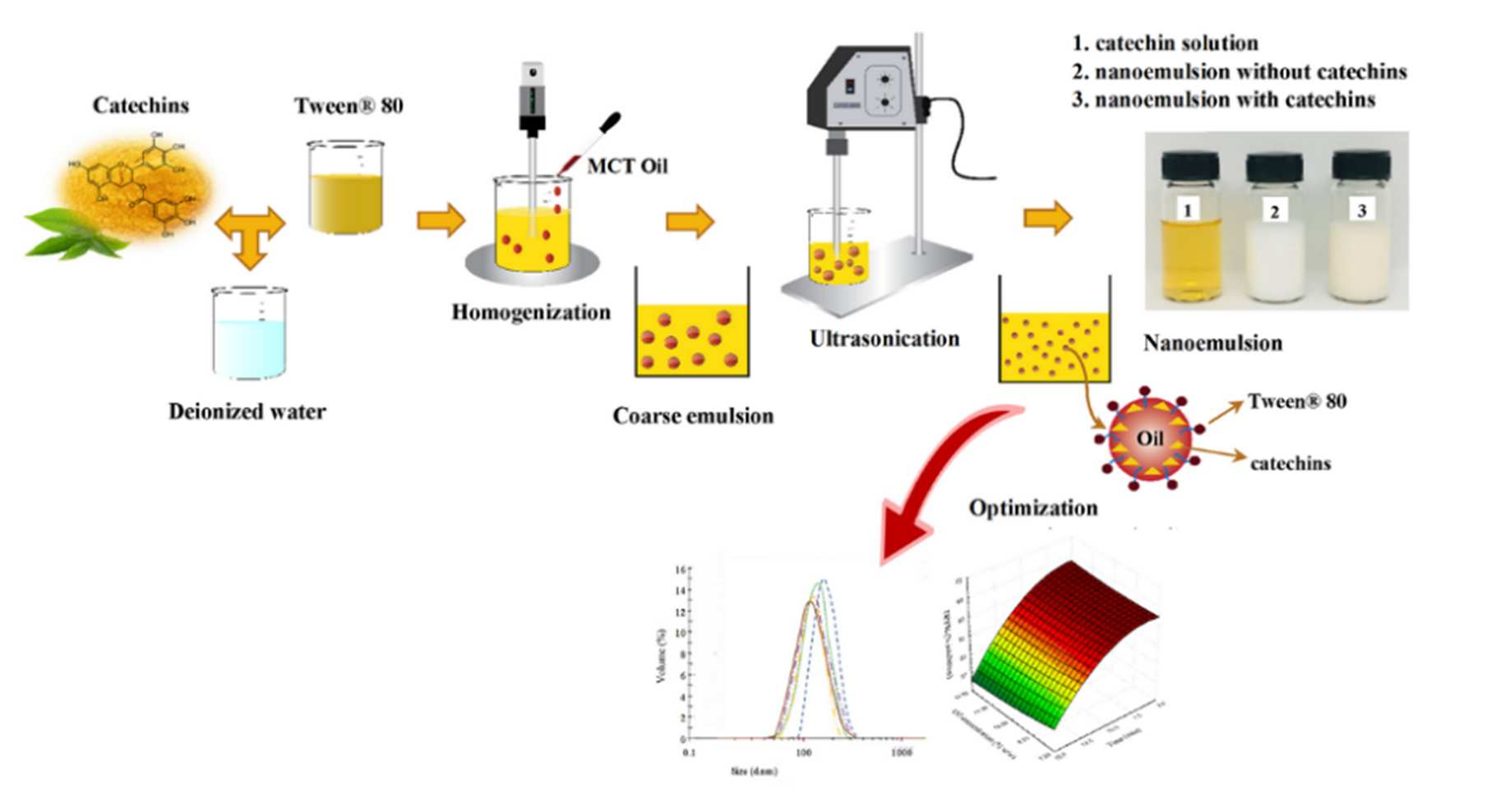
Downloads
References
JA Bhushani, P Karthik and C Anandharamakrishnan. Nanoemulsion based delivery system for improved bioaccessibility and Caco-2 cell monolayer permeability of green tea catechins. Food Hydrocolloids 2016; 56, 372-82.
CW Nain, E Mignolet, MF Herent, J Quetin-Leclercq, C Debier, MM Page and Y Larondelle. The catechins profile of green tea extracts affects the antioxidant activity and degradation of catechins in DHA-rich oil. Antioxidants 2022; 11, 1844.
A Ruengdech and U Siripatrawan. Application of catechin nanoencapsulation with enhanced antioxidant activity in high pressure processed catechin-fortified coconut milk. LWT 2021; 140, 110594
A Rizwan, A Mohammed, A Aljawharah, A Ebtihal, A Fatema, M Ahmed, AM Abdulmalik and S Heba. The effect of natural antioxidants, pH, and green solvents upon catechins stability during ultrasonic extraction from green tea leaves (Camellia sinensis). Ultrason. Sonochem. 2023; 94, 106337
S Aleksandra and P Krystyna. Catechins and selenium species: How they react with each other. Molecules 2023; 28, 5897.
PV Gadkari, MG Shashidhar and M Balaraman. Delivery of green tea catechins through oil-in-water (O/W) nanoemulsion and assessment of storage stability. J Food Eng. 2017; 199, 76.
P Chuesiang, U Siripatrawan, R Sanguandeekul, DJ McClements and L McLandsborough. Antimicrobial activity of PIT-fabricated cinnamon oil nanoemulsions: Effect of surfactant concentration on morphology of foodborne pathogens. Food Control 2019; 98, 405-11.
P Pongsumpun, S Iwamoto and U Siripatrawan. Response surface methodology for optimization of cinnamon essential oil nanoemulsion with improved stability and antifungal activity. Ultrason. Sonochem. 2020; 60, 104604.
ACH Munoz, SM Echeverry and DMA Novoa. Ultrasonic nanoemulsification of Aloe vera: Formulation, optimization, and characterization. J. Excipients Food Chem. 2022, 13, 48-63.
G Páez-Hernández, P Mondragón-Cortez and H Espinosa-Andrews. Developing curcumin nanoemulsions by high-intensity methods: Impact of ultrasonication and microfluidization parameters. LWT 2019; 111, 291-300.
N Hauzin, NM Hadzir and HAA Hamid. Fabrication and characterization of water-in-palm oil nanoemulsion as a carrier for Catechin. Malays. J. Anal. Sci. 2024; 28, 247-56.
N Toro-Funes, J Bosch-Fusté, MT Veciana-Nogués and MC Vidal-Carou. Effect of ultra-highpressure homogenization treatment on the bioactive compounds of soya milk. Food Chem. 2014; 152, 597-602.
P Chuesiang, U Siripatrawan, R Sanguandeekul, JS Yang, DJ McClements and L McLandsborough. Antimicrobial activity and chemical stability of cinnamon oil in oil-in-water nanoemulsions fabricated using the phase inversion temperature method. LWT 2019; 110, 190-6.
V Ryu, DJ McClements, MG Corradini, JS Yang and L McLandsborough. Natural antimicrobial delivery systems: Formulation, antimicrobial activity, and mechanism of action of quillaja saponin-stabilized carvacrol nanoemulsions. Food Hydrocolloids 2018; 82, 442-50.
H Kumar and V Kumar. Ultrasonication assisted formation and stability of water-in-oil nanoemulsions: Optimization and ternary diagram analysis. Ultrason. Sonochem. 2018; 49, 79-88.
U Majeed, H Majeed, X Liu, A Shafi, T Liu, J Ye, Q Meng and Y Luo. Succinylated starch emulsified Eugenol and Carvacrol nanoemulsions improved digestive stability, bio-accessibility and Salmonella typhimurium inhibition. Int. J. Biol. Macromol. 2024; 259, 129230.
R Raviadaran, D Chandran, LH Shin and S Manickam. Optimization of palm oil in water nano-emulsion with curcumin using microfluidizer and response surface methodology. LWT 2018; 96, 58-65.
PS Saravana, K Shanmugapriya, CRN Gereniu, SJ Chae, HW Kang, HC Woo and BS Chun. Ultrasound-mediated fucoxanthin rich oil nanoemulsions stabilized by κ-carrageenan: Process optimization, bio-accessibility and cytotoxicity. Ultrason. Sonochem. 2019; 55, 105-16.
SF Tan, HRF Masoumi, RA Karjiban, J Stanslas, BP Kirby, M Basri and HB Basri. Ultrasonic emulsification of parenteral valproic acid-loaded nanoemulsion with response surface methodology and evaluation of its stability. Ultrason. Sonochem. 2016; 29, 299-308.
S Ahmed, A Gull, M Alam, M Aqil and Y Sultana. Ultrasonically tailored, chemically engineered and “QbD” enabled fabrication of agomelatine nanoemulsion; optimization, characterization, ex-vivo permeation and stability study. Ultrason. Sonochem. 2018; 41, 213-26.
Y Long, W Huang, Q Wang and G Yang. Green synthesis of garlic oil nanoemulsion using ultrasonication technique and its mechanism of antifungal action against Penicillium italicum. Ultrason. Sonochem. 2020; 64, 104970.
Z Yuan, Z Xu, D Zhang, W Chen, T Zhang, Y Huang, L Gu, H Deng and D Tian. Box-Behnken design approach towards optimization of activated carbon synthesized by co-pyrolysis of waste polyester textiles and MgCl2. Appl. Surf. Sci. 2018; 427, 340-8.
A Ruengdech, U Siripatrawan, A Sangnark, S Benedetti and S Buratti. Rapid evaluation of phenolic compounds and antioxidant activity of mulberry leaf tea during storage using electronic tongue coupled with chemometrics. J. Berry Res. 2019; 9, 563-74.
T Mehmood, A Ahmed, A Ahmad, MS Ahmad and MA Sandhu. Optimization of mixed surfactants-based β-carotene nanoemulsions using response surface methodology: An ultrasonic homogenization approach. Food Chem. 2018; 253, 179-84.
AM Joglekar and AT May. Product excellence through design of experiments. Cereal Foods World 2019; 32, 857-68.
M Sarstedt, JF Hair and CM Ringle. “PLS-SEM: Indeed a silver bullet” - retrospective observations and recent advances. J. Mark. Theory Pract. 2023; 31, 261-75.
N Anarjan, H Mirhosseini, BS Baharin and CP Tan. Effect of processing conditions on physicochemical properties of astaxanthin nanodispersions. Food Chem. 2010; 123, 477-83.
T Mehmood, A Ahmad, A Ahmed and Z Ahmed. Optimization of olive oil based O/W nanoemulsions prepared through ultrasonic homogenization: A response surface methodology approach. Food Chem. 2017; 289, 664-70.
MHF Sakeena, SM Elrashid, AS Munavvar and MN Azmin. Effects of oil and drug concentrations on droplets size of palm oil esters (POEs) nanoemulsion. J. Oleo Sci. 2011; 60, 155-8.
J Carpenter and VK Saharan. Ultrasonic assisted formation and stability of mustard oil in water nanoemulsion: Effect of process parameters and their optimization. Ultrason. Sonochem. 2017; 35, 422-30.
Z Izadiyan, M Basri, HRF Masoumi, RA Karjiban, N Salim and K Shameli. Modeling and optimization of nanoemulsion containing Sorafenib for cancer treatment by response surface methodology. Chem. Cent. J. 2017; 11, 21.
SM Jafari, Y He and B Bhandari. Production of sub-micron emulsions by ultrasound and microfluidization techniques. J. Food Eng. 2007; 82, 478-8.
O Shamsara, ZK Muhidinov, SM Jafari, J Bobokalonov, A Jonmurodov, M Taghvaei and M Kumpugdee-Vollrath. Effect of ultrasonication, pH and heating on stability of apricot gum-lactoglobuline two layer nanoemulsions. Int. J. Biol. Macromol. 2015; 81, 1019-25.
J Rao and DJ McClements. Formation of flavor oil microemulsions, nanoemulsions and emulsions: Influence of composition and preparation method. J. Agr. Food Chem. 2011; 59, 5026-35.
Malvern Instruments Worldwide. Dynamic light scattering: Common terms defined. Malvern Instruments Limited, Malvern, 2011.
M Danaei, M Dehghankhold, S Ataei, F Hasanzadeh Davarani, R Javanmard, A Dokhani, S Khorasani and MR Mozafari. Impact of particle size and polydispersity index on the clinical applications of lipidic nanocarrier systems. Pharmaceutics 2018; 10, 57.
TVA Ha, S Kim, Y Choi, HS Kwak, SJ Lee, J Wen and S Ko. Antioxidant activity and bioaccessibility of size-different nanoemulsions for lycopene-enriched tomato extract. Food Chem. 2015; 178, 115-21.
H Zheng, L Mao, J Yang, C Zhang, S Miao and Y Gao. Effect of oil content and emulsifier type on the properties and antioxidant activity of sea buckthorn oil-in-water emulsions. J. Food Qual. 2020; 2020, 1540925.
J Freiría-Gándara, S Losada-Barreiro, F Paiva-Martins and C Bravo-Díaz. Enhancement of the antioxidant efficiency of gallic acid derivatives in intact fish oil-in-water emulsions through optimization of their interfacial concentrations. Food Funct. 2018; 9, 4429-42.
L Zeng, M Ma, C Li and L Luo. Stability of tea polyphenols solution with different pH at different temperatures. Int. J. Food Prop. 2017; 8, 2202-11.
M Sobhaninia, A Nasirpour, M Shahedi and A Golkar. Oil-in-water emulsions stabilized by whey protein aggregates: Effect of aggregate size, pH of aggregation and emulsion pH. J. Dispersion Sci. Tech. 2017; 38, 1366-73.
JB Aswathanarayan and RR Vittal. Nanoemulsions and their potential applications in food industry. Front. Sustainable Food Syst. 2019; 3, 95.
J Zhong, X Liu, Y Wang, X Qin and Z Li. γ-Oryzanol nanoemulsions produced by a low-energy emulsification method: An evaluation of process parameters and physicochemical stability. Food Funct. 2017; 8, 2202-11.
Downloads
Published
How to Cite
Issue
Section
License
Copyright (c) 2024 Walailak University

This work is licensed under a Creative Commons Attribution-NonCommercial-NoDerivatives 4.0 International License.





