
Effect of Probiotic Supplementation in Diet on Egg Production, Egg Quality, Intestinal Morphology and Bacterial Population in Caecum of Laying Hens
DOI:
https://doi.org/10.48048/tis.2024.8445Keywords:
Egg production, Laying hens, Egg quality, Probiotic, Intestinal morphologyAbstract
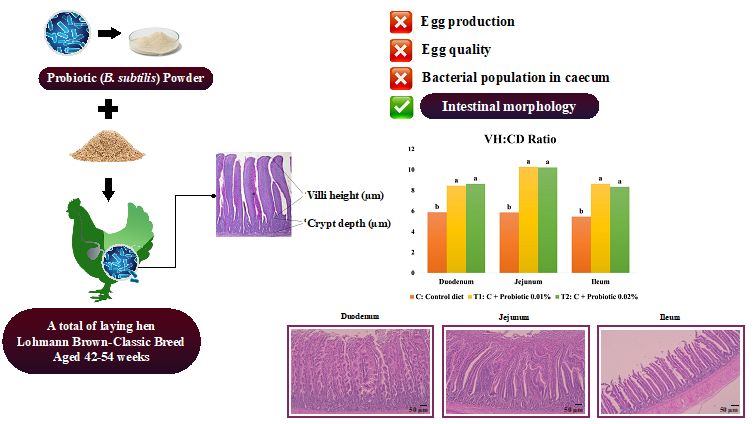
The objective of this study was to study the effect of probiotic supplementation in diet on egg production, egg quality, intestinal morphology, and bacterial population in caecum of laying hens. A total of 768 Lohmann Brown-Classic laying hens, aged 42 - 54 weeks, were used. The laying hens were divided into 3 groups, each with 8 subgroups of 32 birds each. The experiment was planned to use a completely randomized design method. The 3 experimental groups were classified based on their dietary treatment as follows: 1) Basal diet (without probiotic supplementation), 2) Basal diet with probiotic 0.01 and 0.02 % in 3, respectively. Data was collected for 12 weeks. Adding probiotic in the diet was no significant difference on egg production, egg quality, and bacterial population in caecum. However, probiotic supplementation in the diet increased villi height of the duodenum significantly improved (p < 0.02), villi height per depth crypt of the duodenum significantly improved (p < 0.05), villi height per depth crypt of the jejunum significantly improved (p < 0.01), and villi height per depth crypt of the ileum significantly improved (p < 0.02). Therefore, studies have shown that dietary probiotic supplementation can improved small intestinal morphology are the most important indexes for measuring the digestive and absorption function of the small intestine are more efficient.
HIGHLIGHTS
- Probiotic (Bacillus subtilis) is a gram-positive, non-pathogenic bacterium that can inhibit digestive enzymes such as protease, amylase, and lipase. These enzymes help increase the efficiency of digestion and absorption of nutrients.
- As a result of the working mechanism of Bacillus subtilis, it helps strengthen the intestinal wall, eliminates pathogenic microorganisms, reduces damaged intestinal mucosal cells, and improves intestinal absorption, resulting in increased production.
- Effect of probiotic (Bacillus subtilis) supplementation in laying hen diets on total bacterial load in appendix. No difference was found in the load of total bacteria and Escherichia coli (P > 0.05).
- Its beneficial properties stimulate the growth of beneficial bacteria in the intestines, such as Bifidobacteria sp. and Lactobacillus sp., causing the production of lactic acid, which makes the colon more acidic, resulting in inhibition of the growth of pathogenic microorganisms.
GRAPHICAL ABSTRACT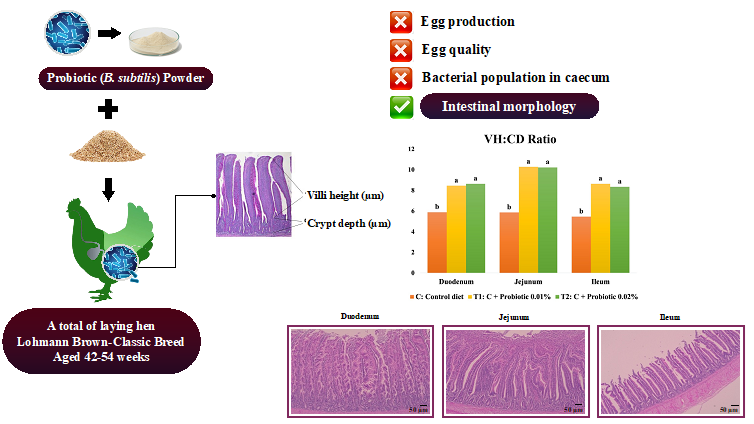
Downloads
References
S Lee, J Lee, YI Jin, JC Jeong, YH Chang, Y Lee, Y Jeong and M Kim. Probiotic characteristics of Bacillus strains isolated from Korean traditional soy sauce. LWT Food Sci. Tech. 2017; 79, 518-24.
PA Vandenbergh. Lactic acid bacteria, their metabolic products and interference with microbial growth. FEMS Microbiol. Rev. 1993; 12, 221-37.
DR Mack, S Michail, S Wei, L McDougall and MA Hollingsworth. Probiotics inhibit enteropathogenic E. coli adherence in vitro by inducing intestinal mucin gene expression. Am. J. Physiol. 1999; 276, G941-G950.
MA Nour, MM El-Hindawy, DE Abou-Kassem, EA Ashour, MEA El-Hack, S Mahgoub, SM Aboelenin, MM Soliman, KA El-Tarabily and AME Abdel-Moneim. Productive performance, fertility and hatchability, blood indices and gut microbial load in laying quails as affected by two types of probiotic bacteria. Saudi J. Biol. Sci. 2021; 28, 6544-55.
E Abel-Santos. Endospores, sporulation and germination. In: YW Tang, M Sussman, D Liu, I Poxton and J Schwartzman (Eds.). Molecular medical microbiology. Academic Press, New York, 2015, p. 163-78.
SM Cutting. Bacillus probiotics. Food Microbiol. 2011; 28, 214-20.
R Jager, M Purpura, S Farmer, HA Cash and D Keller. Probiotic Bacillus coagulans GBI-30, 6086 improves protein absorption and utilization. Probiotics Antimicrob. Proteins 2018; 10, 611-5.
U Ramlucken, Y Roets, SO Ramchuran, G Moonsamy, CJV Rensburg, MS Thantsha and R Lalloo. Isolation, selection and evaluation of Bacillus spp. as potential multi-mode probiotics for poultry. J. Gen. Appl. Microbiol. 2020; 66, 228-38.
A Abdelqader, AR Al-Fataftah and G Das. Effects of dietary Bacillus subtilis and inulin supplementation on performance, eggshell quality, intestinal morphology and microflora composition of laying hens in the late phase of production. Anim. Feed Sci. Tech. 2013; 179, 103-11.
VJ Ribeiro, LFT Albino, HS Rostagno, SLT Barreto, MI Hannas, D Harrington, FAD Araujo, HCJ Ferreira and MA Ferreira. Effects of the dietary supplementation of Bacillus subtilis levels on performance, egg quality and excreta moisture of layers. Anim. Feed Sci. Tech. 2014; 195, 142-6.
AH Mahdavi, HR Rahmani and J Pourreza. Effect of probiotic supplements on egg quality and laying hen’s performance. Int. J. Poult. Sci. 2005; 4, 488-92.
D Mikulski, J Jankowski, J Naczmanski, M Mikulska and V Demey. Effects of dietary probiotic (Pediococcus acidilactici) supplementation on performance, nutrient digestibility, egg traits, egg yolk cholesterol, and fatty acid profile in laying hens. Poult. Sci. 2012; 91, 2691-700.
JR Guo, XF Dong, S Liu and JM Tong. Effects of long-term Bacillus subtilis CGMCC 1.921 supplementation on performance, egg quality, and fecal and cecal microbiota of laying hens. Poult. Sci. 2017; 96, 1280-9.
Association of Official Analytical Chemists. Official methods of analysis. 17th eds. Association of Official Analytical Chemists, Washington DC, 2000.
YO Suk and KW Washburn. Effects of environment on growth, efficiency of feed utilization, carcass fatness, and their association. Poult. Sci. 1995; 74, 285-96.
OD Amstrong, D Atamu and EH Orhomedia and A Destiny. Effect of different storage temperatures on the viabilities change of probiotics in the fish feed. Int. J. Biochem. Biotechnol. 2016; 5, 697-701.
AH Mahdavi, HR Rahmani and J Pourreza. Effect of probiotic supplements on egg quality and laying hen’s performance. Int. J. Poult. Sci. 2005; 4, 488-92.
T Balevi, US Uçan, B Coşkun, V Kurtoglu and IS Cetingül. Effect of dietary probiotic on performance and humoral immune response in layer hens. Br. Poult. Sci. 2001; 42, 456-61.
M Neijat, RB Shirley, J Barton, P Thiery, A Welsher and E Kiarie. Effect of dietary supplementation of Bacillus subtilis DSM29784 on hen performance, egg quality indices, and apparent retention of dietary components in laying hens from 19 to 48 weeks of age. Poult. Sci. 2019; 98, 5622-35.
A Mohebbifar, S Kashani, M Afsari and M Torki. Effects of commercial prebiotic and probiotics of diet on performance of laying hens, egg traits and some blood parameters. Annu. Res. Rev. Biol. 2013; 3, 921-34.
PK Rath, PK Mishra, BK Mallick and NC Behura. Evaluation of different egg quality traits and interpretation of their mode of inheritance in White Leghorns. Vet. World 2015; 8, 449-52.
H Haugh. The Haugh unit for measuring egg quality. U. S. Egg Poult. Mag. 1937; 43, 552-5.
M Fathi, I Al-Homidan, A Al-Dokhail, T Ebeid, O Abou-Emera and A Alsagan. Effects of dietary probiotic (Bacillus subtilis) supplementation on productive performance, immune response and egg quality characteristics in laying hens under high ambient temperature. Ital. J. Anim. Sci. 2018; 17, 804-14.
SHM Elnagar. Effect of dried yeast (Saccharomyces cerevisiae) supplementation as feed additive to laying hen diet on egg production, egg quality, carcass traits and blood constituents. Egypt. J. Anim. Prod. 2013; 50, 111-5.
A Abdelqader, R Irshaid and AR Al-Fataftah. Effects of dietary probiotic inclusion on performance, eggshell quality, cecal microflora composition, and tibia traits of laying hens in the late phase of production. Trop. Anim. Health Prod. 2013; 45, 1017-24.
N Sheoran, Vinus, S Bishnoi, J Shunthwal and NS Maan. Effect of dietary inclusion of probiotics and prebiotics on external egg quality traits in White Leghorn layers. Pharma Innovation J. 2017; 6, 8-13.
HM Salim, HK Kang, N Akter, DW Kim, JH Kim, MJ Kim, JC Na, HB Jong, HC Choi, OS Suh and WK Kim. Supplementation of direct-fed microbials as an alternative to antibiotic on growth performance, immune response, cecal microbial population, and ileal morphology of broiler chickens. Poult. Sci. 2013; 92, 2084-90.
HJ Dunham, C Williams, FWVEC Casas and WJ Dobrogosz. Lactobacillus reuteri immunomodulation of stressor associated diseases in newly hatched chickens and turkeys. Poult. Sci. 1993; 72, 103.
R Marković, D Šefer, M Krstić and B Petrujkić. Effect of different growth promoters on broiler performance and gut morphology. Arch. Med. Vet. 2009; 41, 163-9.
MM Loddi, VMB Maraes, ISO Nakaghi, F Tucci, MI Hannas and JA Ariki. Mannan oligosaccharide and organic acids on performance and intestinal morphometric characteristics of broiler chickens. In: Proceedings of the 20th Annual Symposium on Computational Geometry, Brooklyn, New York. 2004.
J McReynolds, C Waneck, J Byrd, K Genovese, S Duke and D Nisbet. Efficacy of multistrain direct-fed microbial and phytogenetic products in reducing necrotic enteritis in commercial broilers. Poult. Sci. 2009; 88, 2075-80.
L Li, CL Xu, C Ji, Q Ma, K Hao, ZY Jin and K Li. Effects of a dried Bacillus subtilis culture on egg quality. Poult. Sci. 2006; 85, 364-8.
M Yang, W Zhang, S Ji, P Cao, Y Chen and X Zhao. Generation of an artificial double promoter for protein expression in Bacillus subtilis through a promoter trap system. PLoS One 2013; 8, e56321.
M Yang, G Zhu, G Korza, X Sun, P Setlow and J Li. Engineering Bacillus subtilis as a versatile and stable platform for production of nanobodies. Appl. Environ. Microbiol. 2020; 86, e02938-19.
N Yang, X Liu, D Teng, Z Li, X Wang, R Mao, X Wang, Y Hao and J Wang. Antibacterial and detoxifying activity of NZ17074 analogues with multi-layers of selective antimicrobial actions against Escherichia coli and Salmonella enteritidis. Sci. Rep. 2017; 7, 3392.
S Zhang, G Zhong, D Shao, Q Wang, Y Hu, T Wu, C Ji and S Shi. Dietary supplementation with Bacillus subtilis promotes growth performance of broilers by altering the dominant microbial community. Poult. Sci. 2021; 100, 100935.
Downloads
Published
How to Cite
Issue
Section
License
Copyright (c) 2024 Walailak University

This work is licensed under a Creative Commons Attribution-NonCommercial-NoDerivatives 4.0 International License.





