
Beryllium Heat-Treated Blue Sapphire
DOI:
https://doi.org/10.48048/tis.2024.8405Keywords:
Beryllium, Heat treatment, Corundum, Sri Lankan, Blue sapphire, Be-trapped hole color centerAbstract
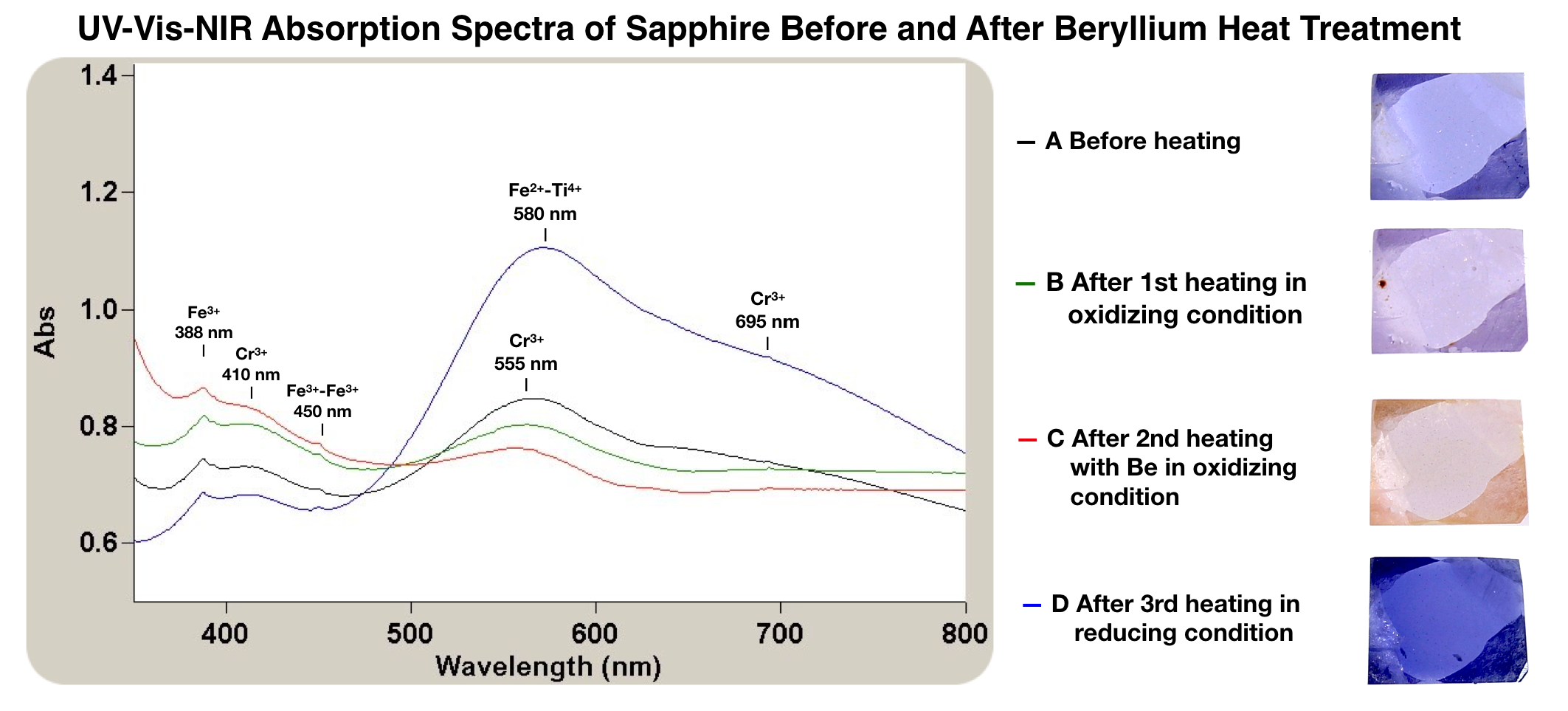
Since 2000, corundum heat-treated by beryllium (Be) has been successfully experimented to lighten the over-dark blue basaltic-related sapphire. In early 2006, advancements in heat treatment techniques in Chanthaburi revealed the ability to darken metamorphic-related blue sapphires using Be treatment, contrary to the previous lightening effect. The role of Be in corundum coloration obviously remains not well understood. Therefore, an experiment involving heat treatment was conducted to study changes in terms of physical, chemical, gemological, and spectroscopic properties of the blue sapphire after beryllium heat treatment, which has never been done before. Natural sapphires from Sri Lanka, varying in color and transparency, were subjected to Be heat treatment across a range of temperatures and in different types of furnaces (e.g. LPG gas, electric, and fuel oil), under both oxidizing and reducing atmospheres. The samples were studied after each heating step for gemological and spectroscopic properties using UV-Vis-NIR and infrared spectroscopy, as well as chemical composition using LA-ICP-MS. The combination of color appearance, absorption spectra, and chemical data suggests the role of beryllium in sapphire coloration. Be-trapped hole yellow color centers formed during oxidation heating can be deactivated through reduction heating. The resulting color is determined by the Mg to Ti ratio, with no influence from Be. However, most beryllium-treated blue sapphires had an Mg/Ti ratio greater than 1. The presence of higher energy level elements, such as Si, may facilitate the formation of blue color by allowing remaining titanium to pair with iron. Therefore, the blue coloration is mainly caused by strong broad absorption bands of Fe2+/Ti4+ IVCT mechanism without Fe2+/Fe3+ IVCT. The study highlights the complex interplay of elements within the crystal lattice and contributes to our understanding of color development mechanisms in beryllium-treated sapphires.
HIGHLIGHTS
A new method for identifying beryllium-treated blue sapphires based on combination of changes in physical, chemical, gemological, and spectroscopic properties after heat treatment is proposed in order to provide new evidence of indication of heating. In order to better understand the cause of color in beryllium-treated blue sapphire from Sri Lanka, a new method of explanation the role of Be and Si is proposed.
GRAPHICAL ABSTRACT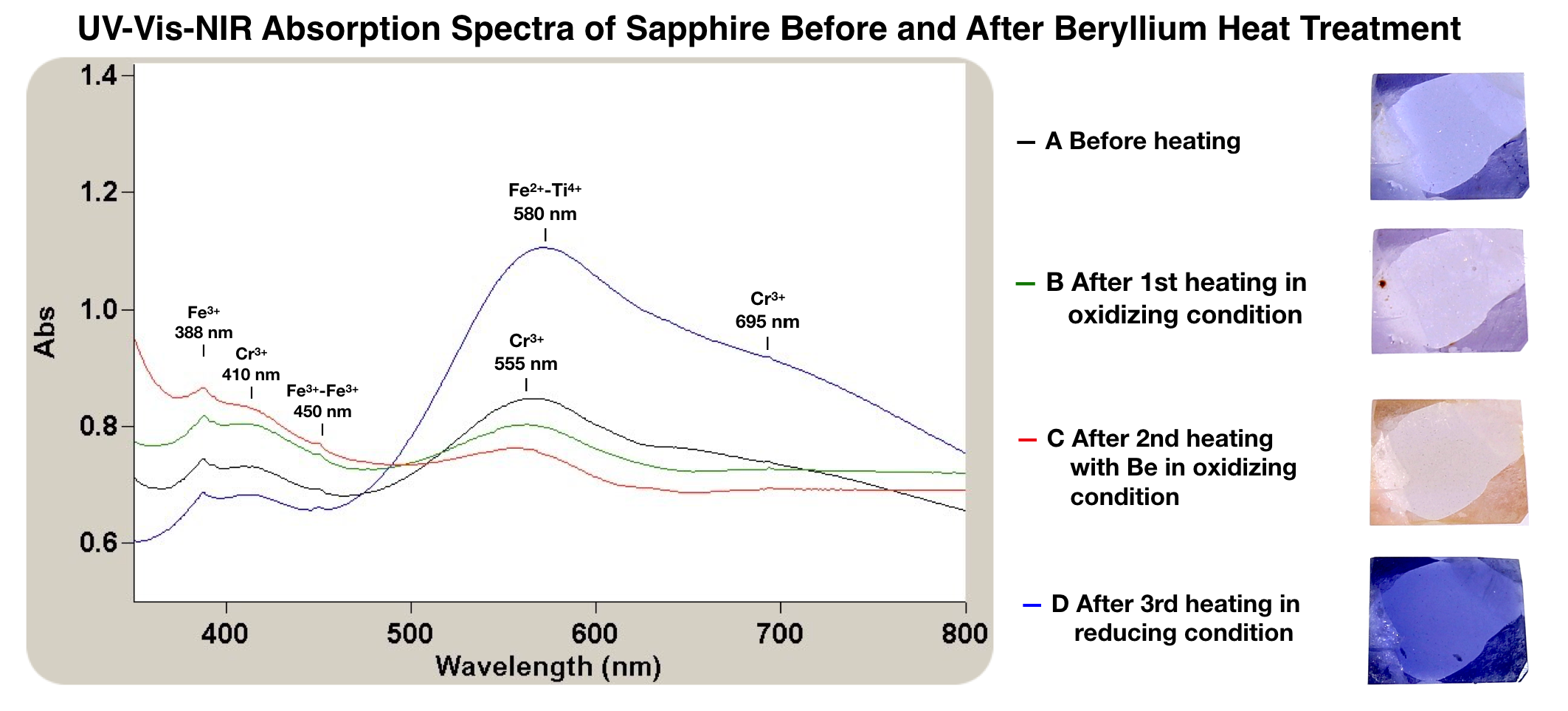
Downloads
References
W Atichat, B Sriprasert, P Wathanakul, V Pisutha-Arnond, TT Sun, T Puttarat and T Leelawatanasuk. Characteristics of “beryllium” heat-treated yellow sapphires. In: Proceedings of the 29th International Gemmological Conference, Wuhan, China. 2004, p. 207-14.
W Balmer and M Krzemnicki. Be-detection by FTIR on corundum: A preliminary report. In: Proceedings of the 34th International Gemological Conference, Vilnius, Lithuania. 2015, p. 60-71.
Gemological Institute of America, Available at: https://www.gia.edu/gia-news-research-nr62609, accessed March 2024.
JL Emmett, K Scarratt, SF McClure, T Moses, TR Douthit, R Hughes, S Novak, JE Shigley, W Wang, O Bordelon and RE Kane. Beryllium diffusion of ruby and sapphire. Gems Gemol. 2003; 39, 84-135.
JL Emmett, J Stone-Sundberg, Y Guan and Z Sun. The role of silicon in the color of gem corundum. Gems Gemol. 2017; 53, 42-7.
RW Hughes, W Manorotkul and EB Hughes. Ruby & sapphire: A gemologist’s guide. In: Illustrated (Ed.). RWH Publishing, Bangkok, Thailand, 2017.
SF McClure, T Moses, W Wang, M Hall and JI Koivula. A new corundum treatment from Thailand. Gems Gemol. 2002; 38, 86-90.
A Peretti and D Günther. Colour enhancement of natural fancy sapphires with a new heat-treatment technique. Contrib. Gemmol. 2002; 1, 1-48.
A Peretti and D Günther and G Anne-Liese. The beryllium treatment of fancy sapphires with a new heat-treatment technique (part B) Contrib. Gemmol. 2003; 2, 21-33.
V Pisutha-Arnond, T Hager, P Wathanakul and W Aticha. A brief summary on a cause of colour in pink-orange, orange and yellow sapphires produced by the “new” heating technique. J. Gem Jewelry 2002; 3, 11-2.
V Pisutha-Arnond, T Hager, P Wathanakul and W Atichat. Yellow and brown coloration in berylium-treated sapphires. J. Gemmol. 2004; 29, 77-103.
V Pisutha-Arnond, T Haeger, P Wathanakul, W Atichat, TT Win, T Leelawatanasuk, C Somboon and C Sutthirat. Chemical characteristic of “Classical” versus “Beryllium” heat-treated ruby and sapphire. In: Proceedings of the 29th International Gemmological Conference, Wuhan, China, 2004, p. 92-4.
V Pisutha-Arnond, T Hager, W Atichat and P Wathanakul. The role of Be, Mg, Fe and Ti in causing colour in corundum. J. Gemmol. 2006; 30, 131-43.
V Pisutha-Arnond, C Somboon, W Atichat, T Leelawatanasuk, C Sutthirat, P Wathanakul, B Sriprasert, T Hager and A Boonchai. Toward a better understanding of the orange coloration in beryllium treated sapphires. In: Proceedings of the 31st International Gemmological Conference, Arusha, Tanzania, 2009.
V Pisutha-Arnond, C Rochd, W Atichat, P Wathanakul and N Naruedeesombat. Role of Be in reduction and oxidation heating of sapphire. In: Proceedings of the 34th International Gemmoloical Coference, Vilnius, Lithuania, 2015, p. 65-8.
D Schwarz, EJ Petsch and J Kanis. Sapphires from the andranondambo region, madagascar. Gems Gemol. 1996; 32, 80-99.
K Schmetzer and D Schwarz. The causes of colour in untreated, heat treated and diffusion treated orange and pinkish-orange sapphires-a review. J. Gemmol. 2004; 29, 149-82.
CP Smith and CVD Bogert. Infrared spectra of gem corundum. Gems Gemol. 2006; 43, 92-3.
T Themelis. The heat treatment of ruby and sapphire. 1st ed. Gemlab Incl, Bangkok, Thailand, 1992.
R Genis. Beryllium-treated rubies and sapphires. Martin Rapaport, Mumbai, India, 2003.
C Wang, Y Yang and G Li. Oxidation treatment of sapphires from Shandong province, China. J. Gemmol. 1992; 23, 195-7.
EV Dubinsky, J Stone-Sundberg and JL Emmett. A quantitative description of the cause of color in corundum. Gems Gemol. 2020; 56, 2-28.
JL Emmett, U Atikarnsakul, J Stone-Sundberg and S Sangsawong. Yellow sapphire: Natural, heat-treated, beryllium-diffused, and synthetic. Gems Gemol. 2020; 59, 268-97.
Downloads
Published
How to Cite
Issue
Section
License
Copyright (c) 2024 Walailak University

This work is licensed under a Creative Commons Attribution-NonCommercial-NoDerivatives 4.0 International License.





