
Integrating Microwave Heating with Foam-Mat Drying: Drying Kinetics and Optimization for Thick Foamed Mango Pulp
DOI:
https://doi.org/10.48048/tis.2024.8327Keywords:
Microwave-assisted drying, Foam-mat drying, Mango pulp, Drying kinetics, Effective diffusivity, Specific energy consumption, Color differenceAbstract
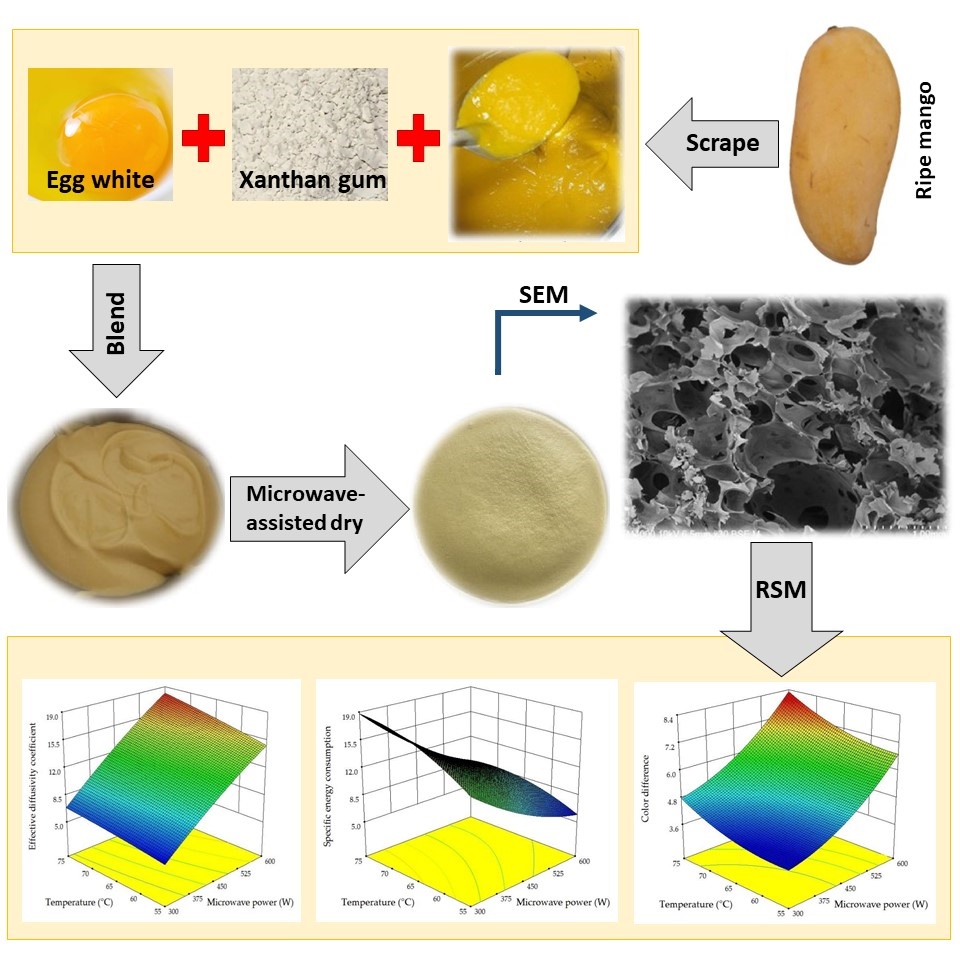
This study addresses the challenge of processing undersized or overripe mangoes by integrating microwave heating with traditional foam-mat drying technique. The study aims at investigating drying kinetics coupled with thin-layer drying modeling and influences of microwave power (300 - 600 W) and hot-air temperature (55 - 75 °C). Among ten drying models, the so-called Midilli equation fitted well with experimental data. Results showed enhanced drying process associated with microwave heating, providing reduced drying time from 600 - 700 min (for conventional hot-air mode) to 30 - 100 min (for microwave-assisted mode). Standard deviations of moisture content and dried foam thickness measured at various points revealed uneven heat distribution when using high microwave energy, evidenced by burnt spots at 600 W. Additionally, foam collapse was observed under the mild process with low microwave powers, possibly due to prolonged drying periods. Response surface methodology demonstrated that microwave power was more important factor, positively affecting effective diffusivity coefficient (Deff) while inversely influencing specific energy consumption (SEC) and color difference (DE). Deff value increased from 5.41´10-6 m²×s-1 at 300 W and 55 °C to 18.43´10-6 m²×s-1 at 600 W and 75 °C, confirming enhance drying performance. As assisted with microwave heating, drying foamed mango sample consumed less energy up to 92 %. Optimal drying parameters were determined based on balancing the enhancement of drying performance and color alteration, suggesting drying the thick foamed mango pulp at temperature of 55 °C combined with microwave heating at 520 W, which can be served as a basis for further industrial scale-up.
HIGHLIGHTS
- Novel method for thick mango pulp snacks.
- Reduced drying time from 600 - 700 to 30 - 100 min.
- Lowered energy use to 5.83 kWh×kg-1.
- Optimal conditions at 520 W, 55 °C, desirability 0.669.
- Applied Midilli model with 99 % accuracy.
GRAPHICAL ABSTRACT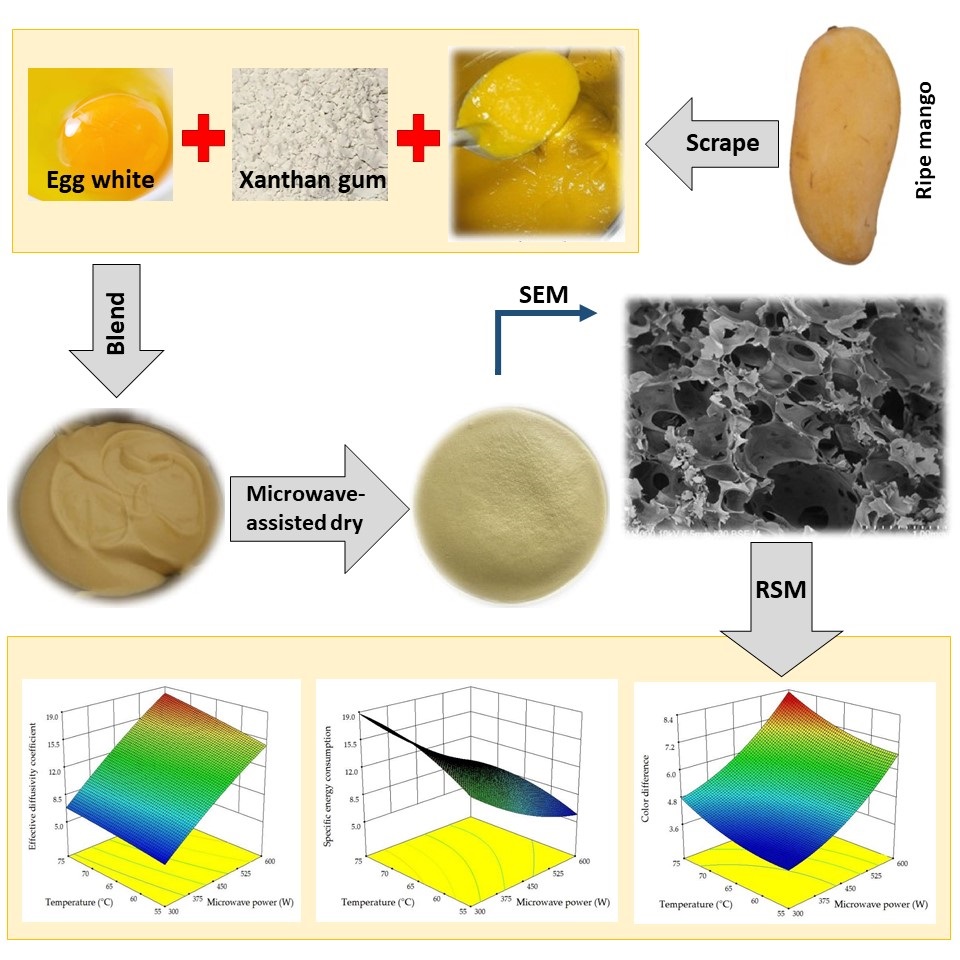
Downloads
References
NTY Tran, TTT Le, NH Nghia, DB Nhu, LB Huynh, TXT Nguyen, PX Huynh and TP Dao. Developing mango powders by foam mat drying technology. Food Sci Nutr. 2023; 11, 4084-92.
P Sansomchai, R Sroynak and T Tikapunya. Powder qualities of foam-mat dried mango. Trends Sci. 2023; 20, 5308.
AM Chaux-Gutiérrez, AB Santos, DM Granda-Restrepo and MA Mauro. Foam mat drying of mango: effect of processing parameters on the drying kinetic and product quality. Dry. Tech. 2017; 35, 631-41.
P Rajkumar, R Kailappan, R Viswanathan, GSV Raghavan and C Ratti. Foam mat drying of alphonso mango pulp. Dry. Tech. 2007; 25, 357-65.
P Rajkumar, R Kailappan, R Viswanathan, K Parvathi, GSV Raghavan and V Orsat. Thin layer drying study on foamed mango pulp. Dry. Tech. 2007; 25, 1069-77.
R Thuwapanichayanan, S Prachayawarakorn and S Soponronnarit. Drying characteristics and quality of banana foam mat. J. Food Eng. 2007; 86, 573-83.
OS Qadri and AK Srivastava. Effect of microwave power on foam-mat drying of tomato pulp. Agr. Eng. Int. CIGR J. 2014; 16, 238-44.
OS Qadri and AK Srivastava. Microwave-assisted foam mat drying of guava pulp: Drying kinetics and effect on quality attributes. J. Food Process Eng. 2017; 40, e12295.
R Gao, L Xue, Y Zhang, Y Liu, L Shen and X Zheng. Production of blueberry pulp powder by microwave-assisted foam-mat drying: Effects of formulations of foaming agents on drying characteristics and physicochemical properties. LWT 2022; 154, 112811.
AN Yüksel and R Pandiselvam. Mathematical modeling of microwave-assisted foam-mat drying of kefir. J. Food Process. Preserv. 2023; 2023, 3917292.
O Sufer, R Pandiselvam and YY Kaya. Drying kinetics, powder properties, and bioactive components of bitter orange (Citrus Aurantium L.) dried by microwave-assisted foam-mat approach. Biomass Convers. Biorefin. 2024; 14, 1275-87.
HT Varol, S Karaaslan, R Kulcu and DS Sivri. Microwave-assisted foam mat drying of kumquat puree and investigation of some parameters. BIO Web Conf. 2024; 85, 01029.
AN Yuksel. Development of yoghurt powder using microwave-assisted foam-mat drying. J. Food Sci. Tech. 2021; 58, 2834-41.
XZ Zheng, CH Liu and H Zhou. Optimization of parameters for microwave-assisted foam mat drying of blackcurrant pulp. Dry. Tech. 2011; 29, 230-8.
W Horwitz and GW Latimer. Official methods of analysis of AOAC International. 18th ed. AOAC International. Gaithersburg, Maryland, 2005.
A Midilli, H Kucuk and Z Yapar. A new model for single-layer drying. Dry. Tech. 2002; 20, 1503-13.
O Yaldiz, C Ertekin and HI Uzun. Mathematical modeling of thin layer solar drying of sultana grapes. Energy 2001; 26, 457-65.
LR Verma, RA Bucklin, JB Endan and FT Wratten. Effects of drying air parameters on rice drying models. Trans. ASAE 1985; 28, 296-301.
H Majdi, JA Esfahani and M Mohebbi. Optimization of convective drying by response surface methodology. Comput. Electron. Agr. 2019; 156, 574-84.
LV Candioti, MMD Zan, MS Camara and HC Goicoechea. Experimental design and multiple response optimization. Using the desirability function in analytical methods development. Talanta 2014; 124, 123-38.
MZ Islam, MI Jahan, K Monalisa, R Rana and MM Hoque. Impact of maltodextrin, egg white protein addition and microwave-assisted foam mat drying on drying kinetics, microstructures, physicochemical and quality attributes of jackfruit juice powder. LWT 2024; 200, 116158.
A Chen, GE Achkar, B Liu, and R Bennacer, R. Experimental study on moisture kinetics and microstructure evolution in apples during high power microwave drying process. J. Food Eng. 2021; 292, 110362.
GVSB Raj and KK Dash. Effect of intermittent microwave convective drying on physicochemical properties of dragon fruit. Food Sci. Biotechnol. 2022; 31, 549-60.
P Poogungploy, N Poomsa-ad and L Wiset. Control of microwave assisted macadamia drying. J. Microwave Power Electromagn. Energ. 2018; 52, 60-72.
OS Qadri. Microwave drying of foamed tomato pulp: optimization and mass transfer modelling. J. Food Process. Preserv. 2022; 46, e15954.
M Zarein, SH Samadi and B Ghobadian. Investigation of microwave dryer effect on energy efficiency during drying of apple slices. J. Saudi Soc. Agr. Sci. 2015; 14, 41-7.
HL Nguyen and TQ Le. Drying kinetics and effective moisture diffusivity of pomelo albedo under vacuum-assisted microwave drying and its semi-product. J. Food Process Eng. 2022; 45, e13968.
M Taşova, H Polatcı and SK Dursun. Comparison of the performance of a modified temperature-controlled microwave dryer to improve heat-mass transfer, increase energy efficiency and preserve quality characteristics of shad (Alosa Fallax Nilotica). Int. Commun. Heat Mass Transf. 2023; 144, 106772.
A Kumar, P Kandasamy, I Chakraborty and L Hangshing. Analysis of energy consumption, heat and mass transfer, drying kinetics and effective moisture diffusivity during foam-mat drying of mango in a convective hot-air dryer. Biosyst. Eng. 2022; 219, 85-102.
D Jiang, C Li, Z Lin, Y Wu and H Pei. Effects of pulsation ratio on center temperature and drying characteristics of pineapple slices with pulsed vacuum drying. Int. J. Agr. Biol. Eng. 2022; 15, 242-53.
A Kumar, A Begum, M Hoque, S Hussain and B Srivastava. Textural degradation, drying and rehydration behavior of ohmically treated pineapple cubes. LWT 2021; 142, 110988.
P Thanompongchart, P Pintana and N Tippayawong. Thermal performance enhancement in hot air and solar drying of pineapple slices with ultrasonic vibration. Case Stud. Therm. Eng. 2022; 37, 102296.
NAM Zaki and SF Ismail. Quality retention of microwave dried pineapple peels and core. Malays. J. Chem. Eng. Tech. 2018; 1, 1-7.
NAM Zaki, H Alwi, SA Hashib, UK Ibrahim and J Jai. Microwave drying characteristics and quality of ananas comosus peel, core and pulp. Mater. Today Proc. 2023; 87, 8-12.
R Biswas, MA Hossain and W Zzaman. Thin layer modeling of drying kinetics, rehydration kinetics and color changes of osmotic pre-treated pineapple (Ananas Comosus) slices during drying: Development of a mechanistic model for mass transfer. Innov. Food Sci. Emerg. Tech. 2022; 80, 103094.
F Sarpong, MT Rashid, H Wahia, TAA Aly and C Zhou. Mitigation of relative humidity (RH) on phytochemicals and functional groups of dried pineapple (Ananas Comosus) slices. Int. J. Food Eng. 2021; 17, 265-74.
Downloads
Published
How to Cite
Issue
Section
License
Copyright (c) 2024 Walailak University

This work is licensed under a Creative Commons Attribution-NonCommercial-NoDerivatives 4.0 International License.





