
The Immediate Effects of a Single 20-Minute Session of Transcranial Direct Current Stimulation (tDCS) on Muscle Strength in Older Adults
DOI:
https://doi.org/10.48048/tis.2024.8284Keywords:
Transcranial Direct Current Stimulation (tDCS), Muscle strength, Older adults, Physical performance, Primary motor cortex, Health promotionAbstract
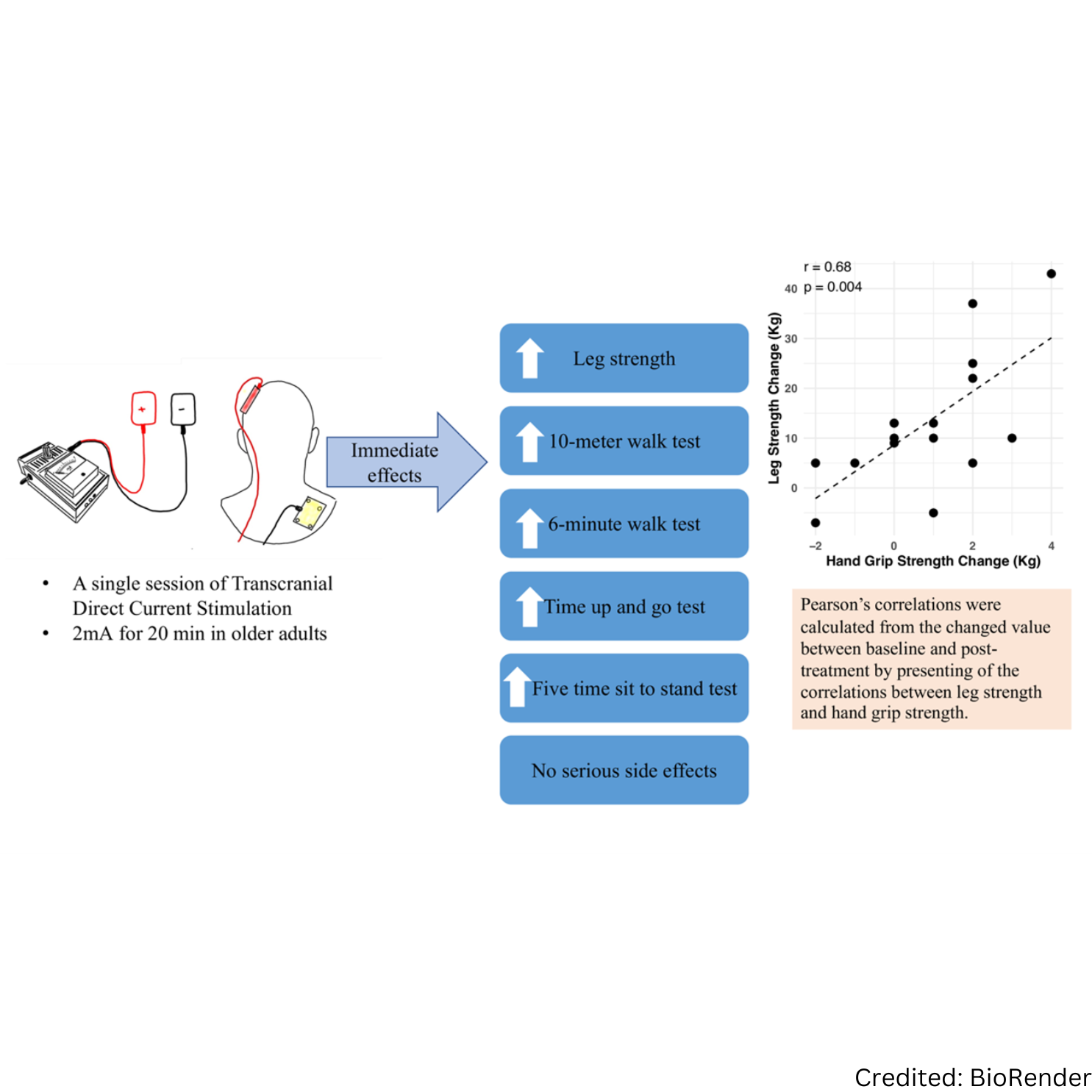
The older population often experiences a gradual age-related decline in the primary motor cortex, leading to muscle weakness that can harm their physical performances. Exercise could improve physical performance and prevent falling in older adults. However, the decrease in motor function and motor skills in older adults reduces the efficiency of fall prevention. Transcranial Direct Current Stimulation (tDCS) is a non-invasive intervention aimed at improving muscle strength in various conditions by utilizing transcranial direct current stimulation applied to the primary motor cortex (M1). Pre- and post-studies were conducted to demonstrate the effects of a single 20-minute session of tDCS alone, as well as to assess any potential side effects. Sixteen older individuals, both male and female, aged 65 years or older, with or without underlying diseases, were assessed for leg and hand grip strength, followed by physical performance tests. Subsequently, they underwent stimulation of the primary motor cortex through the placement of anodal tDCS (a-tDCS) over the left M1 for 20 min. Immediate effects were evaluated within 24 h, and side effects were recorded for up to 2 weeks after the stimulation. The results demonstrated that a single session of tDCS led to a significant increase in leg strength by 13 kg (5.9 to 20.1 kg, p < 0.01). There was also a significant correlation observed with hand grip strength (r = 0.68, p < 0.01). All physical performance tests, except the fastest speed in the 10-meter walk test, showed statistically significant improvements (p < 0.01). Participants reported no serious side effects, and the intervention will now be incorporated into prospective clinical studies involving older populations to compare its effectiveness with other treatments.
HIGHLIGHTS
- A single session of tDCS led to a significant increase in leg strength.
- A single session of tDCS, with a significant correlation observed with hand grip strength.
- Physical performance tests showed statistically significant improvements after a single session of tDCS.
- Participants reported no serious side effects.
- This intervention will now be incorporated into prospective clinical studies involving older populations to compare its effectiveness with other treatments.
GRAPHICAL ABSTRACT
Downloads
References
SH Preston and A Stokes. Sources of population aging in more and less developed countries. Popul. Dev. Rev. 2012; 38, 221-36.
BH Goodpaster, SW Park, TB Harris, SB Kritchevsky, M Nevitt, AV Schwartz, EM Simonsick, FA Tylavsky, M Visser and AB Newman. The loss of skeletal muscle strength, mass, and quality in older adults: The health, aging and body composition study. J. Gerontol. A Biol. Sci. Med. Sci. 2006; 61, 1059-64.
EV Papa, X Dong and M Hassan. Skeletal muscle function deficits in the elderly: Current perspectives on resistance training. J. Nat. Sci. 2017; 3, e272.
R Radel, G Tempest, G Denis, P Besson and R Zory. Extending the limits of force endurance: Stimulation of the motor or the frontal cortex? Cortex 2017; 97, 96-108.
A Canedo. Primary motor cortex influences on the descending and ascending systems. Prog. Neurobiol. 1997; 51, 287-335.
A Demain, GWM Westby, S Fernandez-Vidal, C Karachi, F Bonneville, MC Do, C Delmaire, D Dormont, E Bardinet, Y Agid, N Chastan and ML Welter. High-level gait and balance disorders in the elderly: A midbrain disease? J. Neurol. 2014; 261, 196-206.
D Seidel, N Crilly, FE Matthews, C Jagger, PJ Clarkson and C Brayne. Patterns of functional loss among older people: A prospective analysis. Hum. Factors 2009; 51, 669-80.
RS Mazzeo, P Cavanagh, WJ Evans, M Fiatarone, J Hagberg, E McAuley and J Startzell. ACSM position stand: Exercise and physical activity for older adults. Med. Sci. Sports Exerc. 1998; 30, 992-1008.
M Brown, DR Sinacore, EF Binder and WM Kohrt. Physical and performance measures for the identification of mild to moderate frailty. J. Gerontol. A Biol. Sci. Med. Sci. 2000; 55, M350-M355.
TM Manini, SL Hong and BC Clark. Aging and muscle: A neuron’s perspective. Curr. Opin. Clin. Nutr. Metab. Care 2013; 16, 21-6.
BC Clark, LC Issac, JL Lane, LA Damron and RL Hoffman. Neuromuscular plasticity during and following 3 wk of human forearm cast immobilization. J. Appl. Physiol. 2008; 105, 868-78.
MA Nitsche and W Paulus. Excitability changes induced in the human motor cortex by weak transcranial direct current stimulation. J. Physiol. 2000; 527, 633-9.
HH Liu, XK He, HY Chen, CW Peng, A Rotenberg, CH Juan, YC Pei, HL Liu, YH Chiang, JY Wang, XJ Feng, YZ Huang and TH Hsieh. Neuromodulatory Effects of transcranial direct current stimulation on motor excitability in rats. Neural Plast. 2019; 2019, 4252943.
Z Guo, D Bao, B Manor and J Zhou. The effects of Transcranial Direct Current Stimulation (TDCS) on balance control in older adults: A systematic review and meta-analysis. Front. Aging Neurosci. 2020; 12, 275.
S Tanaka, K Takeda, Y Otaka, K Kita, R Osu, M Honda, N Sadato, T Hanakawa and K Watanabe. Single session of transcranial direct current stimulation transiently increases knee extensor force in patients with hemiparetic stroke. Neurorehabil. Neural Repair 2011; 25, 565-9.
M Zimerman and FC Hummel. Non-invasive brain stimulation: Enhancing motor and cognitive functions in healthy old subjects. Front. Aging Neurosci. 2010; 2, 149.
FA Hazime, R Cunha, R Soliaman, A Romancini, A Pochini, B Ejnisman and AF Baptista. Anodal Transcranial Direst Current Stimulation (TDCS) increases isometric strength of shoulder rotators muscle in handball players. Int. J. Sports Phys. Ther. 2017; 12, 402-7.
A Coldwells, G Atkinson and T Reilly. Sources of variation in back and leg dynamometry. Ergonomics 1994; 37, 79-86.
MJ Benton, JM Spicher and AL Silva-Smith. Validity and reliability of handgrip dynamometry in older adults: A comparison of two widely used dynamometers. PLoS One 2022; 17, e0270132.
DM Peters, SL Fritz and DE Krotish. Assessing the reliability and validity of a shorter walk test compared with the 10-meter walk test for measurements of gait speed in healthy, older adults. J. Geriatr. Phys. Ther. 2013; 36, 24-30.
A Christopher, E Kraft, H Olenick, R Kiesling and A Doty. The reliability and validity of the Timed Up and Go as a clinical tool in individuals with and without disabilities across a lifespan: A systematic review. Disabil. Rehabil. 2021; 43, 1799-813.
A Goldberg, M Chavis, J Watkins and T Wilson. The five-times-sit-to-stand test: Validity, reliability and detectable change in older females. Aging Clin. Exp. Res. 2012; 24, 339-44.
D Yi, Y Sung and JE Yim. Effect of transcranial direct current stimulation on walking speed, functional strength, and balance in older adults: A randomized, double-blind controlled trial. Med. Sci. Mon. 2021; 27, e932623.
CJD Luca, AM Roy and Z Erim. Synchronization of motor-unit firings in several human muscles. J. Neurophysiol. 1993; 70, 2010-23.
JG Semmler. Motor unit synchronization and neuromuscular performance. Exerc. Sport Sci. Rev. 2002; 30, 8-14.
A Dutta, C Krishnan, SS Kantak, R Ranganathan and MA Nitsche. Recurrence quantification analysis of surface electromyogram supports alterations in motor unit recruitment strategies by anodal transcranial direct current stimulation. Restorative Neurol. Neurosci. 2015; 33, 663-9.
AZ LaCroix, JM Guralnik, LF Berkman, RB Wallace and S Satterfield. Maintaining mobility in late life. II. Smoking, alcohol consumption, physical activity, and body mass index. Am. J. Epidemiol. 1993; 137, 858-69.
M Zimerman and FC Hummel. Non-invasive brain stimulation: Enhancing motor and cognitive functions in healthy old subjects. Front. Aging Neurosci. 2010; 2, 149.
GM Rodrigues, A Paixão, T Arruda, BRRD Oliveira, GAM Neto, SRM Neto, E Lattari and S Machado. Anodal transcranial direct current stimulation increases muscular strength and reduces pain perception in women with patellofemoral pain. J. Strength Condit. Res. 2022; 36, 371-8.
T Yamaguchi, K Moriya, S Tanabe, K Kondo, Y Otaka and S Tanaka. Transcranial direct-current stimulation combined with attention increases cortical excitability and improves motor learning in healthy volunteers. J. Neuroeng. Rehabil. 2020; 17, 23.
A Antal, I Alekseichuk, M Bikson, J Brockmöller, AR Brunoni, R Chen, R Chen, LG Cohen, G Dowthwaite, J Ellrich, A Flöel, F Fregni, MS George, R Hamilton, J Haueisen, CS Herrmann, FC Hummel, JP Lefaucheur, D Liebetanz, CK Loo, … and W Paulus. Low intensity transcranial electric stimulation: Safety, ethical, legal regulatory and application guidelines. Clin. Neurophysiol. 2017; 128, 1774-809.
M Bikson, P Grossman, C Thomas, AL Zannou, J Jiang, T Adnan, AP Mourdoukoutas, G Kronberg, D Truong, P Boggio, AR Brunoni, L Charvet, F Fregni, B Fritsch, B Gillick, RH Hamilton, BM Hampstead, R Jankord, A Kirton, … and PE Turkeltaub. Safety of transcranial direct current stimulation: Evidence based update 2016. Brain Stimulation 2016; 9, 641-61.
S Hesse, C Werner, EM Schonhardt, A Bardeleben, W Jenrich and SGB Kirker. Combined transcranial direct current stimulation and robot-assisted arm training in subacute stroke patients: A pilot study. Restorative Neurol. Neurosci. 2007; 25, 9-15.
Downloads
Published
How to Cite
Issue
Section
License
Copyright (c) 2024 Walailak University

This work is licensed under a Creative Commons Attribution-NonCommercial-NoDerivatives 4.0 International License.





