
Exploring Stevia Leaf Residue Extracts: Antibacterial and Antioxidant Potential as Natural Food Preservatives
DOI:
https://doi.org/10.48048/tis.2024.8113Keywords:
Stevia leaf residues, Natural preservatives, Staphylococcus aureus, Antioxidant activity, Phenolic contentAbstract
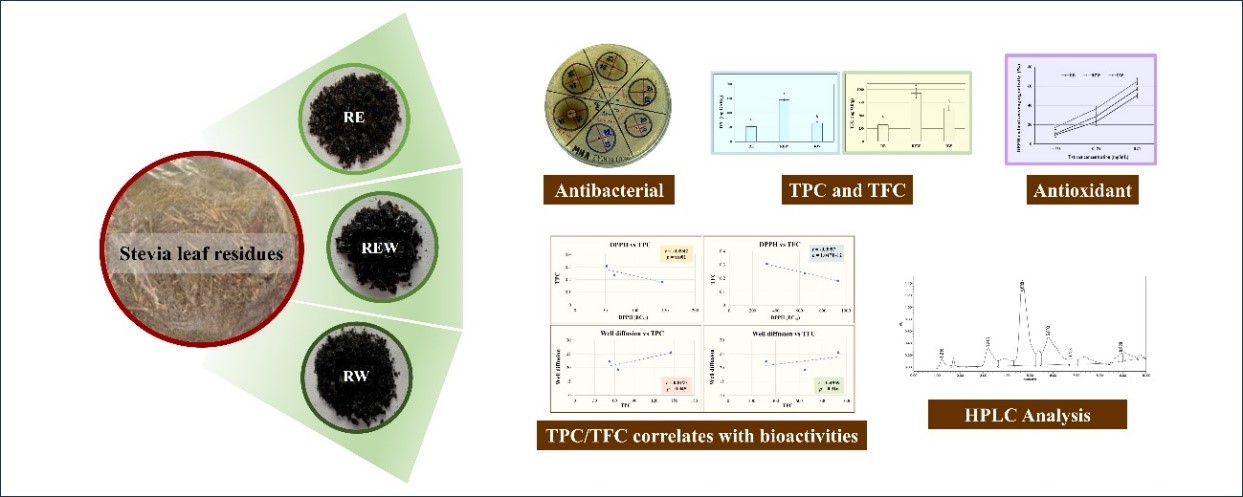
Chemical preservatives commonly used in food preservation often pose health risks and contribute to bacterial resistance, prompting the search for safer alternatives from natural sources. Stevia rebaudiana Bertoni leaves are well-known for their role as natural sweeteners and sugar substitutes in both culinary and medicinal applications. Additionally, their extracts exhibit diverse biological activities, such as anti-diabetic, antibacterial and antioxidant properties, and have previously been confirmed for use in food preservation. Nevertheless, limited research has explored the potential of leaf residues, which are plentiful wastes from steviol glycoside extraction. These residues might still retain valuable bioactive compounds suitable for food preservation, emphasizing the need for additional investigation. Therefore, in this study, stevia leaf residues were subjected to ethanol (RE), a 50 % ethanol/water mixture (REW), and hot water (RW) extraction, and the antibacterial and antioxidant properties of 3 distinct extracts were examined. Evaluation of antibacterial activity against Staphylococcus aureus revealed significant inhibition zones for all extracts, with the REW extract exhibiting the highest efficacy, reaching up to 25.58 ± 2.54 mm. Minimum inhibitory concentration (MIC) and minimum bactericidal concentration (MBC) values of 0.0125 mg per spot and 0.2 mg per spot, respectively, were recorded for the most effective extract (REW), indicating a bacteriostatic effect. Quantification of total phenolic content (TPC) and total flavonoid content (TFC) revealed a strong correlation between phenolic compounds and the tested biological activities, antibacterial and DPPH radical scavenging. Furthermore, HPLC Orbitrap MS analysis identified 6 compounds in the extract: 1 phenolic acid, 4 flavonoids and 1 fatty amide. These identified compounds may be responsible for the observed biological activities of the stevia leaf residue extract. The results confirm the retained potential of stevia leaf residue extracts as sources of natural preservatives in the food industry, offering both antimicrobial and antioxidant benefits.
HIGHLIGHTS
- The REW extract exhibits the highest antibacterial and antioxidant properties
- Phenolic compounds probably contribute to their antibacterial activity
- Antioxidant capacity could derive from flavonoids and phenolics
- The study emphasizes the value of residual-derived compounds for food sustainability
GRAPHICAL ABSTRACT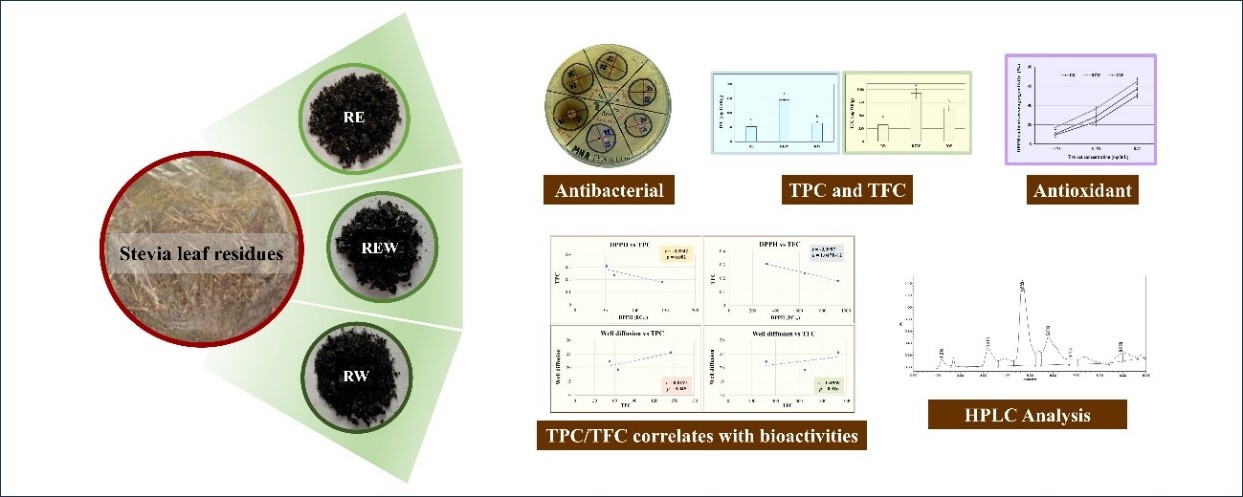
Downloads
References
A Fetsch and S Johler. Staphylococcus aureus as a foodborne pathogen. Curr. Clin. Microbiol. Rep. 2018; 5, 88-96.
AA Mostafa, AA Al-Askar, KS Almaary, TM Dawoud, EN Sholkamy and MM Bakri. Antimicrobial activity of some plant extracts against bacterial strains causing food poisoning diseases. Saudi J. Biol. Sci. 2018; 25, 361-6.
A Bensid, NE Abed, A Houicher, JM Regenstein and F Özogul. Antioxidant and antimicrobial preservatives: Properties, mechanism of action and applications in food - A review. Crit. Rev. Food Sci. Nutr. 2022; 62, 2985-3001.
CO Raphaelli, G Dannenberg, GO Dalmazo, ES Pereira, M Radünz, M Vizzotto, AM Fiorentini, EA Gandra and L Nora. Antibacterial and antioxidant properties of phenolic-rich extracts from apple (Malus domestica cv. Gala). Int. Food Res. J. 2019; 26, 1133-42.
C Zambrano, EB Kerekes, A Kotogán, T Papp, C Vágvölgyi, J Krisch and M Takó. Antimicrobial activity of grape, apple and pitahaya residue extracts after carbohydrase treatment against food-related bacteria. LWT Food Sci. Tech. 2019; 100, 416-25.
KA Nxumalo, AO Aremu and OA Fawole. Metabolite profiling, antioxidant and antibacterial properties of four medicinal plants from Eswatini and their relevance in food preservation. S. Afr. J. Bot. 2023; 162, 719-29.
J Ahmad, I Khan, R Blundell, J Azzopardi and MF Mahomoodally. Stevia rebaudiana Bertoni.: An updated review of its health benefits, industrial applications and safety. Trends Food Sci. Tech. 2020; 100, 177-89.
M Debnath. Clonal propagation and antimicrobial activity of an endemic medicinal plant Stevia rebaudiana. J. Med. Plants Res. 2008; 2, 45-51.
S Jayaraman, MS Manoharan and S Illanchezian. In-vitro antimicrobial and antitumor activities of Stevia rebaudiana (Asteraceae) leaf extracts. Trop. J. Pharmaceut. Res. 2008; 7, 1143-9.
SU Singh, VE Garg, DE Yadav, MN Beg and NI Sharma. In vitro antioxidative and antibacterial activities of various parts of Stevia rebaudiana (Bertoni). Int. J. Pharm. Pharmaceut. Sci. 2012; 4, 468-73.
V Peteliuk, L Rybchuk, M Bayliak, KB Storey and O Lushchak. Natural sweetener Stevia rebaudiana: Functionalities, health benefits and potential risks. EXCLI J. 2021; 20, 1412-30.
J Ortiz‐Viedma, N Romero, L Puente, K Burgos, M Toro, L Ramirez, A Rodriguez, J Barros-Velazquez and SP Aubourg. Antioxidant and antimicrobial effects of stevia (Stevia rebaudiana Bert.) extracts during preservation of refrigerated salmon paste. Eur. J. Lipid Sci. Tech. 2017; 119, 1600467.
S Manandhar, S Luitel and RK Dahal. In vitro antimicrobial activity of some medicinal plants against human pathogenic bacteria. J. Trop. Med. 2019; 2019, 1895340.
M Balouiri, M Sadiki and SK Ibnsouda. Methods for in vitro evaluating antimicrobial activity: A review. J. Pharmaceut. Anal. 2016; 6, 71-9.
B Kowalska-Krochmal and R Dudek-Wicher. The minimum inhibitory concentration of antibiotics: Methods, interpretation, clinical relevance. Pathogens 2021; 10, 165.
MG Shehata, TS Awad, D Asker, SAE Sohaimy, NMA El-Aziz and MN Youssef. Antioxidant and antimicrobial activities and UPLC-ESI-MS/MS polyphenolic profile of sweet orange peel extracts. Curr. Res. Food Sci. 2021; 4, 326-35.
N Phuyal, PK Jha, PP Raturi and S Rajbhandary. Total phenolic, flavonoid contents, and antioxidant activities of fruit, seed, and bark extracts of Zanthoxylum armatum DC. Sci. World J. 2020; 2020, 8780704.
DT Ayele, ML Akele and AT Melese. Analysis of total phenolic contents, flavonoids, antioxidant and antibacterial activities of Croton macrostachyus root extracts. BMC Chem. 2022; 16, 30.
A Chakma, F Afrin, MG Rasul, H Maeda, C Yuan and AKMA Shah. Effects of extraction techniques on antioxidant and antibacterial activity of stevia (Stevia rebaudiana Bertoni) leaf extracts. Food Chem. Adv. 2023; 3, 100494.
S Ghosh, E Subudhi and S Nayak. Antimicrobial assay of Stevia rebaudiana Bertoni leaf extracts against 10 pathogens. Int. J. Integr. Biol. 2008; 2, 27-31.
R Mogana, A Adhikari, MN Tzar, R Ramliza and C Wiart. Antibacterial activities of the extracts, fractions and isolated compounds from Canarium patentinervium Miq. against bacterial clinical isolates. BMC Complementary Med. Ther. 2020; 20, 55.
M Pérez, I Dominguez-López and RM Lamuela-Raventós. The chemistry behind the Folin-Ciocalteu method for the estimation of (poly)phenol content in food: Total phenolic intake in a mediterranean dietary pattern. J. Agr. Food Chem. 2023; 71, 17543-53.
AK Patra. An overview of antimicrobial properties of different classes of phytochemicals. In: Dietary phytochemmicals microbes. Springer, Dordrecht, 2012.
R Lemus-Mondaca, A Vega-Galvez, P Rojas, K Stucken, C Delporte, G Valenzuela-Barra, RJ Jagus, MV Agüero and A Pasten. Antioxidant, antimicrobial and anti-inflammatory potential of Stevia rebaudiana leaves: Effect of different drying methods. J. Appl. Res. Med. Aromat. Plants 2018; 11, 37-46.
C Papuc, GV Goran, CN Predescu, V Nicorescu and G Stefan. Plant polyphenols as antioxidant and antibacterial agents for shelf-life extension of meat and meat products: Classification, structures, sources, and action mechanisms. Compr. Rev. Food Sci. Food Saf. 2017; 16, 1243-68.
S Aryal, MK Baniya, K Danekhu, P Kunwar, R Gurung and N Koirala. Total phenolic content, flavonoid content and antioxidant potential of wild vegetables from Western Nepal. Plants 2019; 8, 96.
JS Kim and JH Lee. Correlation between solid content and antioxidant activities in Umbelliferae salad plants. Prev. Nutr. Food Sci. 2020; 25, 84-92.
YM Muflihah, G Gollavelli and YC Ling. Correlation study of antioxidant activity with phenolic and flavonoid compounds in 12 Indonesian indigenous herbs. Antioxidants 2021; 10, 1530.
M Papaefthimiou, PI Kontou, PG Bagos and GG Braliou. Antioxidant activity of leaf extracts from Stevia rebaudiana Bertoni exerts attenuating effect on diseased experimental rats: A systematic review and meta-analysis. Nutrients 2023; 15, 3325.
JC Ruiz-Ruiz, YB Moguel-Ordoñez, AJ Matus-Basto and MR Segura-Campos. Antidiabetic and antioxidant activity of Stevia rebaudiana extracts (Var. Morita) and their incorporation into a potential functional bread. J. Food Sci. Tech. 2015; 52, 7894-903.
KZ Myint, Z Zhou, Q Shi, J Chen, X Dong and Y Xia. Stevia polyphenols, their antimicrobial and anti-inflammatory properties, and inhibitory effect on digestive enzymes. Molecules 2023; 28, 7572.
B Liu, F Chen, C Bi, L Wang, X Zhong, H Cai, X Deng, X Niu and D Wang. Quercitrin, an inhibitor of Sortase A, interferes with the adhesion of Staphylococcal aureus. Molecules 2015; 20, 6533-43.
A Septembre-Malaterre, A Boumendjel, AS Seteyen, C Boina, P Gasque, P Guiraud and J Sélambarom. Focus on the high therapeutic potentials of quercetin and its derivatives. Phytomed. Plus 2022; 2, 100220.
ZJ Pei, C Li, W Dai, Z Lou, X Sun, H Wang, AA Khan and C Wan. The anti-biofilm activity and mechanism of apigenin-7-o-glucoside against Staphylococcus aureus and Escherichia coli. Infect Drug Resist. 2023; 16, 2129-40.
AB Enogieru, W Haylett, DC Hiss, S Bardien and OE Ekpo. Rutin as a potent antioxidant: Implications for neurodegenerative disorders. Oxid. Med. Cell. Longevity 2018; 27, 6241017.
YC Fiamegos, PL Kastritis, V Exarchou, H Han, AMJJ Bonvin, J Vervoort, K Lewis, MR Hamblin and GP Tegos. Antimicrobial and efflux pump inhibitory activity of caffeoylquinic acids from Artemisia absinthium against gram-positive pathogenic bacteria. PLos One 2011; 6, e18127.
J Han, QY Lv, SY Jin, TT Zhang, SX Jin, XY Li and HL Yuan. Comparison of anti-bacterial activity of three types of di-O-caffeoylquinic acids in Lonicera japonica flowers based on microcalorimetry. Chin. J. Nat. Med. 2014; 12, 108-13.
YJ Hyun, MJ Piao, KA Kang, YS Ryu, AX Zhen, SJ Cho, HK Kang, YS Koh, MJ Ahn, TH Kim and JW Hyun. 3,4-Dicaffeoylquinic acid protects human keratinocytes against environmental oxidative damage. J. Funct. Foods 2019; 52, 430-41.
Downloads
Published
How to Cite
Issue
Section
License
Copyright (c) 2024 Walailak University

This work is licensed under a Creative Commons Attribution-NonCommercial-NoDerivatives 4.0 International License.





