
Revolutionizing Indigo-Dyed Fabric Identification: A Novel Sulfonation Approach for Authenticity and Quality Assurance
DOI:
https://doi.org/10.48048/tis.2024.8043Keywords:
Indigo dyed fabric, Indigo carmine, Indigo blue, Sulfonation, Peak characteristics, Reactive dye, Direct dyeAbstract
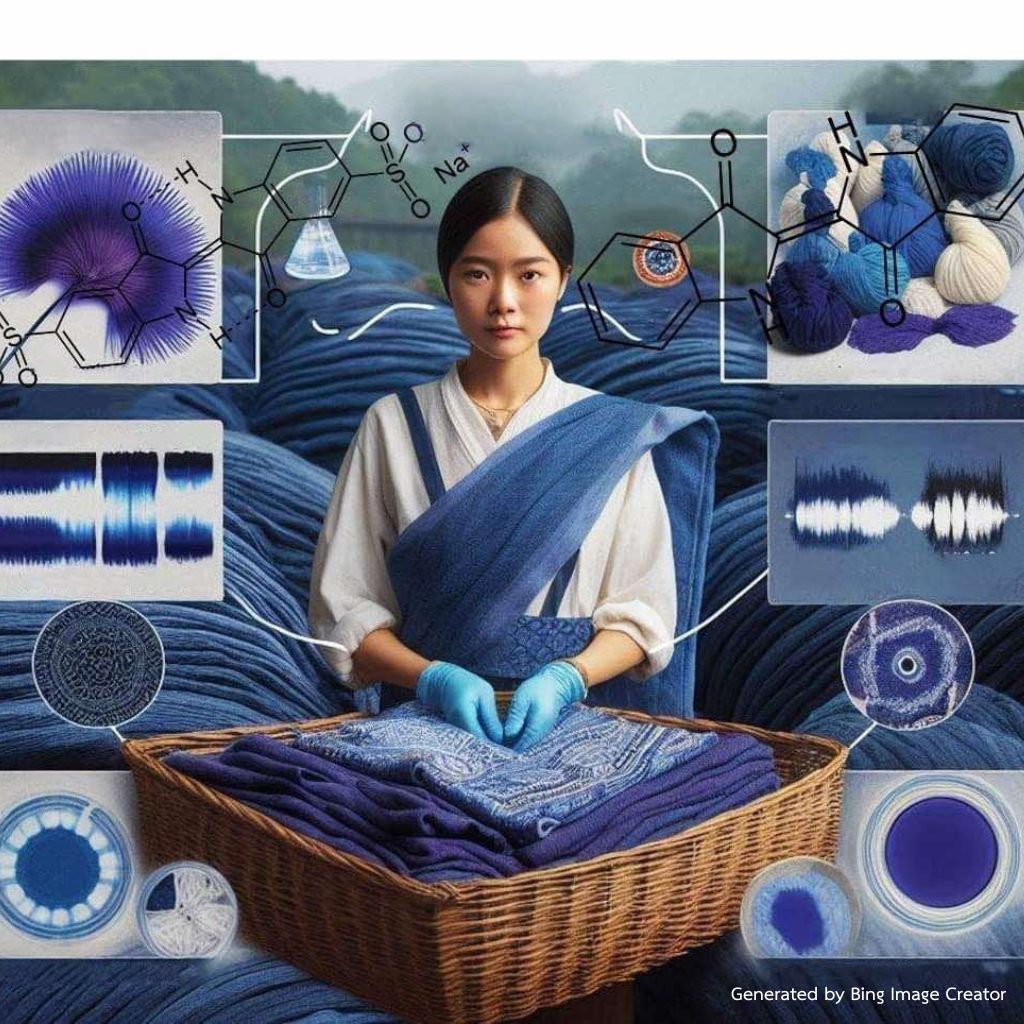
This study explores a novel sulfonation method for analyzing blue-dyed fabrics containing reactive, direct and indigo dyes. The proposed method accurately distinguishes indigo fabrics by converting indigo blue into indigo carmine using concentrated H2SO4, resulting in distinct spectral analysis through UV-Visible spectrophotometry. Generally, UV-Visible spectroscopy shows absorption peak characteristics influenced by analyte and environmental properties, leading to broadening and wavelength shifts. Therefore, statistical analysis of peak characteristics, including center, centroid, Full Width at Half Maximum (FWHM), height and L/R ratio, was performed on the obtained spectra to facilitate comprehensive quality evaluation of indigo-dyed fabrics. The proposed method demonstrated good precision and accuracy, with %RSD values indicating excellent repeatability and reproducibility, contingent on consistent sample preparation, narrow analyte peaks and minimized background signals. Furthermore, this method was applied to analyze the collected indigo-dyed fabrics from Sakon Nakhon Province, revealing the center value (611.79 nm) as a precise marker for indigo dye, with a narrow control range (607.02 - 616.56 nm) and a low coefficient of variation (CV) of 0.26 %. Moreover, centroid, L/R ratio and FWHM significantly contributed to fabric classification and quality assessment. This research offers valuable insights to improve indigo fabric production in Sakon Nakhon Province, leading to more reliable authentication and quality control of the natural indigo-dyed industry.
HIGHLIGHTS
This research presents an innovative method for definitively identifying indigo-dyed fabrics. The sulfonation technique uniquely transforms indigo blue into a distinct marker, indigo carmine, which is absent in other dyes. This reaction initiates characteristic spectral shifts, serving as fingerprints for genuine indigo. Beyond identification, the method establishes quality control parameters, aiding in the detection of alternative dyes. This breakthrough holds immense potential for the indigo-dyed fabric industry, promoting authenticity, quality assurance and overall success.
GRAPHICAL ABSTRACT
Downloads
References
V Gupta and S Gupta. Cotton fiber and its sustainable alternatives. Novel Sustainable Raw Material Alternatives for the Textiles and Fashion Industry. Springer Cham, Germany, 2023, p. 139-60.
R Nayak, L Jajpura and A Khandual. Traditional fibres for fashion and textiles: Associated problems and future sustainable fibres. Sustainable Fibres for Fashion and Textile Manufacturing. Woodhead Publishing, Cambridge, 2023, p. 3-25.
P Hopewell and S Harris. Blue dyed textiles in Early Iron Age Europe: accessible or exclusive? Archaeol. Textil. Rev. 2019; 61, 24-37.
C Gervais, MA Languille, S Reguer, C Garnier and M Gillet. Light and anoxia fading of Prussian blue dyed textiles. Herit. Sci. 2014; 2, 26.
N Tello-Burgos, AM López-Montes, J Ballesta-Claver, FJ Collado-Montero and MDRB García. Identification of indigo dye (Indigofera tinctoria) and its degradation products by separation and spectroscopic techniques on historic documents and textile fibers. Stud. Conservat. 2021; 66, 7-22.
AK Kabish, MT Abate, ZA Alemar and S Girmay. The importance of natural indigo dye and its revitalization and Ethiopian potential for indigo growing. Adv. Mater. Sci. Eng. 2023; 2023, 2135014.
FT Gbolarumi, KY Wong and ST Olohunde. Sustainability assessment in the textile and apparel industry: A review of recent studies. In: Proceedings of the 5th International Conference on Advanced Technology and Applied Sciences, Kuala Lumpur, Malaysia. 2020, p. 2-16.
C Duangbubp, S Chantachon and N Pratumnet. Application of traditional knowledge to create indigo-dyed fabric products in Sakon Nakhon Province, Thailand. Asia Pac. J. Multidisciplinary Res. 2015; 3, 6-10.
P Upping and T Keson. Factors influencing the success of local products: A case study of Sakon Nakhon Province. Univ. Thai Chamber Commerce J. Humanit. Soc. Sci. 2019; 35, 1-13.
JJ Berzas, JR Flores, MJV Llerena and NR Fariñas. Spectrophotometric resolution of ternary mixtures of Tartrazine, Patent Blue V and Indigo Carmine in commercial products. Anal. Chim. Acta 1999; 391, 353-64.
VV Volkov, R Chelli, R Righini and CC Perry. Indigo chromophores and pigments: Structure and dynamics. Dyes Pigments 2020; 172, 107761.
D Mantzouris, I Karapanagiotis and C Panayiotou. Comparison of extraction methods for the analysis of Indigofera tinctoria and Carthamus tinctorius in textiles by high performance liquid chromatography. Microchem. J. 2014; 115, 78-86.
D Śmigiel-Kamińska, J Wąs-Gubała, P Stepnowski and J Kumirska. The identification of cotton fibers dyed with reactive dyes for forensic purposes. Molecules 2020; 25, 5435.
MD Hossain, MMR Khan and MZ Uddin. Fastness properties and color analysis of natural indigo dye and compatibility study of different natural reducing agents. J. Polymer. Environ. 2017; 25, 1219-30.
APS Crema, LDP Borges, GA Micke and NA Debacher. Degradation of indigo carmine in water induced by non-thermal plasma, ozone and hydrogen peroxide: A comparative study and by-product identification. Chemosphere 2020; 244, 125502.
J Zhang, N Jiang, Z Dang, TJ Elder and AJ Ragauskas. Oxidation and sulfonation of cellulosics. Cellulose 2008; 15, 489-96.
K Wang, J Jiang, X Liang, H Wu and J Xu. Direct conversion of cellulose to levulinic acid over multifunctional sulfonated humins in sulfolane-water solution. ACS Sustain. Chem. Eng. 2018; 6, 15092-99.
MC Pagnacco, JP Maksimović, NT Nikolić, DVB Bogdanović, MM Kragović, MD Stojmenović, SN Blagojević and JV Senćanski. Indigo carmine in a food dye: Spectroscopic characterization and determining its micro-concentration through the clock reaction. Molecules 2022; 27, 4853.
W Thosaikham and P Sakong. Indigo blue determination for quality evaluation by UV-Visible spectrophotometry method. J. Sci. Tech. Mahasarakham Univ. 2023; 42, 20-30.
P John and LG Angelini. Indigo—Production and properties. In: C Stevens, T Bechtold, A Manian and T Pham (Eds.). Handbook of natural colorants. John Wiley & Sons, New Jersey, 2023.
C Sunanta and N Srinathom. 2021, Development of lye solution for natural indigo dyeing. Bachelor Degrees. Sakon Nakhon Ratjabhat University, Sakon Nakhon, Thailand.
KCB Textile Company Limited, Available at: https://www.indafix.com/contact-us/, accessed February 2024.
Siwasumpan Company Limited, Available at: https://www.sivasumpan.com/th, accessed February 2024.
MJ Vowels, LM Vowels and ND Wood. Spectral and cross-spectral analysis - a tutorial for psychologists and social scientists. Psychol. Meth. 2021; 28, 631-50.
CT Chen, LM Chang and CH Loh. A review of spectral analysis for low-frequency transient vibrations. J. Low. Freq. Noise Vib. Active Contr. 2021; 40, 656-71.
MH Trauth. Spectral analysis in Quaternary sciences. Quaternary Sci. Rev. 2021; 270, 107157.
NT Burgos, A López-Montes, EM Valero, JL Nieves and MR Blanc. Characterization of the evolution of indigo blue by multispectral imaging. Color Res. Appl. 2022; 47, 486-97.
J Yang, S Chen and G Liu. Eco-friendly dual-chromophore functionalized polyvinylamine derivatives for clean and sustainable coloration of cotton fabric. Dyes Pigments 2022; 207, 110792.
H Iino, S Tokino, J Ryu, M Chen, M Suzuka and T Wakida. Change in color of dyed wool and nylon 6 fabrics by sputter etching. J. Fiber Sci. Tech. 1996; 52, 213-9.
N Meksi, M Kechida and MF Mhenni. New process of dyeing cotton textile by indigo with borohydride: Effect of the concentration of the reducing agent. Int. J. Appl. Chem. 2008; 4, 1-14.
E Frignani, V D’Eusanio, M Grandi, L Pigani and F Roncaglia. A continuous extraction protocol for the characterisation of a sustainably produced natural indigo pigment. Life 2024; 14, 59.
A Doménech-Carbó, S Holmwood, FD Turo, N Montoya, FM Valle-Algarra, HGM Edwards and MT Doménech-Carsbó. Composition and color of maya blue: Reexamination of literature data based on the dehydroindigo model. J. Phys. Chem. C 2019; 123, 770-82.
Z Ju, J Sun and Y Liu. Molecular structures and spectral properties of natural indigo and indirubin: Experimental and DFT studies. Molecules 2019; 24, 3831.
S Ammar, R Abdelhedi, C Flox, C Arias and E Brillas. Electrochemical degradation of the dye indigo carmine at boron-doped diamond anode for wastewaters remediation. Environ. Chem. Lett. 2006; 4, 229-33.
S Younis, HN Bhatti, SZ Bajwa, J Xu and S Jamil. Photodegradation of direct violet 51 dye using Bi2 MoO6/GO nanoflakes as promising solar light-driven photocatalyst. Proc. Pakistan Acad. Sci. B 2023; 60, 113-24.
PO Edlund, ED Lee, JD Henion and WL Budde. The determination of sulfonated azo dyes in municipal wastewater by ion spray liquid chromatography tandem mass spectrometry. Biomed. Environm. Mass Spectrom. 1989; 18, 233-40.
ÁG Aponte, MAL RamÍrez, YC Mora, JF Santa, MarÍn and RB Sierra. Cerium oxide nanoparticles for color removal of indigo carmine and methylene blue solutions. AIMS Mater. Sci. 2020; 7, 468-85.
H Zhang, H Yang, K Xie, A Hou and A Gao. Novel reactive dyes with intramolecular color matching combination containing different chromophores. Dyes Pigments 2018; 159, 576-83.
SG Muntean, Z Szabadai and L Halip. Investigation of aggregation behavior using computational methods and absorption spectra for trisazo direct dyes. Struct. Chem. 2016; 27, 1049-59.
M Reuschenbach, LL Hohrenk-Danzouma, TC Schmidt and G Renner. Development of a scoring parameter to characterize data quality of centroids in high-resolution mass spectra. Anal. Bioanalytical Chem. 2022; 414, 6635-45.
R Wahlen and C Wolff-Briche. Comparison of GC-ICP-MS and HPLC-ICP-MS for species-specific isotope dilution analysis of tributyltin in sediment after accelerated solvent extraction. Anal. Bioanalytical Chem. 2003; 377, 140-8.
L Fasolato, NA Andreani, RD Nardi, G Nalotto, L Serva, B Cardazzo, S Balzan, L Carraro, F Fontana and E Novelli. Spectrophotometric techniques for the characterization of strains involved in the blue pigmentation of food: Preliminary results. Ital. J. Food Saf. 2018; 7, 6932.
ME Ristea and O Zarnescu. Indigo carmine: Between necessity and concern. J. Xenobiotics 2023; 13, 509-28.
K Takeuchi and T Ibusuki. Quantitative determination of aqueous-phase ozone by chemiluminescence using indigo-5,5'-disulfonate. Anal. Chem. 1989; 61, 619-23.
Downloads
Published
How to Cite
Issue
Section
License
Copyright (c) 2024 Walailak University

This work is licensed under a Creative Commons Attribution-NonCommercial-NoDerivatives 4.0 International License.





