
Selection of the Optimal Concentration of Nitro Blue Tetrazolium Dye in Polyvinyl Alcohol Film for Diagnostic Radiology
DOI:
https://doi.org/10.48048/tis.2024.8037Keywords:
Nitroblue Tetrazolium, X Ray Diffraction, CIELab, ImageJ, Color strength K/S, film dosimeterAbstract
Ensuring the limited exposure of both patients and medical professionals to radiation during examinations is paramount. One effective approach is the utilization of a film dosimeter that is not only efficient but also easy to carry. In this research, we employed polyvinyl alcohol/nitro blue tetrazolium (PVA/NBT) with varying concentrations of NBT dye (ranging from 0.015 to 0.3 g) to identify the most optimal concentration. These films were subjected to low doses of gamma rays (8, 25, 55 and 96 mGy) emitted from 3 Cs-137 sources. XRF analysis confirmed the effectiveness of the preparation method used, and the NBT salt exhibited excellent solubility (R2 = 0.93). The films exhibited an increasing yellow hue as the concentration of NBT dye rose. Following irradiation, they took on a yellowish-brown tint, intensifying with higher gamma doses. PVA/NBT films, when stored in the dark, demonstrated good stability for 30 days post-irradiation. Analysis using ImageJ software unveiled that the relative density of the red color heightened proportionally with the concentration of NBT dye. XRD patterns showcased the clarity of structural rearrangements occurring after irradiation with high NBT concentrations. Two distinct peaks were registered at 2θ = 20.12 and 40.94 °, which shifted to 2θ = 19.74 and 41.30 ° post-gamma irradiation. The CIELab system study and K/S color strength indicated that increasing the NBT dye concentration led to a linear rise in color strength with escalating low gamma doses. Through a comprehensive assessment, it is concluded that PVA/NBT film can be effectively employed as a dosimeter for low gamma doses in diagnostic radiology.
HIGHLIGHTS
- Nine different concentrations of NBT dye were used to prepare PVA/NBT films.
- The standard dose scale in diagnostic radiology (mGy) was applied in this work.
- CIELab system parameters showed a linear increase with increasing applied dose.
- XRD pattern recorded a shifted peak after irradiation from 2θ = 20.12 to 19.74 °.
- The dose-response was affected by increasing the NBT dye to a certain concentration.
GRAPHICAL ABSTRACT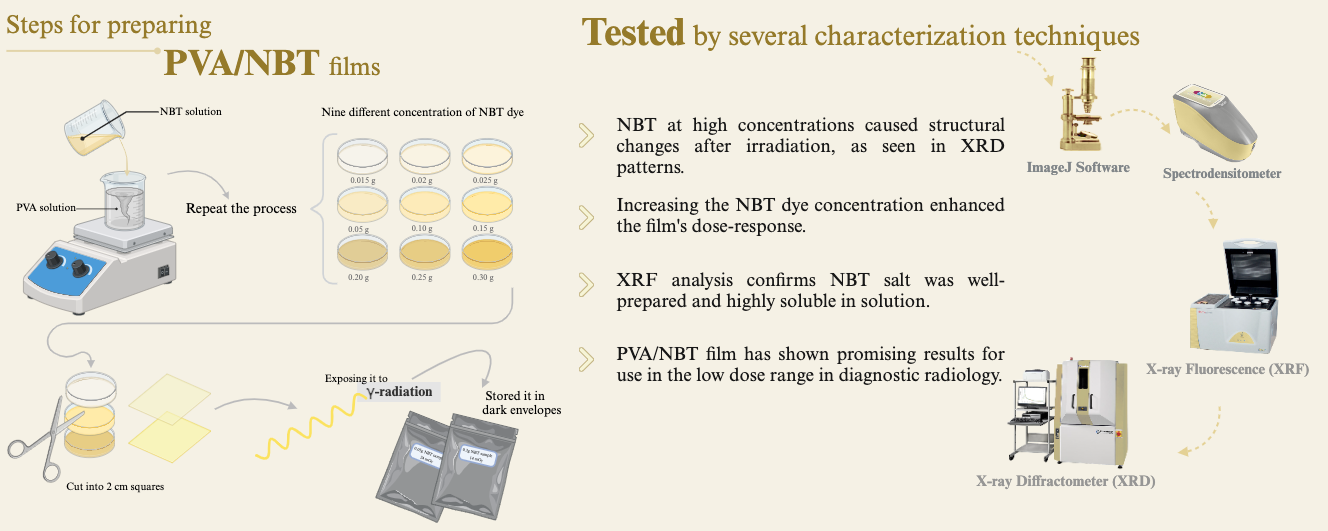
Downloads
References
A Vértes, S Nagy, Z Klencsár and RG Lovas. Handbook of nuclear chemistry: Instrumentation, separation techniques environomental iusses. Springer Science & Business Media, Heidelberg, Germany, 2003.
G Bitton and BJ Dutka. Toxicity testing using microorganisms. CRC Press, Florida, 2019, p. 32-3.
AA Abdel-Fattah, WB Beshir, HM Hassan and YS Soliman. Radiation-induced coloration of nitro blue tetrazolium gel dosimeter for low dose applications. Radiat. Meas. 2017; 100, 18-26.
A Kovács, M Baranyai, L Wojnárovits, A Moussa, I Othman and WL McLaughlin. Aqueous-ethanol nitro blue tetrazolium solutions for high dose dosimetry. Radiat. Phys. Chem. 1999; 55, 799-803.
A Kovács, M Baranyai, L Wojnárovits, I Slezsák, WL McLaughlin, A Miller and A Moussa. Dose determination with nitro blue tetrazolium containing radiochromic dye films by measuring absorbed and reflected light. Radiat. Phys. Chem. 2000; 57, 711-6.
A Moussa, M Baranyai, L Wojnarovits, A Kovács and WL McLaughlin. Dosimetry characteristics of the nitro blue tetrazolium-polyvinylalcohol film for high dose applications. Radiat. Phys. Chem. 2003; 68, 1011-5.
AA Basfar, KA Rabaeh, AA Moussa and RI Msalam. Dosimetry characterization of nitro-blue tetrazolium polyvinyl butyral films for radiation processing. Radiat. Phys. Chem. 2011; 80, 763-6.
S Alashrah, Y El-Ghoul and MAA Omer. Synthesis and characterization of a new nanocomposite film based on polyvinyl alcohol polymer and nitro blue tetrazolium dye as a low radiation dosimeter in medical diagnostics application. Polymers 2021; 13, 1815.
JC Lindon, GE Tranter and DW Koppenaal. Encyclopedia of spectroscopy and spectrometry. Elsevier, Netherlands, 2016.
R Johnston-Feller. Color science in the examination of museum objects: Nondestructive procedures. Getty Conservation Institute, Los Angeles, California, 2001.
S Alashrah, Y El-Ghoul, FM Almutairi and MAA Omer. Development, characterization and valuable use of novel dosimeter film based on PVA polymer doped nitro blue tetrazolium dye and AgNO3 for the accurate detection of low X-ray doses. Polymers 2021; 13, 3140.
YC Chao, T Ho, Z Cheng, L Kao and P Tsai. A study on combining natural dyes and environmentally-friendly mordant to improve color strength and ultraviolet protection of textiles. Fibers Polym. 2017; 18, 1523-30.
JM Jabar, TE Adedayo and YA Odusote. Green, eco-friendly and sustainable alternative in dyeing cotton fabric using aqueous extract Mucuna slonaei F dye: Effects of metal salts pre-mordanting on color strength and fastness properties. Curr. Res. Green Sustain. Chem. 2021; 4, 100151.
S Alashrah and A El-Taher. Assessing exposure Hazards and metal analysis resulting from bauxite samples collected from a Saudi Arabian mine. Pol. J. Environ. Stud. 2018; 27, 959-66.
KhA Rabaeh, AA Basfar and AA Moussa. Enhancement in sensitivity of nitro blue tetrazolium polyvinyl alcohol film dosimeters by sodium formate and Triton X-100. Radiat. Phys. Chem. 2012; 81, 479-83.
P Oberoi, C Maurya and P Mahanwar. Effect of gamma irradiation dose on phthalate free PVC dyed thin film dosimeter. J. Mater. Environ. Sci. 2019; 10, 533-42.
SA Nouh, AG Nagla, MH Othman, SA Eman and ZI Lotfi. Thermal, structural, and optical properties of γ-irradiated poly (vinyl alcohol)/poly (ethylene glycol) thin film. J. Appl. Polym. Sci. 2012; 124, 654-60.
P Liu, W Chen, C Liu, M Tian and PG Liu. A novel poly (vinyl alcohol)/poly (ethylene glycol) scaffold for tissue engineering with a unique bimodal open-celled structure fabricated using supercritical fluid foaming. Sci. Rep. 2019; 9, 9534.
SB Aziz, OG Abdullah, SA Hussein and HM Ahmed. Effect of PVA blending on structural and ion transport properties of CS: AgNt-based polymer electrolyte membrane. Polymers 2017; 9, 622.
S Sau, S Pandit and S Kundu. Crosslinked poly (vinyl alcohol): Structural, optical and mechanical properties. Surf. Interfaces 2021; 25, 101198.
H Abral, A Atmajaya, M Mahardika, F Hafizulhaq, Kadriadi, D Handayani, SM Sapuan and RA Ilyas. Effect of ultrasonication duration of polyvinyl alcohol (PVA) gel on characterizations of PVA film. J. Mater. Res. Tech. 2020; 9, 2477-86.
SJ Alsufyani. Influence of γ-irradiation on the structural and optical properties of PVA/ rGO films reinforced with rGO for nuclear shielding applications. J. Radiat. Res. Appl. Sci. 2023; 16, 100663.
A Raouafi, M Daoudi, K Jouini, K Charradi, AH Hamzaoui, P Blaise, K Farah and F Hosni. Effect of gamma irradiation on the color, structure and morphology of nickeldoped polyvinyl alcohol films: Alternative use as dosimeter or irradiation indicator. Nucl. Instrum. Methods Phys. Res. Sect. B 2018; 425, 4-10.
AG El-Shamy, AA Maati, W Attia and KMA El-Kader. Promising method for preparation the PVA/Ag nanocomposite and Ag nano-rods. J. Alloys Compd. 2018; 744, 701-11.

Downloads
Published
How to Cite
Issue
Section
License
Copyright (c) 2024 Walailak University

This work is licensed under a Creative Commons Attribution-NonCommercial-NoDerivatives 4.0 International License.





