
Characterizations of ZnO Nanoparticles Green Synthesized using Flaxseeds Extract for Biomedical Applications
DOI:
https://doi.org/10.48048/tis.2024.7923Keywords:
Zinc oxide nanoparticles (ZnO-NPs), Flaxseeds (Linum usitatissimum L.), Green synthesisAbstract
ZnO-NPs were synthesized chemically and using the green synthesis technique by flaxseeds (Linum usitatissimum L.), which uses water to extract flaxseeds in a biologically convenient, secure and affordable manner, under different conditions of shape of flaxseed, grinded and full seeds, different concentrations of the precursor, zinc nitrate hexahydrate, (7.43, 14.87 and 22.31 g) each per 50 mL of distilled water to obtain (0.5, 1 and 1.5 mol/L) concentrations and different pH 8, 10, 12 and 13 and studying its characterizations using X-Ray diffraction (XRD) and field emission scanning electron microscopy (FESEM) to obtain the best ZnO-NPs size and morphological properties for biomedical uses.
HIGHLIGHTS
- Green synthesized ZnO-NPs using flaxseed extract
- Whole seed flaxseed extract synthesizes ZnO-NPs with smaller size and spherical shape
- Higher zinc nitrate concentration increases ZnO-NPs size under pH 8 - 10
GRAPHICAL ABSTRACT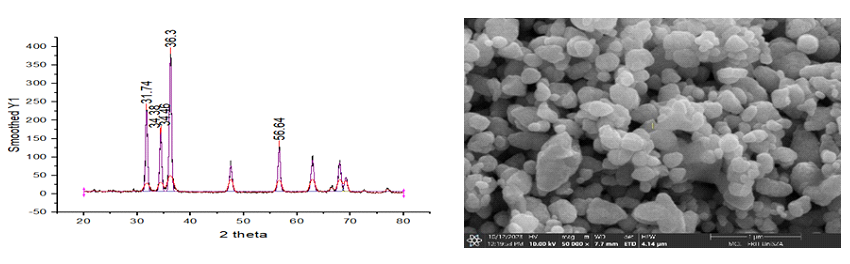
Downloads
References
JA Ruszkiewicz, A Pinkas, B Ferrer, TV Peres, A Tsatsakis and M Aschner. Neurotoxic effect of active ingredients in sunscreen products, a contemporary review. Toxicol. Rep. 2017; 4, 245-59.
HM Yusof, R Mohamad, UH Zaidan and NA Abdul Rahman. Microbial synthesis of zinc oxide nanoparticles and their potential application as an antimicrobial agent and a feed supplement in animal industry: A review. J. Anim. Sci. Biotechnol. 2019; 10, 57.
Food and Drug Administration. Select committee on GRAS substances (SCOGS) opinion: Tannic acid (hydrolyzable gallotannins). Food and Drug Administration, Rockville, 2015.
MH Saleem, S Ali, S Hussain, M Kamran, MS Chattha, S Ahmad and MM AbdelDaim. Flax (Linum usitatissimum L.): A potential candidate for phytoremediation? Biological and economical points of view. Plants 2020; 9, 496.
A Ahmad, P Mukherjee, S Senapati, D Mandal, MI Khan, R Kumar and M Sastry. Extracellular biosynthesis of silver nanoparticles using the fungus Fusarium oxysporum. Colloid Surface B Biointerfaces 2003; 28, 313-8.
A Król, P Pomastowski, K Rafińska, V Railean-Plugaru and B Buszewski. Zinc oxide nanoparticles: Synthesis, antiseptic activity and toxicity mechanism. Adv. Colloid Interface Sci. 2017; 249, 37-52.
S Iravani. Green synthesis of metal nanoparticles using plants. Green Chem. 2011; 13, 2638-50.
BK Teo and XH Sun. From top-down to bottom-up to hybrid nanotechnologies: Road to nanodevices. J. Cluster Sci. 2006; 17, 529-40.
J Qu, X Yuan, X Wang and P Shao. Zinc accumulation and synthesis of ZnO nanoparticles using Physalis alkekengi L. Environ. Pollut. 2011; 159, 1783-8.
J Qu, C Luo and J Hou. Synthesis of ZnO nanoparticles from Zn-hyperaccumulator (Sedum alfredii Hance) plants. Micro Nano Lett. 2011; 6, 174-6.
R Dobrucka and J Długaszewska. Biosynthesis and antibacterial activity of ZnO nanoparticles using Trifolium pratense flower extract. Saudi J. Biol. Sci. 2016; 23, 517-23.
M Sundrarajan, S Ambika and K Bharathi. Plant-extract mediated synthesis of ZnO nanoparticles using Pongamia pinnata and their activity against pathogenic bacteria. Adv. Powder Tech. 2015; 26, 1294-9.
P Golinska, M Wypij, AP Ingle, I Gupta, H Dahm and M Rai. Biogenic synthesis of metal nanoparticles from actinomycetes: Biomedical applications and cytotoxicity. Appl. Microbiol. Biotechnol. 2014; 98, 8083-97.
L Fu and Z Fu. Plectranthus amboinicus leaf extract - assisted biosynthesis of ZnO nanoparticles and their photocatalytic activity. Ceram. Int. 2015; 41, 2492-6.
M Hessien, E Da’na, AL Kawther and MM Khalaf. Nano ZnO (hexagonal wurtzite) of different shapes under various conditions: Fabrication and characterization. Mater. Res. Express 2019; 6, 085057.
C Verrier, E Appert, O Chaix-Pluchery, L Rapenne, Q Rafhay, A Kaminski-Cachopo and V Consonni. Effects of the pH on the formation and doping mechanisms of ZnO nanowires using aluminum nitrate and ammonia. Inorg. Chem. 2017, 56, 13111-22.
B Ajitha, YAK Reddy and PS Reddy. Biogenic nano-scale silver particles by Tephrosia purpurea leaf extract and their inborn antimicrobial activity. Spectrochim. Acta A Mol. Biomol. Spectros. 2014; 121, 164-72.
S Kalathil, J Lee and MH Cho. Electrochemically active biofilm-mediated synthesis of silver nanoparticles in water. Green Chem. 2011; 13, 1482-5.
X Zhang, S Yan, RD Tyagi and RY Surampalli. Synthesis of nanoparticles by microorganisms and their application in enhancing microbiological reaction rates. Chemosphere 2011; 82, 489-94.
K Prasad and AK Jha. Biosynthesis of CdS nanoparticles: An improved green and rapid procedure. J. Colloid Interface Sci. 2010; 342, 68-72.
C Jayaseelan, AA Rahuman, AV Kirthi, S Marimuthu, T Santhoshkumar, A Bagavan and KB Rao. Novel microbial route to synthesize ZnO nanoparticles using Aeromonas hydrophila and their activity against pathogenic bacteria and fungi. Spectrochim. Acta A Mol. Biomol. Spectros. 2012; 90, 78-84.
MZ Hussein, WHWN Azmin, M Mustafa and AH Yahaya. Bacillus cereus as a biotemplating agent for the synthesis of zinc oxide with raspberry-and plate-like structures. J. Inorg. Biochem. 2009; 103, 1145-50.
AA Azeem, AA Nada, A O’donovan, VK Thakur and A Elkelish. Mycogenic silver nanoparticles from endophytic Trichoderma atroviride with antimicrobial activity. J. Renew. Mater. 2020; 8, 171-85.
Downloads
Published
How to Cite
Issue
Section
License
Copyright (c) 2024 Walailak University

This work is licensed under a Creative Commons Attribution-NonCommercial-NoDerivatives 4.0 International License.





