
A Developed Shear Wave Source for Shallow Seismic Survey
DOI:
https://doi.org/10.48048/tis.2024.7472Keywords:
Shear wave, Seismic source, Geophysics, Repeatability, Data acquisitionAbstract
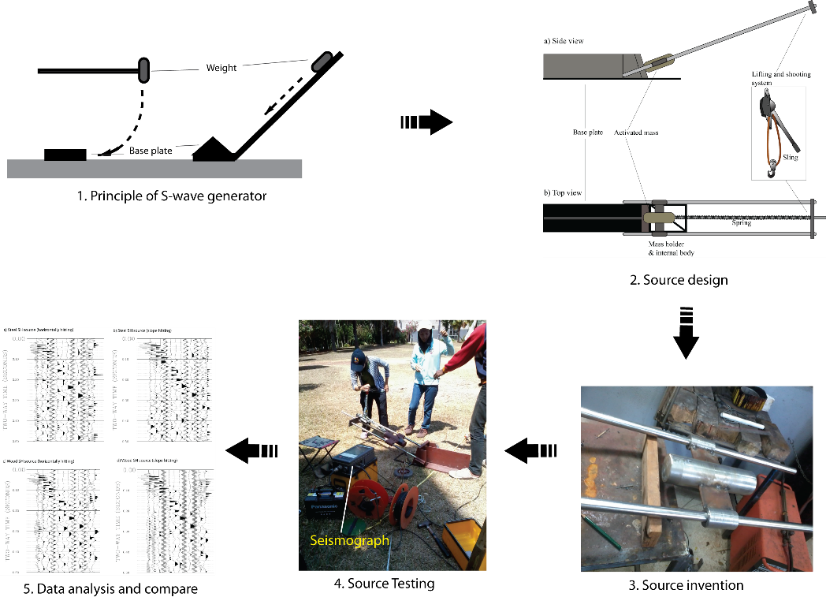
Shear wave velocity is a fundamental parameter in determining geological structures and soil characteristics for geotechnical and earthquake engineering studies. In shallow seismic data acquisition, shear wave is generated by various seismic sources. Although the data quality is affected by the choices of the seismic source, applying highly efficient sources is sometimes limited for some users and by the budget available for a project. Therefore, this work aims to design and develop an effective shear wave seismic source as an alternative for shallow seismic surveys. The developed source consists of 4 main parts, including base plate, activated mass, lifting and shooting system, body and transportation system. It is simply operated by lifting an activated mass with a sling and puller to the armed position. Under this condition, an attached spring is under compression and the maximum potential energy is stored. When the mass is released and horizontally hit the base plate, shear wave is generated by the momentum and energy transferred from the base plate into the ground. To evaluate the source capability, a comparison of the conventional and the developed source was performed at a test site. The recorded data were compared both in qualitative and quantitative manners based on the signal-to-noise ratio, energy and frequency content, signal penetration, and repeatability. It was found that signal energy generated by one blow of the developed source is equivalent to approximately three-fold of the conventional source. There is a remarkably higher repeatability from the developed source than that from the conventional source. Moreover, it is easy to operate, portable, and minimizes required man power. Overall, the new shear source is suitable and has potential application for shallow seismic surveys.
HIGHLIGHTS
- The new shear wave seismic source has been developed and tested as an alternative source for shallow seismic surveys
- The key advantages of the developed source are that it is simple to operate, reduces required manpower, fairly cost-effective, transportable, safe, and has a minimal environmental impact
- There is a noticeably higher input signal energy transfer offered by the source leading to the deeper target depth of investigation
- The better repeatable waveform led to greater accuracy of the 1st break picking in the data processing
GRAPHICAL ABSTRACT

Downloads
References
J Wardell. A comparison of land seismic sources. Geoexploration 1970; 8, 205-29.
BC Aritman. Repeatability study of seismic source signatures. Geophysics 2001; 66, 1811-17.
S Yordkayhun, A Ivanova, R Giese, C Juhlin and C Cosma. Comparison of surface seismic sources at the CO2SINK site, Ketzin, Germany. Geophys. Prospect. 2009; 57, 125-39.
S Yordkayhun and JN Suwan. A university-developed seismic source for shallow seismic surveys. J. Appl. Geophy. 2012; 82, 110-18.
R Herbst, I Kapp, H Krummel and E Luck. Seismic sources for shallow investigations: A field comparison from Northern Germany. J. Appl. Geophy. 1998; 38, 3010-17.
JM Crane, JM Lorenzo and JB Harris. A new electrical and mechanically detonatable shear wave source for near surface (0 - 30 m) seismic acquisition. J. Appl. Geophy. 2013; 91, 1-8.
S Yordkayhun and K Wattanasen. Characterization of the earth dam embankment using shallow seismic data: A case study at klong sadao dam, Southern Thailand. J. Eng. Sci. Tech. 2021; 16, 107-21.
ME Adel, ASA Mohamed, EA Abu, FA Azim and MA Taha. Site specific shear wave velocity investigation for geotechnical engineering applications using seismic refraction and 2D multi-channel analysis of surface waves. NRIAG J. Astron. Geophys. 2013; 2, 88-101.
S Yordkayhun, C Sujitapan and T Chalermyanont. Shear wave velocity mapping of Hat Yai district, southern Thailand: Implication for seismic site classification. J. Geophys. Eng. 2015; 12, 57-69.
S Fabbrocino, G Lanzano, G Forte, FSD Magistris and G Fabbrocino. SPT blow count vs. shear wave velocity relationship in the structurally complex formations of the Molise Region (Italy). Eng. Geol. 2015; 187, 84-97.
T Beilecke, CM Krawczyk, J Ziesch and DC Tanner. Near-surface fault detection using high-resolution shear wave reflection seismics at the CO2CRC Otway Project site, Australia. J. Geophys. Res. 2016; 121, 6510-32.
JB Harris. Hammer-impact SH-wave seismic reflection methods in neotectonic investigations: General observations and case histories from the Mississippi embayment, U.S.A. J. Earth Sci. 2009; 20, 513-25.
D Crice. Near-surface, downhole shear-wave surveys: A primer. Lead. Edge 2011; 30, 164-71.
E Cardarelli, M Cercato and GD Donno. Characterization of an earth-filled dam through the combined use of electrical resistivity tomography, P- and SH-wave seismic tomography and surface wave data. J. Appl. Geophy. 2014; 106, 87-95.
U Polom, H Alrshdan, DA Halbouni, EP Holohan, T Dahm, A Sawarieh, MY Atallah and CM Krawczyk. Shear wave reflection seismic yields subsurface dissolution and subrosion patterns: Application to the Ghor Al-Haditha sinkhole site, Dead Sea, Jordan. Solid Earth 2018; 9, 1079-98.
JA Hunter, HL Crow, WJ Stephenson, AJM Pugin, RA Williams, JB Harris, JK Odum and EW Woolery. Seismic site characterization with shear wave (SH) reflection and refraction methods. J. Seismol. 2022; 26, 631-52.
JA Hunter, B Benjumea, JB Harris, RD Miller, SE Pullan, RA Burns and RL Good. Surface and downhole shear wave seismic methods for thick soils site investigations. Soil Dynam. Earthquake Eng. 2002; 22, 931-41.
A Brom and I Stan-Kleczek. Comparison of seismic sources for shallow seismic sledgehammer and pyrotechnics. Contemp. Trends Geosci. 2015; 4, 39-45.
R Ghose. High‐frequency shear wave reflections from shallow subsoil layers using a vibrator source: Sweep cross‐correlation versus deconvolution with groundforce derivative. In: Proceedings of the SEG International Exposition and 72nd Annual Meeting, Salt Lake City, Utah, 2002, p. 1408-11.
CB Park. MASW for geotechnical site investigation. Lead. Edge 2013; 32, 656-62.
LV Socco, S Foti and D Boiero. Surface-wave analysis for building near-surface velocity models - established approaches and new perspectives. Geophysics 2010; 75, 75A83-75A102.
CB Park, RD Miller and J Xia. Multichannel analysis of surface waves. Geophysics 1999; 64, 800-8.
SS Romero, A Malehmir, I Snowball and B Brodic. Geotechnical site characterization using multichannel analysis of surface waves: A case study of an area prone to quick-clay landslides in southwest Sweden. Near Surf. Geophys. 2021; 19, 699-715.
S Foti, C Comina, D Boiero and LV Socco. Non-uniqueness in surface-wave inversion and consequences on seismic site response analyses. Soil Dynam. Earthquake Eng. 2009; 29, 982-93.
K Helbig and CS Mesdag. The potential of shear-wave observations. Geophys. Prospect. 1982; 30, 413-31.
S Abe, Y Kobayashi and T Ikawa. Seismic characteristics of the weight-dropping source. J. Phys. Earth 1990; 38, 189-212.
RD Miller, SE Pullan, DW Steeples and JA Hunter. Field comparison of shallow seismic sources near Houston, Texas. Geophysics 1994; 59, 1713-28.
C Bibi and BC Aritman. Repeatability study of seismic source signatures. Geophysics 2001; 66, 1811-7.
S Yordkayhun. Detecting near-surface objects with seismic traveltime tomography: Experimentation at a test site. Songklanakarin J. Sci. Tech. 2011; 33, 477-85.
L Fu and SM Hanafy. Ray-tracing traveltime tomography versus wave-equation traveltime inversion for near-surface seismic land data. Interpretation 2017; 5, S011-S019.
GS Chernyshov, AA Duchkov and IY Koulakov. Choosing optimal model parameterization for improving the accuracy of refraction seismic tomography. Near Surf. Geophys. 2022; 20, 135-46.
Downloads
Published
How to Cite
Issue
Section
License
Copyright (c) 2023 Walailak University

This work is licensed under a Creative Commons Attribution-NonCommercial-NoDerivatives 4.0 International License.





