
Estimation of Electromagnetic Radiation Distribution in the Human Heart Rate at Different Frequencies
DOI:
https://doi.org/10.48048/tis.2023.7051Keywords:
Electromagnetic radiation, Heart rate, Maxwell’s equations, FDTD methodAbstract
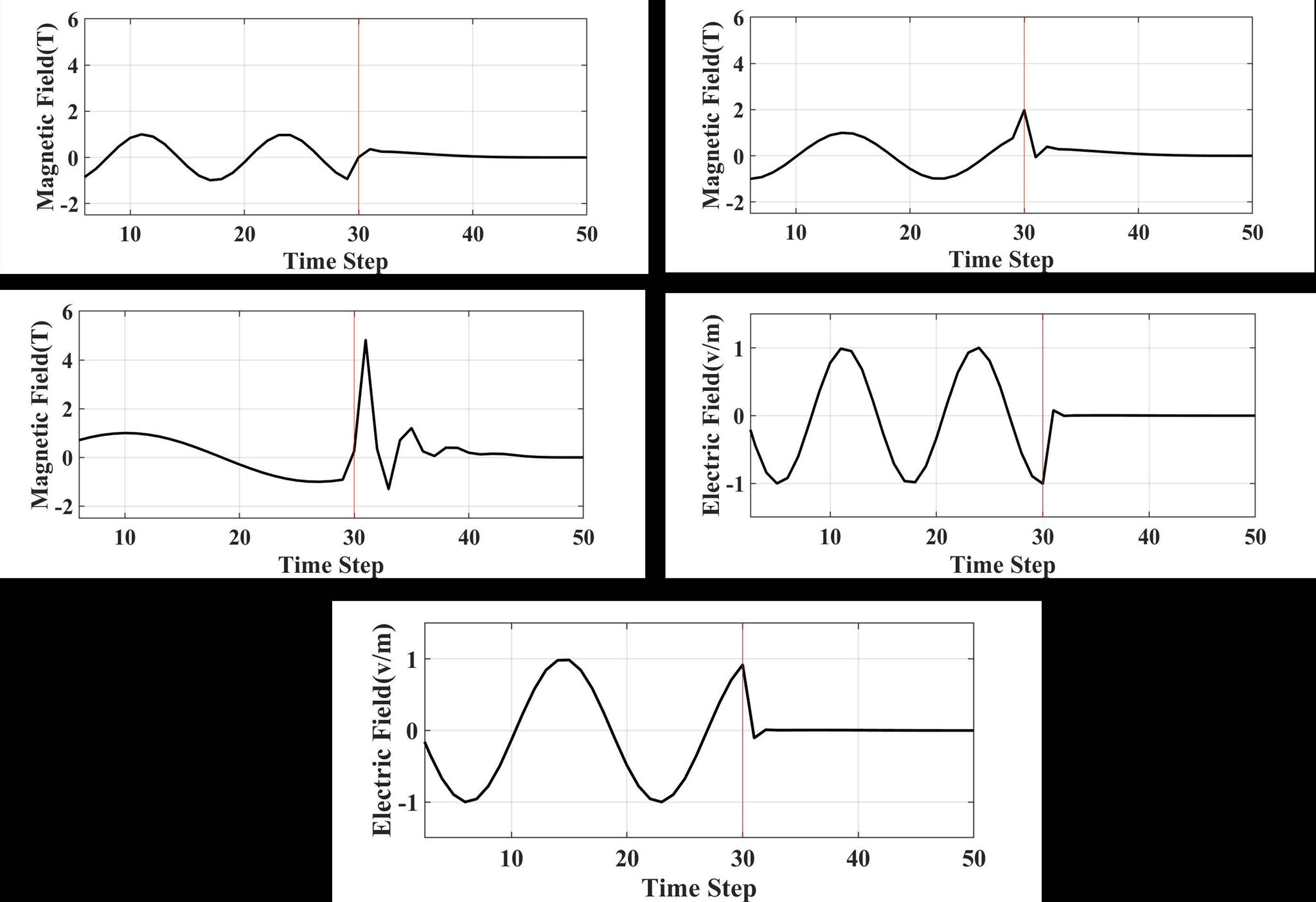
The health implications of electromagnetic radiation have been extensively debated due to the sharp increase in the usage of cell phones, Wi-Fi transmitters and other microwave equipment. Electromagnetic radiation affects the autonomic nervous system, heart rate, blood pressure and other cardiovascular functions. This study aims to present a Numerical Simulation of Electromagnetic Radiation (EMR) on the human heart tissue and to explore the effect of different frequencies in the spectral range (900, 1,800 and 2,400 MHz) on Specific Absorption Rate (SAR), power density, the Distribution of Electromagnetic Fields by Matlab program, and Finite-Difference Time-Domain (FDTD) method in One Dimension (1D). A 1-dimensional finite difference method was used to solve Maxwell’s equations in heart tissue. The heart model was subjected to electromagnetic radiation that has dielectric properties according to frequency. Frequency was chosen and the operation of the software program as Matlab and the dielectric attribute has been calculated. Concurring with the Frequency in a private program, are the conductivity, relative permittivity, wavelength and infiltration profundity. The amplitudes of the reflected and transmitted sinusoid waves, relative to the occurrence wave, were portrayed by the reflection coefficient and the transmission coefficient, which relate to the amplitudes of the electric field wave. The electric field, magnetic field and power density were simulated along the line X = Y = 0. The study showed that the impact of electromagnetic radiation depends on the frequency of the wave which hit the heart. It was found that the heart tissue reacts more at 900 MHz compared to 1,800 and 2,400 MHz, and the tissue absorption is higher at the lower frequency. There was a relation between the magnetic field in the y-dimension and the time step the in x-dimension.
HIGHLIGHTS
- The effect of electromagnetic has been theoretically studied where the electromagnetic fields produced from electromagnetic radiation at 900 MHz,1800 MHz, and 2400 MHz on layered biological tissues (heart model) by the finite difference time domain (FDTD) method
- A one-dimensional finite difference method was used to solve Maxwell's equations in heart tissue
- The amplitudes of the reflected and transmitted sinusoid waves, relative to the occurrence wave, were portrayed by the reflection coefficient and the transmission coefficient, which relate to the amplitudes of the electric field wave
- The impact of electromagnetic radiation depends on the frequency of the wave which hit the heart. There was a relation between the magnetic field in the y-dimension and the time step the in x-dimension
GRAPHICAL ABSTRACT 
Downloads
References
VN Dong, L Tantisuwat, P Setthawong, T Tharasanit, S Sutayatram and A Kijtawornrat. The Preliminary chronic effects of electromagnetic radiation from mobile phones on heart rate variability, cardiac function, blood profiles, and semen quality in healthy dogs. Vet. Sci. 2022; 9, 201.
H Yang, Y Zhang, X Wu, P Gan, X Luo, S Zhong and W Zuo. Effects of acute exposure to 3,500 MHz (5G) radiofrequency electromagnetic radiation on anxiety‐like behavior and the auditory cortex in guinea pigs. Bioelectromagnetics 2022; 43, 106-18.
F Deruelle. The different sources of electromagnetic fields: Dangers are not limited to physical health. Electromagn. Biol. Med. 2022; 39, 166-75.
SY Rybalko, YV Bobrik and AL Korepanov. The influence of wi-fi range electromagnetic radiation on the parameters of the human’s heart variability. IOP Conf. Ser. Earth Environ. Sci. 2021; 853, 12010.
GM Stewart, CM Wheatley‐Guy, BD Johnson, WK Shen and CH Kim. Impact of pulsed electromagnetic field therapy on vascular function and blood pressure in hypertensive individuals. J. Clin. Hypertens. 2020; 22, 1083-9.
V Tsetlin, G Stepanova, N Nikolaykin and N Korepina. Effects of electromagnetic fields on aviation personnel, their behavior, and erroneous actions. In: Proceedings of the 10th International Conference on Recent Advances in Civil Aviation, Singapore. 2022, p. 383-92.
E Binboğa, S Tok and M Munzuroğlu. The short‐term effect of occupational levels of 50 Hz electromagnetic field on human heart rate variability. Bioelectromagnetics 2021; 42, 60-75.
A Vraka, J Moreno-Arribas, JM Gracia-Baena, F Hornero, R Alcaraz and JJ Rieta. The relevance of heart rate fluctuation when evaluating atrial substrate electrical features in catheter ablation of paroxysmal atrial fibrillation. J. Cardiovasc. Dev. Dis. 2022; 9, 176.
K Janashia, L Tvildiani, T Tsibadze and N Invia. Effects of the geomagnetic field time-varying components compensation as evidenced by heart rate variability of healthy males. Life Sci. Space Res. 2022; 32, 38-44.
K Mann, J Roschke, B Connemann and H Beta. No effects of pulsed high-frequency electromagnetic fields on heart rate variability during human sleep. Neuropsychobiology 1998; 38, 251-6.
R Huber, J Schuderer, T Graf, K Jütz, AA Borbély, N Kuster and P Achermann. Radiofrequency electromagnetic field exposure in humans: Estimation of SAR distribution in the brain, effects on sleep and heart rate. Bioelectromagnetics 2003; 24, 262-76.
JD Usman, MU Isyaku and AA Fasanmade. Evaluation of heart rate variability, blood pressure and lipid profile alterations from dual transceiver mobile phone radiation exposure. J. Basic Clin. Physiol. Pharmacol. 2020; 32, 951-7.
S Braune, C Wrocklage, J Raczek, T Gailus and CH Lücking. Resting blood pressure increase during exposure to a radiofrequency electromagnetic field. Lancet 1998; 351, 1857-8.
K Tahvanainen, J Nino, P Halonen, T Kuusela, T Laitinen, E Länsimies, J Hartikainen, M Hietanen and H Lindholm. Cellular phone use does not acutely affect blood pressure or heart rate of humans. Bioelectromagnetics 2004; 25, 73-83.
VIT Ahamed, NG Karthick and PK Joseph. Effect of mobile phone radiation on heart rate variability. Comput. Biol. Med. 2008; 38, 709-12.
NK Panda, R Jain, J Bakshi and S Munjal. Audiologic disturbances in long-term mobile phone users. J. Otolaryngol. Head Neck Surg. 2010; 39, 5-11.
R Andrzejak, R Poreba, M Poreba, A Derkacz, R Skalik, P Gac, B Beck, A Steinmetz-Beck and W Pilecki. The influence of the call with a mobile phone on heart rate variability parameters in healthy volunteers. Ind. Health 2008; 46, 409-17.
A Razek. Biological and medical disturbances due to exposure to fields emitted by electromagnetic energy devices-A review. Energies 2022; 15, 4455.
Downloads
Published
How to Cite
Issue
Section
License
Copyright (c) 2023 Walailak University

This work is licensed under a Creative Commons Attribution-NonCommercial-NoDerivatives 4.0 International License.





