
Bioremediation of Contaminated Diesel and Bioelectricity Generation Using Marine Bacterial Consortium Integrated with Microbial Fuel Cell
DOI:
https://doi.org/10.48048/tis.2023.6900Keywords:
Dehydrogenase, Electricity generation, Marine bacteria, Microbial fuel cell, Petroleum degrading bacteriaAbstract
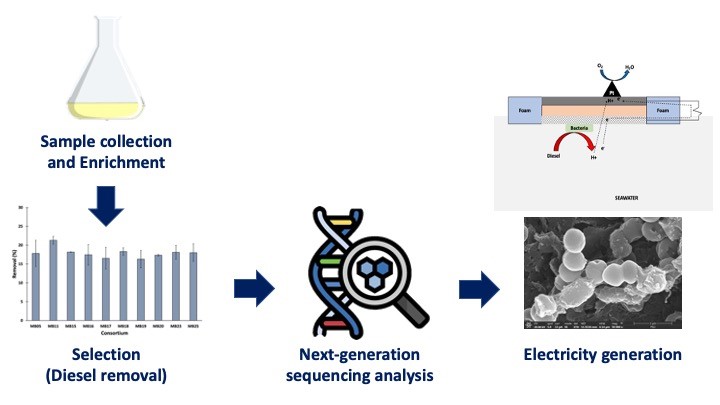
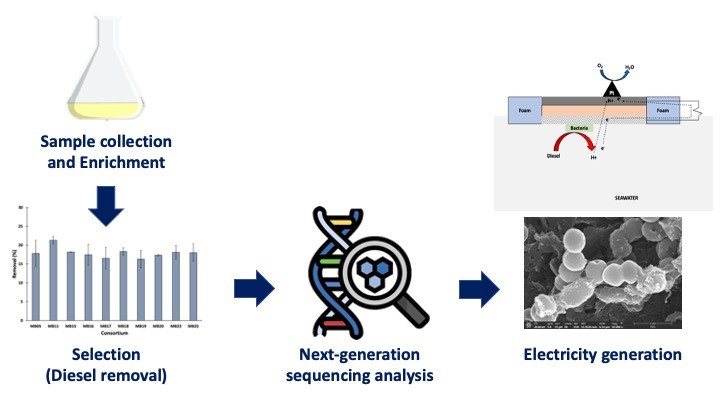
Biodegradation is a commonly used method to treat seawater polluted by petroleum. In addition to its ability to selectively degrade pollutants, it is also important to investigate the effectiveness of degradation and the benefits of restoration. This study focused on selecting a group of bacteria that can degrade diesel from marine sediment. The bacterial consortium called MB11 was found to be the most effective in removing diesel, with a removal rate of 53.77 ± 0.59 %. The consortium MB11 consists mainly of 6 types of bacteria: Enterococcus faecalis, Proteus mirabillis, Pseudomonas aeruginosa, Raoutella planticola, Enterobacter soli and Oceanotoga teriensis. The effective bacterial consortium MB11 was integrated with the floating MFC for electricity generation. The maximal open circuit voltage (OCV) and power density (PD) of 676.88 ± 5.94 mV and 0.16 ± 0.02 W/m3, respectively.
HIGHLIGHTS
- The diesel degrading bacterial consortium was enriched and selected from the marine sediment sample.
- The consortium can degrade the contaminated diesel in artificial seawater and generated the electrical energy.
- The maximal power density of 0.16 ±02 W/m3 was gained when diesel was remove.
GRAPHICAL ABSTRACT
Downloads
References
S Narayan, TH Le, BN Rath and N Doytch. Petroleum consumption and economic growth relationship: Evidence from the Indian States. Asia Pac. Sustain. Dev. J. 2019; 26, 21-65.
D Dave and A Ghaly. Remediation technologies for marine oil spills: A critical review and comparative analysis. Am. J. Environ. Sci. 2011; 7, 423-40.
A Agarwal and Y Liu. Remediation technologies for oil-contaminated sediments. Mar. Pollut. Bull. 2015; 101, 483-90.
R Duran and C Cravo-Laureau. Role of environmental factors and microorganisms in determining the fate of polycyclic aromatic hydrocarbons in the marine environment. FEMS Microbiol. Rev. 2016; 40, 814-30.
S Maletic, B Dalmacija and S Roncevic. Petroleum hydrocarbon biodegradability in soil-implications for bioremediation. In: V Kutcherov and A Kolesnikov (Eds.). Hydrocarbon. IntechOpen, London, 2013.
D Giannopoulos, DI Kolaitis, A Togkalidou, G Skevis and MA Founti. Quantification of emissions from the co-incineration of cutting oil emission in cement plants - part II: Trace species. Fuel 2007; 86, 1144-52.
J Evans and PT Williams. Heavy metal adsorption onto flyash in waste incineration fuel gases. Process Saf. Environ. Protect. 2000; 78, 40-6.
N Das and P Chandran. Microbial degradation of petroleum hydrocarbon contaminants: An overview. Biotechnol. Res. Int. 2011; 10, 941810.
F Dell’Anno, E Rastrlli, C Sansone, C brunet, A Ianora and A Dell’Anno. Bacteria, fungi and microalgae for the bioremediation of marine sediments contaminated by petroleum hydrocarbons in the omics era. Microorganisms 2021; 9, 1695.
MM Yakimov, KN Timmis and PN Golyshin. Obligate oil degrading marine bacteria. Curr. Opin. Biotechnol. 2007; 18, 257-66.
OB Ojuederie and OO Babalola. Microbial and plant-assisted bioremediation of heavy metal polluted environments: A review. Int. J. Environ. Res. Publ. Health 2017; 14, 1504.
X Xu, W Liu, S Tian, W Wang, Q Qi, P Jiang, X Gao, F Li, H Li and H Li. Petroleum hydrocarbon-degrading bacteria for the remediation of oil pollution under aerobic conditions: A perspective analysis. Front. Microbiol. 2018; 9, 2885.
M Morel, E Meux, Y Mathieu, A Thuillier, K Chibani, L harvengt, JP Jacquot and E Gelhaaye. Xenobiotic networks variability and adaptation traits in wood decaying fungi. Microb. Biotechnol. 2013; 6, 248-63.
P Durairaj, S Malla, SP Nadarajan, PG Lee, E Jung, HH Park, BG Kim and H Yun. Fungal cytochrome P450 monooxygenases of Fusarium oxysporum for the synthesis of -hydroxy fatty acids in engineered Saccharomyces cerevisiae. Microb. Cell Factories 2015; 14, 45.
K Shi, Z Liu, H Xu, J Xue, Y Liu, Y Wu, X Xiao, Y Gao and B Liu. Degradation characteristics and microbial community change of marine petroleum-degrading bacteria in different degradation environments. Petrol. Sci. Tech. 2018; 36, 1361-7.
J Jiang, H Wang, S Zhang, S Li, W Zeng and F Li. The influence of external resistance on the performance of microbial fuel cell and removal of sulfamethoxazole wastewater. Bioresource Tech. 2021; 336, 125308.
P Fatehbasharzad, S Aliasghari, IS Tabrizi, JA Khan and G Boczkaj. Microbial fuel cell applications for removal of petroleum hydrocarbon pollutants: A review. Water Resour. Ind. 2022; 28, 100178.
ZX Liu, JL Xue, YN Wu, M Li, X Sun, H Cui, L Cheng, Y Gao and X Xiao. Preliminary analysis of diesel-degrading bacteria immobilized on organic carriers in seawater. China Petrol. Process. Petrochemical Tech. 2017; 19, 33-9.
J Xue, Y Yu, Y Bai, L Wang and Y Wu. Marine oil-degrading microorganisms and biodegradation process of petroleum hydrocarbon in marine environments. Curr. Microbiol. 2015; 71, 220-8.
M Kim, YE Song, S Li and JR Kim. Microwave-treated expandable graphite granule for enhancing the bioelectricity generation of microbial fuel cell. J. Electrochem. Sci. Tech. 2021; 12, 297-301.
P Michu and P Chaijak. Electricity generation and winery wastewater treatment using silica modified ceramic separator integrated with yeast-based microbial fuel cell. Comm. Sci. Tech. 2022; 7, 98-102.
W Zhang, X Kong, Z Han, P Wang, L Ma, Y Wang and H Chen. Preparation of micron-scale activated carbon-immobilized bacteria for the adsorption-biodegradation of diesel oil. Water 2022; 14, 2061.
JH Hong, J Kim, KK Choi, KS Cho and HW Ryu. Characteriazation of a diesel-degrading bacterium Pseudomonas aeruginosa IU5, isolated from oil contaminated soil in Korea. World J. Microbiol. Biotechnol. 2005; 21, 381-4.
MM Stancu. Characterization of new diesel-degrading bacteria isolated from freshwater sediments. Int. Microbiol. 2023; 26, 109-22.
GK Bekele, SA Gabrie, E Mekonen, TT Fida, AA Woldesemayat, EM Abda, M Tafesse and F Assefa. Isolation and characterization of diesel-degrading bacteria from hydrocarbon-contaminated sites, flower farms, and soda lakes. Int. J. Microbiol. 2022; 2022, 5655767.
SK Panda, RN Kar and CR Panda. Isoaltion and identification of petroleum hydrocarbon degrading microorganisms from oil contaminated environment. Int. J. Environ. Sci. 2013; 2, 1314-21.
X Zhang, Z Wang, X Liu, X Hu, X Liang and Y Hu. Degradation of diesel pollutants in Huangpu-Yangtze river estyary wetland using plant-microbe systems. Int. Biodeterioration Biodegradation 2013; 76, 71-5.
Y Chen, J Lin and Z Chen. Remediation of water contaminated with diesel oil using a coupled process: Biological degradation followed by heterogeneous Fenton-like oxidation. Chemosphere 2017; 183, 286-93.
IF Purwanti, SB Kurniawan, HS Titah and BV Tangahu. Identification of acid and aluminum recycling area. Int. J. Civ. Eng. Tech. 2018; 9, 945-54.
B Wu, T Lan, D Lu and Z Liu. Ecological and enzymatic responses to petroleum contamination. Environ. Sci. Process. Impacts 2014; 16, 1501-9.
XG Fu, JL Xue, C Chen, Y Bai, YL Qiao, YX Liu, XM Hu, Y Gao and H Yu. Systematic adsorption process of petroleum hydrocarbon by immobilized petroleum-degradation bacteria system in degradation pathways. Petrol. Sci. 2021; 18, 1543-50.
J Xue, Y Wu, Z Liu, M Li, X Sun, H Wang and B Liu. Characteristic assessment of diesel-degrading bacteria immobilized on natural organic carriers in marine environment: The degradation activity and nutrient. Sci. Rep. 2017; 7, 8635.
X Zhang, L Chen, X Liu, C Wang, X Chen, G Xu and K Deng. Synergic degradation of diesel by Scirpus triqueter and its endophytic bacteria. Environ. Sci. Pollut. Res. 2014; 21, 8198-205.
X Dai, J Lv, G Yan, C Chen, S Guo and P Fu. Bioremediation of intertidal zones polluted by heavy oil spilling using immobilized laccase-bacteria consortium. Bioresource Tech. 2020; 309, 123305.
C Bhuvaneswar, G Swathi, BV Bhaskar, T Munichandrababu and W Rajendra. Effective synergetic biodegradation of diesel oil by bacteria. Int. J. Environ. Biol. 2012; 2, 195-9.
MF Imron and HS Titah. Optimization of diesel biodegradation by Vibrio alginolyticus using Box-Behnken design. Environ. Eng. Res. 2018: 23, 374-82.
PM Martin-Sanchez, R Becker, AA Gorbushina and J Toepel. An improved test for the evaluation of hydrocarbon degradation capacities of diesel-contaminating microorganisms. Int. Biodeterioration Biodegradation 2018; 129, 89-94.
IA Al-Baldawi, SRS Abdullah, N Anuar and I Mushrifah. Bioaugmentation for the enhancement of hydrocarbon phytoremediation by rhizobacteria consortium in pilot horizontal subsurface flow constructed wetlands. Int. J. Environ. Sci. Tech. 2017; 14, 75-84.
C Marchand, M St-Arnaud, W Hogland, TH Bell and M Hijri. Petroluem biodegradation capacity of bacteria and fungi isolated from petroleum-contaminated soil. Int. Biodeterioration Biodegradation 2017; 116, 48-57.
M Wu, W Li, WA Dick, X Ye, K Chen, D Kost and L Chen. Bioremediation of hydrocarbon degradation in a petroleum -contaminated soil and microbial population and activity determination. Chemosphere 2017; 169, 124-30.
H Yuan and Z He. Integrating membrane filtration into bioelectrochemical systems as next generation energy-efficient wastewater treatment technologies for water reclamation: A review. Bioresource Tech. 2015; 195, 202-9.
T Li, R Li and Q Zhou. The application and progress of bioelectrochemical system (BESs) in soil remediation: A review. Green Energ. Environ. 2021; 6, 50-65.
H Guo, S Xie, H Deng, X Geng, P Wang, C Huang and S Tang. Electricity production and bacterial communities of microbial fuel cell supplied with oily sludge. Environ. Progr. Sustain. Energ. 2020; 39, e13409.
D Majumdar, JP Maity, MJ Tseng, VR Nimje, HR Chen, CC Chen, YF Chang, TC Yang and CY Chen. Electricity generation and wastewater treatment of oil refinery in microbial fuel cells using Pseudomonas putida. Int. J. Mol. Sci. 2014; 15, 16772-86.
S Sarmin, AB Ideris, B Ethiraj, MA Islam, CS Yee and MR Khan. Potentiality of petrochemical wastewater as substrate in microbial fuel cell. IOP Conf. Ser. Mater. Sci. Eng. 2020; 736, 032015.
K Venkidusamy, M Megharsaj, M Marzorati, R Lockington and R Naidu. Enhanced removal of petroleum hydrocarbons using a bioelectrochemical remediation system with pre-cultured anodes. Sci. Total Environ. 2016; 539, 61-9.
JM Morris, S Jin, B Crimi and A Pruden. Microbial fuel cell in enhancing anaerobic biodegrdation of diesel. Chem. Eng. J. 2009; 146, 161-7.
JM Foley, RA Rozendal, CK Hertle, PA Lant and K Rabaey. Life cycle assessment of high-rate anaerobic treatment, microbial fuel cells, and microbial electrolysis cells. Environ. Sci. Tech. 2010; 44, 3629-37.
L Zhao, J Deng H Hou, J Li and Y Yang. Investigation of PAH and oil degradation along with electricity generation in soil using an enhanced plant-microbial fuel cell. J. Cleaner Prod. 2019; 221, 678-83.
X Li, X Wang, L Wan, Y Zhang, N Li, D Li and Q Zhou. Enhanced biodegradation of aged petroleum hydrocarbons in soils by glucose addition in microbsial fuel cells. J. Chem. Tech. Biotechnol. 2016; 91, 267-75.
Y Zhang, X Wang, X Li, L Cheng, L Wan and Q Zhou. Horizontal arrangement of anodes of microbial fuel cells enhances remediation of petroleum hydrocarbon-contaminated soil. Environ. Sci. Pollut. Res. 2015; 22, 2335-41.
JM Morris and S Jin. Enhanced biodegradation of hydrocarbon-contaminated sediments using microbial fuel cells. J. Hazard. Mater. 2012; 213-214, 474-7.
Downloads
Published
How to Cite
Issue
Section
License
Copyright (c) 2023 Walailak University

This work is licensed under a Creative Commons Attribution-NonCommercial-NoDerivatives 4.0 International License.





