
Assessment of Heavy Metal Concentrations in Penang, Malaysia’s Wastewater Treatment Plants: A Wastewater-Based Epidemiology Approach
DOI:
https://doi.org/10.48048/tis.2023.6523Keywords:
Wastewater, Heavy metals, Toxicology, Wastewater based epidemiologyAbstract
Heavy metals and trace metals are among the most prevalent contaminants in sewage. Depending on the concentration and frequency of exposure, certain heavy metals are toxic, carcinogenic, and hazardous to humans. In this study, copper (Cu), nickel (Ni), zinc (Zn), iron (Fe), and cadmium (Cd) levels were measured in the collected wastewater samples from 10 selected domestic sewage treatment plants (STPs) in Penang, Malaysia in December 2021. All metals in the wastewater were determined using the atomic absorption spectrometric (AAS) method followed by the wastewater-based epidemiology (WBE) analysis. The mean concentrations of heavy metals in the wastewater samples were found to be in the following order (unit of mg/L): Fe > Ni > Zn > Cu > Cd (influent), and Fe > Ni > Zn > Cd > Cu (effluent). Among the metals, Fe concentrations were found to be the highest in effluent, with average values at 5.93 ± 5.319 mg/L, slightly over than a maximum permissible Fe concentration. Cadmium level in all STPs was significantly higher when compared to the maximum permissible Cd concentration (0.02 mg/L) allowed by Malaysia’s regulation, with an average of 0.13 ± 0.011 mg/L. Other metals concentration such as Cu, Ni and Zn in wastewater at the studied STPs showed low level and were considered safe. Using the WBE approach, the collected data were then calculated to estimate the population’s exposure consumption to heavy metals. Mass loading demonstrated high Fe exposure in all STPs but low Cd exposure, with the mean exposure of 1,924.86 ± 2451.772 and 46.91 ± 20.936 mg/1000p/d, respectively. Given the World Health Organization’s recommendation for tolerable weekly cadmium intake, the estimated human exposure to Cd in this study was particularly concerning, in addition to the lack of efficiency of Cd removal in the studied STPs.
HIGHLIGHTS
- The order of the heavy metal mean concentrations in wastewater samples was Fe > Ni > Zn > Cu > Cd (influent), and Fe > Ni > Zn > Cd > Cu (effluent)
- The removal efficiency of the STPs followed the order: Cu > Fe > Zn > Cd > Ni
- The daily exposure rate of Fe was recorded as the highest exposure rate among other studied heavy metals (1924.7 ± 2451.772 mg/1000p/d)
- The daily exposure rate of Cd, estimated from the mass loads of total Cd, was found to be the lowest when compared to the other heavy metals (46.91 ± 20.936 mg/1000p/d)
GRAPHICAL ABSTRACT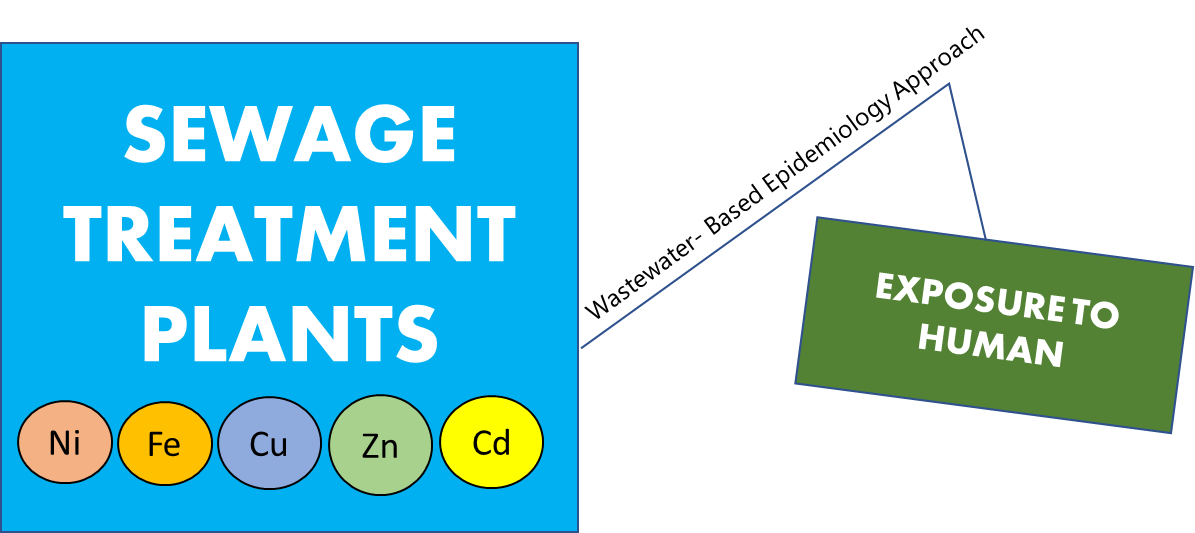
Downloads
References
CF Carolin, PS Kumar, A Saravanan, GJ Joshiba and Mu Naushad. Efficient techniques for the removal of toxic heavy metals from aquatic environment: A review. J. Environ. Chem. Eng. 2017; 5, 2782-99.
KH Vardhan, PS Kumar and RC Panda. A review on heavy metal pollution, toxicity and remedial measures: Current trends and future perspectives. J. Mol. Liq. 2019; 290, 111197.
R. Sankaran, PL Show, CW Ooi, TC Ling, C Shu-Jen, SY Chen and YK Chang. Feasibility assessment of removal of heavy metals and soluble microbial products from aqueous solutions using eggshell wastes. Clean Tech. Environ. Pol. 2020; 22, 773-86.
F Fu and Q Wang. Removal of heavy metal ions from wastewaters: A review. J. Environ. Manage. 2011; 92, 407-18.
MMSC Pinto, MMV Silva, EAFD Silva and AP Marinho-Reis. The cancer and non-cancer risk of Santiago island (Cape Verde) population due to potential toxic elements exposure from soils. Geosciences 2017; 7, 78.
A Kumar, M Cabral-Pinto, A Kumar, M Kumar and PA Dinis. Estimation of risk to the eco-environment and human health of using heavy metals in the Uttarakhand Himalaya, India. Appl. Sci. 2020; 10, 7078.
M Jaishankar, T Tseten, N Anbalagan, BB Mathew and KN Beeregowda. Toxicity, mechanism and health effects of some heavy metals. Interdiscip. Toxicol. 2014; 7, 60-72.
W Yuan, N Yang and X Li. Advances in understanding how heavy metal pollution triggers gastric cancer. BioMed Res. Int. 2016; 2016, 7825432.
MMSC Pinto and EAFD Silva. Heavy metals of Santiago island (Cape Verde) alluvial deposits: Baseline value maps and human health risk assessment. Int. J. Environ. Res. Publ. Health 2019; 16, 2.
MMSC Pinto, P Marinho-Reis, A Almeida, E Pinto, O Neves, M Inácio, B Gerardo, S Freitas, MR Simões, PA Dinis, L Diniz, EFD Silva and PI Moreira. Links between cognitive status and trace element levels in hair for an environmentally exposed population: A case study in the surroundings of the Estarreja industrial area. Int. J. Environ. Res. Publ. Health 2019; 16, 4560.
TTN Le, VT Le, MU Dao, QV Nguyen, TT Vu, MH Nguyen, DL Tran and HS Le. Preparation of magnetic graphene oxide/chitosan composite beads for effective removal of heavy metals and dyes from aqueous solutions. Chem. Eng. Commun. 2019; 206, 1337-52.
P Zhang, C Qin, X Hong, G Kang, M Qin, D Yang, B Pang, Y Lia, J He, RP Dick. Risk assessment and source analysis of soil heavy metal pollution from lower reaches of Yellow River irrigation in China. Sci. Total Environ. 2018; 633, 1136-47.
R Khan, A Saxena and S Shukla. Evaluation of heavy metal pollution for River Gomti, in parts of Ganga Alluvial Plain, India. SN Appl. Sci. 2020; 2, 1451.
MAEK Zahran, YA El-Amier, AA Elnaggar, HAEA Mohamed and MAEH El-Alfy. Assessment and distribution of heavy metals pollutants in Manzala Lake, Egypt. J. Geosci. Environ. Prot. 2015; 3, 107-22.
Y Xu, Y Wu, J Han and P Li. The current status of heavy metal in lake sediments from China: Pollution and ecological risk assessment. Ecol. Evol. 2017; 7, 5454-66.
A Kurnaz, E Mutlu and AA Uncumusaoğlu. Determination of water quality parameters and heavy metal content in surface water of Çiğdem Pond (Kastamonu/Turkey). Turk. J. Agr. Food Sci. Tech. 2016; 4, 907-13.
Y Liang, X Yi, Z Dang, Q Wang, H Luo and J Tang. Heavy metal contamination and health risk assessment in the vicinity of a Tailing Pond in Guangdong, China. Int. J. Environ. Res. Publ. Health 2017; 14, 1557.
S Li, J Wu, Y Huo, X Zhao and L Xue. Profiling multiple heavy metal contamination and bacterial communities surrounding an iron tailing pond in Northwest China. Sci. Total Environ. 2021; 752, 141827.
J. Feng, X Chen, L Jia, Q Liu, X Chen, D Han and J Cheng. Effluent concentration and removal efficiency of nine heavy metals in secondary treatment plants in Shanghai, China. Environ. Sci. Pollut. Res. 2018; 25, 17058-65.
S Chaoua, S Boussaa, AE Gharmali and A Boumezzough. Impact of irrigation with wastewater on accumulation of heavy metals in soil and crops in the region of Marrakech in Morocco. J. Saudi Soc. Agr. Sci. 2019; 18, 429-36.
A Juliani. Heavy metal characteristics of wastewater from Batik industry in Yogyakarta area, Indonesia. Int. J. GEOMATE 2021; 20, 59-67.
AH Ahmed and R Hanafy. Effects of industrial effluents polluting the ismailia water canal on growth and metabolic responses of Pisum sativum seedlings. Egypt. J. Bot. 2017; 57, 583-94.
II Omran, N Al-Saati, K Hashim, Z Al-Saati, P Kot, RMA Khaddar, D Al-Jumeily, A Shaw, F Ruddock and M Aljefery. Assessment of heavy metal pollution in the Great Al-Mussaib irrigation channel. Desalinat. Water Treat. 2019; 168, 165-74.
C Markosian and N Mirzoyan. Wastewater-based epidemiology as a novel assessment approach for population-level metal exposure. Sci. Total Environ. 2019; 689, 1125-32.
Baird, Rodger and Laura. Standard methods for the examination of water and wastewater. American Public Health Association, Washington DC, 2017.
P. Du, X Liu, G Zhong, Z Zhou, MW Thomes, CW Lee, CW Bong, X Zhang, F Hao, X Li, G Zhang and PK Thai. Monitoring consumption of common illicit drugs in Kuala Lumpur, Malaysia, by wastewater-cased epidemiology. Int. J. Environ. Res. Publ. Health 2020; 17, 889.
Agency for Toxic Substances and Disease Registry. Cadmium toxicity: What are the U.S. standards for cadmium exposure? Available at: https://www.atsdr.cdc.gov/csem/cadmium/Safety-Standards.html, accessed May 2022.
M Rafati-Rahimzadeh, M Rafati-Rahimzadeh, S Kazemi and A Moghadamnia. Cadmium toxicity and treatment: An update. Caspian J. Intern. Med. 2017; 8, 135-45.
World Health Organization. Air quality guidelines for Europe. World Health Organization, WHO Regional Office for Europe, Copenhagen, Denmark, 2000.
N Roohani, R Hurrell, R Kelishadi and R Schulin. Zinc and its importance for human health: An integrative review. J. Res. Med. Sci. 2013; 18, 144-57.
Hunt JR, Zito CA, Johnson LK. Body iron excretion by healthy men and women. The American journal of clinical nutrition. 2009; 89, 1792-8.
Department of Environmental. Jabatan Alam Sekitar - Kementerian Alam Sekitar dan Air, Available at: https://www.doe.gov.my, accessed June 2022.
A Kaizer and S Osakwe. Physicochemical characteristics and heavy metal levels in water samples from five river systems in Delta State, Nigeria. J. Appl. Sci. Environ. Manag. 2010; 14, 83 - 87
AM Taiwo, AO Adeogun, KA Olatunde and KI Adegbite. Analysis of groundwater quality of hand-dug wells in Peri-urban area of Obantoko, Abeokuta, Nigeria for selected physico-chemical parameters. Pac. J. Sci. Tech. 2011; 12, 527-34.
K Sardar, S Ali, S Hameed, S Afzal, S Fatima, MB Shakoor, SA Bharwana, HM Tauqeer. Heavy metals contamination and what are the impacts on living organisms. Greener J. Environ. Manag. Publ. Saf. 2013; 2, 172-9.
A Godwin, E Oghenekohwiroro, A Funso and O Olaniyi. Using EF, PLI and Igeo for the assessment of heavy metal pollution and sediment quality of Asejire reservoir, Southwest Nigeria. Int. J. Environ. Pollut. Res. 2015; 3, 77-90.
AK Baranwal and SC Singhi. Acute iron poisoning: management guidelines. Indian Pediatr. 2003; 40, 534-40.
HW Yuen and W Becker. Iron toxicity. In: HW Yuen and W Becker (Eds.). StatPearls. StatPearls Publishing, Florida, 2022.
G Murtaza, W Javed, A Hussain, A Wahid, B Murtaza and G Owens. Metal uptake via phosphate fertilizer and city sewage in cereal and legume crops in Pakistan. Environ. Sci. Pollut. Res. 2015; 22, 9136-47.
PCT Perera, TV Sundarabarathy, T Sivananthawerl, SP Kodithuwakku and U Edirisinghe. Arsenic and cadmium contamination in water, sediments and fish is a consequence of paddy cultivation: Evidence of river pollution in Sri Lanka. Achiev. Life Sci. 2016; 10, 144-60.
SZ Zulkifli, A Ismail, F Mohamat-Yusuff, T Arai and N Miyazaki. Johor strait as a hotspot for trace elements contamination in Peninsular Malaysia. Bull. Environ. Contam. Toxicol. 2010; 84, 568-73.
OO Olujimi, OS Fatoki, JP Odendaal and OU Oputu. Variability in heavy metal levels in river water receiving effluents in Cape Town, South Africa. In: TS Lee (Eds.). Research and practices in water quality in research and practices in water quality. IntechOpen, London, 2015.
T Sarwar, M Shahid, Natasha, S Khalid, AH Shah, N Ahmad, MA Naeem, Z Haq, B Murtaza and HF Bakhat. Quantification and risk assessment of heavy metal build-up in soil-plant system after irrigation with untreated city wastewater in Vehari, Pakistan. Environ. Geochem. Health 2020; 42, 4281-97.
MA Agoro, AO Adeniji, MA Adefisoye and OO Okoh. Heavy metals in wastewater and sewage sludge from selected municipal treatment plants in Eastern Cape Province, South Africa. Water 2020; 12, 2746.
LC Hsu, CY Huang, YH Chuang, HW Chen, YT Chan, HY Teah, TY Chen, CF Chang, YT Liu and YM Tzou. Accumulation of heavy metals and trace elements in fluvial sediments received effluents from traditional and semiconductor industries. Sci. Rep. 2016; 6, 34250.
M Sriuttha, A Khammanichanh, I Patawang, A Tanomtong, B Tengjaroenkul and L Neeratanaphan. Cytotoxic assessment of Nile Tilapia (Oreochromis niloticus) from a domestic wastewater canal with heavy metal contamination. Cytologia 2017; 82, 41-50.
AT Huynh, YC Chen and BNT Tran. a small-scale study on removal of heavy metals from contaminated water using water hyacinth. Processes 2021; 9, 1802.
FM Francisca and DA Glatstein. Influence of pH on cadmium, copper, and lead removal from wastewater by steel slag. Desalina. Water Treat. 2016; 57, 21610-8.
L Li, J He, Z Gan and P Yang. Occurrence and fate of antibiotics and heavy metals in sewage treatment plants and risk assessment of reclaimed water in Chengdu, China. Chemosphere 2021; 272, 129730.
M Anjum, R Miandad, M Waqas, F Gehany and MA Barakat. Remediation of wastewater using various nano-materials. Arab. J. Chem. 2019; 12, 4897-919.
S Kaur and A Roy. Bioremediation of heavy metals from wastewater using nanomaterials. Environ. Dev. Sustain. 2021; 23, 9617-40.
United States Environmental Protection Agency. Standard methods for the examination of water and wastewater. American Public Health Association, Washington DC, 1993.
S Satarug, MR Haswell-Elkins and MR Moore. Safe levels of cadmium intake to prevent renal toxicity in human subjects. Br. J. Nutr. 2000; 84, 791-802.
Downloads
Published
How to Cite
Issue
Section
License
Copyright (c) 2023 Walailak University

This work is licensed under a Creative Commons Attribution-NonCommercial-NoDerivatives 4.0 International License.





