
Population Ecology and Habitat use of the Sea Slug Elysia pusilla (Bergh, 1872) (Sacoglossa) in A Tropical Halimeda macroloba Decaisne Meadow
DOI:
https://doi.org/10.48048/tis.2023.6402Keywords:
Plant-animal interactions, Sacoglossa, Algal host, Symbiosis, Elysia, HalimedaAbstract
Relationship between abundance of specialist marine herbivores and their food sources is poorly known because these herbivores are relatively rare in marine systems. The relationship between the cryptic sea slug Elysia pusilla (Bergh, 1872) and its host alga, Halimeda macroloba Decaisne, was evaluated in terms of spatial association and habitat utilization in a tropical algal meadow in southern Thailand that exclusively comprised of H. macroloba. The density of H. macroloba and of E. pusilla egg masses varied temporally throughout the sampling period, but temporal variation was not detected in the density of E. pusilla individuals, which was generally low with a maximum of 4 individuals per 400 cm2. Analysis suggests that the occurrence of the slug and its egg masses might be determined by the availability of the algal host. The slug was more likely to be observed in dense patches of algae that which offered a large total algal surface area. Occurrence of the slug was also higher when the algae were abundant. The numbers of slugs, egg masses and grazing marks were higher on mature thalli, which have larger surface areas than younger thalli. Egg masses and grazing marks were observed more often on segments at terminal positions on thalli. According to previous works, these segments contain low levels of accumulated calcium carbonate and high levels of secondary metabolites, which are sequestered by the slug and used to deter predators. The findings provide an insight into the life history of E. pusilla and variations in a natural population which that were previously little known.
HIGHLIGHTS
- The relationship between the cryptic sea slug Elysia pusilla (Bergh, 1872) and its host alga, Halimeda macroloba Decaisne, was evaluated in terms of spatial association and habitat utilization in a tropical algal meadow in southern Thailand
- The slug pusilla was more likely to be observed in dense patches of its algal host H. macroloba
- Occurrence of the slug was also higher when the algae were abundant
- The numbers of slugs, egg masses and grazing marks were higher on mature thalli
- Egg masses and grazing marks were observed more often on segments at terminal positions on thalli
GRAPHICAL ABSTRACT 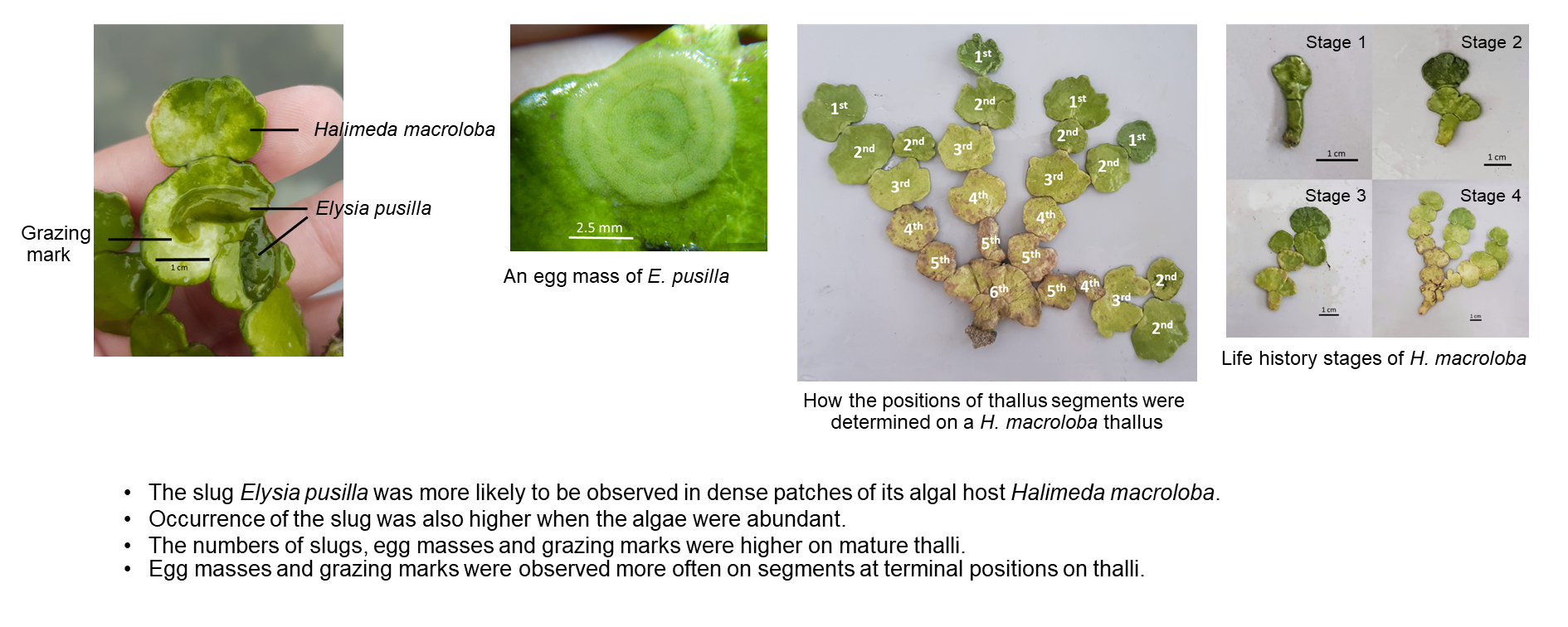
Downloads
References
JE Duffy and ME Hay. Herbivore resistance to seaweed chemical defense: the roles of mobility and predation risk. Ecology 1994; 75, 1304-19.
KR Jensen. Evolution of the sacoglossa (Mollusca, Opisthobranchia) and the ecological associations with their food plants. Evol. Ecol. 1997; 11, 301-35.
ML Middlebrooks, WA Gowacki, SS Bell and SK Pierce. Annual occurrence and algal preferences of the kleptoplastic sea slug, Elysia papillosa. Symbiosis 2019; 77, 217-24.
S Weaver and KB Clark. Light intensity and color preferences of five ascoglossan (= sacoglossan) molluscs (Gastropoda: Opisthobranchia): A comparison of chloroplast‐symbiotic and aposymbiotic species. Mar. Freshwat. Behav. Physiol. 1981; 7, 297-306.
BK Brandley. Aspects of the ecology and physiology of Elysia cf. furvacauda (Mollusca: Sacoglossa). Bull. Mar. Sci. 1984; 34, 207-19.
NE Curtis, SE Massey and SK Pierce. The symbiotic chloroplasts in the sacoglossan Elysiaclarki are from several algal species. Invertebr. Biol. 2006; 125, 336-45.
MA Phuong. Solar powered slugs: Biology of sacoglossans on Mo’orea, French Polynesia. University of California Berkeley, California, 2010.
KR Jensen. Morphological adaptations and plasticity of radular teeth of the Sacoglossa (= Ascoglossa) (Mollusca: Opisthobranchia) in relation to their food plants. Biol. J. Linn. Soc. 1993; 48, 135-55.
K Händeler and H Wägele. Preliminary study on molecular phylogeny of Sacoglossa and a compilation of their food organisms. Bonner Zool. Beiträge 2007; 55, 231-54.
JE Vendetti, CD Trowbridge and PJ Krug. Poecilogony and population genetic structure in Elysiapusilla (Heterobranchia: Sacoglossa), and reproductive data for five sacoglossans that express dimorphisms in larval development. Integr. Comp. Biol. 2012; 52, 138-50.
S Pongparadon. Diversity, distribution and variations within species of genus Halimeda JV Lamour. (Chlorophyta) in Peninsular Thailand. Master Thesis. Prince of Songkla University, Songkhla, Thailand.
J Mayakun and A Prathep. Calcium carbonate productivity by Halimeda macroloba in the tropical intertidal ecosystem: the significant contributor to global carbonate budgets. Phycological Res. 2019; 67, 94-101.
S Sinutok. Seasonal variation in distribution, density, and life stage of HalimedamacrolobaDecaisne at Tangkhen Bay, Phuket Province, Thailand. Master Thesis. Prince of Songkla University, Songkhla, Thailand.
AW Larkum, A Salih and M Kühl. Rapid mass movement of chloroplasts during segment formation of the calcifying siphonalean green alga, Halimeda macroloba. PLoS One 2011; 6, e20841.
VJ Paul and KLV Alstyne. Chemical defense and chemical variation in some tropical Pacific species of Halimeda (Halimedaceae; Chlorophyta). Coral Reefs 1988; 6, 263-9.
KR Jensen. Anatomy of some Indo-Pacific Elysiidae (Opisthobranchia: Sacoglossa (= Ascoglossa)), with a discussion of the generic division and phylogeny. J. Molluscan Stud. 1992; 58, 257-96.
VJ Paul and KL Van Alstyne. Use of ingested algal diterpenoids by Elysiahalimedae Macnae (Opisthobranchia: Ascoglossa) as antipredator defenses. J. Exp. Mar. Biol. Ecol. 1988; 119, 15-29.
J Schubert and SDA Smith. Sea slugs - “rare in space and time” - but not always. Diversity 2020; 12, 423.
ML Middlebrooks, SS Bell, NE Curtis and SK Pierce. Atypical plant-herbivore association of algal food and a kleptoplastic sea slug (Elysiaclarki) revealed by DNA barcoding and field surveys. Mar. Biol. 2014; 161, 1429-40.
J Panyawai, P Tuntiprapas and A Prathep. High macrophyte canopy complexity enhances sediment retention and carbon storage in coastal vegetative meadows at Tangkhen Bay, Phuket, Southern Thailand. Ecol. Res. 2019; 34, 201-12.
Downloads
Published
How to Cite
Issue
Section
License

This work is licensed under a Creative Commons Attribution-NonCommercial-NoDerivatives 4.0 International License.





