
Efficiency of Nitrification Inhibitor on Designing Nitrogen Fertilizer by Neem Compounds Based on Molecular Docking
DOI:
https://doi.org/10.48048/tis.2023.6395Keywords:
Nitrogen fertilizer, Neem, Nitrification inhibitor, Molecular docking, Binding energyAbstract
In the agricultural trade, nitrogen fertilizer is one among the popular fertilizers within the world market. However, the high use of nitrogen fertilizers causes negative impacts within the type of environmental pollution, each in water, soil, and within the air. Nitrification inhibitor required to enhance the potency of nitrogen fertilizer use to realize additional economical production of food crops and minimize fertilizer related pollution of the environment. Neem (Azadirachta indica) act as an inhibitor nitrification that contained high tannin and the other secondary metabolite compounds. Neem plants encapsulated by urea as a nitrification inhibitor can increase nitrogen efficiency in the soil during fertilization. This research is a computational experiment research in solving problems using Molecular Docking Analysis. Molecular Docking method was performed using AutoDock Vina Tools 1.5.6 and Open Babel 2.4.1 Program. The use of molecular docking aims to predict ligand bonds and target proteins that focus on affinity and bond interactions. The high and low affinity of ligand-protein bonds is influenced by free bond energies, surface interactions, and intermolecular interactions. The results represent Neem (A. Indica) contains high tannin and the other secondary metabolite compounds (Nimbin, Nimbidin, Nimbic Acid, Nimbidinin, Nimbinin, Azadirachtin, Diepoxy Azadiradione, Dyhidrogedunin, Gallic Acid and Gedunin). Those metabolite compounds can inhibiting 4 enzymes such as methane monooxygenase, Hydroxylamine oxidoreductase, Nitric oxide reductase and Nitrite Reductase. From 10 metabolite compounds, Diepoxy Azadiradione and Gedunin may become the most stable complex that indicated become strength binding energy based on the lowest energy score of −10.3 kcal/mol.
HIGHLIGHTS
- One of the agricultural problem is the inefficiency of Nitrogen fertilization will be released in the form of N2O and Nitrate gases which pollute the environment as a result of the nitrification process
- Azadirachta indica is known to have secondary metabolite which have the ability to inhibit nitrification
- The molecular docking method was used as an initial analysis of the effectiveness of secondary metabolites from Azadirachta indica inhibiting enzymes that play a role in the nitrification process
GRAPHICAL ABSTRACT 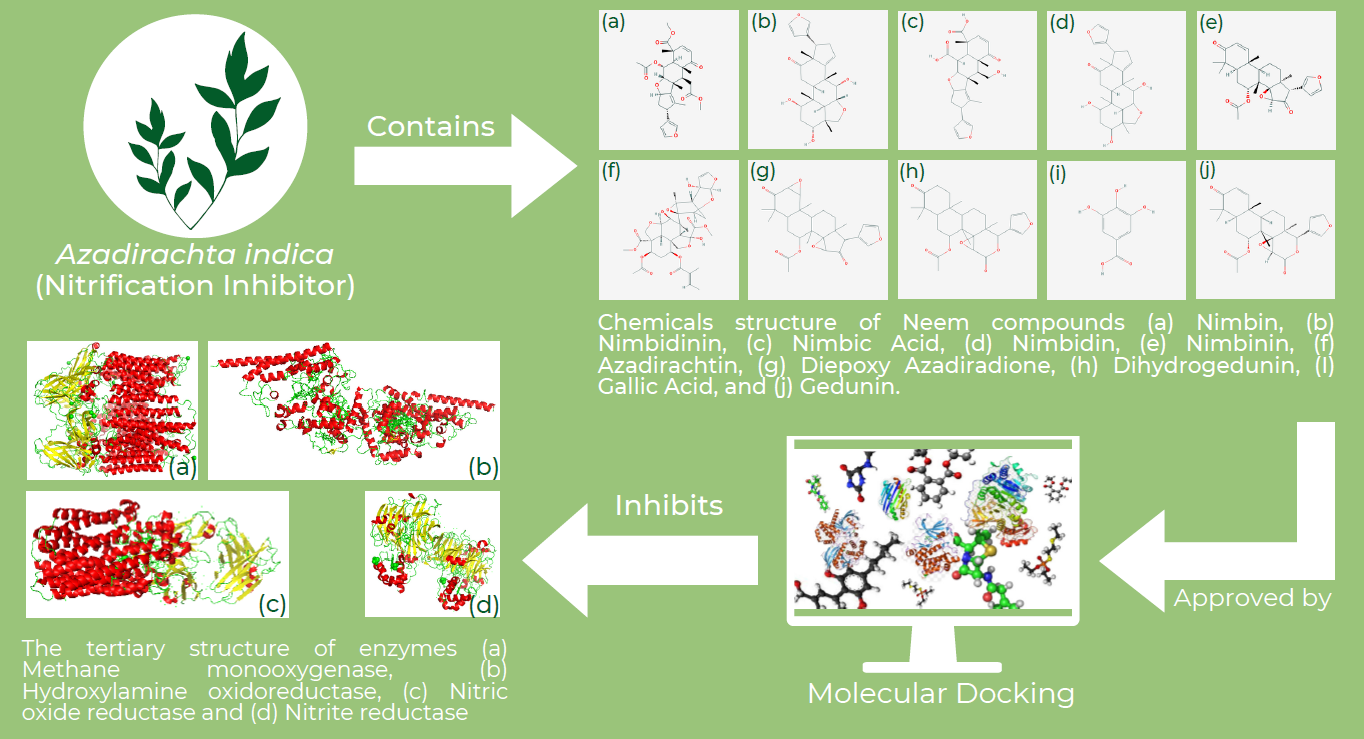
Downloads
References
R Sayuti and M Taqiuddin. Performance analysis of the agricultural sector in poverty alleviation efforts in west nusa tenggara in the 2008-2018 period. Agroteksos Agronomi Teknologi Dan Sosial Ekonomi Pertanian 2020; 30, 11-17.
N Ardiani. The supply chain for maize in Indonesia’s production centers. J. Food 2009; 18, 73-85.
NA Jariyah. Analysis of socio-economic aspects to support the management of das moyo, sumbawa regency, west nusa tenggara. J. Forest. Res. 2020; 4, 95-114.
J Pramono, D Prajitno and T Tohari. Utilization of natural materials as a nitrification inhibitor to increase the efficiency of lowland rice nitrogen fertilization. Agrin 2011; 15, 92-102.
O Jumadi. The application of nitrification inhibitors to reduce emission gas of Nitrous Oxide and enhance of crop growth. Makassar State University, Makassar, Indonesia, 2018.
W Hartatik and H Wibowo. The effectiveness of several types of N fertilizer on palm oil nursery. J. Ind. Crop. Res. 2018; 24, 29-38.
NK Fageria. The use of nutrients in crop plants. CRC Press, New York, 2009, p. 40-74.
LS Komariyah. 2010, Test the antioxidant activity of the methanol extract of leaves and seeds of prickly acacia (Acacia Nilotica (L.) Willd. Ex Delile). Master Thesis. University of Jember, Jember, Indonesia.
AB Purnamasari, Y Hala and O Jumadi. The effect of Neem (Azadirachta indica) coated urea fertilizer against NH4+ and NO3− concentration in clay loam soil texture. In: Proceedings of the International Conference on Mathematic, Science, Technology, Education and their Applications, Makassar Indonesia. 2016, p. 416-22.
O Trott and AJ Olson. AutoDock Vina: Improving the speed and accuracy of docking with a new scoring function, efficient optimization, and multithreading. J. Comput. Chem. 2010; 31, 455-61.
GM Morris, H Ruth, W Lindstrom, MF Sanner, RK Belew, DS Goodsell and AJ Olson. Software news and updates AutoDock4 and AutoDockTools4: Automated docking with selective receptor flexibility. J. Comput. Chem. 2009; 30, 2785-91.
AI Sawitri, P Purwanto and S Minardi. Study of the effectiveness of nitrification inhibition in the Rhizosphere of various Brachiaria plant species in alfisols. J. Soil Sci. Agroclimatology 2013; 10, 153-64.
O Jumadi, Y Hala, ABD Muis, A Ali, M Palennari, K Yagi and K Inubushi. Infuences of chemical fertilizers and a nitrification inhibitor on greenhouse gas fluxes in a corn (Zea mays L.) field in Indonesia. Microb. Environ. 2008; 23, 29-34.
NM Hassan, AA Alhossary, Y Mu and CK Kwoh. Protein-ligand blind docking using QuickVina-W with inter-process spatio-temporal integration. Sci. Rep. 2017; 7, 1-13.
RY Purnomo. Antimalarial potential of azadiractin, gedunin, and nimbolideto bind PfATP6 and inhibit lactate dehydrogenase: In silico study. J. Bio Komplementer Med. 2019; 6, 199-204.
B Davarcioglu. The general characteristic of weak intermolecular interactions in liquids and crystals. Int. J. Res. Mod. Eng. Emerg. Tech. 2011; 1, 443-54.
DS Damayanti, DH Utomo and C Kusuma. Revealing the potency of annona muricata leaves extract as FOXO1 inhibitor for diabetes mellitus treatment through computational study. In Silico Pharmacol. 2017; 5, 3.
RD Malmstrom and SJ Watowich. Using free energy of binding calculations to improve the accuracy of virtual screening predictions. J. Chem. Inform. Model. 2011; 51, 1648-55.

Downloads
Published
How to Cite
Issue
Section
License

This work is licensed under a Creative Commons Attribution-NonCommercial-NoDerivatives 4.0 International License.





