
Improving Ionic Conductivity of Carboxymethyl Cellulose Solid Biopolymer Electrolyte with Assist from Dimethyl Carbonate
DOI:
https://doi.org/10.48048/tis.2022.6174Keywords:
Solid biopolymer electrolytes, Carboxymethyl cellulose, Ammonium acetate, Plasticizer, Transference number, Dimethyl carbonateAbstract
Ionic conductivity is one of the important properties for an electrolyte to be considered before it can used as practical application in energy storage. Therefore, this study aims to improve the ionic conductivity of solid biopolymer electrolyte (SBE) based on carboxymethyl cellulose (CMC) doped with ammonium acetate (AA) by incorporating plasticizer, namely, dimethyl carbonate (DMC). The SBEs were prepared using solution casting technique. Fourier Transform Infrared (FTIR) was used to ascertain the complexation among CMC, AA and DMC. From FTIR analysis, DMC is believed to have created new pathways for ionic conduction. The electrical properties of SBEs were investigated using Electrical Impedance Spectroscopy (EIS). The highest conducting value achieved for the plasticized system was 4.27×10⁻⁵ S cm-1 for sample containing 10 wt% DMC. Dielectric analysis revealed that frequency and plasticizer content affect the dielectric constant value. By employing Transference Number Measurement (TNM), the charge transport in the SBE system proved to be predominantly ions where DMC 10 has the highest tion (0.95). Overall, addition of 10 wt% of DMC has the best electrical properties.
HIGHLIGHTS
- Solid electrolyte is the answer to problems faced by liquid electrolyte, and it can be made by using biopolymer-based materials to form Solid biopolymer electrolyte (SBE)
- The SBE in this report was prepared successfully using the simplest and cheapest technique (solution casting technique). The SBE prepared possesses good mechanical properties (free standing, flexible and robust)
- High ionic conductivity and high ionic transference value (tion) is beneficial in electrochemical application and was investigated in this report and found to corelated with each other
GRAPHICAL ABSTRACT 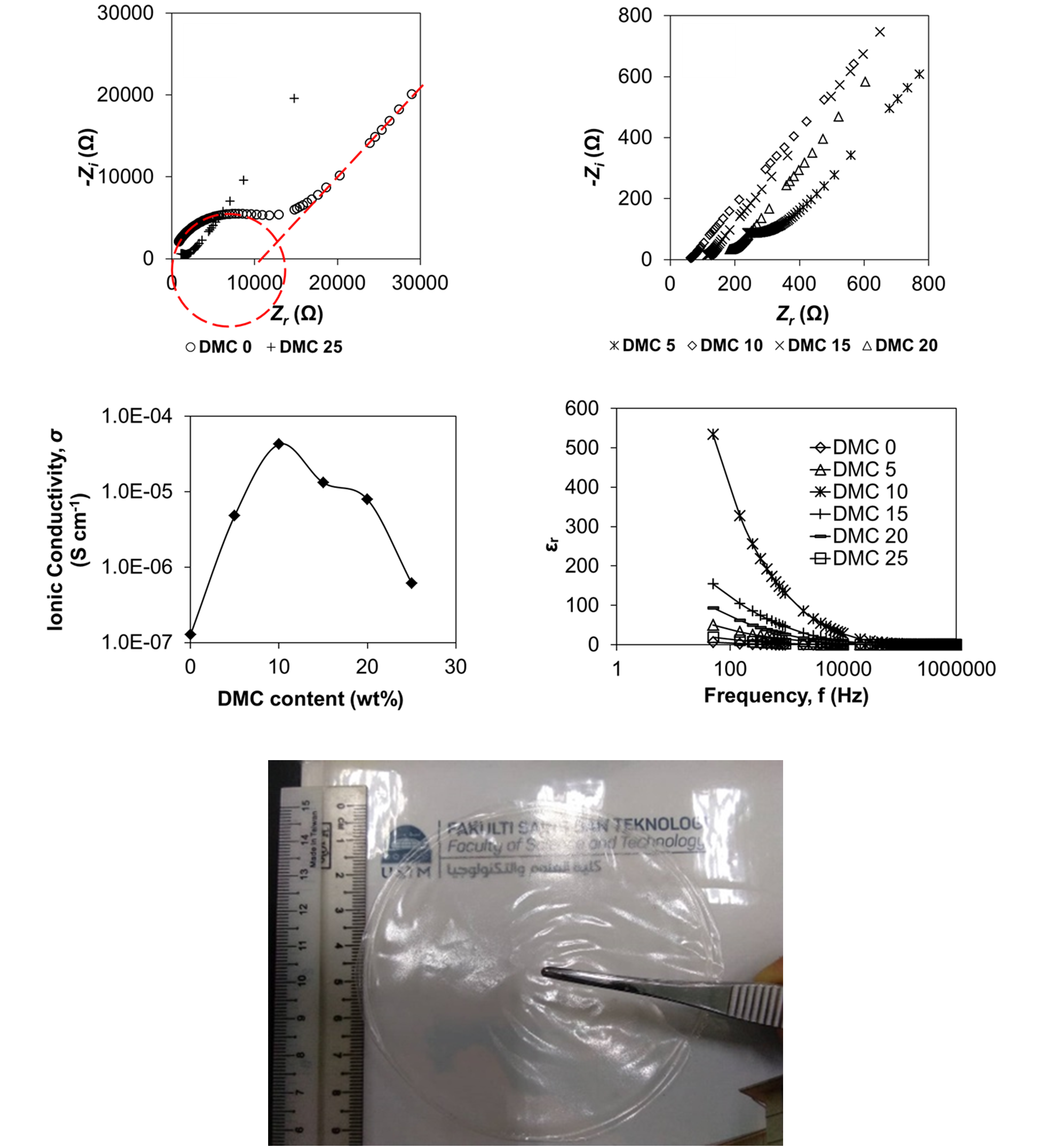
Downloads
References
MN Chai and MIN Isa. Novel proton conducting solid bio-polymer electrolytes based on carboxymethyl cellulose doped with oleic acid and plasticized with glycerol. Sci. Rep. 2016; 6, 27328.
How a battery works, Available at: https://www.science.org.au/curious/technology-future/batteries, accessed March 2021.
SB Aziz, TJ Woo, MFZ Kadir and HM Ahmed. A conceptual review on polymer electrolytes and ion transport models. J. Sci.: Adv. Mater. Devices 2018; 3, 1-17.
P Yao, H Yu, Z Ding, Y Liu, J Lu, M Lavorgna, J Wu and X Liu. Review on polymer-based composite electrolytes for lithium batteries. Front. Chem. 2019; 7, 522.
MN Hafiza and MIN Isa. Studies of ionic conductivity and A.C. conduction mechanism of 2-hydroxyethyl cellulose based solid polymer electrolytes. J. Sustain. Sci. Manag. 2017; 2017, 65-70.
MIH Sohaimy and MIN Isa. Ionic conductivity and conduction mechanism studies on cellulose based solid polymer electrolytes doped with ammonium carbonate. Polym. Bull. 2017; 74, 1371-86.
SDP Cabello, S Molla, NA Ochoa, J Marchese, E Gimenez and V Compan. New bio-polymeric membranes composed of alginate-carrageenan to be applied as polymer electrolyte membranes for DMFC. J. Power Sources 2014; 265, 345-55.
M Kumar, T Tiwari and N Srivastava. Electrical transport behaviour of bio-polymer electrolyte system: Potato starch + ammonium iodide. Carbohydr. Polym. 2012; 88, 54-60.
SB Aziz, MA Brza, K Mishra, MH Hamsan, WO Karim, RM Abdullah, MFZ Kadir and TT Abdulwahid. Fabrication of high performance energy storage EDLC device from proton conducting methylcell¬ulose: Dextran polymer blend electrolytes. J. Mater. Res. Technol. 2020; 9, 1137-50.
OG Abdullah, RR Hanna, HT Ahmed, AH Mohamad, SA Saleem and MAM Saeed. Conductivity and dielectric properties of lithium-ion biopolymer blend electrolyte based film. Results Phys. 2021; 24, 104135.
J Yu, L Wang, Y Zhao and C Zhou. Preparation, characterization, and antibacterial property of carboxymethyl cellulose derivatives bearing tetrabutylammonium salt. Int. J. Biol. Macromol. 2021; 176, 72-7.
MIN Isa, MIH Sohaimy and NH Ahmad. Carboxymethyl cellulose plasticized polymer application as bio-material in solid-state hydrogen ionic cell. Int. J. Hydrog. Energy 2021; 46, 8030-9.
YAK Salman, OG Abdullah, RR Hanna and SB Aziz. Conductivity and electrical properties of chitosan - methylcellulose blend biopolymer electrolyte incorporated with lithium tetrafluoroborate. Int. J. Electrochem. Sci. 2018; 13, 3185-99.
NK Zainuddin, NMJ Rasali, NF Mazuki, MA Saadiah and AS Samsudin. Investigation on favourable ionic conduction based on CMC-K carrageenan proton conducting hybrid solid bio-polymer electrolytes for applications in EDLC. Int. J. Hydrog. Energy 2020; 45, 8727-41.
MSA Rani, S Rudhziah, A Ahmad and NS Mohamed. Biopolymer electrolyte based on derivatives of cellulose from kenaf bast fiber. Polymers 2014; 6, 2371-85.
HT Ahmed, VJ Jalal, DA Tahir, AH Mohamad and OG Abdullah. Effect of PEG as a plasticizer on the electrical and optical properties of polymer blend electrolyte MC-CH-LiBF4 based films. Results Phys. 2019; 15, 102735.
M Sangeetha, A Mallikarjun, Y Aparna, MV Reddy, JS Kumar, T Sreekanth and MJ Reddy. Dielectric studies and AC conductivity of PVDF-HFP: LiBF4: EC plasticized polymer electrolytes. Mater. Today: Proc. 2021; 44, 2168-72.
MIHA Sohaimy, MJA Fauzi and MINM Isa. Electrical behavior of ethylene carbonate-plasticized cellulose biopolymer electrolyte films. Malaysian J. Chem. 2020; 22, 22-8.
AOG Abdalla and D Liu. Dimethyl carbonate as a promising oxygenated fuel for combustion: A review. Energies 2018; 11, 1552.
AS Samsudin, WM Khairul and MIN Isa. Characterization on the potential of carboxy methylcellulose for application as proton conducting biopolymer electrolytes. J. Non-Cryst. Solids 2012; 358, 1104-12.
A Arya and AL Sharma. Structural, electrical pro678905-perties and dielectric relaxations in Na+-ion-conducting solid polymer electrolyte. J. Phys. Condens. Matter 2018; 30, 165402.
S Han. Structure and dynamics in the lithium solvation shell of nonaqueous electrolytes. Sci. Rep. 2019; 9, 5555.
SB Aziz, ASFM Asnawi, RT Abdulwahid, HO Ghareeb, SM Alshehri, T Ahamad, JM Hadi and MFZ Kadir. Design of potassium ion conducting PVA based polymer electrolyte with improved ion transport properties for EDLC device application. J. Mater. Res. Technol. 2021; 13, 933-46.
HN Kwon, SJ Jang, YC Kang and KC Roh. The effect of ILs as co-salts in electrolytes for high voltage supercapacitors. Sci. Rep. 2019; 9, 1180.
P Galek, A Slesinski, K Fic and J Menzel. Peculiar role of the electrolyte viscosity in the electrochemical capacitor performance. J. Mater. Chem. A 2021; 9, 8644-54.
UY Bello, PS Dhapola, H Ahuja and PK Singh. High conducting PVDF-HFP + PTA polymer electrolyte for supercapacitor application. Mater. Today: Proc. 2021; 49, 3449-52.
HT Ahmed and OG Abdullah. Impedance and ionic transport properties of proton-conducting electrolytes based on polyethylene oxide/methylcellulose blend polymers. J. Sci.: Adv. Mater. Devices 2020; 5, 125-33.
MN Hafiza and MIN Isa. Analyses of ionic conductivity and dielectric behavior of solid polymer electrolyte based 2-hydroxyethyl cellulose doped ammonium nitrate plasticized with ethylene carbonate. AIP Conf. Proc. 2017; 1885, 020080.
S Majumdar, R Ray and P Sen. Anomalous intra diffusive behavior of chitosan/PVDF solid polymer electrolytes and the enhancement of effective specific capacitance with nanostructured spinel MnCoFeO4 electrode in solid-state supercapacitors. Electrochim. Acta 2021; 385, 138295.
NH Ahmad and MIN Isa. Structural and ionic conductivity studies of CMC based polymer electrolyte doped with NH4Cl. Adv. Mater. Res. 2015; 1107, 247-52.
X Wu, K Chen, Z Yao, J Hu, M Huang, J Meng, S Ma, T Wu, Y Cui and C Li. Metal organic framework reinforced polymer electrolyte with high cation transference number to enable dendrite-free solid state Li metal conversion batteries. J. Power Sources 2021; 501, 229946.
D Zhou, D Shanmukaraj, A Tkacheva, M Armand and G Wang. Polymer electrolytes for lithium-based batteries: Advances and prospects. Chem 2019; 5, 2326-52.
MN Hafiza and MIN Isa. Transport studies of carboxymethyl cellulose/chitosan-ammonium bromide biopolymer blend electrolytes as an ionic conductor. J. Sustain. Sci. Manag. 2017; 2017, 58-64.
M Muthuvinayagam and C Gopinathan. Characterization of proton conducting polymer blend electrolytes based on PVdF-PVA. Polymer 2015; 68, 122-30.
M Hema, S Selvasekerapandian, A Sakunthala, D Arunkumar and H Nithya. Structural, vibrational and electrical characterization of PVA–NH4Br polymer electrolyte system. Physica B: Condens. Matter 2008; 403, 2740-7.

Downloads
Published
How to Cite
Issue
Section
License

This work is licensed under a Creative Commons Attribution-NonCommercial-NoDerivatives 4.0 International License.





