
Optical and Photovoltaic Properties of New Synthesized Quinoxaline-2,3 Dione Derivatives for Efficient Dye Sensitized Solar Cell Application
DOI:
https://doi.org/10.48048/tis.2022.6173Keywords:
Optical, Photovoltaic, Quinoxalinedione, PCM, TD-DFTAbstract
In this study, the synthesis of 4 new heterocyclic compounds derived from quinoxalinedione were presented, which have been characterized by 1H and 13C NMR spectroscopy. The solar cells’ photovoltaic properties based on these novels organic compounds donor-π-acceptor dyes were studied. Density functional theory DFT method is realized to optimize electronic parameters, optical and photovoltaic properties for some new 8-hydroxyquinoline derivatives based on quinoxaline-2,3-dione. The results have shown that time-dependent DFT (TDDFT) investigations with polarizable continuum model PCM were significantly able to foretell the excitation energy and the spectroscopy of the molecule. The highest occupied molecular orbital HOMO and the lowest unoccupied molecular orbital LUMO energy levels of these molecules can ensure a positive impact on the dye regeneration and electron injection process. Injection driving force ΔGinject, light-harvesting efficiency LHE, reorganization energy λtotal and open-circuit photovoltage Voc provide qualitative predictions on these dyes’ reactivity. Among these 4 molecules, the compounds which can be used as organic solar cells have determined.
HIGHLIGHTS
- We presented the synthesis and the characterization of a new series of heterocyclic compounds obtained by association of 8-hydroxyquinoline with quinoxalindione derivatives.
- The synthesis of this series of compounds was carried out by simple conditions but with good yields and the characterization data shows that there is good consistency between the spectroscopic data and the proposed structures
- These new compounds were obtained according to simple procedures with good yields and they have been the subject of a theoretical study
- This investigated process can be employed to predict the optical and photovoltaics properties on the other compounds and polymers, and it encourages to synthesis the novel organic solar cell materials
GRAPHICAL ABSTRACT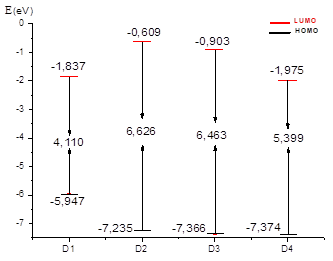
Downloads
References
M Alswah, AH Bayoumi, K Elgamal, A Elmorsy, S Ihmaid and HEA Ahmed. Design, synthesis and cytotoxic evaluation of novel chalcone derivatives bearing triazolo[4,3-a]-quinoxaline moieties as potent anticancer agents with dual EGFR kinase and tubulin polymerization inhibitory effects. Molecules 2018; 23, 48.
M Joshi, SK Pal and JJ Drabick. Novel approaches in cancer immunotherapy: A light at the end of the tunnel. Dis. Med. 2016; 21, 479-87.
B Mathew, JV Hobrath, MC Connelly, RK Guy and RC Reynolds. Diverse amide analogs of sulindac for cancer treatment and prevention. Bioorg. Med. Chem. Lett. 2017; 27, 4614-21.
I Ali, J Lee, A Go, G Choi and K Lee. Discovery of novel [1, 2, 4] triazolo [4, 3-a] quinoxaline aminophenyl derivatives as BET inhibitors for cancer treatment. Bioorg. Med. Chem. Lett. 2017; 27, 4606-13.
AE Assyry, B Benali, B Lakhrissi, ME Faydy, ME Touhami, R Touir and M Touil. Experimental and theoretical comparatives investigation of mild steel corrosion inhibition by quinoxalinone derivatives in 1 M HCl. Res. Chem. Intermed. 2015; 41, 3419-31.
F Benhiba, Y ELaoufir, M Belayachi, H Zarrok, AE Assyry, A Zarrouk, B Hammouti, EE Ebenso, A Guenbour, SSA Deyab and H Oudda. Theoretical and experimental studies on the inhibition of 1,1â-(2-phenylquinoxaline-1,4-diyl) diethanone for the corrosion of carbonsteel in 1.0 M HCl. Der Pharm. Lett. 2014; 6, 306-18.
M Larouj, Y ELaoufir, H Serrar, AE Assyry, M Galai, A Zarrouk, B Hammouti, A Guenbour, AE Midaoui, S Boukhriss, ME Touhami and H Oudda. Inhibition effects and theoretical studies of novel synthesized pyrimidothiazine derivative as corrosion inhibitor for carbon steel in phosphoric acid solution. Der Pharm. Lett. 2014; 6, 324-34.
A Chaouiki, M Chafiq, M Rbaa, H Lgaz, R Salghi, B Lakhrissi, IH Ali, S Masroor and Y Cho. New 8-hydroxyquinoline-bearing quinoxaline derivatives as effective corrosion inhibitors for mild steel in HCl: electrochemical and computational investigations. Coatings 2020; 10, 811.
M Rbaa, M Galai, ME Faydy, Y Lakhrissi, ME Touhami, A Zarrouk and B Lakhrissi. Synthesis and characterization of new quinoxaline derivatives of 8- hydroxyquinoline as corrosion inhibitors for mild steel in 1.0 M HCl medium. J. Mater. Environ. Sci. 2018; 9, 172-88.
AE Assyry, B Benali, R Jdaa, B Lakhrissi, M Touil and A Zarrouk. Theoretical investigation using AMYR calculations of five quinoxalinones in interaction with water molecules. J. Mater. Environ. Sci. 2014; 5, 1434-41.
Q Liu, Y Jiang, K Jin, J Qin, J Xu, W Li, J Xiong, J Liu, Z Xiao, K Sun, S Yang, X Zhang and L Ding. 18% Efficiency organic solar cells. Sci. Bull. 2020; 65, 272-5.
JH Schön, C Kloc and B Batlogg. Efficient photovoltaic energy conversion in pentacene-based heterojunctions. Appl. Phys. Lett. 2000; 77, 2473-5.
PL Barny, V Dentan, H Facoetti, M Vergnolle, G Vériot, B Servet and CR Acad. Application of organic electroluminescent materials in visualization. Sci. Paris Sér. 2000; 1, 493.
N Mariotti, M Bonomo, L Fagiolari, N Barbero, C Gerbaldi, F Bella and C Barolo. Recent advances in eco-friendly and cost-effective materials towards sustainable dye-sensitized solar cells. Roy. Soc. Chem. 2020; 22, 7168-218.
AAF Husain, WZW Hasan, S Shafie and SS Pandey. A review of transparent solar photovoltaic technologies. Renew. Sustain. Energ. Rev. 2018; 94, 779-91.
FC Krebs, SA Gevorgyan and J Alstrup. A roll-to-roll process to flexible polymer solar cells: model studies, manufacture and operational stability studies. J. Mater. Chem. 2009; 19, 5442-51.
FC Krebs, J Fyenbo and M Jørgensen. Product integration of compact roll-to-roll processed polymer solar cell modules: methods and manufacture using flexographic printing, slot-die coating and rotary screen printing. J. Mater. Chem. 2010; 20, 8994-9001.
K Sharma, V Sharma and SS Sharma. Dye-sensitized solar cells: Fundamentals and current status. Nanoscale Res. Lett. 2018; 13, 381.
Q Fan, Q An, Y Lin, Y Xia, Q Li, M Zhang, W Su, W Peng, C Zhang, F Liu, L Hou, W Zhu, D Yu, M Xiao, E Moons, F Zhang, TD Anthopoulos, O Inganas and E Wang. Over 14% efficiency all-polymer solar cells enabled by a low bandgap polymer acceptor with low energy loss and efficient charge separation. Energ. Environ. Sci. 2020; 13, 5017-27.
YY Liang, Z Xu, JB Xia, ST Tsai, Y Wu, G Li, C Ray and LP Yu. For the bright future-bulk heterojunction polymer solar cells with power conversion efficiency of 7.4%. Adv. Mater. 2010; 22, E135-E138.
KL Mutolo, EI Mayo, BP Rand, SR Forrest and ME Thompson. Enhanced open-circuit voltage in subphthalocyanine/C60 organic photovoltaic cells. J. Am. Chem. Soc. 2006; 128, 8108-9.
A Gadisa, M Svensson, MR Andersson and O Ingana. Correlation between oxidation potential and open-circuit voltage of composite solar cells based on blends of polythiophenes/ fullerene derivative. Appl. Phys. Lett. 2004; 84, 1609-11.
SH Chan, CP Chen, TC Chao, C Ting, CS Lin and BT Ko. Synthesis, characterization, and photovoltaic properties of novel semiconducting polymers with thiophene-phenylene-thiophene (TPT) as coplanar units. Macromolecules 2008; 41, 5519-26.
AE Assyry, A Hallaoui, F Abrighach, R Touzani, A Zarrouk and A Lamhamd. DFT spectroscopy properties of new N-heterocyclic compounds designed for efficient photovoltaic applications. Der Pharm. Lett. 2015; 7, 151.
HX Ji, ZS Huang, L Wang, D Cao. Quinoxaline-based organic dyes for efficient dye-sensitized solar cells: Effect of different electron-withdrawing auxiliary acceptors on the solar cell performance. Dyes Pigm. 2018; 159, 8-17.
AE Assyry, R Jdaa, B Benali, M Addou and A Zarrouk. Optical and photovoltaic properties of new quinoxalin-2 (1H)-one-based DA organic dyes for efficient dye-sensitized solar cell using DFT. J. Mater. Environ. Sci. 2015; 6, 2612-23.
A Dessì, GB Consiglio, M Calamante, G Reginato, A Mordini, M Peruzzini, M Taddei, A Sinicropi, ML Parisi, FF Biani, R Basosi, R Mori, M Spatola, M Bruzzi, L Zani. Organic chromophores based on a fused bis-thiazole core and their application in dye-sensitized solar cells. Eur. J. Org. Chem. 2013; 2013, 1916-28.
L Sicot, C Fiorini, A Lorin, P Raimond, C Sentein, JM Nunzi. Improvement of the photovoltaic properties of polythiophene-based cells. Sol. Energ. Mater Sol. Cells. 2000; 63, 49-60.
JM Nunzi. Organic photovoltaic materials and devices. Compt. Rendus. Phys. 2002; 3, 523-42.
J Rostalski and D Meissner. Monochromatic versus solar efficiencies of organic solar cells. Solar Energ. Mater. Solar Cells 2000; 61, 87-95.
YS Ang, Y Chen, C Tan and LK Ang. Generalized high-energy thermionic electron injection at
graphene interface. Phys. Rev. Appl. 2019; 12, 014057.
ZL Zhang, LY Zou, AM Ren, YF Liu, JK Feng and CC Sun. Theoretical studies on the electronic structures and optical properties of star-shaped triazatruxene/heterofluorene co-polymers. Dyes Pigm. 2013; 96, 349-63.
JB Asbury, YQ Wang, E Hao, H Ghosh and T Lian. Evidences of hot excited state electron injection from sensitizer molecules to TiO2 nanocrystalline thin films. Res. Chem. Intermed. 2001; 27, 393-406.
J Zhang, HB Li, SL Sun, Y Geng, Y Wu and ZM Su. Density functional theory characterization and design of high-performance diarylamine-fluorene dyes with different π spacers for dye-sensitized solar cells. J. Mater. Chem. 2012; 22, 568-76.
AE Assyry, A Hallaoui, A Zarrouk, ME Hezzat, M Assouag, S Boukhris and MME Touhami. Photophysical study by density functional theory for photovoltaic effects of some quinoxaline derivatives. Der Pharm. Chem. 2015; 7, 128-38.
WL Ding, DM Wang, ZY Geng, XL Zhao and WB Xu. Density functional theory characterization and verification of high-performance indoline dyes with D–A–π–A architecture for dye-sensitized solar cells. Dyes Pigm. 2013; 98, 125-35.
W Sang-aroon, S Saekow and V Amornkitbamrung. Density functional theory study on the electronic structure of Monascus dyes as photosensitizer for dye-sensitized solar cells. J. Photochem. Photobiol. A 2012; 236, 35-40.
MP Balanay and DH Kim. DFT/TD-DFT molecular design of porphyrin analogues for use in dye-sensitized solar cells. J. Mol. Struct. 2009; 910, 20-6.
AE Assyry, M Lamsayah, I Warad, R Touzani, F Bentiss and A Zarrouk. Theoretical investigation using DFT of quinoxaline derivatives for electronic and photovoltaic effects. Heliyon 2020; 6, e03620.
S Zhang. 2017, Study of fluorine-doped tin oxide (FTO) thin films for photovoltaics applications. Ph. D. Dissertation, Université Grenoble Alpes, Grenoble, France.
JG Hill. Gaussian basis sets for molecular applications. Int. J. Quantum Chem. 2013; 113, 21-34.
RJ Magyar and S Tretiak. Dependence of spurious charge-transfer excited states on orbital exchange in TDDFT: large molecules and clusters. J. Chem. Theory. Comput. 2007; 3, 976-87.
MJ Frisch, GW Trucks, HB Schlegel, MJ Frisch, GW Trucks, HB Schlegel, GE Scuseria, MA Robb, JR Cheeseman, G Scalmani, V Barone, B Mennucci and GA Petersson. Gaussian 09, revision A.02. Gaussian, Pennsylvania, 2009.
AE Assyry, A Hallaoui, R Saddik, N Benchat, B Benali and A Zarrouk. Combined electrochemical and quantum chemical study of new quinoxaline derivative as corrosion inhibitor for carbon steel in acidic media. Der Pharm. Lett. 2015; 7, 295-304.
AE Assyry, B Benali, A Boucetta and B Lakhrissi. Quantum chemical study by Density Functional Theory (DFT) of some benzodiazepine derivatives. J. Mater. Environ. Sci. 2014 ; 5, 1860-7.
J Tomasi, B Mennucci and R Cammi. Quantum mechanical continuum solvation models. Chem. Rev. 2005; 105, 2999-3094.
AE Assyry, B Benali, A Boucetta and D Mondieig. Synthesis and structural study of N-isopropenylbenzimidazolone. Res. Chem. Intermed. 2014; 40, 1043-52.
M Cossi and V Barone. Ab initio study of solvated molecules: A new implementation of the polarizable continuum model. J. Chem. Phys. 2001; 115, 4708-17.
C Adamo and V Barone. Toward reliable adiabatic connection models free from adjustable parameters. Chem. Phys. Lett. 2000; 330, 152-60.
M Rbaa, A Hichar, O Bazdi, Y Lakhrissi, K Ounine and B Lakhrissi. Synthesis, characterization, and in vitro antimicrobial investigation of novel pyran derivatives based on 8-hydroxyquinoline. J. Basic Appl. Sci. 2019; 8, 8
M Rbaa, H Lgaz, YE Kacimi, B Lakhrissi, F Bentiss and A Zarrouk. Synthesis, characterization and corrosion inhibition studies of novel 8-hydroxyquinoline derivatives on the acidic corrosion of mild steel: Experimental and computational studies. Mater. Discov. 2018; 12, 43-54.
D Mondieig, P Negrier, JM Leger, L Lakhrissi, AE Assyry, B Lakhrissi, EM Essassi, B Benali and A Boucetta. Synthesis and structural study of N-isopropenylbenzimidazolone. Russ. J. Phys. Chem. A 2015; 89, 807-11.
P Négrier, D Mondieig, JM Léger, B Benali, Z Lazar, A Boucetta, A Elassyry, B Lakhrissi, C Jermoumi and M Massoui. Crystal structure of benzodiazepin-2, 4-dione. Anal. Sci. 2006; 22,175-6.
D Jacquemin, EA Perpete, I Ciofini and C Adamo. TD-DFT performance for the visible absorption spectra of organic dyes: conventional versus long-range hybrids. Acc. Chem. Res. 2009; 42, 326-34.
C Adamo and D Jacquemin. The calculations of excited-state properties with Time-Dependent Density Functional Theory. Chem. Soc. Rev. 2013; 42, 845-56.
AE Assyry and B Benali. Theoretical study of the interaction between benzodiazepine derivatives and water by use of AMYR calculations. Res. Chem. Intermed. 2014; 40, 627-36.
KOK Al-Masoodi, I Rafiq, AE Assyry and A Derouiche. DFT/TD-DFT study of donorπ-acceptor organic dye models contained triarylamine for an efficient dye-sensitized solar cell. J. Phys. Conf. Ser. 2021; 1963, 012012.

Downloads
Published
How to Cite
Issue
Section
License

This work is licensed under a Creative Commons Attribution-NonCommercial-NoDerivatives 4.0 International License.





