
Effectiveness of Salty Sand in Improving the Adobe’s Thermomechanical Properties: Adrar Case Study (South Algeria)
DOI:
https://doi.org/10.48048/tis.2021.6Keywords:
Adobe, Arid zones, Mechanical resistance, Normal sand, Salty sand, Thermal conductivityAbstract
Adobe constructions have always existed, particularly in the Sahara’s dry and scorching regions. This material has a high thermal inertia and can protect buildings from inclement weather. Its mechanical resistance, on the other hand, is still low and has to be increased. The current research, thus, investigated the effect of sand salinity on the thermal and mechanical properties of adobe. The sand needed to create adobe blocks was purchased from 2 distinct locations. The first one was normal sand while the other one was salty sand rich in SO4- sulfate. We considered different ratios of each sand from 10, 20 up to 90 %. The results showed that the adobe made from the sulfate-containing sand improved the compressive strength by about 36 % from 1.91 to 2.58 MPa, and flexural strength by about 71 %, from 0.35 to 0.60 MPa, and reduced the thermal conductivity by 14 % from 0.86 to 0.72 w/mk.
HIGHLIGHTS
- Improving the compressive strength by about 36 %
- Improving the flexural strength by about 71 %
- Improving its thermal behaviour and inertia by about 3 %
- Testing more of 90 samples
- Studying two different locations
- Analyse Mineral and physical Analyse of clay and sands from the arid zone
GRAPHICAL ABSTRACT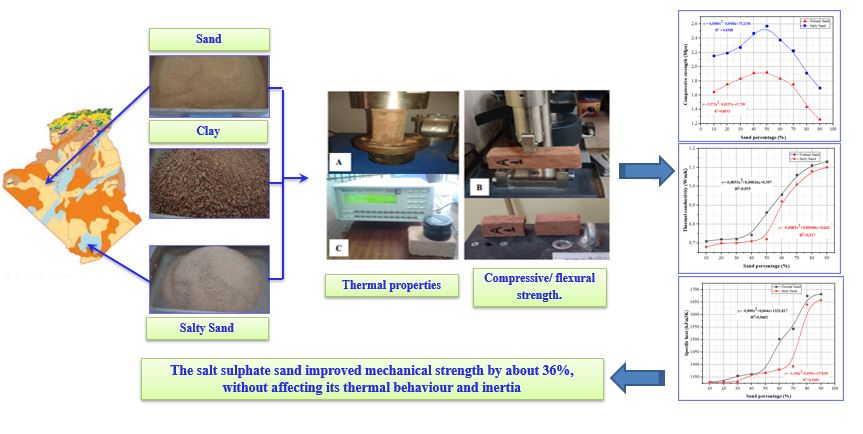
Downloads
References
Map Algerie, Available at: https://fr.maps-algeria.com, accessed December 2020.
G Minke. Building with Earth: Design and technology of a sustainable architecture. 4th ed. Birkhäuser, Basel, Switzerland, 2021.
H Houben and H Guillaud. CRATerre - Traité de construction en terre. Éditions parenthèses, Marseille, France, 2006.
L Keefe. Earth building: Methods and materials, repair and conservation. Taylor & Francis, London, 2012, p.7.
S Maini. Earthen architecture for sustainable habitat and compressed stabilised earth blocktechnology. Auroville Earth Institute, Tamil Nadu, India, 2005.
EA Adam and ARA Agib. Compressed stabilised earth block manufacture in Sudan. United Nations Educational, Scientific and Cultural Organization, Paris, France, 2001.
K Hadjri, M Osmani, B Baiche and C Chifunda. Attitudes towards earth building for Zambian housing provision. In: Proceedings of the Institution of Civil Engineers: Engineering Sustainability. 2007.
APO Obafemi and S Kurt. Environmental impacts of adobe as a building material: The north cyprus traditional building case. Case Stud. Constr. Mater. 2016; 4, 32-41.
MS Zami and A Lee. Economic benefits of contemporary earth construction in low-cost urban housing-State-of-the-art review. J. Build. App. 2010; 5, 259-71.
G Calatan, A Hegyi, C Dico and C Mircea. Experimental research on the recyclability of the clay material used in the fabrication of adobe bricks type masonry units. Proc. Eng. 2017; 181, 363-9.
A Shukla, GN Tiwari and MS Sodha. Embodied energy analysis of adobe house. Renew. Energ. 2009; 34, 755-61.
J Carvalho, D Silveira, H Varum and A Costa. Mechanical properties and behavior of traditional adobe wall panels of the Aveiro district. American Society of Civil Engineers. 2015; 27, 04014253.
F Fratini, E Pecchioni, L Rovero and U Tonietti. The earth in the architecture of the historical centre of Lamezia Terme (Italy): Characterization for restoration. Appl. Clay Sci. 2011; 53, 509-16.
D Silveira, H Varum, A Costa, T Martins, H Pereira and J Almeida. Mechanical properties of adobe bricks in ancient constructions. Constr. Build. Mater. 2012; 28, 36-44.
V Sharma, HK Vinayak and BM Marwaha. Enhancing sustainability of rural adobe houses of hills by addition of vernacular fiber reinforcement. Int. J. Sustain. Built Environ. 2015; 4, 348-58.
M Ouedraogo, K Dao, Y Millogo, JE Aubert, A Messan, M Seynou, L Zerbo and M Gomina. Physical, thermal and mechanical properties of adobes stabilized with fonio (Digitaria exilis) straw. J. Build. Eng. 2019; 23, 250-8.
F Jové-Sandoval, MM Barbero-Barrera, NF Medina. Assessment of the mechanical performance of three varieties of pine needles as natural reinforcement of adobe. Constr. Build. Mater. 2018; 187, 205-13.
M Giroudon, A Laborel-Préneron JE Aubert and C Magniont. Comparison of barley and lavender straws as bioaggregates in earth bricks. Constr. Build. Mater. 2019; 202, 254-65.
XW Jia, YJ Zhang and JS Qian. The properties of modified adobe materials with desulfurization waste. Adv. Mater. Res. 2012; 562-564, 47-51.
N Degirmenci. The using of waste phosphogypsum and natural gypsum in adobe stabilization. Constr. Build. Mater. 2008; 22, 1220-4.
M Bouhicha, F Aouissi and S Kenai. Performance of composite soil reinforced with barley straw. Cement Concr. Compos. 2005; 27, 617-21.
R Amoanyi, PS Kwawukume, FWY Momade. Improving the Strength properties of Afari and Mfensi clays by chemical stabilization. Int. J. Eng. Res. Afr. 2012; 8, 1-15.
GA Jokhio, FM Saad, Y Gul, SMS Mohsin and NI Ramli. Uniaxial compression and tensile splitting tests on adobe with embedded steel wire reinforcement. Constr. Build. Mater. 2018; 176, 383-93.
W Namboonruang and P Yongam-Nuai. Thermal, strength and leachability characteristics of cellulose fibre reinforced lime-soil brick. Key Eng. Mater. 2016; 703, 386-95.
R Illampas, VG Loizou and I Ioannou. Effect of straw fiber reinforcement on the mechanical properties of Adobe bricks. In: Proceedings of the 6th Biot Conference on Poromechanics, Paris, France. 2017, p. 1331-8.
G Araya-Letelier, J Concha-Riedel, FC Antico, C Valdés and G Cáceres. Influence of natural fiber dosage and length on adobe mixes damage-mechanical behavior. Constr. Build. Mater. 2018; 174, 645-55.
G Guyot. Climatologie de l'environnement. Dunod, Paris, France, 1999.
MR Yaiche and A Bouhanik. Atlas solaire algérien. Vol. 16. Centre de Développement des Energies Renouvelables, Bouzareah, Algeria, 2002.
Association Francaise de Normalisation. NF P94-057. Sols: Reconnaissance et essais - analyse granulométrique des sols - méthode par sédimentation (in French). Association Francaise de Normalisation, Paris, France, 1992.
Association Francaise de Normalisation. NF EN 933-8. Essais pour déterminer les caractéristiques géométriques des granulats - Partie 8 (in French). Association Francaise de Normalisation, Paris, France, 2015.
Association Francaise de Normalisation. NF EN 206-1. Béton-Partie 1: Spécification, performances, production et conformité (in French). Association Francaise de Normalisation, Paris, France, 2004.
Association Francaise de Normalisation. FD P18-011. Béton - Définifion et classification des environnements chimiquement agressifs - Recommandations pour la formulation des bétons (in French). Association Francaise de Normalisation, Paris, France, 2016.
Association Francaise de Normalisation. NF EN 933-9+A1. Essais pour déterminer les caractéristiques géométriques des granulats - Partie 9 (in French). Association Francaise de Normalisation, Paris, France, 2013.
Association Francaise de Normalisation. NF P94-051. Sols: reconnaissance et essais-Détermination des limites d'Atterberg-Limite de liquidité à la coupelle-Limite de plasticité au rouleau (in French). Association Francaise de Normalisation, Paris, France, 1993.
M Garcia-Valles, P Alfonso, S Martínez and N Roca. Mineralogical and thermal characterization of kaolinitic clays from Terra Alta (Catalonia, Spain). Minerals 2020; 10, 142.
Organisation Mondiale de la Sante. Directives de qualité pour l’eau de boisson (in French). Vol I. Organisation Mondiale de la Sante, Genève, Switzerland, 2004.
European Committee for Standardization. EN 1015-10. Methods of test for mortar for masonry - Part 11: Determination of flexural and compressive strength of hardened mortar. European Committee for Standardization, Brussels, Belgium 1999.
Applied Precision. ISOMET model 2104. Bratislava.
RM Gandia, FC Gomes, AAR Corrêa, MC Rodrigues and RF Mendes. Physical, mechanical and thermal behavior of adobe stabilized with glass fiber reinforced polymer waste. Constr. Build. Mater. 2019; 222, 168-82.
F Wu, G Li, HN Li, JQ Jia. Strength and stress-strain characteristics of traditional adobe block and masonry. Mater.Struct. 2012; 46, 1449-57.
I Kafodya, F Okonta and P Kloukinas. Role of fiber inclusion in adobe masonry construction. J. Build. Eng. 2019; 26, 100904.
C Bock-Hyeng, AN Ofori-Boadu, E Yamb-Bell and MA Shofoluwe. Mechanical properties of sustainable adobe bricks stabilized with recycled sugarcane fiber waste. Int. J. Eng. Res. Appl. 2016; 6, 50-9.
G Araya-Letelier, FC Antico, C Burbano-Garcia, J Concha-Riedel, J Norambuena-Contreras, J Concha and EIS Flores. Experimental evaluation of adobe mixtures reinforced with jute fibers. Constr. Build. Mater. 2021; 276, 122127.
C Babé, DK Kidmo, A Tom, RRN Mvondo, RBE Boum and N Djongyang. Thermomechanical characterization and durability of adobes reinforced with millet waste fibers (sorghum bicolor). Case Stud. Constr. Mater. 2020; 13, e00422.
E Olacia, AL Pisello, V Chiodo, S Maisano, A Frazzica and LF Cabeza. Sustainable adobe bricks with seagrass fibres. Mechanical and thermal properties characterization. Constr. Build. Mater. 2020; 239, 117669.
G Araya-Letelier, H Gonzalez-Calderon, S Kunze, C Burbano-Garcia, U Reidel, C Sandoval and F Bas. Waste-based natural fiber reinforcement of adobe mixtures: Physical, mechanical, damage and durability performance assessment. 2020; 273, 122806.
IMG Bertelsen, LJ Belmonte, G Fischer and LM Ottosen. Influence of synthetic waste fibres on drying shrinkage cracking and mechanical properties of adobe materials. Constr. Build. Mater. 2021; 286, 122738.
K Dao, M Ouedraogo, Y Millogo, JE Aubert and M Gomina. Thermal, hydric and mechanical behaviours of adobes stabilized with cement. Constr. Build. Mater. 2018; 158, 84-96.
P Zare, SS Narani, M Abbaspour, A Fahimifar, SMMMH Hosseini and P Zare. Experimental investigation of non-stabilized and cement-stabilized rammed earth reinforcement by Waste Tire Textile Fibers (WTTFs). Constr. Build. Mater. 2020; 260, 120432.
Downloads
Published
How to Cite
Issue
Section
License

This work is licensed under a Creative Commons Attribution-NonCommercial-NoDerivatives 4.0 International License.





