
Modelling and Stress Analysis of Shaft Work Subsidence of Underground Power Transmission Line Tunnel
DOI:
https://doi.org/10.48048/tis.2022.5778Keywords:
Shaft work, Subsidence, Sinking the reinforced concrete method, Finite element method, FEMAbstract
This research presents an analysis of soil subsidence around shaft work under its construction process and drilling tunnel by finite element method (FEM). The study is focused on the underground power transmission tunnel in the Chao Phraya River construction project (Southern Bangkok Station to Suksawat Road, Thailand) of the Metropolitan Electricity Authority. This research aims to provide information for designing shaft work and preventing drilling tunnel problems. The research analyzed the soil subsidence around shaft work with 12 m of inside diameter and 1 m of thickness that located 33 m underground during constructing a tunnel chimney by sinking method. It is assumed that the analyzed horizontal reaction is the net resistance of the lateral earth pressure around the shaft work. This study found that the subsidence of soil around shaft work during the construction and drilling process had the value between 0.80 - 53.30 mm. In the part of the base slab, the soil subsidence value is between 3.40 - 16.00 mm. It can be concluded that the top of shaft work during the construction and drilling process had a soil subsidence value of 53.30 mm with dmax/H ratio of 0.00162.
HIGHLIGHTS
- The Metropolitan Electricity Authority has an underground power transmission tunnel in the Chao Phraya River Construction (Southern Bangkok Station to Suksawat Road, Thailand) project which used to distribute electricity from the source station to the other side of the Chao Phraya River
- This research studied the behavior of the shaft work in sinking reinforced concrete shaft work and drilling tunnel process by finite element method (FEM) with the Midas Gen 2021 program
- The analysis results of the maximum soil subsidence around the shaft work wall occurred in the top area (very soft to medium stiff clay layer)
GRAPHICAL ABSTRACT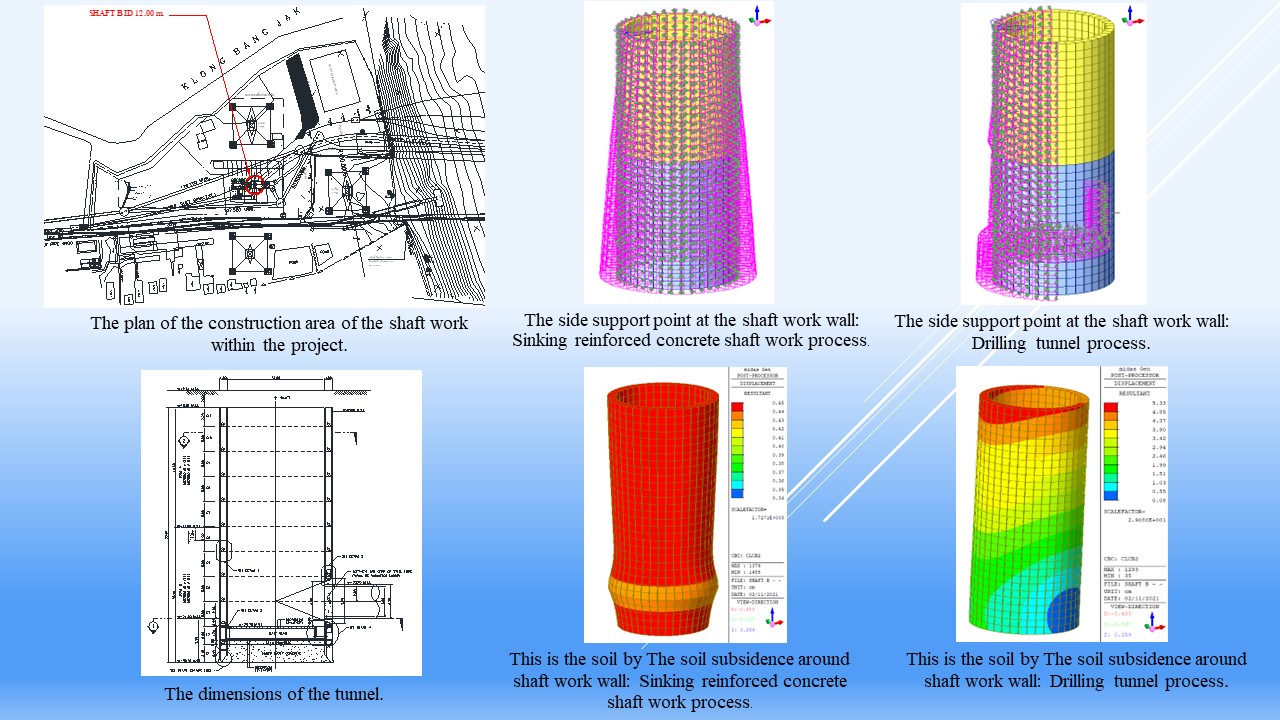
Downloads
References
S Srisathitwat. 2003, Lateral movement of deep worked shaft for tunnelling in Bangkok subsoils. Master Thesis. Chulalongkorn University, Bangkok, Thailand.
S Kaenpudcha. 2005, Behavior of deep working shaft for construction of a big flood diversion tunnel. Master Thesis. Chulalongkorn University, Bangkok, Thailand.
Y Zhang, H Tang, C Li, G Lu, Y Cai, J Zhang and F Tan. Design and testing of a flexible inclinometer probe for model tests of landslide deep displacement measurement. Sensors 2018; 18, 224.
XQ Zhou, JL Pan, Y Liu and CC Yu. Analysis of ground movement during large-scale pipe roof installation and artificial ground freezing of Gongbei tunnel. Adv. Civ. Eng. 2021; 2021, 8891600.
Y Wang, J Guo, Y Tang, T Liu and Y Yang. Settlement and damage analysis of working shaft for underground high-voltage electricity cables. IOP Conf. Ser. Earth Environ. Sci. 2019; 304, 1755-315.
CW Ong, JP Ee, T Su, KY Yong and A Kulaindran. A case study of twin bored tunnelling under mixed-face soil-Bendemeer MRT station project (Downtown Line 3), Singapore. Jpn. Geotech. Soc. Spec. Publ. 2016; 2, 176-81.
A Tippawan, H Pratip and C Pornkasem. Influence of lagging distance on ground surface settlement due to mechanized twin tunneling-3D numerical simulation. In: Proceedings of the 25th National Convention on Civil Engineering, Chonburi, Thailand. 2020, p. 1-7.
K Kunnarong. 2015, Settlement analysis of soft clay with and without improved by prefabricated vertical drain. Master Thesis. Chulalongkorn University, Bangkok, Thailand.
F Khana and B Das. Geospatial approach to determine Soil bearing capacity of Nagpur city, Maharashtra India. IOP Conf. Ser. Earth Environ. Sci. 2021; 796, 012069.
J Rybak, A Ivannikov, E Kulikova and T Zyrek. Deep excavation in urban areas-defects of surrounding buildings at various stages of construction. MATEC Web of Conf. 2018; 146, 02012.
Z Yao, H Cai, W Xue, X Wang and Z Wang. Numerical simulation and measurement analysis of the temperature field of artificial freezing shaft sinking in Cretaceous strata. AIP Adv. 2019; 9, 025209.
Q Yan, W Wu, C Zhang, S Ma and Y Li. Monitoring and evaluation of artificial ground freezing in metro tunnel construction: A case study. KSCE J. Civil Eng. 2019; 23, 2359-70.

Downloads
Published
How to Cite
Issue
Section
License

This work is licensed under a Creative Commons Attribution-NonCommercial-NoDerivatives 4.0 International License.





