
The Effect of Thai Traditional Play Program on Speed and Agility in Male Students in the Upper Primary School
DOI:
https://doi.org/10.48048/tis.2022.5764Keywords:
Speed, Agility, Male student, Thai traditional play programAbstract
The purpose of the research was to study and compare the effect of Thai Traditional Play program on the speed and agility of Upper primary school male students. Group samples consisted of 32 male students from Chumchonsampraw School in Udonthani province. The test group (N = 16) was trained with both the Thai Traditional Play program and physical education activity and the control group was trained with physical education activity only. The training 60 min per day, 3 days per week, for 8 weeks. A personal questionnaire was collected and a speed test by using running 50 m and an agility test by using running a zig-zag course. All parameters were measured baseline, at week 4 and 8, respectively. The data were analyzed by using percentage, mean, standard deviation, t-test and One-way analysis of variance with repeated measure. Scheffe was compared at the statistical significance level at p < 0.05. The results showed that the speed and agility of the experimental group before, after the 4th and after the eight weeks were found to be significantly at 0.05 level. But control group found not significantly at 0.05 level. This research suggests that Thai Traditional Play program could increase speed and agility of male students in the Upper primary school.
HIGHLIGHTS
- Thai Traditional play is an activity based on running skills. Walking skills and mobility
- Thai Traditional play is an exercise because while playing, the child moves the body and every muscle, thus affecting the development of speed and agility
- Speed and agility are basic skills that elementary school students need to be trained in to have basic movements appropriate for their age
GRAPHICAL ABSTRACT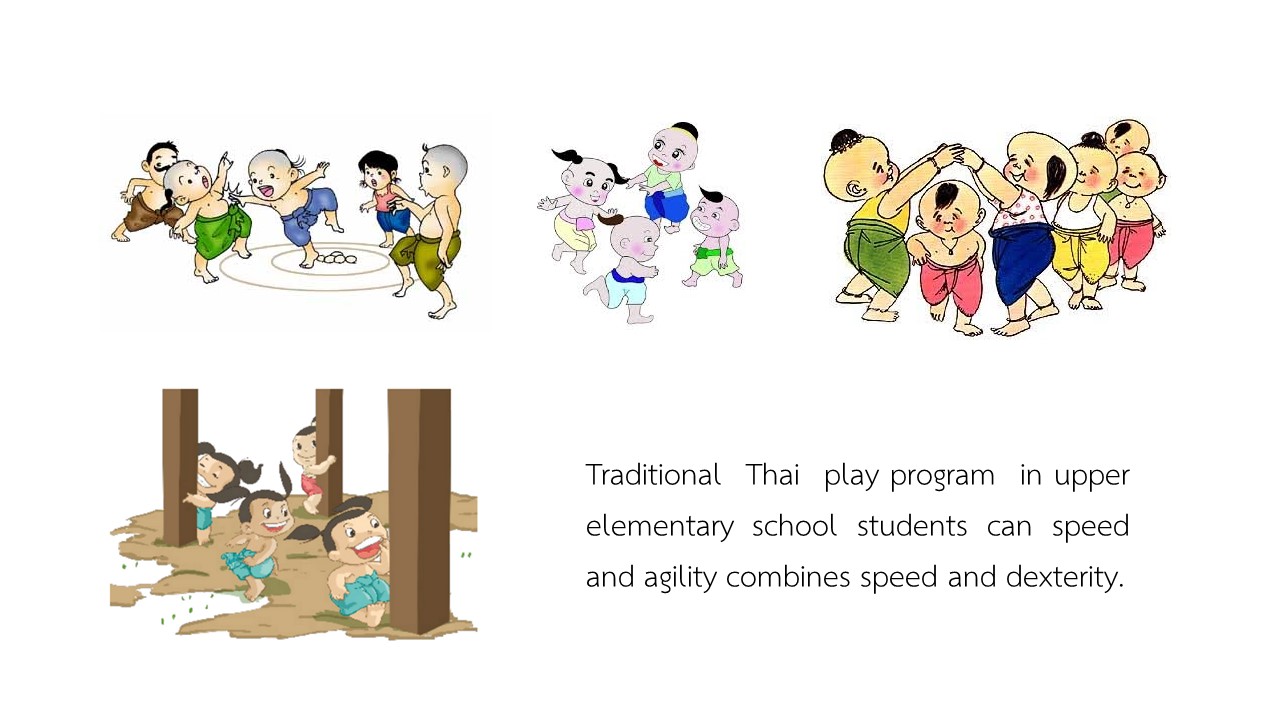
Downloads
References
Department of Academic Affairs, Ministry of Education. Guidelines for organizing student development activities according to the curriculum Basic education. Teacher Council Ladprao, Bangkok, Thailand, 2003.
P Praditsukthaworn.Physical development early elementary school age, Available at: http://taamkru.com/th, accessed October 2019.
S Watsapad and K Palawiwat. Physiology of exercise. Thunkamol Press, Bangkok, Thailand, 1993.
R Wongprasert. The development of physical fitness test by using Thai folk activities for early childhood students, the demonstration school of Silpakorn University early childhood and elementary). Silpakorn Educ. Res. J. 2015; 7, 66-78.
C Gomaratut. Thai traditional sports: Origin, playing methods and values. Thai Study Center, Chulalongkorn University, Bangkok, Thailand, 2003.
J Cohen. Statistical power analysis for the behavior sciences. Lawrence Erlbaum Associates, Publishers, New Jersey, 1988.
T Charoenchapmanee. Doctrine of the principles of sports training. Department of Physical Education, Faculty of Physical Education, Srinakharinwirot University, Bangkok, Thailand, 2003.
M Budmeang. Principles for training the speed of the feet with ladder. Bangkok, Thailand, 2007.
P Ruengpanyawut. Effect of physical education learning management using Thai folk game on health - related physical of elementary school student. Chulalongkorn University, Bangkok, Thailand, 2013.
C Krabuanrat. Science of coaching. Kasetsart University, Bangkok, Thailand, 2014.
A Choengkilnchan. Effects of the agility training program with integration of Thai traditional plays on agility development of football players between the age of 10 -12 years old. Chulalongkorn University, Bangkok, Thailand, 2009.
TO Bompa. Periodization: Theory and methodology of training. Human Kinetic, Illinois, 1999.
C Gomaratut. Thai traditional sports: Southern region. Thai Study Center, Chulalongkorn University, Bangkok, Thailand, 2006.
C Gomaratut. Thai traditional sports: Central region. Thai Study Center, Chulalongkorn University, Bangkok, Thailand, 2006.
C Gomaratut. Thai traditional sports: North-eastern region. Thai Study Center, Chulalongkorn University, Bangkok, Thailand, 2006.
Downloads
Published
How to Cite
Issue
Section
License

This work is licensed under a Creative Commons Attribution-NonCommercial-NoDerivatives 4.0 International License.





