
Development and Characterization of Bioactive Edible Films Based on Semi-Refined Kappa Carrageenan Incorporated with Honey and Kaempferia galanga L. Essential Oil
DOI:
https://doi.org/10.48048/tis.2022.5761Keywords:
Edible film, Kappa carrageenan, Kaempferia galanga L. essential oil, Honey, CharacterizationAbstract
This paper emphasized the innovation of commercial semi-refined kappa carrageenan-based (SRKC) films incorporated with Ceiba pentandra honey and Kaempferia galanga L. essential oil to develop bioactive edible film. The influence of honey and essential oil concentrations on the mechanical, physical, moisture barrier, and sensory properties has been investigated. It was found that the thickness, solubility, elongation at break of the edible film with honey addition (50, 100, 150, and 200 % w/w carrageenan) were increased (p < 0.05), whereas the tensile strength was decreased (p < 0.05), and there was no significant difference in the water vapor transmission rate of all the films (p > 0.05). In the next stage, increment of essential oil concentration (0.25, 0.5, and 1 % w/v) in SRKC film with 200 % honey increased the thickness, but reduced the solubility, tensile strength, and elongation at break, and had no significant influence on the water vapor transmission rate (p > 0.05). The edible film incorporated with 200 % honey and 0.25 % Kaempferia galanga L. essential oil demonstrated a significant effect on the sensory evaluation test on aroma, taste, and overall attributes (p < 0.05). Furthermore, the edible films also encompassed many bioactive compounds. In summary, the present research findings confirmed the potentials of SRKC edible film enriched with 200 % honey and 0.25 % Kaempferia galanga L. essential oil as a novel edible food packaging with enhanced bioactive characteristics.
HIGHLIGHTS
- Semi-refined kappa carrageenan (SRKC) is a good film-forming material
- Kaempferia galanga L. essential oil is known for its bioactive components
- Honey and the essential oil are added to develop bioactive edible film
GRAPHICAL ABSTRACT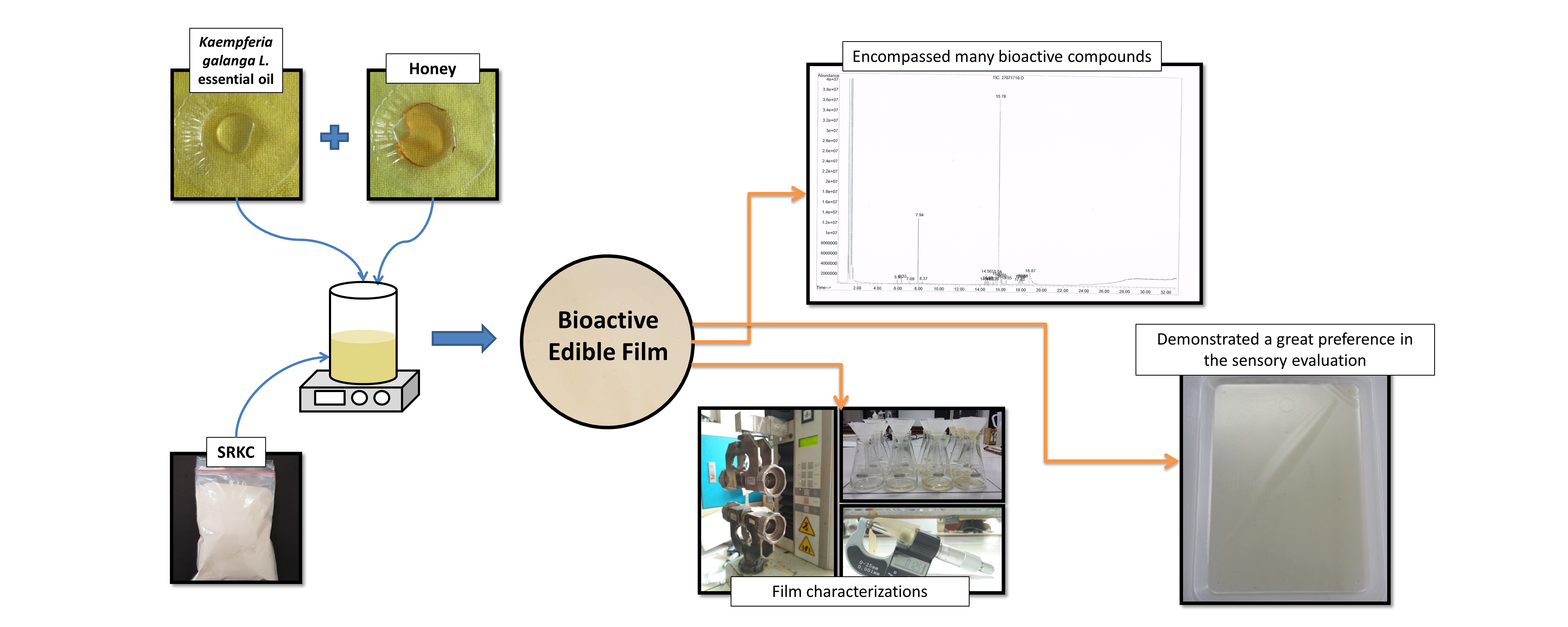
Downloads
References
SAA Mohamed, M El-Sakhawy and MAM El-Sakhawy. Polysaccharides, protein and lipid -based natural edible films in food packaging: A review. Carbohydr. Polymer. 2020; 238, 116178.
D Praseptiangga, N Fatmala, GJ Manuhara, R Utami and LU Khasanah. Preparation and preliminary characterization of semi refined kappa carrageenan-based edible film incorporated with cinnamon essential oil. AIP Conf. Proc. 2016; 1746, 020036.
HPSA Khalil, CK Saurabh, YY Tye, TK Lai, AM Easa, E Rosamah, MRN Fazita, MI Syakir, AS Adnan, HM Fizree, NAS Aprilia and A Banerjee. Seaweed based sustainable films and composites for food and pharmaceutical applications: A review. Renew. Sustain. Energ. Rev. 2017; 77, 353-62.
AE Saputri, D Praseptiangga, E Rochima, C Panatarani and IM Joni. Mechanical and solubility properties of bio-nanocomposite film of semi refined kappa carrageenan/ZnO nanoparticles. AIP Conf. Proc. 2018; 1927, 030040.
GJ Manuhara, D Praseptiangga, DRA Muhammad and BH Maimuni. Preparation and characterization of semi-refined kappa carrageenan-based edible film for nano coating application on minimally processed food. AIP Conf. Proc. 2016; 1710, 030043.
A Farhan and NM Hani. Characterization of edible packaging films based on semi-refined kappa-carrageenan plasticized with glycerol and sorbitol. Food Hydrocolloids 2017; 64, 48-58.
D Praseptiangga. Development of seaweed-based biopolymers for edible films and lectins. IOP Conf. Series Mater. Sci. Eng. 2017; 193, 012003.
S Khedri, E Sadeghi, M Rouhi, Z Delshadian, AM Mortazavian, JDT Guimarães, M Fallah and R Mohammadi. Bioactive edible films: Development and characterization of gelatin edible films incorporated with casein phosphopeptides. LWT 2021; 138, 110649.
S Ebrahimzadeh, MR Bari, H Hamishehkar, HS Kafil and L Loong-Tak. Essential oils-loaded electrospun chitosan-poly(vinyl alcohol) nonwovens laminated on chitosan film as bilayer bioactive edible films. LWT 2021; 144, 111217.
W Zhou, Y He, F Liu, L Liao, X Huang, R Li, Y Zou, L Zhou, L Zou, Y Liu, R Ruan and J Li. Carboxymethyl chitosan-pullulan edible films enriched with galangal essential oil: Characterization and application in mango preservation. Carbohydr. Polym. 2021; 256, 117579.
J Cai, J Xiao, X Chen and H Liu. Essential oil loaded edible films prepared by continuous casting method: Effects of casting cycle and loading position on the release properties. Food Packag. Shelf Life 2020; 26, 100555.
HE Salama, MSA Aziz and MW Sabaa. Development of antibacterial carboxymethyl cellulose/chitosan biguanidine hydrochloride edible films activated with frankincense essential oil. Int. J. Biol. Macromol. 2019; 139, 1162-7.
Q Ma, F Xiao-Dan, L Xiao-Cao, Q Tai-Qiu and J Jian-Guo. Ultrasound-enhanced subcritical water extraction of essential oils from Kaempferia galangal L. and their comparative antioxidant activities. Separ. Purif. Tech. 2015; 150, 73-9.
N Srivastava, Ranjana, S Singh, AC Gupta, K Shanker, DU Bawankule and S Luqman. Aromatic ginger (Kaempferia galanga L.) extracts with ameliorative and protective potential as a functional food, beyond its flavor and nutritional benefits. Toxicol. Rep. 2019; 6, 521-8.
MI Umar, MZ Asmawi, A Sadikun, AMSA Majid, FSR Al-Suede, LEA Hassan, R Altaf and MBK Ahamed. Ethyl-p-methoxycinnamate isolated from kaempferia galanga inhibits inflammation by suppressing interleukin-1, tumor necrosis factor-α, and angiogenesis by blocking endothelial functions. Clinics 2014: 69, 134-44.
N Srivastava, S Mishra, H Iqbal, D Chanda and K Shanker. Standardization of kaempferia galanga L. rhizome and vasorelaxation effect of its key metabolite ethyl p-methoxycinnamate. J. Ethnopharmacol. 2021; 271, 113911.
MS Ali, PR Dash and M Nasrin. Study of sedative activity of different extracts of kaempferia galanga in swiss albino mice. BMC Compl. Alternative Med. 2015; 15, 158.
YD Handiati, D Praseptiangga, GJ Manuhara and LU Khasanah. Effects of kaempferia galanga L. essential oil incorporation on sensory and physical properties of dark chocolate bar. IOP Conf. Series Mater. Sci. Eng. 2019; 633, 012036.
S Munda, P Saikia and M Lal. Chemical composition and biological activity of essential oil of kaempferia galanga: A review. J. Essent. Oil Res. 2018; 30, 1486240.
S Sahoo, R Parida, S Singh, RN Padhy and S Nayak. Evaluation of yield, quality and antioxidant activity of essential oil of in vitro propagated kaempferia galanga linn. J. Acute Dis. 2014; 3, 124-30.
SKT Seraglio, M Schulz, P Brugnerotto, B Silva, LV Gonzaga, R Fett and ACO Costa. Quality, composition and health-protective properties of citrus honey: A review. Food Res. Int. 2021; 143, 110268.
SK Yap and NL Chin. Identification of distinctive properties of common Malaysian honeys. Mater. Today Proc. 2021; 42, 115-8.
S Almasaudi. The antibacterial activities of honey. Saudi J. Biol. Sci. 2021; 28, 2188-96.
NMDMW Nayaka, I Fidrianny, Sukrasno, R Hartati and M Singgih. Antioxidant and antibacterial activities of multiflora honey extracts from the Indonesian Apis cerana bee. J Taibah Univ. Med. Sci. 2020; 15, 211-7.
B Silva, FC Biluca, LV Gonzaga, R Fett, EM Dalmarco, T Caon and ACO Costa. In vitro anti-inflammatory properties of honey flavonoids: A review. Food Res. Int. 2021; 141, 110086.
M Srisayam and P Chantawannakul. Antimicrobial and antioxidant properties of honeys produced by Apis mellifera in Thailand. J. ApiProduct ApiMedical Sci. 2010; 2, 77-83.
JT Soininen, J Heinämäki and J Yliruusi. From acacia honey monosaccharide content to a new external binary plasticizer applicable in aqueous whey protein films. Food Bioproducts Process. 2013; 91, 440-6.
ASTM. Standard Test Method for Tensile Properties of Thin Plastic Sheeting. ASTM International, Pennsylvania, 2010.
WG Sullivan, EM Wicks and CP Koelling. Engineering Economy, 16th Edition. Pearson, London, 2015.
M Meilgaard, GV Civille and BT Carr. Sensory Evaluation Techniques, 4th Edition. CRC Press, Florida, 2006.
D Praseptiangga, AR Qomaruzzaman and GJ Manuhara. The effect of clove leaves essential oil addition on physicochemical and sensory characteristics of milk chocolate bar. Int. J. Adv. Sci. Eng. Inform. Tech. 2021; 11, 165-71.
M Beigomi, M Mohsenzadeh and A Salari. Characterization of a novel biodegradable edible film obtained from dracocephalum moldavica seed mucilage. Int. J. Biol. Macromol. 2018; 108, 874-83.
R Arham, MT Mulyati, M Metusalach and S Salengke. Physical and mechanical properties of agar based edible film with glycerol plasticizer. Int. Food Res. J. 2016; 23, 1669-75.
T Wittaya. Protein-based edible films: Characteristics and improvement of properties. In: AA Eissa (Ed.). Structure and Function of Food Engineering. IntechOpen, London, 2012.
H Seyedeh-Maryam and J Dehghannya. Development and characterization of novel edible films based on Cordia dichotoma gum incorporated with Salvia mirzayanii essential oil nanoemulsion. Carbohydr. Polymer. 2021; 257, 117606.
S Shojaee-Aliabadi, H Hosseini, MA Mohammadifar, A Mohammadi, M Ghasemlou, SM Ojagh, SM Hosseini and R Khaksar. Characterization of antioxidant-antimicrobial κ-carrageenan films containing Satureja hortensis essential oil. Int. J. Biol. Macromol. 2013; 52, 116-24.
A Soni, G Kandeepan, SK Mendiratta, V Shukla and A Kumar. Development and characterization of essential oils incorporated carrageenan based edible film for packaging of chicken patties. Nutr. Food Sci. 2016; 46, 82-95.
D Veena, EN Mallika, GV Reddy and K Sudheer. Quality of edible polymer films incorporated with plant essential oils. Int. J. New Tech. Sci. Eng. 2015; 2, 43-7.
S Shojaee-Aliabadi, H Hosseini, MA Mohammadifar, A Mohammadi, M Ghasemlou, SM Hosseini and R Khaksar. Characterization of κ-carrageenan films incorporated plant essential oils with improved antimicrobial activity. Carbohydr. Polymer. 2014; 101, 582-91.
Y Chu, T Xu, CC Gao, X Liu, N Zhang, X Feng, X Liu, X Shen and X Tang. Evaluations of physicochemical and biological properties of pullulan-based films incorporated with cinnamon essential oil and Tween 80. Int. J. Biol. Macromol. 2019; 122, 388-94.
M Vargas, A Albors, A Chiralt and C González-Martínez. Characterization of chitosan-oleic acid composite films. Food Hydrocolloids 2009; 23, 536-47.
L Sánchez-González, M Cháfer, A Chiralt and C González-Martínez. Physical properties of edible chitosan films containing bergamot essential oil and their inhibitory action on penicillium italicum. Carbohydr. Polymer. 2010; 82, 277-83.
Y Zhang, L Zhou, C Zhang, PLShow, A Du, JC Fu and V Ashokkumar. Preparation and characterization of curdlan/polyvinyl alcohol/ thyme essential oil blending film and its application to chilled meat preservation. Carbohydr. Polymer. 2020; 247, 116670.
LB Norcino, JF Mendes, CVL Natarelli, A Manrich, JE Oliveira and LHC Mattoso. Pectin films loaded with copaiba oil nanoemulsions for potential use as bio-based active packaging. Food Hydrocolloids 2020; 106, 105862.
K Candogan, GV Barbosa-Cánovas and E Çarkcioglu. Edible films and coatings: Sensory aspects. In: MPM García, MC Gómez-Guillén, ME López-Caballero and GV Barbosa-Cánovas (Eds.). Edible Films and Coatings: Fundamentals and Applications. CRC Press, Florida, 2016, p. 497-518.
Downloads
Published
How to Cite
Issue
Section
License

This work is licensed under a Creative Commons Attribution-NonCommercial-NoDerivatives 4.0 International License.





