
Drying Process Optimization and Modelling the Drying Kinetics and Quality Attributes of Dried Chili Pepper (Capsicum frutescens L.)
DOI:
https://doi.org/10.48048/tis.2022.5752Keywords:
Chili pepper drying, Drying kinetics, Optimization, Product quality attributes, Quadratic regression modelsAbstract
This study is important in terms of the fact that the production of a dried product with good quality and minimum process drying cost is dependent on individual or combinations of several drying conditions. However, if drying is not properly conducted at favourable drying conditions, it generates product quality-related problems for the consumer and food market. Thus, this study focused on the optimization and evaluation of the main and interactive effects of drying air temperature (DAT), air velocity (DAV), relative humidity (RH), and drying time (DRT) on the cabinet-tray hot air drying and quality attributes of chili pepper using the four-factors-five-level-rotatable central composite experimental design of response surface methodology. The drying kinetics was also modeled using known empirical drying models (Page, Newton, Logarithmic, and Henderson and Pabis). The drying conditions utilized are DAV (0 - 2 m/s), RH (60 - 80 %), DAT (40 - 80 °C), and DRT (180 - 900 min), while the moisture content (MC), carbohydrate content (CHC), total plate count (TPLC), and protein content (PTC) were the considered product quality attributes. The results showed that the most significant drying process conditions that exerted a more pronounced main and interactive effects on the dried chili pepper quality attributes are drying process time and drying air temperature. Second-order quadratic regression model adequately predicted the quality attributes of the dried chili pepper. The optimum process conditions for the production of dried chili pepper with minimum MC (9.93 %) and TPLC (40.10 CFU/g) as well as maximum PTC (7.88 %) and CHC (24.66 %) were obtained to be DAT, 61.59 °C, DAV, 0.70 m/s, RH, 68.39. %, and DRT, 729.63 min. The Page model best describe the drying kinetics. The drying treatments generally retained the protein and carbohydrate contents (nutritional properties) in the dried chili pepper product as well as reduced the microbial load to the acceptable limit allowed for consumption.
HIGHLIGHTS
- Effects of drying conditions on dried chili pepper quality attributes were evaluated using response surface method (RSM)
- Dried chili pepper quality attributes were optimized using RSM
- Drying conditions retained the quality attributes of dried chili pepper
- Microbial load of dried chili pepper was within the acceptable limit for consumption
- A mathematical model was developed for the dried chili pepper quality attributes’ prediction
GRAPHICAL ABSTRACT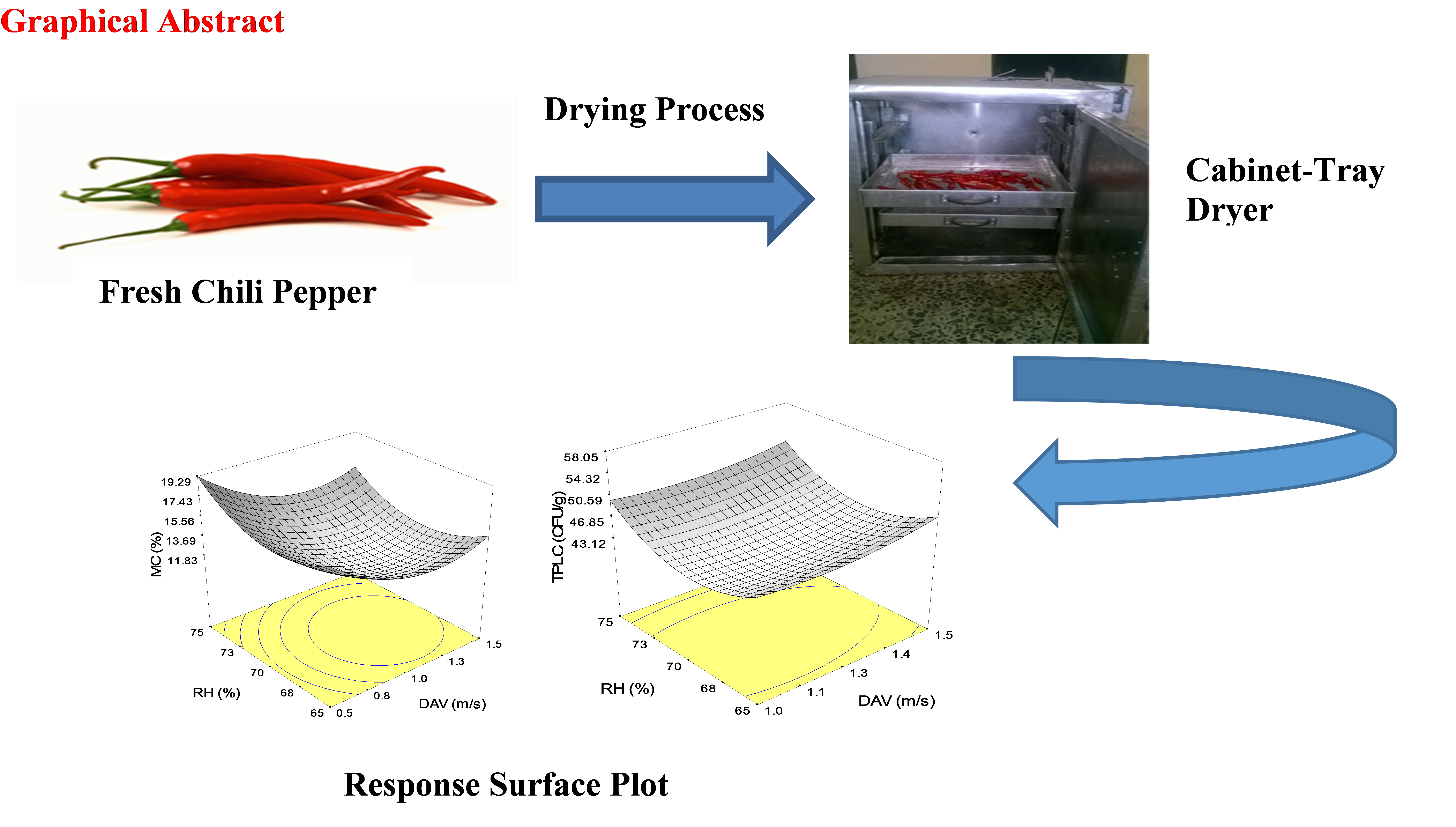
Downloads
References
F Salehi and M Kashaninejad. Modeling of moisture loss kinetics and color changes in the surface of lemon slice during the combined infrared-vacuum drying. Inform. Process. Agr. 2018; 5, 516-23.
B Sturm, WC Hofacker and O Hensel. Optimizing the drying parameters for hot-air-dried apples. Drying Tech. 2012; 30, 1570-82.
AO Omolola, AIO Jideani, PF Kapila and VA Jideani. Optimization of microwave drying conditions of two banana varieties using response surface methodology. Food Sci. Tech. 2015; 35, 438-44.
E Takougnadi, TB Tcha-Esso and OY Azoumaab. Effects of drying conditions on energy consumption and the nutritional and organoleptic quality of dried bananas. J. Food. Eng. 2020; 268, 109747.
A Taheri-Garavand, F Karimi, M Karimi, V Lotfi and G Khoobbakht. Hybrid response surface methodology–artificial neural network optimization of drying process of banana slices in a forced convective dryer. Food Sci. Tech. Int. 2017; 24, 277-91.
E Getahun, MA Delele, N Gabbiye, SW Fanta and M Vanierschot. Studying the drying characteristics and quality attributes of chili pepper at different maturity stages: Experimental and mechanistic model. Case Stud. Therm. Eng. 2021; 26, 101052.
RH Myers, DC Montgomery and CM Anderson-Cook. Response surface methodology: Process and product optimization using designed experiments. John Wiley & Sons, New Jersey, 2016.
E Abano, H Ma and W Qu. Optimization of drying conditions for quality dried tomato slices using response surface methodology. J. Food Process. Preservation 2014; 38, 996-1009.
SE Agarry and CN Owabor. Statistical optimization of process variables for osmotic dehydration of okra (Abelmoschus esculentus) in sucrose solution. Niger. J. Tech. 2012; 31, 370-82.
MRI Shishir, FS Taip, A Norashikin, RA Talib and SH Sarker. Optimization of spray drying parameters for pink guava powder using RSM. Food Sci. Biotechnol. 2016; 25, 461-8.
CC Zhao, GH Jiang and JB Eun. Optimization of drying process for squid-laver snack by a combined method of fuzzy synthetic and response surface methodology. J. Food Qual. 2017; 2017, 9761356.
A Lingayat, VP Chandramohan and VRK Raju. Energy and exergy analysis on drying of banana using indirect type natural convection solar dryer. Heat Tran. Eng. 2020; 41, 551-61.
L Taşeri, M Aktaş, S Şevik, M Gülcü, G Uysal Seçkin and B Aktekeli. Determination of drying kinetics and quality parameters of grape pomace dried with a heat pump dryer. Food Chem. 2018; 260, 152-9.
Z Šumić, A Vakula, A Tepić, J Čakarević, J Vitas and B Pavlić. Modeling and optimization of red currants vacuum drying process by response surface methodology (RSM). Food Chem. 2016; 203, 465-75.
MB Silva, VH Perez, NR Pereira, TC Silveira and NRFD Silva, CMD Andrade and RM Sampaio. Drying kinetic of tucum fruits (Astrocaryum aculeatum Meyer): Physicochemical and functional properties characterization. J. Food Sci. Tech. 2018; 55, 1656-66.
PC Corrêa, GHHD Oliveira, FM Baptestini, MDMS Diniz and AAD Paixão. Tomato infrared drying: Modeling and some coefficients of the dehydration process. Chilean J. Agr. Res. 2012; 72, 262-7.
JP Bebartta, NR Sahoo, SK Dash, MK Panda and US Pal. Kinetics modeling and moisture diffusivity of onion slices in fluidized bed drying. J. Food Process. Preservation 2012; 38, 193-9.
RY Cabrera-Padilha, TO Oladeinde, JR Delalibera Finzer and JR Limaverde. Drying of banana paste in rotatory dryer with inert bed. Braz. J. Food Tech. 2014; 17, 41-50.
MD Purkayastha, A Nath, BC Deka and CL Mahanta. Thin layer drying of tomato slices. J. Food Sci. Tech. 2013; 50, 642-53.
SG Agrawal and RV Methekar. Mathematical model for heat and mass transfer during convective drying of pumpkin. Food Bioproducts Process. 2016; 101, 68-73.
H Darvishi, M Zarein and Z Farhudi. Energetic and exergetic performance analysis and modeling of drying kinetics of kiwi slices. J. Food Sci. Tech. 2016; 53, 2317-33.
RPF Guiné. The Drying of foods and its effect on the physical-chemical, sensorial and nutritional properties. Int. J. Food Eng. 2018; 4, 93-100.
R Saleh, B Kulig, O Henseland and B Sturm. Investigation of dynamic quality changes and optimization of drying parameters of carrots (Daucus carota var. laguna). J. Food Process Eng. 2020; 43, e13314.
C Ayegba, O Makinde, P Obigwa and J Orijajogun. Effect of drying temperature on nutritional content of moringa oleifera leave. World J. Food Sci. Tech. 2017; 1, 93-6.
M Miranda, A Vega-Gálvez, J López, G Parada, M Sanders, M Aranda, E Uribe and KD Scala. Impact of air-drying temperature on nutritional properties, total phenolic content and antioxidant capacity of quinoa seeds (Chenopodium quinoa Willd). Ind. Crop. Prod. 2010; 2, 258-63.
JAV Famurewa and KM Olumofin. Drying kinetics and influence on the chemical characteristics of dehydrated okra (Abelmoschus esculentus) using cabinet dryer. Eur. J. Eng. Tech. 2015; 3, 7-19.
AM Bikila, Y Tola, TB Esho and SF Forsido. Effect of pre-drying treatment and drying temperature on proximate composition, mineral contents, and thermo physical properties of anchote (Coccinia abyssinica (Lam.) Cogn.) flour. Food Sci. Nutr. 2020; 8, 5532-44.
C Branden and J Tooze. Introduction to protein structures. Taylor and Francis, Oxfordshire, 1998.
PA Idah, JJ Musa and ST Olaleye. Effect of temperature and drying time on some nutritional quality parameters of dried tomatoes. Assumption Univ. J. Tech. 2010; 14, 25-32.
AM Olaniyan and BD Omoleyomi. Characteristics of Okra under different process pretreatments and different drying conditions. J. Food Process. Tech. 2013; 4, 000237.
GY Ren, LD Zhang, FL Zeng, YB Li, Li Linlin and X Duan. Effects of hot air drying temperature and tempering time on the properties of maize starch. Int. J. Agr. Biol. Eng. 2020; 13, 236-41.
TL Olatunji and AJ Afolayan. The suitability of chili pepper (Capsicum annuum L.) for alleviating human micronutrient dietary deficiencies: A review. Food Sci. Nutr. 2018; 6, 2239-51.
S Kaleemullah and R Kailappan. Modelling of thin-layer drying kinetics of red chillies. J. Food Eng. 2006; 76, 531-7.
SDF Mihindukulasuriya and HPW Jayasuriya. Drying of chilli in a combined infrared and hot air rotary dryer. J. Food Sci. Tech. 2015; 52, 4895-904.
LC Montoya-Ballesteros, A González-León, YJ Martínez-Núnez, MR Robles-Burgueno, MA García-Alvarado and GC Rodríguez-Jimenes. Impact of open sun drying and hot air drying on capsaicin, capsanthin, and ascorbic acid content in chiltepin (Capsicum annuum L. var. glabriusculum). Revista Mexic. Ingeniera Quim. 2017; 16, 813-25.
TY Tunde-Akintunde and TJ Afolabi. Drying of chili pepper (Capscium frutscens). J. Food Process Eng. 2010; 33, 649-60.
SDF Mihindukulasuriya and HPW Jayasuriya. Mathematical modeling of drying characteristics of chilli in hot air oven and fluidized bed dryers. Agr. Eng. Int. CIGR e-journal 2013; 15, 154-66.
R Saengrayap, N Boonlap and U Boonsorn. Effect of pre-treatment methods on the color changes during drying of red chilli (Capsicum frutescens L.). In: Proceedings of the 3rd International Conference on Chemical and Food Engineering, Tokyo, Japan. 2016, p. 02009.
NC Santos, SL Barros, SN Silva, VHA Ribeiro, MOP Melo, WP Silva, RLJ Almeida, TDS Pereira, AJB Araujo, JP Gomes, APS Nascimento, VMA Silva and DM Vieira. Physico-chemical characterization and kinetics of drying of organic yellow bell pepper (Capsicum annuum L.). Afr. J. Agr. Res. 2019; 14, 1247-53.
ET deAndrade, VG Figueira, LP Teixeira, AP Martinazzo and KGL Araujo. Effect of drying kinetics on color of “dedo de moça” chili peppers (Capsicum baccatum). Eng. Agr. 2019; 39, 659-67.
TY Tunde-Akintunde. Effect of pretreatments on drying time and quality of chilli pepper. J. Food Process. Preservation 2010; 34, 595-608.
GO Sigge, CF Hansmann and E Joubert. Effect of temperature and relative humidity on the drying rates and drying times of green bell peppers (Capsicum annuum L). Drying Tech. 1998; 16, 1703-14.
EK Akpinar, Y Bicer and C Yildiz. Thin layer drying of red pepper. J. Food Eng. 2003; 59, 99-104.
PC Vengaiah and JP Pandey. Dehydration kinetics of sweet pepper (Capsicum annum L.). J. Food Eng. 2007; 81, 282-6.
JL Guil-Guerrero, C Martínez-Guirado, M del Mar Rebolloso-Fuentes and A Carrique-Pérez. Nutrient composition and antioxidant activity of 10 pepper (Capsicum annuun) varieties. Eur. Food Res. Tech. 2006; 224, 1-9.
F Román and O Hensel. Effect of air temperature and relative humidity on the thin-layer drying of celery leaves (Apium graveolens var. secalinum). Agr. Eng. Int. CIGR J. 2011; 13, 1-8.
P Pankaew, S Janjai, W Nilnont, C Phusampao and BK Bala. Moisture desorption isotherm, diffusivity and finite element simulation of drying of macadamia nut (Macadamia integrifolia). Food Bioproducts Process. 2016; 100, 16-24.
A Taheri-Garavand and V Meda. Drying kinetics and modeling of savory leaves under different drying conditions. Int. Food Res. J. 2018; 25, 1357-64.
HY Ju, SH Zhao, AS Mujumdar, HY Zhao, X Duan, ZA Zheng, ZJ Gao and HW Xiao. Step-down relative humidity convective air drying strategy to enhance drying kinetics, efficiency, and quality of American ginseng root (Panax quinquefolium). Drying Tech. 2020; 38, 903-16.
V Agnihotri, A Jantwal and R Joshi. Determination of effective moisture diffusivity, energy consumption and active ingredient concentration variation in Inula Racemosa, rhizomes during drying. Ind. Crop. Prod. 2017; 106, 40-7.
S Bourdoux, D Li, A Rajkovic, F Devlieghere and M Uyttendaele. Performance of drying technologies to ensure microbial safety of dried fruits and vegetables. Compr. Rev. Food Sci. Food Saf. 2016; 15, 1056-66.
A Dauda, O Abiodun, T Salami and O Akintayo. Chemical and microbiological evaluation of dried tomato slices for Nigerian system. Global J. Nutr. Food Sci. 2019; 1, 1-4.
AP Martinazzo, LCC Filho, CES Teodoro and PA Berbert. Drying kinetics and microbiological quality of green onions. Revista Ceres 2016; 63, 769-74.
IK Arah, H Amaglo, EK Kumah and H Ofori. Preharvest and postharvest factors affecting the quality and shelf life of harvested tomatoes: A mini review. Int. J. Agron. 2015; 2015, 478041.
SE Agarry, FN Osuolale, OO Agbede, AO Ajani, TJ Afolabi, OO Ogunleye, F Ajuebor and CN Owabor. Transport phenomena, thermodynamic analyses, and mathematical modelling of okra convective cabinet-tray drying at different drying conditions. Eng. Appl. Sci. Res. 2021; 48, 637-56.
RE Treybal. Mass transfer operations. McGraw-Hill, New York, 1981.
AOAC International. Official methods of analysis of AOAC international. CAB International, Arlington, 1995.
M Dubois, KA Gilles, JK Hamilton, PA Rebers and F Smith. Colorimetric method for determination of sugars and related substances. Anal. Chem. 1956; 3, 350-6.
WF Harrigan and ME Mccance. Laboratory methods in food and dairy microbiology. Academic Press, Massachusetts. 1976, p. 401-30.
SE Agarry and OO Ogunleye. Box-behnken designs application to study enhanced bioremediation of soil artificially contaminated with spent engine oil using biostimulation strategy. Int. J. Energ. Environ. Eng. 2012; 3, 31-44.
TJ Afolabi and SE Agarry. Thin layer drying kinetics and modelling of okra (Abelmoschus Esculentus (L.) Moench) slices under natural and forced convective air drying. Food Sci. Qual. Manag. 2014; 28, 35-50.
SE Agarry. Modelling the drying characteristics and kinetics of hot air-drying of un-blanched whole red pepper and blanched bitter leaf slices. Turk. J. Agr. Food Sci. Tech. 2017; 5, 24-32.
OY Turan and E Fıratlıgil. Modelling and characteristics of thin layer convective air-drying of thyme (Thymus vulgaris) leaves. Czech J. Food Sci. 2019; 37, 128-34.
F Babanovska-Milenkovska, L Karakasova, B Petanovska-Ilievska, S Manasievska-Simic, E Miskoska-Milevska, L Velkoska-Markovska and M Jankulovska. Change in the quality properties of two different pepper varieties in fresh and dried condition. J. Int. Sci.Publ. 2016; 4, 250-9.
I Zlatanović, M Komatina and D Antonijević. Low-temperature convective drying of apple cubes. Appl. Therm. Eng. 2013; 53, 114-23.
C Duarte, P Sousa, S Rocha, R Pinheiro and MV Velho. The effect of different drying processes on physicochemical characteristics and antioxidant activity of brassica spp. cultivars from Northern Atlantic Portugal. Chem. Eng. Trans. 2019; 75, 421-6.
W Senadeera, G Adiletta, B Önal, MD Matteo and P Russo. Influence of different hot air drying temperatures on drying kinetics, shrinkage, and colour of persimmon slices. Foods 2020; 9, 101-12.
MV Schothorst. Principles for the establishment of microbiological food safety objectives and related control measures. Food Contr. 1998; 9, 379-84.
Downloads
Published
How to Cite
Issue
Section
License

This work is licensed under a Creative Commons Attribution-NonCommercial-NoDerivatives 4.0 International License.





