
Toxicity Assessment of Titanium Dioxide Nanoparticles in E. coli Mutant with Truncated Lipopolysaccharide (LPS)
DOI:
https://doi.org/10.48048/tis.2022.5696Keywords:
Toxicity, Nanoparticles, Titanium oxide, Mutation, LPSAbstract
As the production and use of titanium dioxide nanoparticles (TiO2NPs) have increased, so has concern over their environmental impact. Bacteria play an important role in ecological processes and may be harmed by these nanoparticles' toxicity. The specific mechanisms of TiO2NPs toxicity towards bacteria, as well as the primary role of bacterial cell surface composition, are so far not fully recognized. The impact of TiO2NPs exposure on both wild strain, E. coli K 12 W3110, and LPS biosynthesis pathway galU gene mutant was assessed in the present study to gain insight into the underlying mechanisms contributing to TiO2NPs toxicity. We demonstrate that a truncated LPS causes increased sensitivity to TiO2NPs. During the experiment, TiO2NPs formed aggregates with bacteria, and the electrophoretic mobility test revealed a higher interaction between nanoparticles and bacteria due to the positive and negative charge on their surfaces. The high sensitivity of the galU mutant to TiO2NPs may be attributed to the shorter LPS and also possibly with outer membrane efflux proteins like TolC and porins/OmpF, which provide stability to the outer membrane while also acting as permeability barriers to hazardous substances like chemicals, detergents, antibiotics and nanoparticles.
HIGHLIGHTS
- The present study highlights the role of the morphological features of bacteria involved in TiO2NPs toxicity at the molecular level
- LPS in the bacteria act as an efficient barrier function as truncated LPS makes the bacteria more sensitive to TiO2NPs
- The changed expression of TolC efflux proteins and OmpF/C porin proteins due to galU mutation can possibly lead to disturbed cell signaling and instability of the outer membrane
GRAPHICAL ABSTRACT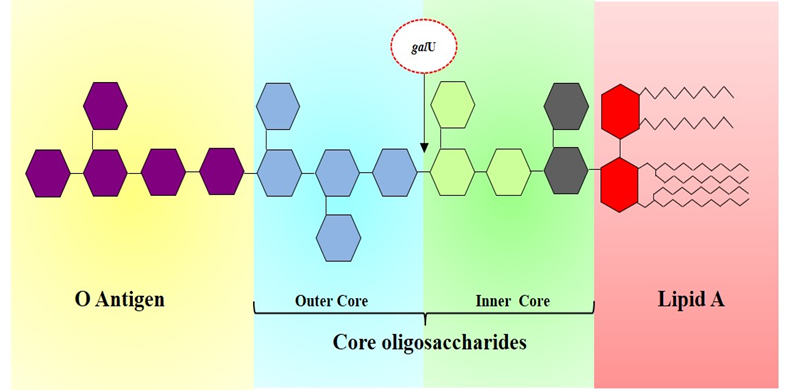
Downloads
References
MA Irshad, R Nawaz, M Rehman, M Adrees, M Rizwan, S Ali, S Ahmad and S Tasleem. Synthesis, characterization and advanced sustainable applications of titanium dioxide nanoparticles: A review. Ecotoxicol. Environ. Saf. 2021; 212, 111978.
D Ziental, B Czarczynska-Goslinska, DT Mlynarczyk, A Glowacka-Sobotta, B Stanisz, T Goslinski and L Sobotta. Titanium dioxide nanoparticles: Prospects and applications in medicine. Nanomaterials 2020; 10, 387.
S Jomini, H Clivot, P Bauda and C Pagnout. Impact of manufactured TiO2 nanoparticles on planktonic and sessile bacterial communities. Environ. Pollut. 2015; 202, 196-204.
J Musial, R Krakowiak, DT Mlynarczyk, T Goslinski and BJ Stanisz. Titanium dioxide nanoparticles in food and personal care products-what do we know about their safety? Nanomaterials 2020; 10, 1110.
M Vujovic and E Kostic. Titanium dioxide and zinc oxide nanoparticles in sunscreens: A review of toxicological data. J. Cosmet. Sci. 2019; 70, 223-34.
P Sharma. Characterization and bacterial toxicity of titanium dioxide. Int. J. Sci. Res. 2021; 10, 9-11.
NS Ahmad, N Abdullah and FM Yasin. Toxicity assessment of reduced graphene oxide and titanium dioxide nanomaterials on gram-positive and gram-negative bacteria under normal laboratory lighting condition. Toxicol. Rep. 2020; 7, 693-9.
ED Cavassin, LFPD Figueiredo, JP Otoch MM Seckler, RAD Oliveira, FF Franco, VS Marangoni, V Zucolotto, ASS Levin and SF Costa. Comparison of methods to detect the in vitro activity of silver nanoparticles (AgNP) against multidrug resistant bacteria. J. Nanobiotechnol. 2015, 13, 64.
YN Slavin, J Asnis, UO Häfeli and H Bach. Metal nanoparticles: Understanding the mechanisms behind antibacterial activity. J. Nanobiotechnol. 2017, 15, 65.
E Sánchez-López, D Gomes, G Esteruelas, L Bonilla, AL Lopez-Machado, R Galindo, A Cano, M Espina, M Ettcheto, A Camins, AM Silva, A Durazzo, A Santini, ML Garcia and EB Souto. Metal-based nanoparticles as antimicrobial agents: An overview. Nanomaterials 2020; 10, 292.
L Wang, C Hu and L Shao. The antimicrobial activity of nanoparticles: Present situation and prospects for the future. Int. J. Nanomed. 2017, 2017, 1227-49.
C Pagnout, B Sohm, A Razafitianamaharavo, C Caillet, M Offroy, M Leduc, H Gendre, S Jomini, A Beaussart, P Bauda and J Duval. Pleiotropic effects of rfa-gene mutations on Escherichia coli envelope properties. Sci. Rep. 2019; 9, 9696.
C Pagnout, A Razafitianamaharavo, B Sohm, C Caillet, A Beaussart, E Delatour, I Bihannic, M Offroy and J Duval. Osmotic stress and vesiculation as key mechanisms controlling bacterial sensitivity and resistance to TiO2 nanoparticles. Commun. Biol. 2021; 4, 678.
RL Marshall, and VN Bavro. Mutations in the TolC periplasmic domain affect substrate specificity of the AcrAB-TolC pump. Front. Mol. Biosci. 2020; 21, 166.
CA Schnaitman and JD Klena. Genetics of lipopolysaccharide biosynthesis in enteric bacteria. Microbiol. Rev. 1993; 57, 655-82.
H I Zgurskaya, G Krishnamoorthy, A Ntreh and S Lu. Mechanism and function of the outer membrane channel TolC in multidrug resistance and physiology of enterobacteria. Front. Microbiol. 2011; 16, 189.
SL Walker, JA Redman and M Elimelech. Role of cell surface lipopolysaccharides in escherichia coli K12 adhesion and transport. Langmuir 2004; 20, 7736-46.
S Halder, KK Yadav, R Sarkar, S Mukherjee, P Saha, S Haldar, S Karmakar and T Sen. Alteration of Zeta potential and membrane permeability in bacteria: A study with cationic agents. SpringerPlus 2015; 4, 672.
C Pagnout, S Jomini, M Dadhwal, C Caillet, F Thomas and P Bauda. Role of electrostatic interactions in the toxicity of titanium dioxide nanoparticles toward Escherichia coli. Colloids Surf. B 2012; 1, 315-21.
Downloads
Published
How to Cite
Issue
Section
License

This work is licensed under a Creative Commons Attribution-NonCommercial-NoDerivatives 4.0 International License.





