
Examination of Astrophysical S-Factor and Non-Resonant Rates of the 64Ge(p,γ)65As Reaction
DOI:
https://doi.org/10.48048/tis.2022.5685Keywords:
Light curves, Proton capture, rp-process, Waiting point, X-ray burstAbstract
The 64Ge(p,γ)65As reaction rates strongly impact the predictions of the energy generation and isotopic abundance in the rp-process in X-ray bursts. However, the rates are ambiguous at present due to the lack of experimental cross section and the uncertainty in the non-resonant reaction rates. To provide informative data for the astrophysical rates of the 64Ge(p,γ)65As reaction, we evaluate the astrophysical S factor and direct capture rates of the 64Ge(p,γ)65As reaction using the cross sections relied on the statistical theory with various mass models. The S factors at 0 energy were found to be S(0) = 7.2×10⁵ and 1.1×10⁶ MeV.barn for the Finite-Range Droplet Model (FRDM) and the extended Thomas-Fermi (ETFSI) mass models, respectively. These values are about 4 orders of magnitude different from the value obtained in previous study. The empirical parameters for the non-resonant-rate approximations were also deduced for the 64Ge(p,γ)65As reaction and its photodisintegration. By considering the results in this study together with those obtained in the previous work, we confirm that a strong waiting point at the 64Ge nucleus is still a doubt because of large uncertainty of the S factor and non-resonant rates. The results in this study are useful for a better understanding of the X-ray burst properties and reaction flow at 64Ge in the rp-process.
HIGHLIGHTS
- Large discrepancy up to 4 orders of magnitude in the S factor at zero energy was found
- The strength of the waiting point at 64Ge in the rp-process is still questionable
- The astrophysical rates of the 64Ge(p,γ)65As reaction are very uncertain due to the S-factor uncertainty
- The non-resonant rates of the 64Ge(p,γ)65As reaction estimated using statistical method are not significantly impacted by the FRDM and ETFSI mass models
GRAPHICAL ABSTRACT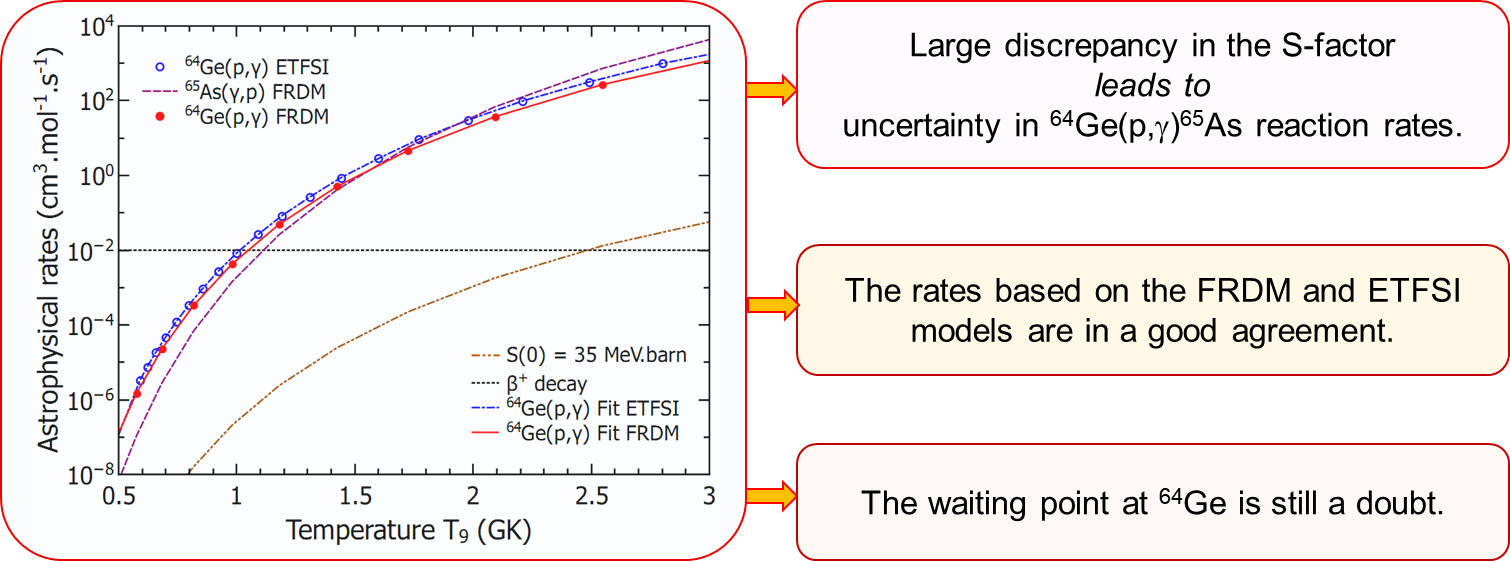
Downloads
References
JJMI Zand, MEB Visser, DK Galloway, J Chenevez, L Keek, E Kuulkers, C Sánchez-Fernánde and H Wörpel. Neutron star cooling and the rp process in thermonuclear X-ray bursts. Astron. Astrophys. 2017; 606, A130.
RH Cyburt, AM Amthor, A Heger, E Johnson, L Keek, Z Meisel, H Schatz and K Smith. Dependence of X-ray burst models on nuclear reaction rates. Astrophys. J. 2016; 830, 1-20.
JU Nabi. Nucleosynthesis and the rp-process. AIP Conf. Proc. 2012; 1498, 160-8.
C Lahiri and G Gangopadhyay. Endpoint of rp process using relativistic mean field approach and a new mass formula. Int. J. Mod. Phys. E. 2012; 21, 1250074.
VV Elomaa, GK Vorobjev, A Kankainen, L Batist, S Eliseev, T Eronen, J Hakala, A Jokinen, ID Moore, YN Novikov, H Penttilä, A Popov, S Rahaman, J Rissanen, A Saastamoinen, H Schatz, DM Seliverstov, C Weber and J Äystö. Quenching of the SnSbTe cycle in the rp process. Phys. Rev. Lett. 2009; 102, 252501.
Z Meisel, G Merz and S Medvid. Influence of nuclear reaction rate uncertainties on neutron star properties extracted from X-ray burst model - observation comparisons. Astrophys. J. 2019; 872, 1-18.
A Parikh, J Jose, F Moreno, C Iliadis and T Rauscher. Impact of uncertainties in reaction Q values on nucleosynthesis in type I X-ray bursts. Phys. Rev. C 2009; 79, 045802.
A Parikh, J Jose and G Sala. Classical novae and type I X-ray bursts: Challenges for the 21st century, AIP Adv. 2014; 4, 041022.
YH Lam, JJ He, A Parikh and H Schatz. Reaction rates of 64Ge(p,γ)65As and 65As(p,γ)66Se and the extent of nucleosynthesis in type I X-ray bursts. Astrophys. J. 2016; 818, 78.
H Schartz. The importance of nuclear masses in the astrophysical rp-process. Int. J. Mass Spectrom. 2006; 251, 293.
H Herndl, J Görres, M Wiescher and BA Brown. Proton capture reaction rates in the rp process. Phys. Rev. C. 1995; 52, 1078.
M Wang, G Audi, FG Kondev and W Huang. This person is not on ResearchGate, or hasn't claimed this research yet. The AME2016 atomic mass evaluation (II). Tables, graphs and references. Chinese Phys. C 2017; 41, 030003.
T Rauscher and RT Thielemann. Astrophysical reaction rates from statistical model calculations. At. Data Nucl. Data Tables 2000; 75, 1.
D Rochman, S Goriely, AJ Koning and H Ferroukhi. Radiative neutron capture: Hauser Feshbach vs. statistical resonances. Phys. Lett. B. 2017; 764, 109-13.
P Mohr, Gy Gyurky and Zs Fulop. Statistical model analysis of α-induced reaction cross sections of 64Zn at low energies. Phys. Rev. C. 2017; 95, 015807.
JJ He, A Parikh, BA Brown, T Rauscher, SQ Hou, YH Zhang, XH Zhou1 and HS Xu. Thermonuclear 42Ti(p, γ)43V rate in type-I x-ray bursts. Phys. Rev. C. 2014; 89, 035802.
C Iliadis. Nuclear physics of stars. Wiley-VCH, Weinheim, 2015, p. 163-77.
CA Bertulani. A potential model tool for direct capture reactions. Comp. Phys. Commun. 2003; 156, 123-41.
T Rauscher, NON-SMOKERWEB, Available at: https://nucastro.org/websmoker.html, accessed July 2021.
LP Zhang, JJ He, WD Chai, SQ Hou and LY Zhang. Reevaluation of thermonuclear reaction rate of 50Fe(p,γ)51Co. Chinese Phys. C. 2016; 40, 125101.
P Moller, WD Myers, H Sagawa and S Yoshida. New finite-range droplet mass model and equation-of-state parameters. Phys. Rev. Lett. 2012; 108, 052501.
P Moller, AJ Sierk, T Ichikawa and H Sagawa. Nuclear ground-state masses and deformations: FRDM (2012). At. Data Nucl. Data Tables 2016; 109, 1-204.
F Aymard, F Gulminelli and J Margueron. In-medium nuclear cluster energies within the extended Thomas-Fermi approach. Phys. Rev. C. 2014; 89, 065807.
JM Pearson, N Chamel, S Goriely and C Ducoin. Inner crust of neutron stars with mass-fitted Skyrme functionals. Phys. Rev. C. 2012; 85, 065803.
GG Kiss, Gy Gyurky, Z Elekes, ZS Fulop, E Somorjai, T Rauscher and M Wiescher. 70Ge (p,γ)71As and 76Ge (p,n)76As cross sections for the astrophysical p-process: Sensitivity of the optical proton potential at low energies. Phys. Rev. C. 2007; 76, 055807.
Qi Chong, RZ Du, Y Gao, JY Zhu and FR Xu. Theoretical studies of proton capture reactions in A∼25 proton-rich nuclei. Sci. China Ser. G-Phys. Mech. Astron. 2009; 52, 1464-70.
K Farouqi, KL Kratz, B Pfeiffer, T Rauscher, FK Thilemann and JW Truran. Charged-particle and neutron-capture processes in the high-entropy wind of core-collapse supernovae. Astrophys. J. 2010; 712, 1359-77.
Downloads
Published
How to Cite
Issue
Section
License

This work is licensed under a Creative Commons Attribution-NonCommercial-NoDerivatives 4.0 International License.





